






The hardest company on Wall Street to get into: Jane Street, earning $40 billion a year. How absurd are its interview questions?


- Core Insight: Quantitative trading firm Jane Street uses its extremely rigorous interview screening and unique trading culture to attract and select traders with "raw talent." With a staggering $39.6 billion in operating revenue for 2025, it surpasses traditional Wall Street giants, demonstrating the excellence of its talent strategy and profitability.
- Key Elements:
- Exceptional Performance: With just 3,500 employees, Jane Street achieved annual revenue of $39.6 billion, a profit margin of 65-70%, and per-employee profit of approximately $8-9 million. This ranks it first among global companies with over a thousand employees, surpassing giants like JPMorgan Chase, Goldman Sachs, and Nvidia.
- S+ Level Interview Difficulty: Renowned for its extreme difficulty and high elimination rate, the interview is often described as "impossible to prepare for." Formats include verbal chess problems, probability puzzles, and continuous stress tests lasting up to six hours, putting it on par with top-tier AI labs.
- Screening Criteria: Jane Street values "raw talent" over existing knowledge. It favors candidates with experience making decisions and bearing economic consequences under uncertainty, such as poker players or sports betting winners, rather than pure math problem solvers.
- Trading Culture: The company heavily emphasizes verbal thinking and real-time decision-making. Candidates are required to "think out loud," and silent contemplation is frowned upon. Refusing to place a bet or panicking and accepting an unfavorable offer are major interview taboos.
- Industry Impact: Several well-known figures in the crypto space (such as SBF and Caroline Ellison) have been trained or interviewed at Jane Street. Its unique market thinking framework profoundly influenced the construction of subsequent crypto trading strategies, indirectly shaping the industry landscape.
This week, the most talked-about name on Wall Street is Jane Street.
With 3,500 employees, no banking license, charging no advisory fees, and engaging in no investment banking business, it generated $39.6 billion in revenue in 2025 solely through trading. That surpasses JPMorgan. It surpasses Goldman Sachs. It surpasses any institution in Wall Street history.
Based on a 65-70% profit margin, the company's profit per employee is approximately $8 million to $9 million. Among all companies with over 1,000 employees, that's number one globally. For comparison, neighboring Citadel Securities has 1,800 people and a profit per employee of $3.6 million; Hudson River Trading is at $6.6 million; even Nvidia, a company the whole world is throwing money at, only has a profit per employee of $2.9 million.
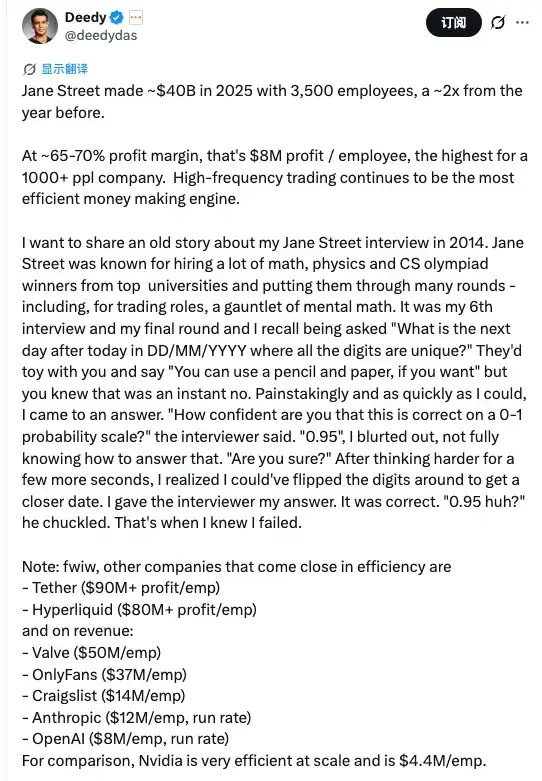
So this week, finance professionals across Twitter are all discussing the same thing: How did Jane Street manage to hire these people?
The Toughest Company on Wall Street to Get Into
The name Jane Street is not unfamiliar in the crypto world.
FTX founder SBF's first job in the industry was an internship at Jane Street. SBF's ex-girlfriend, Caroline Ellison, the CEO who later left a mess at Alameda, also came from there. In Michael Lewis's book, SBF repeatedly mentioned that the market thinking framework he learned at Jane Street almost entirely shaped his trading intuition for FTX and Alameda later on.
Many crypto fund founders and project teams have Jane Street on their resumes before transitioning into crypto, but the vast majority "interviewed," not "got an offer."
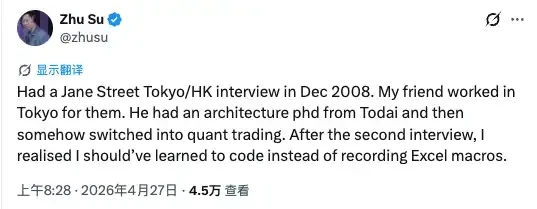
Three Arrows Capital founder Zhu Su also tweeted about his recollection: "Interviewed with Jane Street in Tokyo and Hong Kong in December 2008. My friend was in their Tokyo office back then – an architecture PhD from the University of Tokyo who switched to quant. After the second round, I figured out one thing: I should learn programming, not mess with Excel."
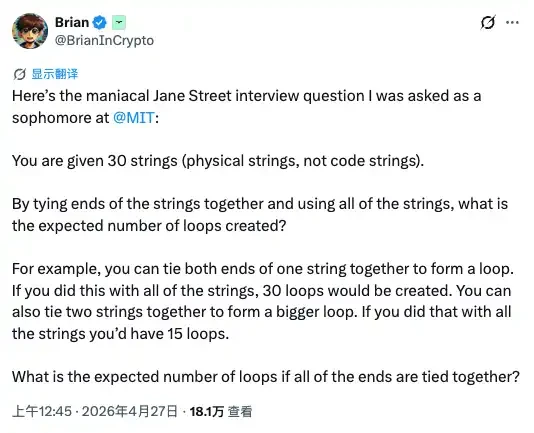
The Head of Growth at the Monad Foundation retweeted a question he was asked during his sophomore year at MIT, saying "he still remembers how crazy that interview was." Brian, co-founder of Glider Finance, was also following discussions about a classic Jane Street password lock problem.
Many seasoned players in the crypto circle have crossed paths with this company at some point, only to miss each other.
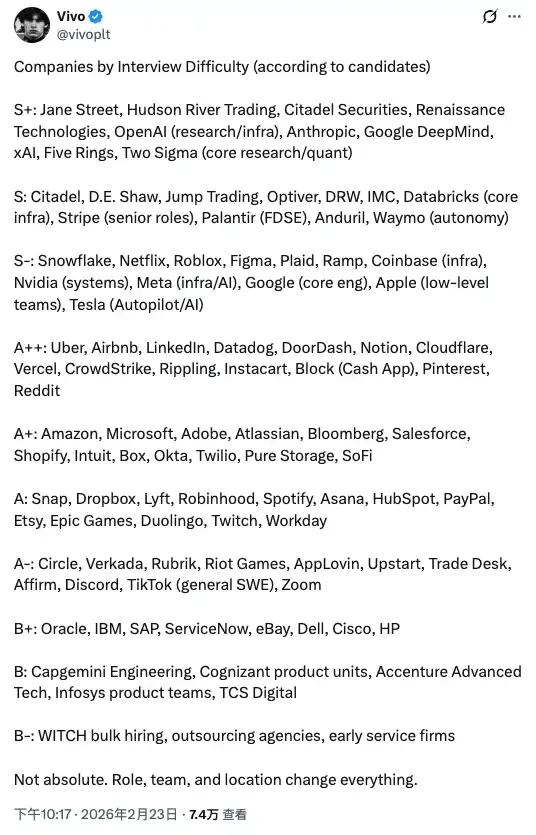
And the difficulty of Jane Street's interviews is second to none on Wall Street. According to a candidate interview difficulty ranking from Twitter user @vivoplt, Jane Street sits at the very top of the S+ tier, on par with top-tier AI labs.
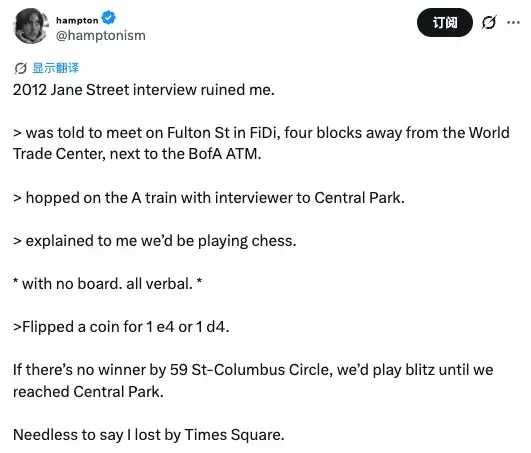
A Twitter user named Hampton shared his memory of an interview in 2012. Reading it feels like black comedy: They met at Fulton Street in the Financial District, near the Bank of America ATM next to the World Trade Center. Then the interviewer took him on the A train heading towards Central Park. They played chess on the subway. But without a board – entirely verbal. Flipping a coin decided whether the opening was 1.e4 or 1.d4. If there was no winner by Columbus Circle at 59th Street, they switched to blitz chess all the way to Central Park. Hampton says he lost at the Times Square station.
Another investor, Alex Song, recalled his Jane Street interview in 2010: "The worst interview of my life. One hour. The guy across from me explained the rules of some card game and gave me one hour to figure out the dominant winning strategy. This was absolutely not Putnam-level math, but it was worse than D.E. Shaw, QVT, or DRW."
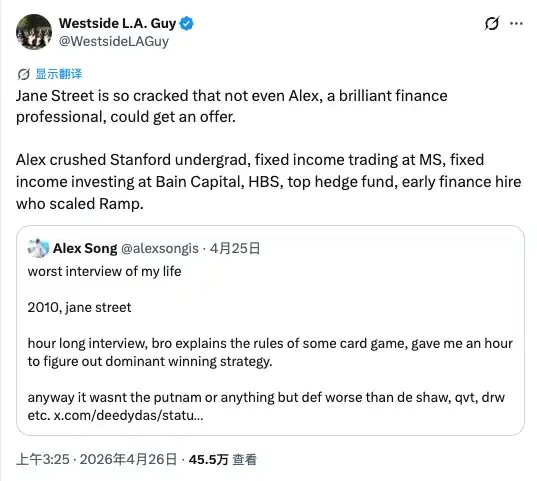
Another user retweeting this chimed in: This Alex later had a resume that included a Stanford undergrad degree, fixed income trading at Morgan Stanley, fixed income investing at Bain Capital, an MBA from Harvard, a top hedge fund, and early finance hiring lead at Ramp. Jane Street didn't take him.
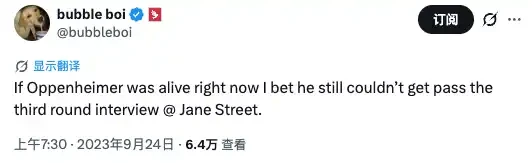
One interviewee said: "It's still the toughest interview process in investment banking. Other companies you can prepare for; Jane Street, you really can't." Another netizen even joked: "If Oppenheimer were still alive, I'd bet he still couldn't pass Jane Street's third round of interviews."
Tricky Interview Questions
Stories alone aren't enough. Below are some questions repeatedly discussed on Twitter. The BlockBeats editor picked a few of varying difficulty. Readers can try them out and see how many you can solve.
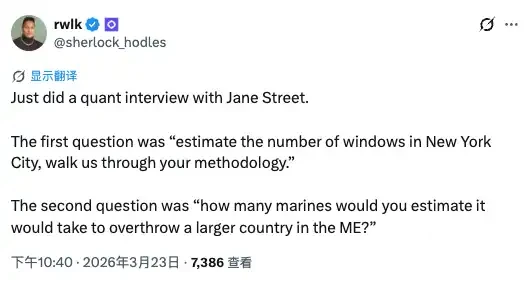
Question 1: "Estimate how many windows are in New York City. Explain your methodology."
Question 2: "How many Marines do you estimate it would take to overthrow a major country in the Middle East?"
Question 3: "A safe has a six-digit password. The lock tells us if we have four or more digits correct, but only opens when all six are correct. What is the optimal strategy to find the password with the fewest number of attempts?"
Question 4: "You have 30 real ropes (not strings in code). You randomly tie all 60 ends together in pairs. What is the expected number of loops formed? Example: Tying both ends of one rope together = 1 loop; doing this for all 30 ropes = 30 loops. Tying the ends of two ropes together crosswise = 1 big loop; tying all 30 ropes in pairs like this = 15 loops."
Question 5: "What is the next date after today where all digits are unique? Format DD/MM/YYYY. How confident are you?"
Question 6: "What integer is closest to the square root of 1420?"
Question 7: "I have a relative who is a professional baseball player. What is the probability that this statement is true?"
Question 8: "What is the smallest positive integer composed only of the digits 1 and 0 that is divisible by 15?"
Question 9: "What is the angle in degrees between the hour hand and the minute hand of a clock at 3:15 PM?"
Question 10: "You have a chance to bid on a treasure chest. The true value of the chest is some number between $0 and $1000, and you are 100% confident it lies in this range. If your bid is equal to or greater than the chest's true value, you get the chest at your bid price; if lower, you get nothing. Also, you have a friend willing to buy the chest from you for 1.5 times its true value. How much should you bid?"
Question 11: "I roll a 20-sided die (numbers 1 to 20). How much would you pay to play this game once, receiving the number on the die in dollars? Now change the rule: each round you can either 'take the current number on the die' or 'reroll.' You have 100 rounds total. What is your optimal strategy? How much is this game worth?"
Question 12: "There are 100 sentences written on a blackboard. Sentence 1 says, 'At most 0 of these 100 sentences are true.' Sentence 2 says, 'At most 1 of these 100 sentences is true.' ... Sentence n says, 'At most n−1 of these 100 sentences are true.' Sentence 100 says, 'At most 99 of these 100 sentences are true.' How many of these 100 sentences are actually true?"
Question 13: "I flip 4 coins. What is the expected number of heads? Now you are given one chance to re-flip all 4 coins (you must accept the new outcome). What does the expected value become?"
Question 14: "Two perfectly equal teams play a best-of-seven series. What is the probability that the series goes to game 7 to decide the winner?"
Question 15: "Suppose you and your roommate throw a party and invite 10 other roommate pairs. During the party, you ask everyone except yourself: 'How many hands did you shake?' It is known that no one shook their own roommate's hand, and everyone gave you a different answer. How many hands did your roommate shake?"
Question 16: "100 prisoners are in 100 separate cells. The prison has one Light Room with only a light bulb. Only one prisoner is allowed in at a time and can turn the light on or off. Prisoners are called into the Light Room randomly, with unpredictable frequency and order. Any prisoner can declare at any time: 'All 100 of us have been in this room.' If correct, all go free; if wrong, all are executed. Prisoners can devise a strategy before the game starts but cannot communicate after. What is the optimal strategy?"
Question 17: "Suppose I have 10 coins. One is fair (50/50 heads/tails), while the other 9 are biased, but the degree of bias for each is unknown. Given a limited number of flips, how do you find the fair coin?"
Question 18: "1000 ninjas stand in a circle, each with a knife. Number 1 kills Number 2, Number 3 kills Number 4, Number 5 kills Number 6, and so on, continuing around the circle until only one person is left. Which number is that person?"
If you survive all the previous phone interviews, the last hurdle is called Super Day. At the door, staff will hand you 100 poker chips. Then it's 4 to 6 consecutive one-hour technical interviews, all pitting you against active traders. You use these chips to bet or make markets in each session. When SBF entered Super Day, he was told: "Not a single person who has lost all their chips has ever gotten an offer."
Who Does Jane Street Want?
Augustin Lebron is a former Jane Street trader who worked in the London office for many years and managed the intern program that included SBF. After leaving Jane Street, he wrote a book called "The Laws of Trading." In an interview, he said something very candid: "Globally, each year perhaps only one to two thousand new people enter truly good quant trading firms."
"I talk to many students. If you ask them why they want to do this, they say math is interesting, AI is interesting, statistics is interesting. But these skills can be applied in many other places, so this reason alone doesn't really hold up." But Augustin believes the real answers are usually two: first, it's a high-status thing; second, they actually want to get rich.
So what kind of people does Jane Street actually hire?
In the interview, Augustin Lebron explicitly stated that these institutions look for raw talent, not pre-existing knowledge. That is, people whose past experience has pre-trained them for this job – for example, people who have played poker, done sports betting, and actually made money. People who have had some experience in life making decisions under uncertainty and bearing the economic consequences of those decisions.
Another very typical type is those who will quickly wash out, even if they are extremely smart, very good at math, and very good at solving problems. They just don't like trading. They care more about solving the math problem than making money. "In trading, you ultimately have to make money."
Some old Jane Streeters have also summarized several common reasons candidates fail: overconfidence; silent thinking – Jane Street heavily emphasizes thinking out loud, with silent thinking being a major no-no; refusing to take a position – if you are given an opportunity to make a market and you refuse, it equals "you are unwilling to take risk"; also, when you are in a bad position, the interviewer will deliberately give you terrible quotes. If you panic and accept, you prove you shouldn't be hired. Ignoring hidden information in the problem, and so on.
And perhaps these are significant reasons why Jane Street can rake in $40 billion a year.


