Musk vs. Altman: The Biggest Trial in AI History Has Begun


- Core Thesis: Musk's lawsuit against OpenAI has officially gone to trial. The central dispute is whether OpenAI violated its founding agreement to be a "non-profit, open-source" entity by shifting to a commercial, for-profit model. The outcome will directly affect OpenAI's restructuring and valuation, and could reshape the power dynamics of the AI industry.
- Key Elements:
- Musk accuses OpenAI and Altman of breaching the founding agreement, claiming the organization transformed from a non-profit into a "closed-source subsidiary" controlled by Microsoft. He demands a return to its non-profit mission and seeks up to $150 billion in damages.
- OpenAI has countersued Musk, alleging he acted out of "jealousy" over losing control and maliciously interfered with the company's operations to benefit his own AI venture, xAI, escalating the conflict into a two-way legal battle.
- The trial is expected to last four weeks. Key evidence includes testimony from former OpenAI board member Shivon Zilis and Greg Brockman's private diaries. Judge Yvonne Gonzalez Rogers will rule on liability and remedies in separate phases.
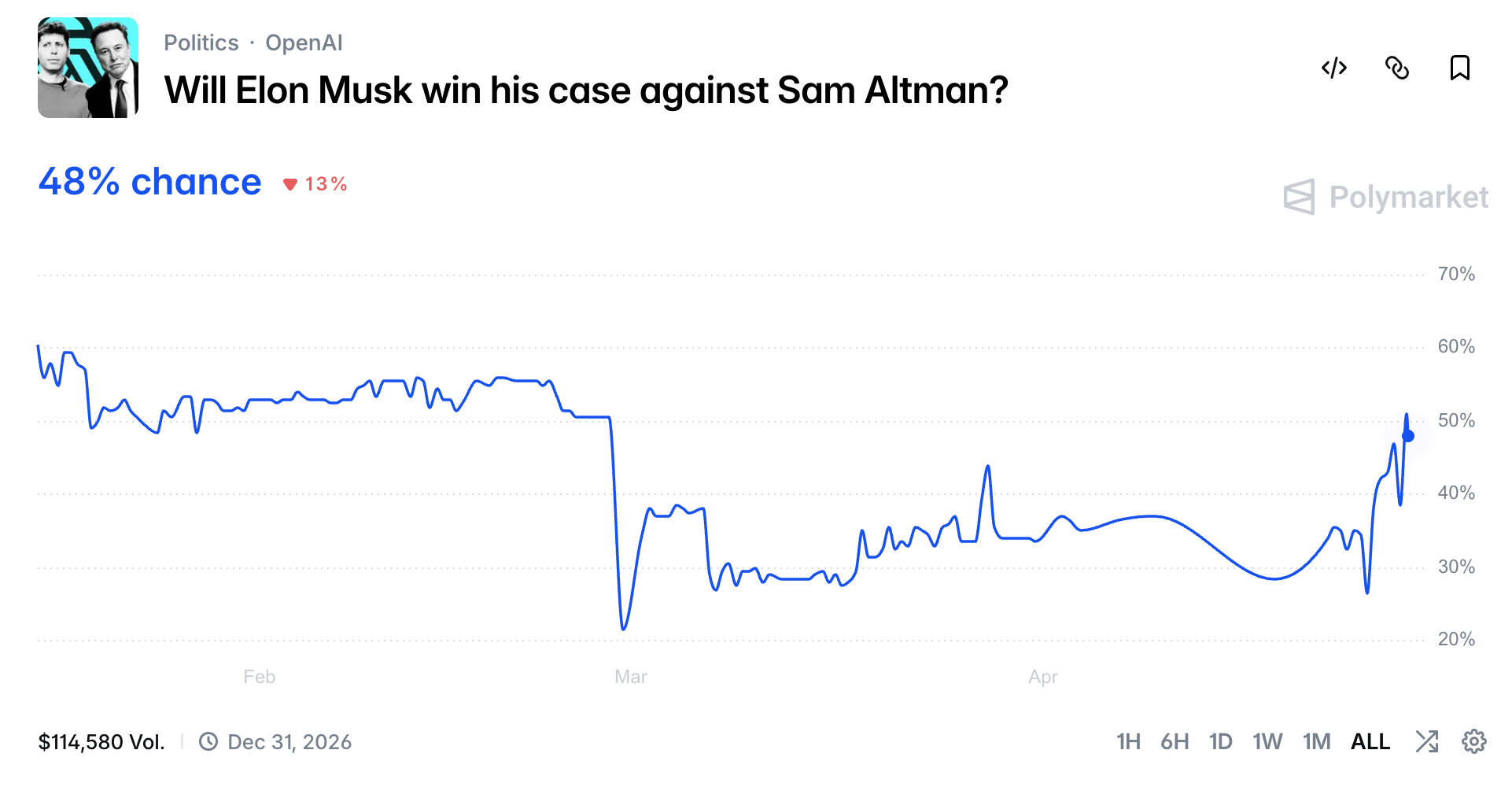
- Prediction markets show a near-even split in the odds, with Musk's chance of winning at around 48%. The release of case details during the trial will be the critical variable determining the outcome.
- This case goes beyond personal history; it will directly influence the future IPO process for two trillion-dollar companies—OpenAI and Musk's SpaceX—making it a major non-technical variable in the landscape of the AI race.
Original by Odaily (@OdailyChina)
Author: Azuma (@azuma_eth)
The first major case of the AI era has officially gone to trial.
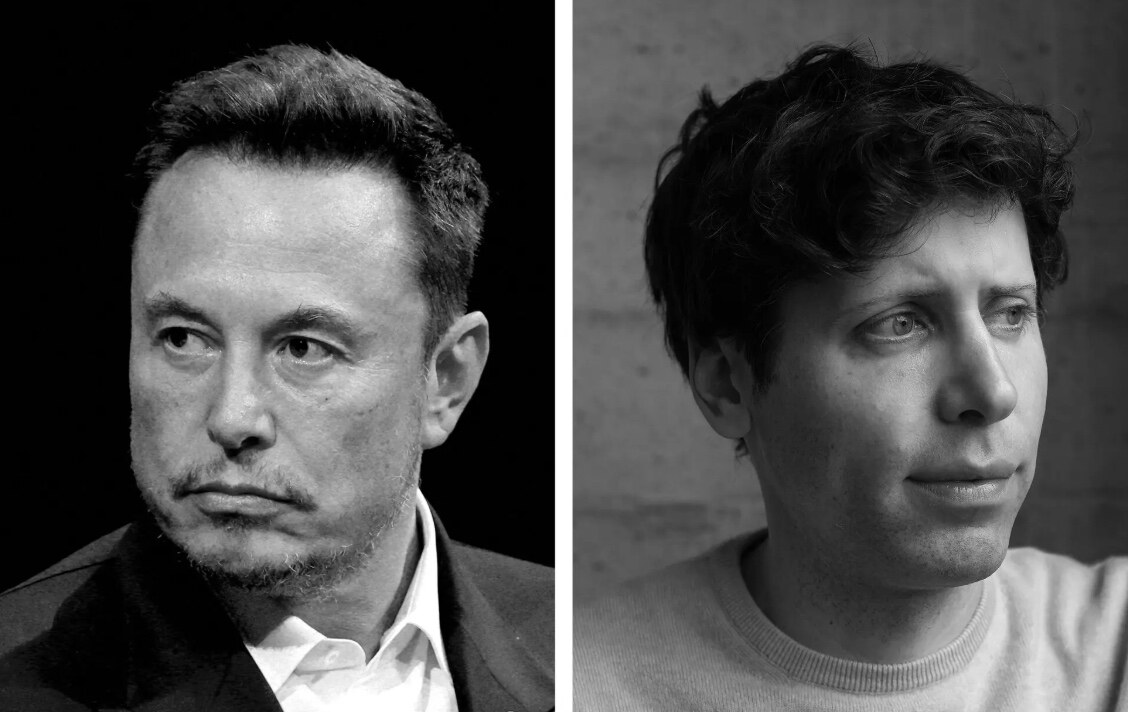
On April 27, the lawsuit brought by the "world's richest man," Elon Musk, against "the world's top AI company," OpenAI, officially entered the trial phase at the U.S. District Court for the Northern District of California. Jury selection began the same day, with opening statements expected to start today. Presiding Judge Yvonne Gonzalez Rogers will oversee the trial, which is estimated to last four weeks.
A History of Grievances
The conflict between Musk and OpenAI has deep roots.
In 2015, Musk co-founded OpenAI with Sam Altman and others, both driven by a shared idealism — to create a "non-profit, open-source" AI organization to counter the AI monopoly of giants like Google. In the early days, Musk was even one of OpenAI's largest donors and played a key role on its board.
However, idealism soon faced harsh realities. In its early years, OpenAI's AI development lagged significantly behind Google's DeepMind. Under the dual pressures of funding shortages and a lack of progress, Musk grew increasingly dissatisfied with the leadership of Altman and others. He even proposed merging OpenAI into Tesla, with himself as CEO to exert deeper control.
Altman and the leadership naturally rejected this. The outcome was that Musk was pushed out of the OpenAI board in 2018, effectively ending their partnership.
Subsequently, in March 2019, OpenAI formally abandoned its non-profit model, transitioning to a "capped-profit" company. Later that year, it accepted a $1 billion investment from Microsoft, accelerating its commercial trajectory.
The year 2022 was another pivotal moment. That year, OpenAI released ChatGPT, stunning the world and kickstarting the LLM boom. Driven by his former idealism, or perhaps sheer displeasure at his former partner's success, Musk was reportedly furious (as media described at the time).
Following this, Musk launched a stream of attacks on social media, accusing OpenAI of abandoning its open-source, non-profit principles, claiming it was no longer "OPEN" and was entirely controlled by Microsoft (ironically, OpenAI has since announced terminating Microsoft's exclusive rights). At the same time, Musk founded xAI to compete directly with OpenAI.
On the other side, OpenAI views Musk's actions as purely sour grapes. OpenAI argues that when Musk was on the board, he expressed support for a commercial pivot (evidenced by historical emails), only to criticize it after his exit. They claim his accusations of betraying the mission are merely an excuse for losing control.
Day in Court
With tensions escalating, Musk formally filed a lawsuit against OpenAI and its co-founders, Sam Altman and Greg Brockman, in 2024.
First, in March 2024, Musk sued in a California state court, accusing OpenAI of violating its founding agreement by transitioning from a "non-profit" to a "for-profit" entity, effectively becoming Microsoft's "closed-source subsidiary." He sought to force OpenAI back to its non-profit, open-source mission and block Microsoft from profiting.
However, this initial lawsuit was quickly dropped, appearing to be a probing move.
In October 2024, Musk refiled the lawsuit in the Northern District of California, this time naming Microsoft as a defendant and escalating his claims. He alleged fraud and misrepresentation (later withdrawn on this part), unjust enrichment, breach of charitable trust, and conspiracy to divert non-profit assets for commercial gain. He sought to prevent OpenAI's full conversion to a for-profit company, restore its non-profit structure, disgorge illegal profits, demand damages of $134 billion–$150 billion, and remove Altman and Brockman from their positions.
In April 2025, OpenAI countersued Musk, accusing him of harassment and malicious interference, claiming he was intentionally slowing OpenAI's progress for personal gain, escalating the dispute into a two-way legal battle.
Then, in September 2025, Musk's xAI filed another lawsuit against OpenAI, alleging theft of trade secrets, partly due to OpenAI hiring former xAI employees to obtain confidential information. The following day, Musk posted on X: "We sent them many warning letters, but they kept cheating. After exhausting all other options, litigation was the only choice."
Yesterday, this long-running saga finally entered the courtroom. With the trial phase beginning, more details of the case are expected to emerge over the next four weeks. While the possibility of an appeal by either side remains, the proceedings will undoubtedly bring much-needed clarity.
War of Words
As the trial commenced, both Musk and OpenAI engaged in a fierce war of words on social media.
Last night, Musk posted or retweeted dozens of messages, including personal attacks, calling Altman "Scam Altman" and Brockman "Greg Stockman."
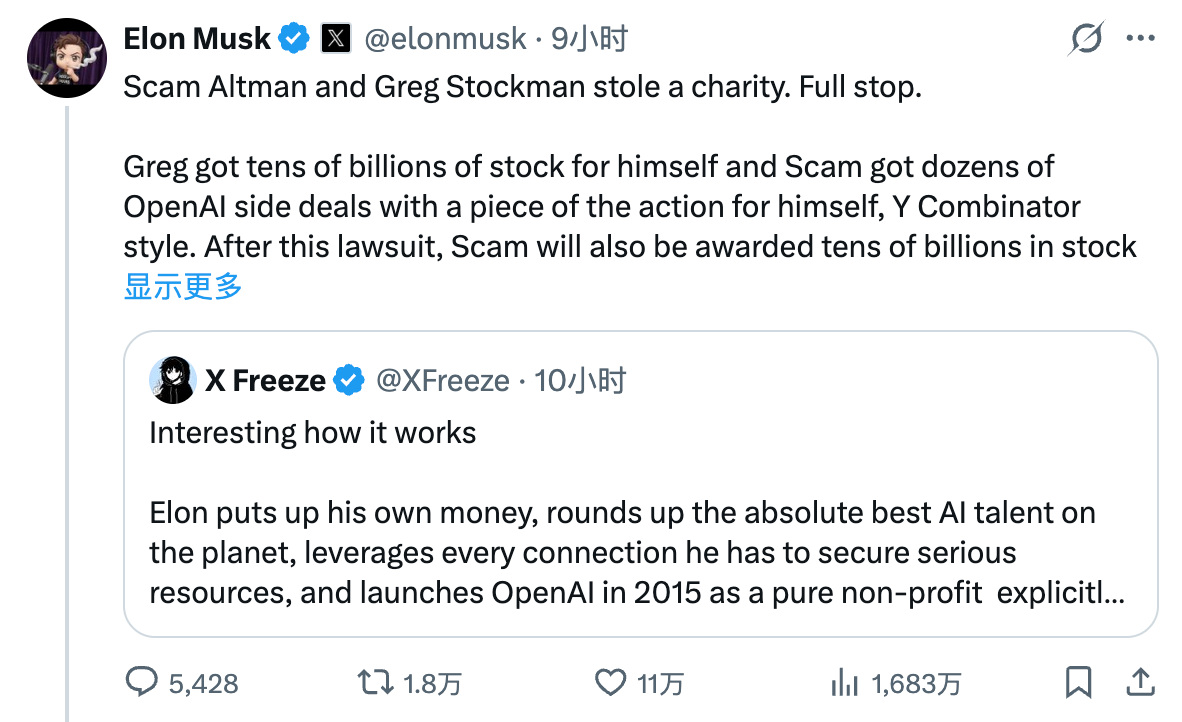
"Greg 'Stockman' gave himself tens of billions in equity, and Scam Altman took a slice for himself through a bunch of Y Combinator-style related-party deals (and will directly get another tens of billions after this lawsuit). I could have made OpenAI a for-profit company from the start, but I didn't. I founded it, funded it, recruited key talent, and taught them everything I knew about building a successful startup — all for the public good. Then, they stole this charitable institution."
On OpenAI's side, while Altman and Brockman have not commented directly, OpenAI responded through its official channels: "We can't wait to present our case in court, because the truth and the law are on our side. This lawsuit was baseless from the start, filed out of jealousy to hinder a competitor. We look forward to the opportunity to depose Musk under oath before a California jury regarding his attempts to sabotage our work to ensure AGI benefits all of humanity."
Outlook and Predictions
Over the next four weeks of trial, several key figures, including Musk, Altman, Brockman, and Satya Nadella (Microsoft CEO), are expected to testify.
According to various media reports, potential key factors influencing the case include testimony from witnesses like former OpenAI board member Shivon Zilis (also the mother of four of Musk's children), as well as physical evidence such as Greg Brockman's personal diaries (which record internal strategic thinking and have been submitted as evidence).
Judge Yvonne Gonzalez Rogers, appointed by former President Obama, is known for her pragmatic approach and has handled numerous major disputes between tech companies. In this case, she has significant discretion to decide whether and what remedies are necessary. She has divided the trial into two phases: Phase One determines whether Altman and OpenAI are liable for misconduct; Phase Two, if necessary, determines the remedy.
With the trial underway, prediction markets like Kalshi and Polymarket have listed related events. Currently, the odds are roughly even (Musk's chance of winning stands at 48%), awaiting further developments.
Looking ahead, this "AI case of the century" will not only adjudicate the historical grievances between Musk, Altman, and others but will also directly or indirectly impact the future IPO processes of two trillion-dollar valuation companies: OpenAI and SpaceX.
This represents the single most significant non-technical variable in the current AI competitive landscape and could profoundly reshape the power structure of the future AI world.