






One Article to Understand: All Transmission Chains and Sector Targets of the Global Natural Gas Shortage


- Key Insight: The military conflict in the Middle East at the end of February 2026, transmitted through four major chains—natural gas, fertilizer, helium, and chips—escalates a local energy shock into a systemic stress test for the global industrial chain, ultimately driving value divergence between AI chips and consumer electronics within the tech sector.
- Key Elements:
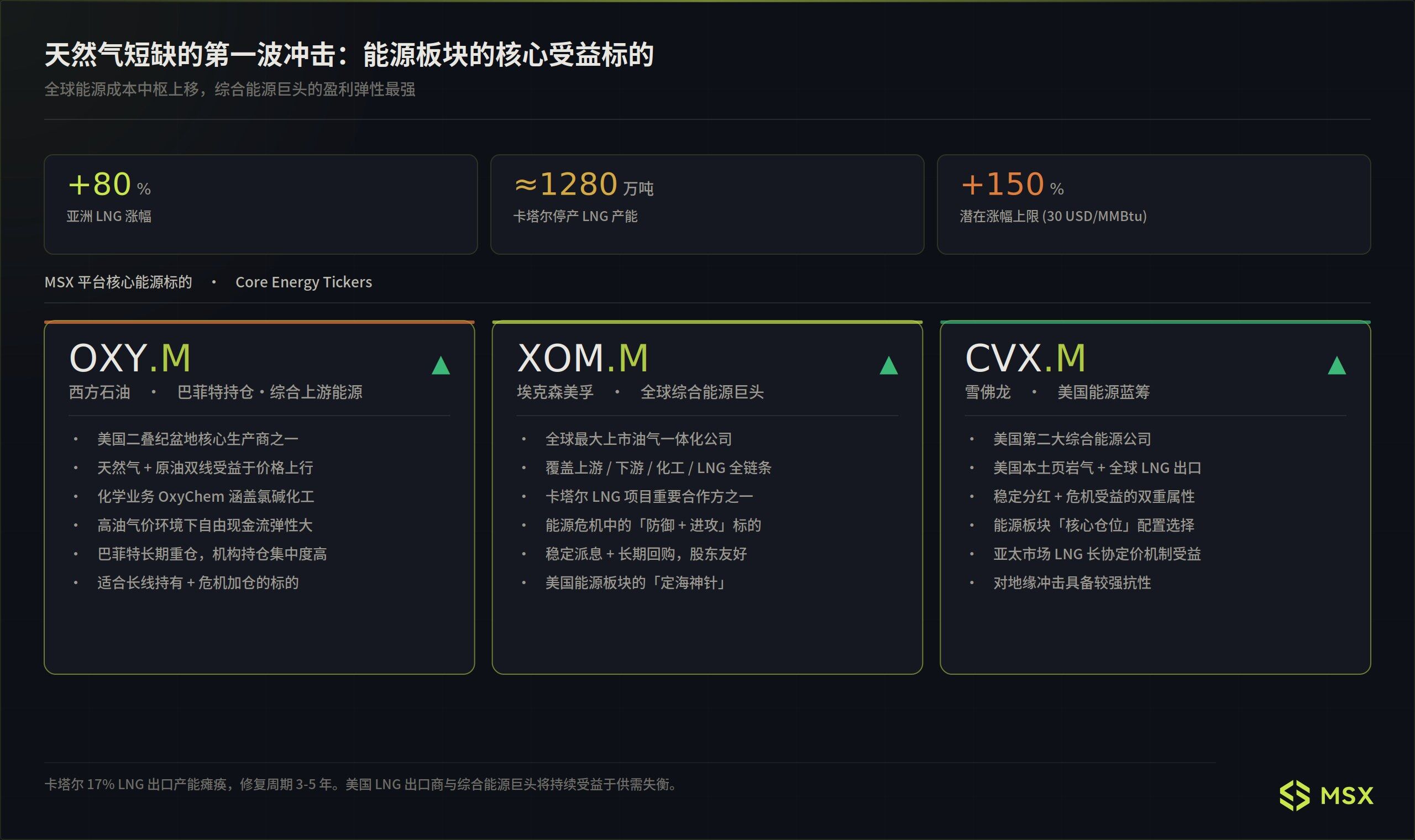
- Approximately 17% of Qatar's LNG production capacity is damaged, with 12.8 million tons per year of output halted. The repair cycle is 3-5 years. Compounded by disruptions in the Strait of Hormuz, Asian LNG spot prices have surged from $10/MMBtu to over $25/MMBtu.
- Natural gas is a key upstream input for ammonia and urea production. The conflict has caused the shutdown of the QAFCO plant, which produces 5.6 million tons of urea annually. In 2024, approximately 30% of global fertilizer trade was transported via the Strait of Hormuz.
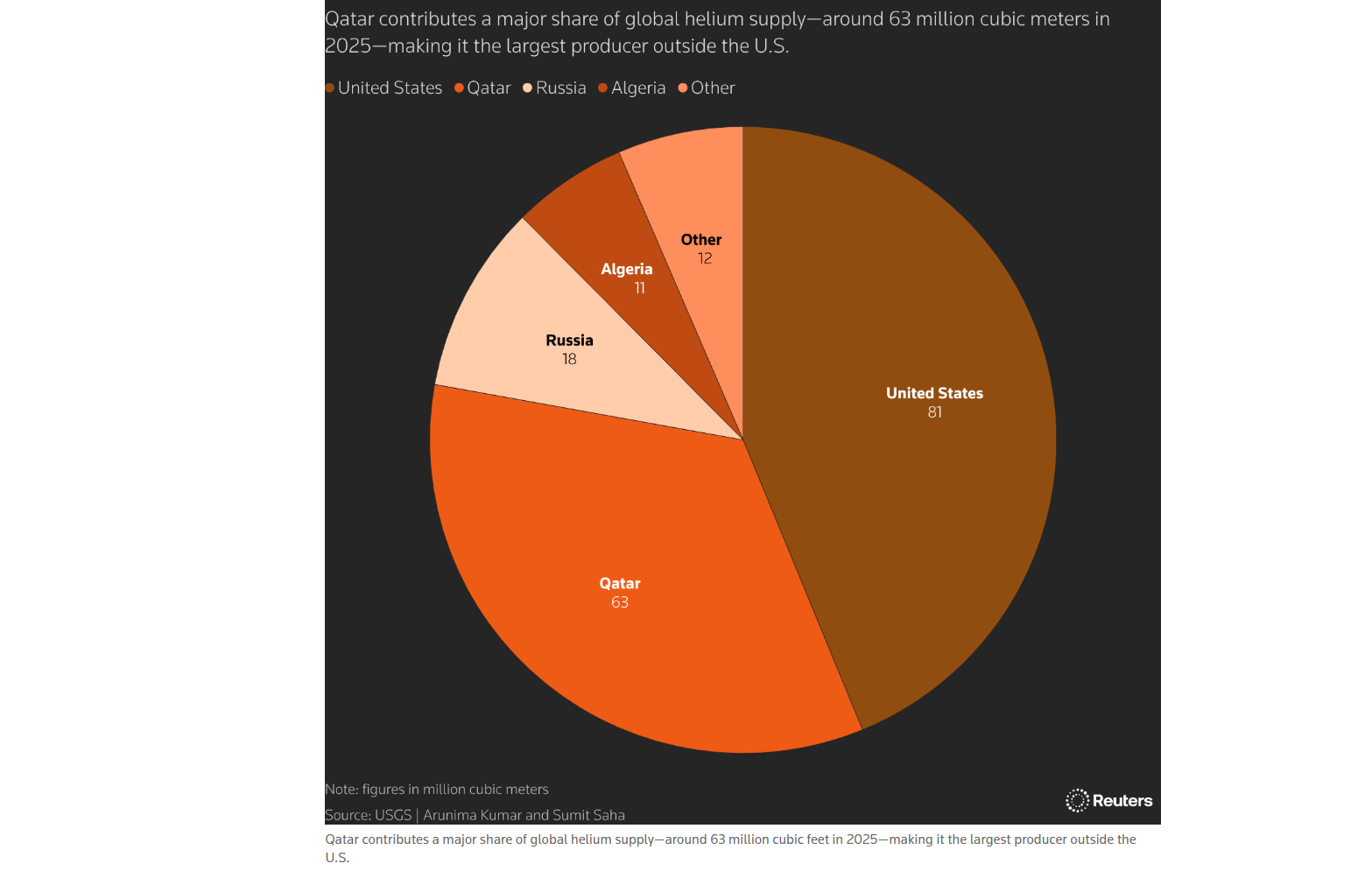
- Qatar supplies nearly one-third of the world's helium. As a critical material for wafer cooling and vacuum systems in semiconductor manufacturing, supply disruptions will structurally impact advanced process node capacity.
- With limited production capacity, manufacturers prioritize high-margin AI chip orders to meet the rigid demand from cloud providers' computing power race. Consumer electronics (PCs, smartphones) bear the brunt of rising costs and capacity constraints.
- If the conflict extends beyond May, the energy, fertilizer, and chip chains will transition from price shocks to real capacity constraints, triggering a rebalancing of the global industrial chain.
Original Author: Frank, MSX
Few anticipated that a military conflict in the Middle East would eventually transmit along multiple links – natural gas, fertilizers, helium, semiconductors, consumer electronics – cascading into a systemic stress test spanning dozens of industries.
In late February 2026, the US and Israel launched military strikes against Iran. Iran subsequently restricted passage through the Strait of Hormuz, forcing one of the most critical chokepoints for global energy transport into a semi-frozen state. Shortly after, the Ras Laffan Industrial City, Qatar's largest natural gas facility, was repeatedly attacked, shutting down one of the world's most important LNG production and export hubs.
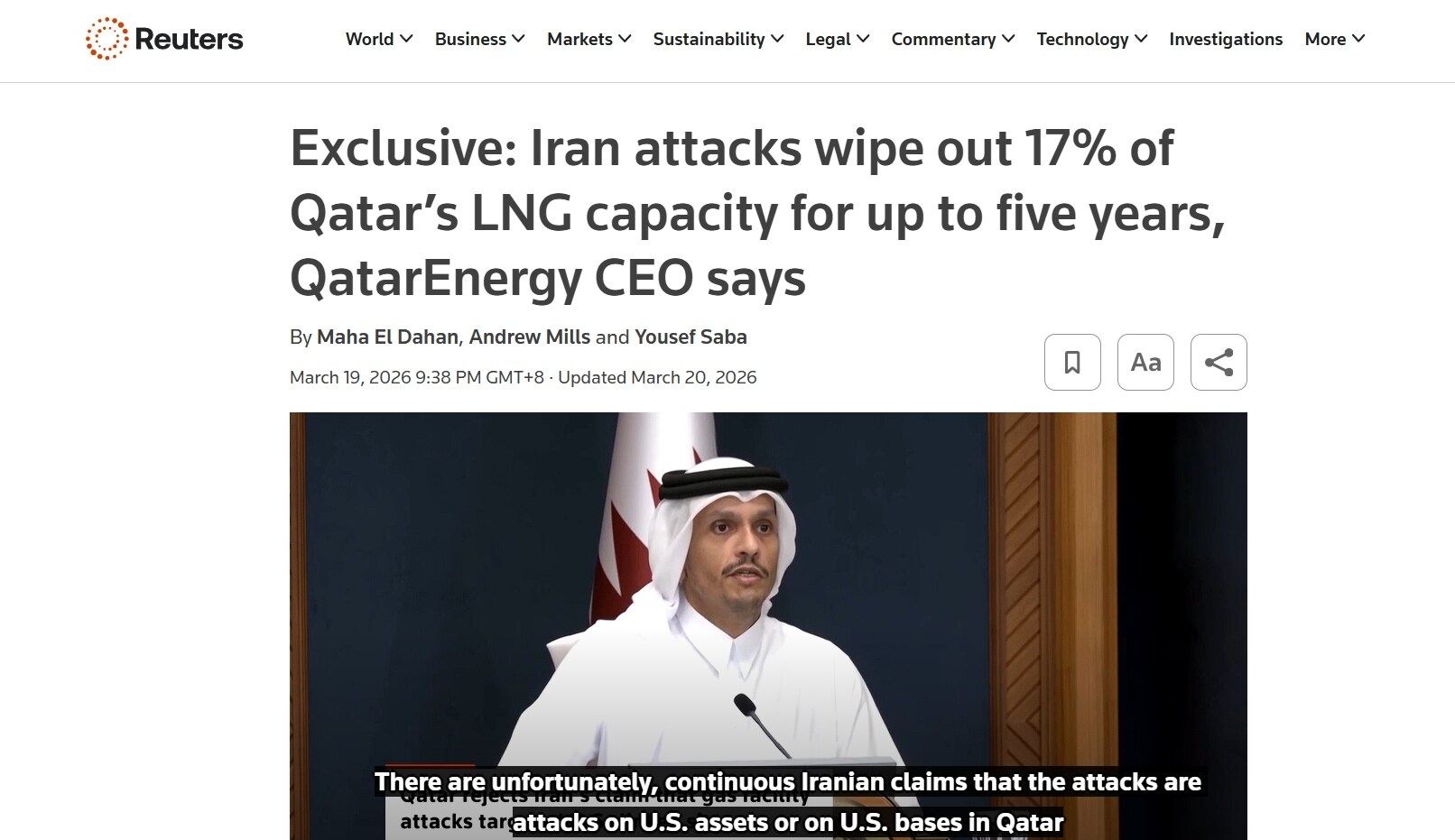
According to Reuters, approximately 17% of Qatar's LNG export capacity was damaged, resulting in the shutdown of 12.8 million tons of LNG annually. Repair of some facilities could take 3 to 5 years.
At first glance, this might seem like an energy event centered on "rising natural gas prices."
However, what truly warrants attention is that natural gas is not just fuel for power generation and heating; it is also the upstream input for several key industrial products, including ammonia, urea, methanol, hydrogen, and helium. Once this input is choked off, the transmission chain spreads from energy markets to agriculture, food inflation, semiconductor manufacturing, and ultimately to divergent valuations in tech stocks.
This is the core logic this article aims to unpack layer by layer – this crisis is not a single-point shock but a continuous transmission across four chains: Natural gas prices → Energy sector; Natural gas → Ammonia → Fertilizer & Agriculture; Helium supply disruption → Chip manufacturing; AI chips vs. Consumer electronics → Tech stock divergence.
1. Natural Gas Prices: The "First Shockwave" for the Energy Sector
The global natural gas market was the first to be breached.
Qatar's LNG production halt, combined with the blocked Strait of Hormuz, effectively pulled two fuses in the global natural gas supply simultaneously. On one hand, Qatar is one of the most crucial LNG exporters globally. On the other hand, the Strait of Hormuz is the key channel for its LNG to reach the sea. With both production and transport constrained, a surge in natural gas prices was nearly inevitable.
From a market performance perspective, spot Asian LNG prices briefly soared from around $10 per million British thermal units (mmBtu) before the conflict to over $25, before retreating somewhat, though still significantly above pre-war levels. European TTF prices were also impacted. Goldman Sachs maintained its Q2 TTF forecast around €63 per megawatt-hour, noting that if Qatari supply cannot recover by early May, prices may need to rise further to suppress demand.
The beneficiaries of this chain are straightforward: US and other non-Middle East LNG exporters, along with energy companies possessing stable production capacity and export capabilities, are poised to be the biggest winners from replacement supply. For instance, MSX has listed OXY.M, XOM.M, and CVX.M, corresponding respectively to Occidental Petroleum (Buffett's long-term holding), ExxonMobil (the global integrated oil and gas leader), and Chevron (combining US domestic shale gas and global LNG export capabilities).
But the losers are equally clear. Asian economies heavily reliant on LNG imports are bearing the brunt, particularly South Korea, Japan, Singapore, Taiwan (China), and parts of South Asia. This explains why energy price increases won't stay confined to oil and gas company profit statements.
For importing countries, LNG price hikes mean higher electricity generation costs, increased industrial production costs, and upward pressure on residential electricity bills. Ultimately, this extends inflation tail risks. For capital markets, this compresses expectations for interest rate cuts and puts higher discount rate pressure on high-valuation growth sectors.
In other words, natural gas is the first shockwave, but it is never the final link in the chain.
2. Natural Gas → Ammonia → Fertilizers: The Overlooked Agricultural Chain
The second transmission chain is more subtle but comes closer to everyone's life, directly concerning the "food security" of 8 billion people globally.
Why does rising natural gas prices affect food? The logic isn't complex: Natural gas is the primary raw material for producing ammonia, ammonia is the basis for urea and nitrogen fertilizers, and nitrogen fertilizers directly impact global crop production costs. Therefore, when natural gas supply tightens and prices rise, fertilizer production costs increase simultaneously. And when the Strait of Hormuz is blocked, Middle East fertilizer exports face further logistical constraints.
This has been vividly demonstrated in the current conflict. CRU Group pointed out that the Middle East situation has already exacerbated urea supply uncertainty. After QatarEnergy suspended LNG and related product production in early March, QAFCO's 5.6 million tons/year urea plant located in Mesaieed was also affected, becoming the first confirmed fertilizer production casualty in this conflict.
IFPRI data further illustrates the severity of the problem: in 2024, up to approximately 30% of global fertilizer trade had to pass through the Strait of Hormuz, while about 20% of LNG and 27% of globally traded crude oil also transit this waterway. This means Hormuz is not just an oil and gas passage; it is also a vital artery for global agricultural inputs.
The danger of this chain lies in its tight alignment with agricultural seasons. Energy prices can react quickly in futures markets, but the impact of fertilizer shortages on crops has a specific window. Crucially, if the key fertilization phase during the Northern Hemisphere spring planting season is missed, even if supply recovers later, the early losses cannot be fully compensated. This implies that the impact of this crisis on food prices likely will not be fully reflected in the current month's CPI, but will instead be released over subsequent months through grain output, agricultural product prices, and food processing costs.
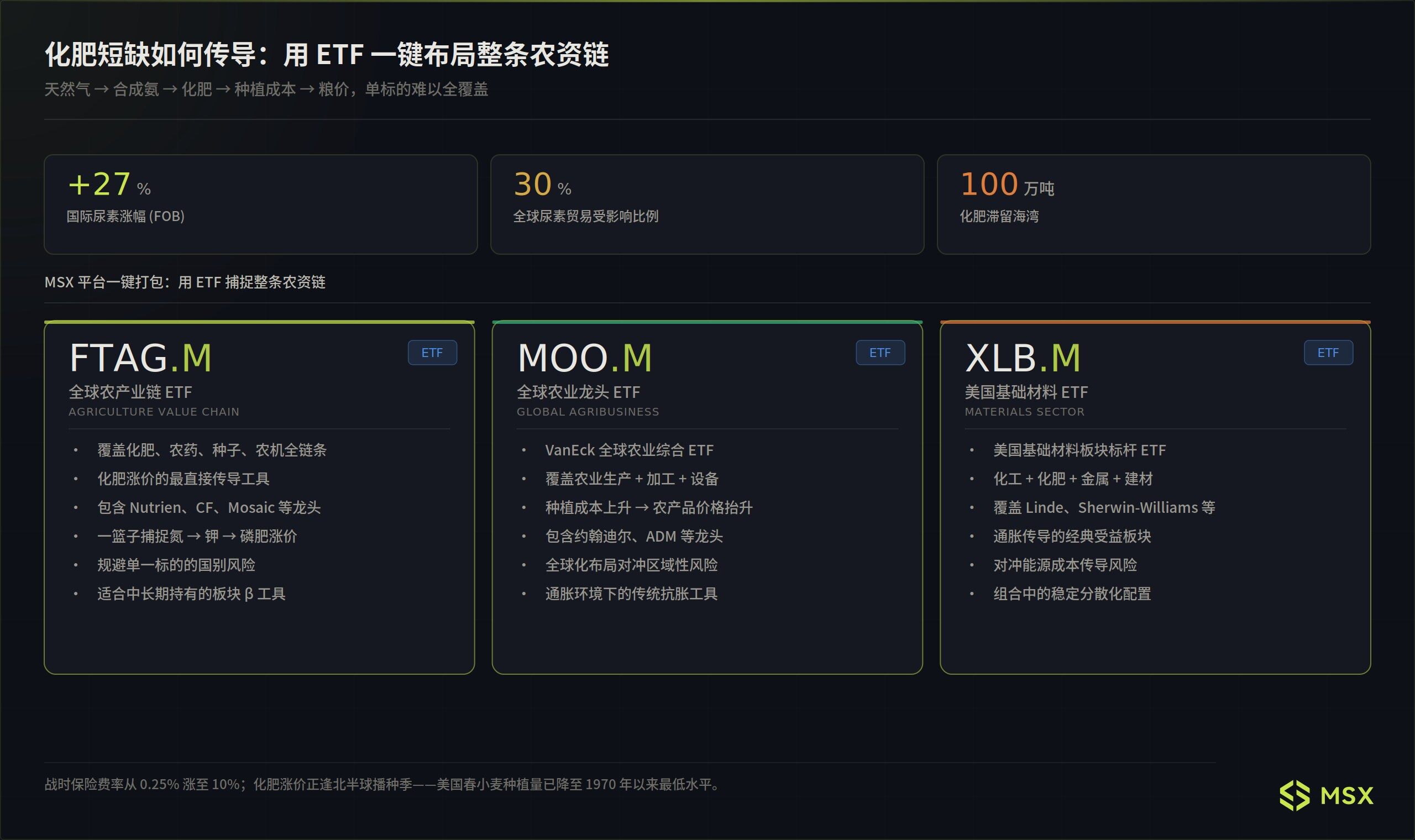
The difficulty with the fertilizer chain, however, is that a single fertilizer company often struggles to fully cover the complex transmission between natural gas, ammonia, urea, agricultural products, and basic materials. Therefore, ETF tokens might be better suited to capture these medium-to-long-term logics. For example, MSX has listed FTAG.M, MOO.M, and XLB.M, corresponding respectively to the global agricultural supply chain, global agricultural leaders, and the US basic materials sector:
•FTAG.M leans more towards a "one-basket agricultural input chain" tool, covering fertilizers, pesticides, seeds, and farm machinery;
•MOO.M focuses more on global agricultural production, processing, and equipment leaders, suitable for observing the transmission of rising planting costs to agricultural product prices;
•XLB.M covers basic industrial sectors like chemicals, materials, metals, and construction materials, including companies like Linde and Sherwin-Williams that are significantly impacted by inflation and industrial costs;
In other words, while fertilizer price hikes represent a long chain from energy to food, these ETF tokens offer not a bet on a single company but a way to capture the repricing opportunity across the entire agricultural input chain through a portfolio approach.
3. Helium: The Systemic Risk Most Overlooked
This is the most underestimated link in the entire transmission chain, but potentially the most consequential.
If the fertilizer chain connects to food, the helium chain connects to chips.
Many might wonder: how does a natural gas plant shutdown affect semiconductors? The answer lies in the fact that helium is a significant byproduct of natural gas processing and cannot be manufactured on a large scale through chemical synthesis. Qatar has long been a crucial global source of helium supply. Reuters, citing US Geological Survey data, reported that Qatar produces close to one-third of the world's helium supply. Following the current Middle East conflict, tightening helium supply has already begun impacting the global tech supply chain.
Helium is nearly irreplaceable in semiconductor manufacturing, used for wafer cooling, vacuum system leak detection, inert atmosphere control, and certain precision manufacturing steps. For advanced process nodes, temperature stability, cleanliness, and process consistency are paramount, and helium is a foundational material for maintaining these conditions.
Once supply becomes unstable, chip fabs can buffer short-term using inventories and recycling systems. However, if the shortage persists for months, production line scheduling, material priorities, and customer delivery schedules will be forced to adjust.
More concerningly, helium, unlike crude oil, is not easily stockpiled on a large scale. As one of the smallest monatomic gases, it is difficult to store and transport, with liquid helium transport relying on specialized cryogenic equipment. This explains why the crisis's impact on semiconductors is not a simple "chip stock negative," but a more granular structural shock.
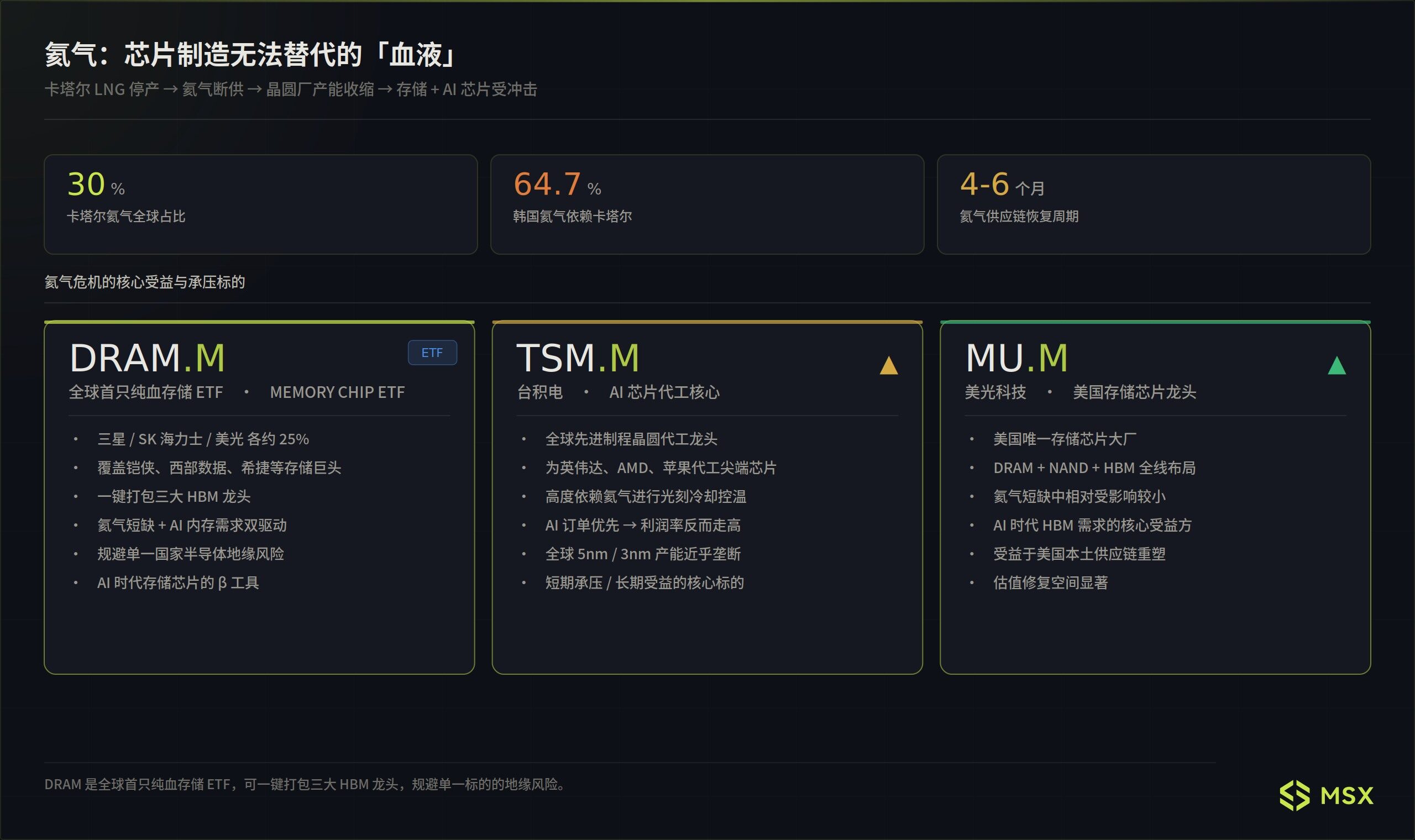
Among these, MSX's listed tokens DRAM.M, TSM.M, and MU.M align perfectly with several key observation points along this chain:
•DRAM.M is the world's first pure-play memory ETF token, covering memory leaders like Samsung, SK Hynix, and Micron, useful for observing supply-demand dynamics in storage segments like HBM, DRAM, and NAND in the AI era;
•TSM.M (TSMC) corresponds to Taiwan Semiconductor Manufacturing Company, a central node for global advanced process foundry and a key manufacturer for end-user chips from NVIDIA, AMD, and Apple;
•MU.M (Micron Technology) corresponds to the US memory chip leader Micron, with positions in DRAM, NAND, and HBM, while also benefiting more than Korean counterparts from the reshaping of the US domestic supply chain;
Ultimately, the helium shortage triggers a larger realization: the global semiconductor supply chain depends not only on EUV lithography, EDA tools, advanced packaging, and high-end equipment but also on industrial gases, chemicals, transport tanks, and regional energy security – elements often overlooked by capital markets.
This is where this crisis is most easily underestimated. It serves not just as a reminder that "chips are important," but underscores that computing infrastructure for the AI era is built upon an extremely long, highly fragile, and deeply globalized physical supply chain.
4. AI Chips vs. Consumer Electronics: The Real Divergence Begins
As helium shortages, rising energy costs, and material transport delays cascade down to the semiconductor manufacturing end, the market's easiest mistake is to lump all tech assets together.
Reality, however, points in the opposite direction. This shock will not simply cause a collective decline in the tech sector; it will drive further divergence within tech stocks.
AI chips will certainly feel pressure in the short term. Advanced process manufacturing heavily depends on stable supplies of high-purity gases, photolithography materials, packaging capacity, and energy. The supply chain links required for HBM, GPUs, and AI servers are demonstrably more complex. If upstream materials face constraints, AI chip delivery cycles may lengthen, potentially causing periodic disruptions in the capital expenditure pace of some cloud providers and server manufacturers.
But from the demand side, the rigidity of AI chips is significantly stronger than that of consumer electronics. The computing power race among cloud providers, model companies, and enterprise clients is far from over. AI infrastructure remains one of the most certain directions for tech capital expenditure. Therefore, under capacity constraints, the manufacturing side is more likely to prioritize high-margin, high-strategic-value AI chip orders over low-profit, price-sensitive consumer electronics orders.
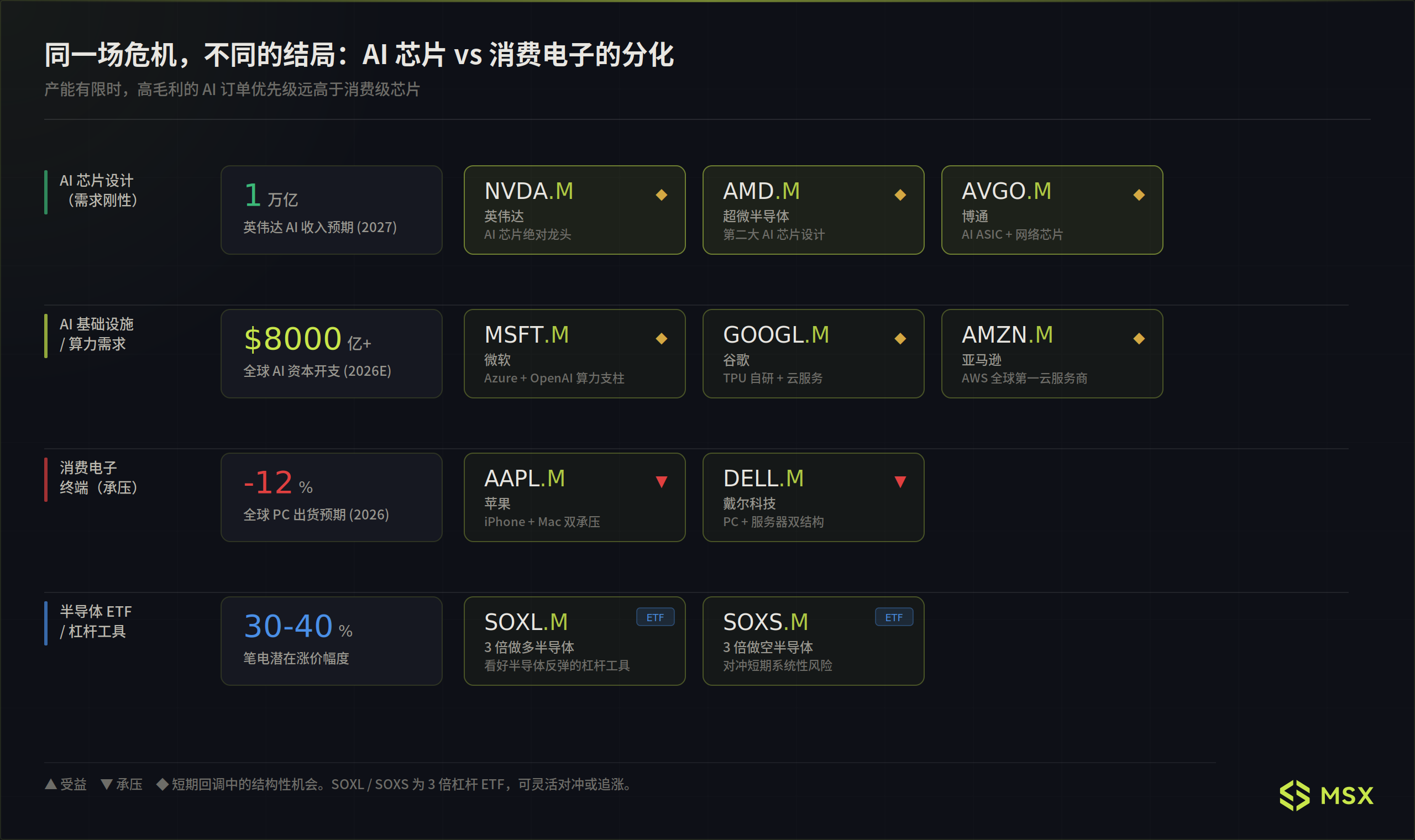
The real pressure is likely to fall on end-consumer electronics like PCs, phones, and tablets. This means the core contradiction within the tech chain is not "Will AI continue to grow?" but rather "To whom will limited advanced capacity, memory capacity, and key materials be allocated first?":
•NVDA.M (NVIDIA) remains the undisputed AI chip leader, AMD.M (Advanced Micro Devices) is the second-largest AI chip design force, and AVGO.M (Broadcom) combines AI ASIC and networking chip attributes;
•MSFT.M (Microsoft), GOOGL.M (Google), and AMZN.M (Amazon) correspond to AI infrastructure and cloud computing demand, representing three paths: Azure + OpenAI, TPU self-development + cloud services, and AWS global cloud services;
•In contrast, AAPL.M (Apple) and DELL.M (Dell Technologies) are more susceptible to fluctuations in consumer electronics, PC, server hardware costs, and end-demand, with a clearer logic for facing pressure;
•As for 3x leveraged semiconductor ETF tokens like SOXL.M and SOXS.M, these are better suited for expressing short-term sentiment and sector volatility rather than long-term allocation logic;
In other words, while all are tech assets, the risk-reward structures of AI chips, cloud infrastructure, consumer electronics, and leveraged ETF tokens are entirely different. The true test of this crisis is whether investors can dissect finer positions within the industry chain beyond the broad label of "tech."
For investors, the real opportunity lies not in simply being bullish or bearish on tech stocks, but in re-identifying, within the tech sector, who holds pricing power, who has supply priority, and who can only passively absorb rising costs.
Final Thoughts
Returning to the core argument at the article's start, this Middle East crisis, lasting approximately 60 days, has transmitted from natural gas all the way to AI chips. The transmission chain is far longer and more complex than it appears on the surface.
After all, the


