Back on the AI Table, Zuckerberg's First Move Is Layoffs?


- Core Viewpoint: Meta plans to initiate large-scale layoffs, aiming to build a leaner, AI-driven, and efficient organizational structure. This reflects how the development of AI technology is prompting tech giants to adjust their human resource strategies in pursuit of higher productivity and cost-effectiveness.
- Key Elements:
- Meta plans to initiate the first round of layoffs on May 20, expected to cut approximately 8,000 positions (10% of its total workforce), with potential for more layoffs in the second half of the year.
- The backdrop for these layoffs is Meta's recent breakthroughs in the AI field, having released its powerful self-developed multimodal model, Muse Spark, aiming to catch up with the industry's top tier.
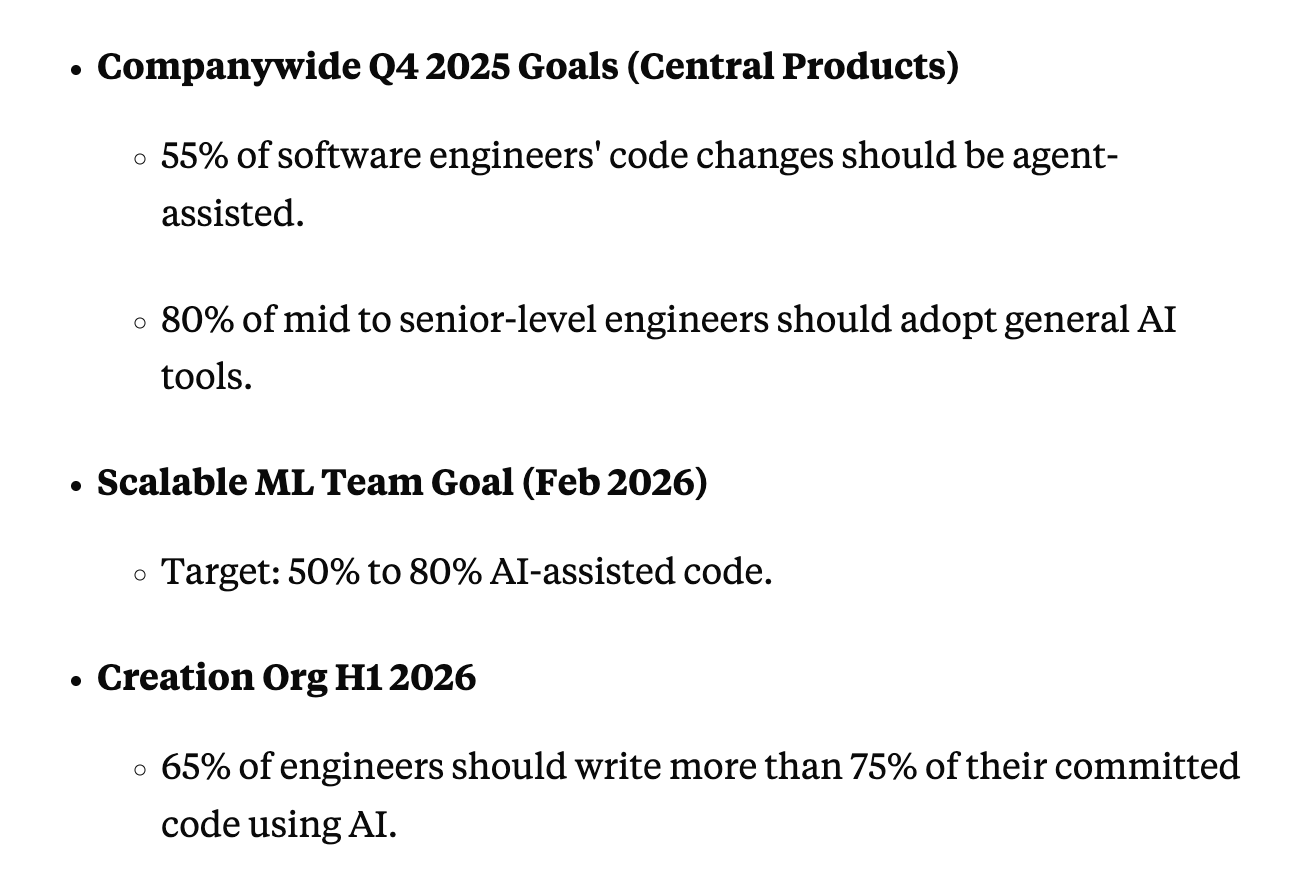
- Meta is internally promoting the use of AI tools, targeting for 65% of engineers to have over 75% of their code written by AI by mid-2026, and linking AI usage to employee promotions.
- Using AI-driven efficiency as a reason for layoffs is not an isolated case; tech companies like Amazon, Block, and Snap have taken similar actions previously.
- Despite the clear trend, Block experienced a partial return of employees after aggressive layoffs, highlighting execution risks during the transformation process.
Original | Odaily (@OdailyChina)
Author|Azuma (@azuma_eth)
An exclusive report from Reuters on April 18th revealed, citing three informed sources, that Mark Zuckerberg's Meta plans to initiate the first round of its large-scale layoffs for this year on May 20th, with further job cuts to follow.
One source indicated that Meta will cut approximately 10% of its global workforce (around 79,000 employees) in the first round, amounting to roughly 8,000 people. Another source stated that Meta also plans further layoffs in the second half of the year, but the specific timing and scale have not been finalized. Meta's executive leadership may adjust the plans based on ongoing observations of AI capability developments.
In another Reuters report last month, sources had also revealed that Meta was considering layoffs of 20% or more.
As of the time of writing, Meta has declined to comment on the timing and scale of the layoffs.
Just 10 Days Ago, Meta Finally Caught Up with the AI Mainstream
Just 10 days prior, Meta's AI development team, the "Meta Superintelligence Labs" (MSL), led by the highly recruited Chinese-American prodigy Alexandr Wang, released its first self-developed AI model, Muse Spark.
Alexandr Wang disclosed that over the past nine months, MSL rebuilt the entire AI technology stack from scratch. Muse Spark is a native multimodal reasoning model supporting tool calling, visual chain of thought, and multi-agent orchestration. This is the most powerful model Meta has released to date. During training, MSL observed predictable scaling improvements in the model across pre-training, reinforcement learning, and test-time reasoning stages.
Muse Spark also supports a "Contemplating Mode," which orchestrates multiple agents reasoning in parallel, specifically designed for handling complex scientific problems and reasoning tasks. In testing, MSL found its performance competitive with top-tier reasoning models like Gemini Deep Think and GPT Pro.
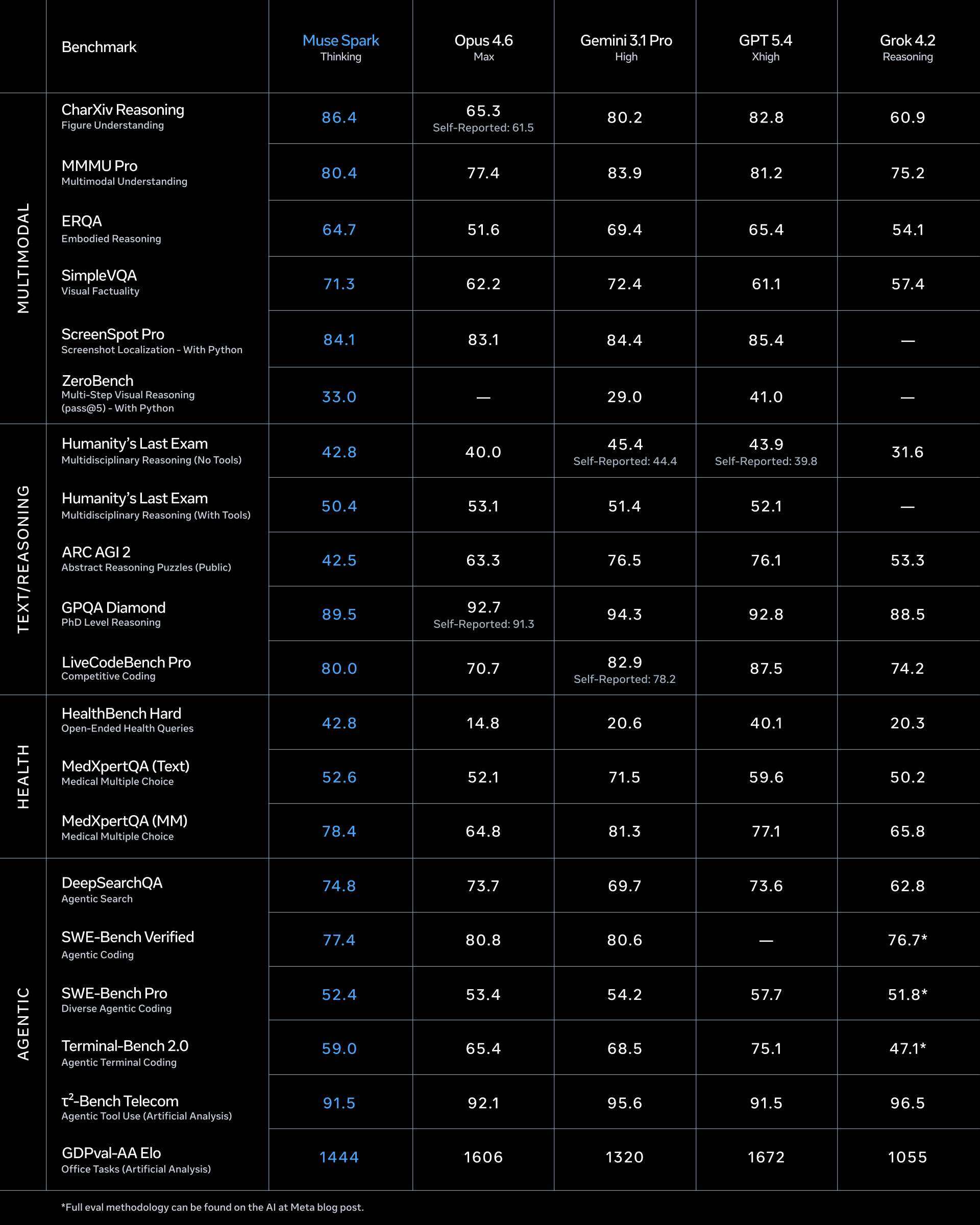
As the first substantial product following Meta's heavy bet on AI and shift to a closed-source model, Muse Spark is widely seen by the market as the beginning of Meta's pursuit of the AI frontrunners like Anthropic, OpenAI, and Google. While Meta acknowledges that the model still lags behind the flagship models of those three companies in some capabilities, for Zuckerberg, who had long fallen behind in the AI race after the Llama strategy faltered, Muse Spark and subsequent models in the series are sufficient chips for him to re-enter the AI game.
The market responded positively to Muse Spark. On the day of its announcement, Meta's closing price was $612.42, up 6.5%. It continued to rise over the following 10 days (also influenced by the overall market uptrend), reaching a closing price of $688.55 yesterday.
The AI Blade Falls First on Employees
From late 2022 to early 2023, Meta initiated its controversial "year of efficiency" plan, conducting the largest layoff in the company's history, cutting approximately 21,000 positions. This new round could become Meta's largest since the "year of efficiency."
Compared to the "year of efficiency" period when Meta faced significant stock price declines and pressure to adjust after pandemic-era over-hiring, Meta's financial situation is now much more robust. However, executives envision a future with fewer management layers and a more efficient organizational structure powered by AI-assisted employees.
Last month, Business Insider reported, based on leaked internal Meta documents, that Meta is pushing employees to use AI tools more actively. The set target is — by mid-2026, 65% of engineers should have over 75% of their code written with AI assistance.
According to disclosures (unverified, no source provided) by the X account Official Layoff (@LayoffAI), which focuses on big tech layoffs: "Starting this year, Meta has incorporated 'AI-driven impact' into the performance evaluations of all employees as a core metric. Without using AI, promotion is impossible. Meta has become the first major tech company to formally link AI usage to promotions."
AI Replacing White-Collar Workers Is No Longer an Isolated Case
Using "AI-driven productivity iteration" as a reason for layoffs is no longer an isolated phenomenon.
Last October, Amazon cut up to 30,000 jobs across logistics, payments, video games, and cloud computing divisions. The company's CEO, Andy Jassy, had hinted at these cuts earlier: "As the company increasingly uses AI to perform tasks previously done by humans, Amazon's workforce may shrink."
In late February this year, Jack Dorsey's (also Twitter's founder) fintech company Block announced 4,000 job cuts, reducing total staff from over 10,000 to under 6,000, aiming for a leaner, flatter, and AI-centric organizational structure. Block's CFO and COO, Amrita Ahuja, revealed that after the company announced the cuts, numerous enterprise executives proactively contacted Block seeking to replicate this "playbook."
- Odaily Note: For details, see "Jack Dorsey's Company: 4,000 White-Collar Workers Are Being Replaced by AI".
Earlier this week, Snap, a direct competitor to Meta's core product Instagram, also cut about 1,000 jobs. Its CEO, Evan Spiegel, stated: "AI will enable our teams to reduce repetitive work, increase efficiency, and better support our community, partners, and advertisers."
Now, the same wind has blown to Menlo Park, California, and Zuckerberg has raised his sword.
Oh, and one more thing worth mentioning. While Jack Dorsey loudly proclaimed during the layoffs that "the rapid development of AI is iterating on traditional productivity growth paradigms," shortly after Block's layoffs, many of the laid-off employees received invitations to return (see "The First Batch of Big Tech Employees Laid Off by AI Have Already Returned")...
AI replacing white-collar workers may eventually become a reality, but hastily cutting 40% of staff at once, as Block did, can easily lead to "taking too big a step and stumbling."