






Nasdaq Index Achieves 11 Consecutive Gains! Why Haven't the 'Magnificent Seven' All Returned?


- Core View: The recent consecutive gains of the Nasdaq Index are not a simple broad-based rally in tech stocks. Instead, it represents a process of stratified and orderly recovery for core tech assets (the "Magnificent Seven"), driven by multiple fundamental factors such as upward revisions to earnings expectations and a rebound in risk appetite, rather than a mere sentiment-driven bounce.
- Key Elements:
- The market recovery exhibits a clear hierarchy: The first tier, represented by Alphabet, Amazon, and NVIDIA, led the recovery with clear profit growth logic; Microsoft, Apple, and Meta followed suit; while Tesla still exhibits high volatility and event-driven characteristics.
- Drivers are diverse and solid: The gains are jointly propelled by expectations of easing tensions in the Middle East, lower-than-expected PPI data, and strong early earnings season performance, supported by fundamentals.
- Continuous upward revisions to earnings expectations are key: The Q1 earnings growth forecast for the S&P 500 has been revised up to 13.9%, providing a core foundation for the tech stock recovery.
- The recovery logic is spreading: After confirming the effectiveness of the initial batch of companies' recovery, capital is now spreading in an orderly manner to the second batch, showing structural patience rather than short-term sentiment-driven speculation.
- Main risks stem from external macro factors: Subsequent market volatility may arise from external macro factors such as oil prices, inflation, and geopolitics, rather than a failure of the internal logic of tech companies.
- Institutional views are turning positive: Institutions like BlackRock and Citigroup have upgraded their ratings on U.S. stocks due to corporate earnings resilience, boosting market confidence.
In just 15 days, the Nasdaq has experienced a tale of two extremes.
At the end of March, market sentiment towards the "Magnificent Seven" was highly divided. High valuation pressures had not yet been fully digested, yet capital found it difficult to truly move away from core technology stocks. Fast forward to April 15th, the Nasdaq Composite Index had risen for 11 consecutive trading days, breaking its longest winning streak record since November 2021, while the S&P 500 also hit a new all-time high.
If one only looks at the indices, this seems like a familiar story of a tech stock rebound. However, a closer look reveals that the drivers of this rally extend far beyond tech stocks themselves—expectations of easing tensions in the Middle East, lower-than-expected PPI data, and a strong start to the earnings season all contributed simultaneously. In other words, this isn't just a sentiment-driven bounce; it's a simultaneous occurrence of index recovery, rising risk appetite, and a repricing of earnings expectations.
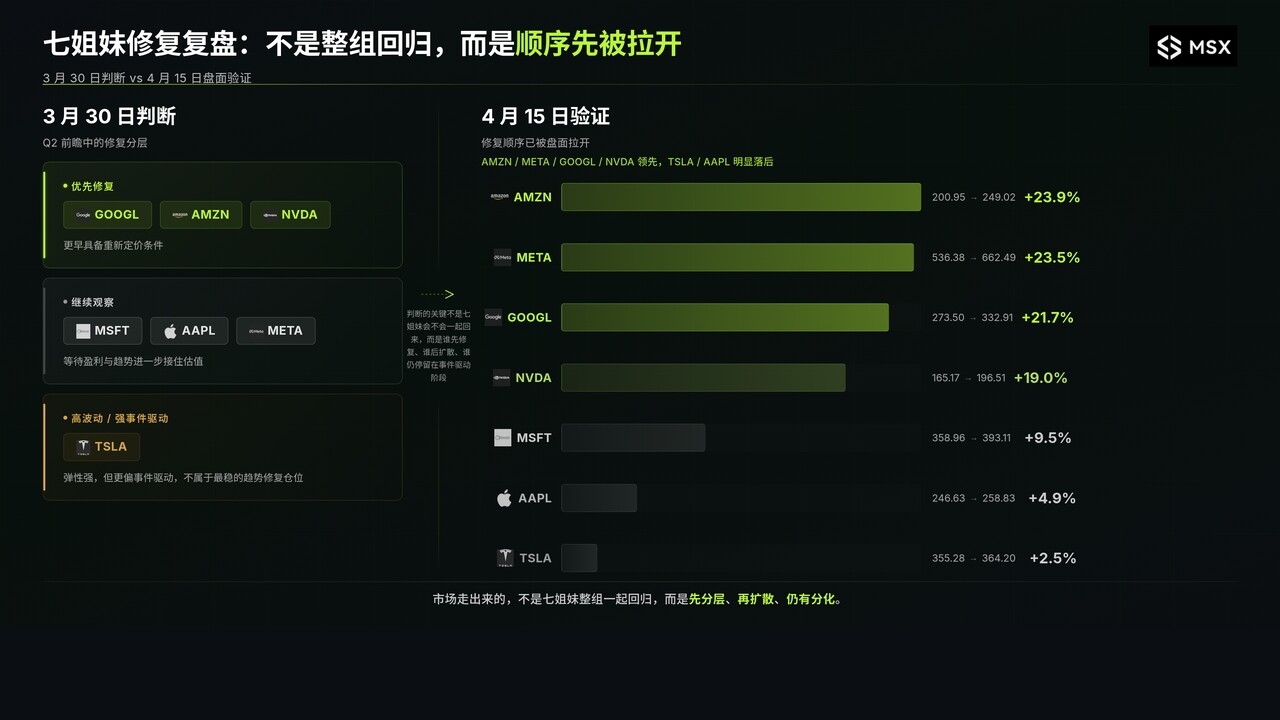
More notably, the performance within the Magnificent Seven has not been uniform. Some have already led the return to trend, others are catching up, and some still haven't established a clear trend. MSX's Q2 outlook also predicted that this round might not see the Magnificent Seven return together, but rather likely establish a recovery sequence first (Extended reading: Soaring Oil Prices, Stubborn Rates, and the Magnificent Seven Stalling: Where to Look for Excess Returns in Q2 US Stocks?). It broke down the recovery into three tiers: Alphabet (GOOGL.M), Amazon (AMZN.M), and NVIDIA (NVDA.M) were identified as better candidates for priority attention in the recovery; Microsoft (MSFT.M), Apple (AAPL.M), and Meta (META.M) were better placed on a continued watchlist; while Tesla (TSLA.M) remained characterized by high volatility and strong event-driven moves.
This judgment seemed restrained at the time, perhaps even lacking a strong "point of view."
But now, the market's unfolding narrative precisely follows this rhythm of "first stratification, then expansion."
1. Which Group Returns First, and Why?
Looking back to late March, market views on the Magnificent Seven were highly divergent.
On one side were concerns about unresolved high valuation pressures, and on the other was the reality that capital struggled to truly distance itself from core tech assets. The most concentrated discussion then was "Will big tech come back?" In hindsight, this question itself was too broad. The real question was never "whether they would return," but rather "who returns first, and why them?"
Half a month later, the answer has written itself on the charts.
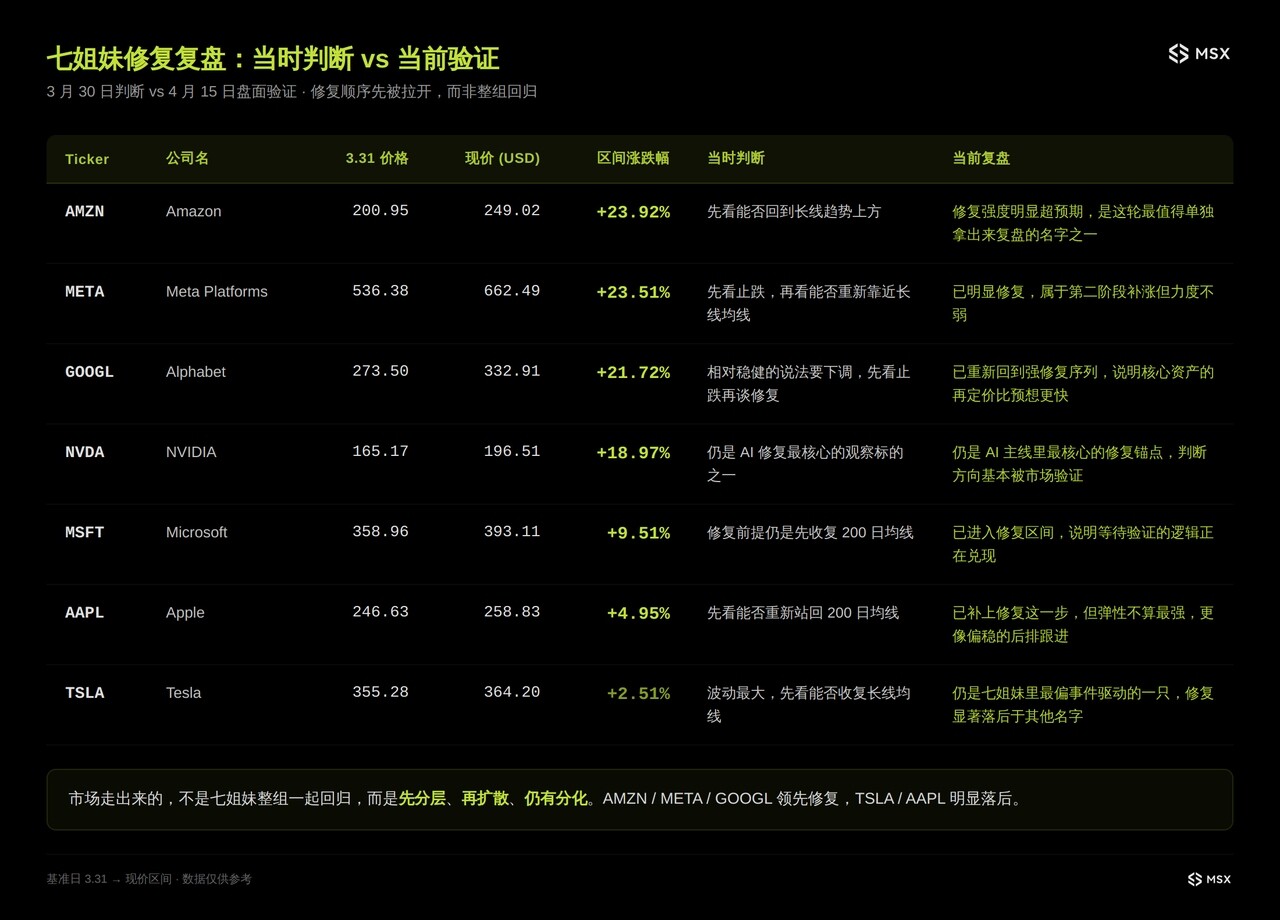
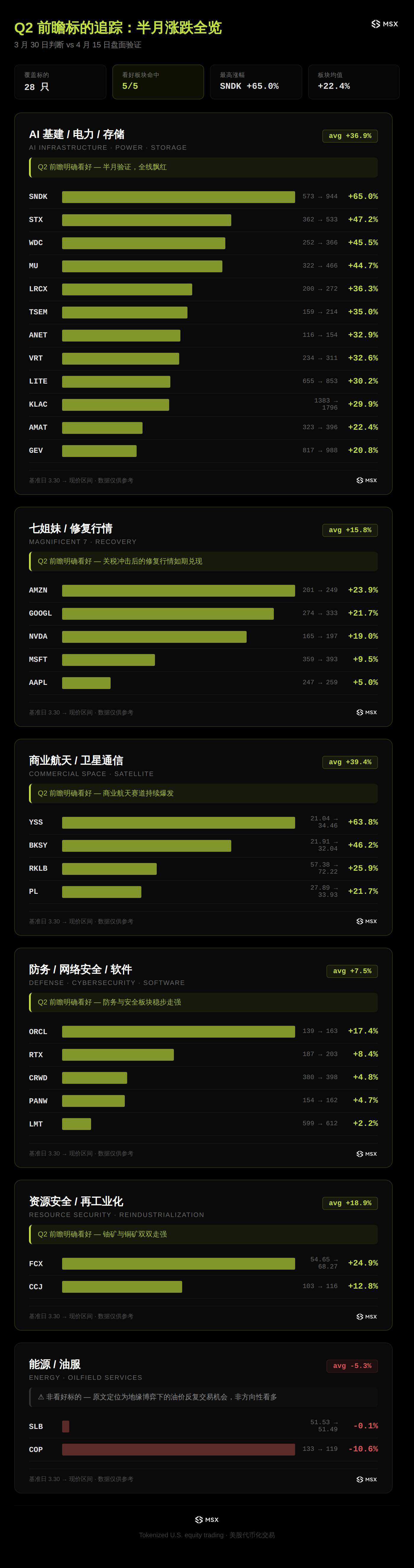
Looking at performance from late March to April 15th, Alphabet (GOOGL.M), Amazon (AMZN.M), Meta (META.M), and NVIDIA (NVDA.M) led the gains, followed by Microsoft (MSFT.M) and Apple (AAPL.M), with Tesla (TSLA.M) lagging significantly. This further validates that this is not a uniform rally but a layered recovery ranking.
Within the first-to-recover group—Alphabet (GOOGL.M), Amazon (AMZN.M), and NVIDIA (NVDA.M)—the logic differs for each, but they share a commonality: They made the market believe earlier that "investment can still drive growth."
- Alphabet's (GOOGL.M) recovery logic is the clearest: The cash flow resilience of its core advertising business provided support at the valuation bottom, while AI's penetration into search and cloud businesses allowed the market to see the continuation of the growth narrative. It purely regained investor trust first through the verifiability of its fundamentals.
- NVIDIA's (NVDA.M) position needs little explanation: As long as AI remains the main theme of this tech cycle, NVIDIA is the core anchor. Market debate about it has never been "Does AI need computing power?" but rather "How long can this growth rate last?" Therefore, at least at this stage, whether it's cloud providers' capex plans or demand signals from both training and inference, they still support its recovery logic.
- Amazon's (AMZN.M) change is the most noteworthy: Initially, the market's patience with Amazon wasn't the highest, mainly due to persistent concerns about slowing e-commerce growth and unabated competitive pressure on AWS. However, with continuous improvement in cloud business margins, AI capex investments beginning to translate into visible revenue clues, and the overall profit realization logic gradually being accepted again, Amazon entered the recovery zone earlier than many expected. Thus, its return wasn't driven by a single catalyst, but by multiple factors simultaneously reaching the threshold where the market was willing to reprice it.
In other words, the companies the market revalued first weren't necessarily the "safest" names, but those that made capital believe earlier that "investment can still drive growth, and recovery can continue towards trend."
In this round for the Magnificent Seven, who recovers first and who follows isn't about sentiment strength, but about who regains the narrative "explanation power" sooner.
2. The Recovery is Spreading, Not Narrowing
More notably, this recovery hasn't stopped at the first group of names.
Microsoft (MSFT.M), Apple (AAPL.M), and Meta (META.M), originally better suited for the watchlist, have now clearly caught up. In other words, the market isn't just chasing the first movers; after confirming the validity of the first-stage recovery, it continues to spread to the second layer.
This is actually crucial. If this were just a short-term sentiment bounce, market action would typically be rougher: a sharp rise together, then a collective pullback, fast-paced and with limited sustainability. But the current market isn't like that. It's more like the index recovers first, then capital returns to core assets, and then continues to rank within those core assets. Those whose earnings can support valuations, whose investments can still correspond to growth, remain in the recovery sequence; those merely riding sentiment will fall behind in the subsequent divergence.
Precisely because of this, the Magnificent Seven's move this round resembles a "sequential unfolding" rather than a "collective return."
The more critical signal is that this recovery hasn't stopped at the first group of names.
Microsoft (MSFT.M), Apple (AAPL.M), and Meta (META.M), originally better placed on the watchlist, have now clearly caught up. In other words, the market isn't just chasing the first movers and stopping there; after confirming the first-stage recovery, it continues to spread to the second layer.
The significance of this is greater than it appears. If this were just a short-term sentiment bounce, market action would typically be rougher: a sharp rise together, then a collective pullback, fast-paced and with limited sustainability. But the current structure is clearly not like that; it's more like the index recovers first, then capital returns to core assets, and then continues to rank within those core assets.
That means those whose earnings can support valuations, whose investments can still correspond to growth, remain in the recovery sequence; those merely riding sentiment will fall behind in the subsequent divergence.
This is why this market move resembles "recovery diffusion" rather than "bounce conclusion," causing the Magnificent Seven not to surge collectively and then quickly fade, but to recover the first batch first, then diffuse to the second, and continue filtering who can stay in the trend during the diffusion process.
Objectively speaking, this structure itself indicates the market is repricing core assets in a more patient manner.
However, it must be noted that within this ranking, Tesla (TSLA.M) remains the most unique variable.
It certainly has elasticity and strong market attention. But so far, Tesla still resembles a high-volatility, strongly event-driven asset more than a core position that has stably returned to the trend recovery sequence. The market's pricing of Tesla is often based more on expectation trading and event-driven factors—progress in autonomous driving policies, Robotaxi timelines, Elon Musk's public statements—rather than stable profit realization.
This isn't to say Tesla lacks trading value; on the contrary, its volatility itself presents trading opportunities. But its existence precisely illustrates that the Magnificent Seven haven't returned neatly together this round. Some are already back in the trend, some are catching up, and some still stand at the edge of the trend. Describing this round for the Magnificent Seven as a "collective return" is too broad; understanding it as a "recovery sequence already unfolding" is closer to the market's actual behavior.
3. How Much Further Can This Recovery Go?
At this juncture, the more pertinent discussion isn't "has this rally gone too far?" but rather "does this recovery still have a foundation to continue expanding?"
From an institutional perspective, the answer leans positive. BlackRock Investment Institute has upgraded its view on US equities from neutral to overweight, citing corporate earnings resilience, especially in tech. Citi has similarly upgraded US equities to overweight. Q1 earnings growth expectations for the S&P 500 have been revised up from 12.7% before the Middle East conflict to 13.9%. This means the support for this recovery isn't just improved risk appetite, but more importantly, earnings expectations themselves haven't collapsed.
This point is particularly crucial for the Magnificent Seven's recovery theme. Because the logic of this recovery, from start to finish, hasn't been built on sentiment or liquidity drivers, but on the fundamental judgment of "whether core tech companies' earnings can still be realized." Continued upward revisions to earnings expectations mean the recovery's foundation remains intact, providing room for both the first batch that has already recovered and the second batch that is catching up to continue moving along the trend.
Of course, variables haven't disappeared. The IMF has already downgraded its global growth outlook due to the Middle East conflict and rising energy prices, warning that a prolonged conflict and sustained high oil prices would bring the global economy closer to an adverse scenario. In other words, the biggest potential disturbance for this market move going forward may not come from internal logic failures within the Magnificent Seven, but more likely from external macro factors—oil prices, inflation, and geopolitics.
But at least so far, the market's answer has been positive: index recovery first, followed by layered recovery in core tech, with diffusion outward after the first batch completes, rather than a collective surge followed by a quick fade. As long as the market continues to operate within this structure, this round resembles an ongoing unfolding process more than a story nearing its end.
In Conclusion
The significance of the Nasdaq's 10-day winning streak extends beyond just the duration of the index rise.
It's more like the market using its own behavior to answer a fiercely debated question from late March: In this round for the Magnificent Seven, would it be a collective return, or would a sequence emerge first?
Now the answer is clear.
Frankly, the market is never short on post-mortems or hindsight summaries. What's truly scarce is often whether someone can identify the key points during times of greatest divergence. The Q2 outlook from late March did precisely that—it didn't chase a more sensational, easily spreadable conclusion, but instead placed the most crucial element of this market move front and center: The Magnificent Seven won't return as a group; the market will establish a recovery sequence first. What truly determines the subsequent upside isn't who bounces fastest in the first wave, but who can continue to hold their ground in subsequent earnings, trends, and risk appetite.
Ultimately, whether it's the divergence in realization during earnings season or the next wave of diffusion beyond core tech, what truly deserves attention remains those judgments that can clarify the market's key points earlier—not waiting for the move to finish before offering a seemingly smooth explanation.
Before the next inflection point arrives, let's continue to identify the market's key points together, ensuring our focus is targeted.
Let's encourage each other in this endeavor.


