






New battle for Web3 traffic portal: Telegram versus MetaMask


Original - Odaily
Author - Husband How
Editor - Hao Fangzhou
No one has a definite answer to what the next bull market will bring to Web3. CZ once said: The next round of bull market is likely to make DeFi surpass CeFi in scale. If CZs words can be realized, then the decentralized Web3 portal is also expected to gradually surpass CEX and carry a larger scale of new users.
In the last cycle, MetaMask was undoubtedly the representative of the decentralized Web3 portal, and a number of wallet projects followed closely behind, chasing the leader on the track with features such as multi-chain support and experience optimization.
While everyone was looking for the next MetaMask in their wallets, Odaily discovered that Telegram, with 800 million active users, was inadvertently targeting this track and impacting MetaMasks status.
Although Telegram is not rooted in Web3, it is favored by Web3 users due to its anti-censorship feature. Not only do most project developers use it as the main platform for the community, but the rapid rise of Bot in recent months has also made Telegram gradually become a new way for new users to experience entering Web3.
MetaMask has not rested on its laurels. It has launched a series of products and Snap functions in the past year, especially after it opened deposit and withdrawal channels, further consolidating its position as a Web3 traffic portal.
Both have their own advantages in becoming a universal portal for Web3. Which one will be better in the future? Below, Odaily compares and elaborates on the development directions and advantages of the two.
Telegram and MetaMask belong to different tracks: Telegram focuses on instant messaging and is a social-driven model; MetaMask focuses on Web3 wallets and is an asset management-driven model. This is roughly similar to the traffic battle between WeChat and Alipay. Although the two have different genes, they are both expected to occupy the majority of Web3 traffic.
Telegram: Use Bot to bypass wallets and gauge user needs
Telegram currently has 800 million active users. However, the Web3 group accounts for a small proportion of the 800 million users, approximately 10 million people. In recent months, with the rapid development of Bot tools with various functions, the threshold for new users to participate in Web3 is being lowered, and Telegram is gradually transforming from a single social application to a multi-functional Web3 portal. (It can also be said that Telegram is passively connected to Web3.)
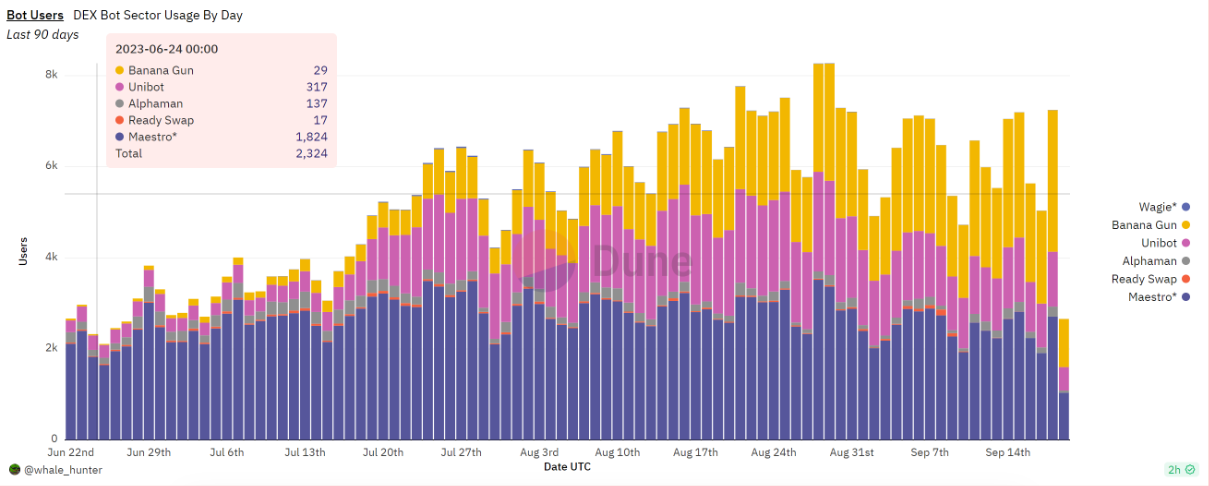
The popularity of Unibot has driven the entire Telegram Bot sector, and the popularity remains high. In the early days, Telegram Bot had many types of functions, such as token exchange, copy trading, analysis, automatic brush airdrop trading, asset cross-chain, etc., and there were different projects In specialization.
However, with the development of time, DEX Bots have occupied the mainstream of the Bot track with functions that traditional DEXs do not have but are urgently needed (such as blocking new disks, anti-MEV, and following orders, etc.).
Today, DEX Bot has formed a three-legged situation - Unibot, Banana Gun and MaestroBot divide the market share of DEX Bot.
at the same time,Telegram announced the TON network as its Web3 infrastructure choice on September 13, and TON will also launch the TON Space wallet to serve Telegram users.
In general, Telegram is gradually weakening the status of the wallet in the Web3 portal through Bot, allowing users to reduce the interaction process between the wallet and on-chain applications to a certain extent; and is cooperating with the TON network to lay out the wallet field. At this point, Telegram used Bot as a spear to attack MetaMask.
MetaMask: a set of combination punches, defensive and offensive
MetaMask is the main entrance for most people to participate in Web3. According to data disclosed on the Consensys official website: MetaMask has a total number of users of 100 million, is associated with 17,000 DApps, and has a daily interaction volume of 244,000 times. MetaMask relies on Ethereums dominant advantage in the public chain and the support of the Ethereum Foundation. Its number of users in the field of hot wallets leads by a cliff, and it is a well-deserved leader.
In the early days, MetaMask was only used as an asset management tool, or more like a middleware participating in on-chain activities. Users deposit money on the exchange to purchase tokens, which are sent to MetaMask to interact with on-chain projects. However, in the past year, MetaMask has continued to make new moves, aiming to gradually shift from a single ecological wallet to a universal portal for Web3, and also move from a more invisible infrastructure layer to a more visible product layer.
MetaMask launched the MetaMask portfolio DApp in September last year, providing MetaMasks related product portfolio, which combines the related functions of most current on-chain activities to form a unified UI interface, so that new users of Web3 do not need to understand different functional on-chain applications. , you can also participate in on-chain activities, such as token exchange, cross-chain bridge, staking, etc. In particular, the recently added deposit and withdrawal channels have opened up the entire process of users entering and exiting Web3, extending the time users can stay in MetaMask.
What really makes MetaMask turn to the universal entrance of Web3 is the recently launched Snap function. Snap is a plug-in platform for user-defined wallet functions launched by MetaMask. Major project parties can create relevant Snaps on MetaMask Flask and connect their functions to MetaMask without permission. Currently, 34 third-party created Snaps are included, enabling cross-platform transaction insights, notifications, and interoperability features.
Snap will enhance the scalability of MetaMask, allowing it to spread from EVM-related public chains and L2 ecosystems to non-EVM public chain ecosystems. Expand its service scope and enhance MetaMask function permissions. At the same time, using XMTP Snap access, MetaMask also has certain instant messaging capabilities.
MetaMask broadens its channels for obtaining traffic through its product portfolio and Snap, and reduces the complexity of users choosing to participate in different chains.
Faced with the onslaught of Telegram and other wallets, MetaMask has strengthened its position by broadening its services.
In contrast, Telegram and MetaMask adopt different methods to seize Web3 traffic in different exclusive fields. The two may not be directly competing, butThe key point of Web3s universal traffic entrance is that it is universal. How to retain users with different needs on its own products is the core point of competition between the two.
Odaily summarizes the advantages and disadvantages of Telegram and MetaMask as follows:
Telegram’s advantage lies in its traffic base of 800 million active users and the rapid development of Telegram Bot.
However, Telegrams disadvantages are also obvious. Bot projects are not highly decentralized and may have certain security risks. The social attributes and Web3 are not integrated, and they feel that they are developing relatively independently.
MetaMasks advantages lie in its precise user base, the establishment of deposit and withdrawal channels that open up all aspects of Web3, and the establishment of Snap to expand the coverage of MetaMask.
The disadvantage of MetaMask is that it acquires new users from a single source, mostly from tap water. The product portfolio is less relevant to the wallet, and it takes time to educate users and the cost is high. Snap has a single function, and there is no out-of-the-box Snap to attract users.
Perhaps MetaMask has never imagined that its opponent is not the wallet, but the player in the next game; maybe it doesnt matter who wins in the end.The Web3 industry hopes to absorb fresh external traffic in the competition of multiple products with different attributes.


