






Forbes: Three Stages Detailing How Gary Gensler Went from Crypto Ally to Industry Enemy?


Original author: Sam Lyman
Original translation: Luffy, Foresight News
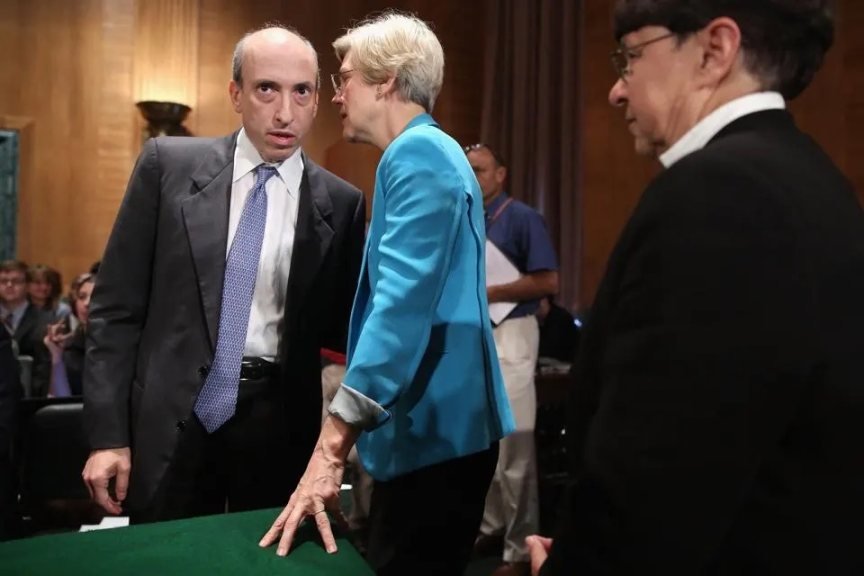
Washington, D.C. - SEC Chair Gary Gensler has established close connections with members of the House and Senate...
Who watches the watchdogs?
As federal bureaucratic agencies continue to expand in budget and size, this age-old question becomes even more important.
But as the U.S. government develops, the influence of the fourth estate also continues to grow. Social media enables a new generation of citizen journalists to hold officials accountable by scrutinizing their past positions. In recent weeks, attention has been focused on SEC Chair Gary Gensler.
As the SEC ramps up its regulation of cryptocurrencies, members of Congress have been pressuring Gensler to change his stance on cryptocurrency. Thanks to the work of professional journalists and amateur sleuths, the contradictions between Gensler's past and present statements have come to light on Twitter. This decentralized community is diligently watching the watchers.
What have they discovered? Gensler's views on cryptocurrency have undergone significant changes. Here is a timeline of his journey from industry ally to adversary.
Phase 1: Ally (2018-2020)
Although Gensler's recent enforcement actions have made him a pariah in the industry, this hasn't always been the case. Many cryptocurrency enthusiasts once viewed him as a forward-thinking regulator and ally. Prior to taking over the SEC, Gensler spent three years in academia, where he gained a reputation as a public leader who saw the innovative potential of cryptocurrency.
2018
Gensler gave a speech on the policy implications of emerging cryptocurrencies to a group of hedge fund managers. In his speech, he explicitly stated that Bitcoin, Ether, Litecoin, and Bitcoin Cash "are not securities." Given that these tokens accounted for the majority of cryptocurrency trading volume at the time, he said, "Three-quarters of this market is likely not securities."
That same year, Gensler began researching digital assets at MIT and taught courses on blockchain and cryptocurrency at the university. There, he delivered a speech openly discussing the question of whether cryptocurrency is a security or a commodity. His answer was, "Both. I know that's not the answer many people want, but that's where we are right now."
2019
Gensler spoke at the Fintech Conference in New York City, where he highly praised Algorand and its Chief Developer Silvio Micali (who was Gensler's colleague at MIT). Gensler called Algorand's project a "great technology" and stated that the blockchain is highly efficient, saying, "You can create an Uber on it."
According to a Binance lawyer, in the same year, Gensler voluntarily applied to be an advisor for the cryptocurrency exchange and even had a special meeting with Binance CEO Zhao Changpeng in Japan. (Gensler has not refuted this claim to date).
2020
Gensler taught his final course on blockchain and cryptocurrency at MIT. His lecture was available to watch online, leading many to believe that if he were to re-enter public service, he would adopt a supportive strategy towards cryptocurrency innovation. With Biden elected as president, more and more people speculated that he would appoint Gensler as the chairman of the U.S. Securities and Exchange Commission (SEC).
Phase Two: The Skeptic (2021-2022)
Sure enough, President Biden appointed Gensler as the SEC chairman. Given Gensler's past public statements and praise for various crypto projects, many in the crypto community celebrated his appointment. For example, Senator Cynthia Lummis tweeted, "While the SEC has a reputation for being an innovation black hole, Gary Gensler understands the potential of crypto assets."
In fact, with Gensler assuming office, there was a general sense of optimism in Congress. However, shortly after taking office, Gensler's attitude towards cryptocurrency began to shift.
2021
In press releases and public comments regarding cryptocurrencies, Gensler's tone shifted from openness to skepticism, and in some cases, even hostility.
The SEC chairman began advocating for stronger regulation, labeling the cryptocurrency market as a "Wild West" full of fraud. He further stated, "I believe many tokens in our current crypto markets may be unregistered securities."
Despite this, Gensler acknowledged that cryptocurrencies remained in a regulatory gray area. He expressed that congressional legislation would help provide greater clarity for the industry, as "these crypto assets exchanges have no regulatory framework at the SEC or our sister agency, the CFTC."
2022
Gensler further emphasized the "Wild West" narrative, adopting a more assertive tone. "Of the nearly 10,000 tokens in the cryptocurrency market, I believe the vast majority are securities," Gensler stated in a speech given to the entire institution in September. Just two months later, the cryptocurrency exchange FTX went bankrupt, validating some of Gensler's assertions.
Phase Three: The Adversary (2023-Present)
After the FTX debacle, Gensler's skeptical attitude turned into an opposition. The SEC grew tired of waiting for Congress to pass legislation and instead took a regulatory enforcement approach, initiating a series of Wells notices and lawsuits against prominent cryptocurrency exchanges.
There's just one problem: the new strategy requires Gensler to "swallow" all of his previous statements about cryptocurrencies.
2023
In an interview with The New Yorker, Gensler stated that "everything other than Bitcoin" is a security, which contradicts his clear statements from 2018 when he said that several major cryptocurrencies are not securities and that many tokens have characteristics of commodities.
Gensler said, "The cryptocurrency market lacks regulatory compliance, not transparency," which contradicts his own demand for Congress to legislate for increased transparency in the cryptocurrency industry in 2021.
Although Gensler claimed in 2021 that cryptocurrencies lacked a clear regulatory framework at the SEC, he now believes that the "law is very clear" and that all cryptocurrency exchanges must register with the SEC.
Despite reports that Gensler proposed to serve as an advisor to cryptocurrency giant Binance in 2019, the SEC is currently suing the company for market manipulation and misuse of customer funds. The U.S. Securities and Exchange Commission has also filed a lawsuit against Coinbase, alleging that the latter listed "unregistered securities."
Speaking of unregistered securities, the SEC claims in the lawsuit that ALGO is such a security. Remember, ALGO is the native token of Algorand, an protocol that Gensler praised as groundbreaking in 2019.
Gensler's "anchoring strategy"
So why the sudden change in Gensler's attitude?
There is likely a consistent strategy behind his contradictory statements.
As a seasoned bureaucrat, Gensler understands the workings of Washington negotiations better than most. Effective policymakers employ a negotiation technique called "anchoring," where their initial proposal often deviates significantly from the expected outcome. (Think of Alexandria Ocasio-Cortez's "Green New Deal" or the initial $3.5 trillion price tag of Biden's "Build Back Better" plan.)
These initial proposals are often outlandish and have little chance of becoming law. However, they set a reference point for negotiations and make the proposing party appear to make significant concessions because policies inevitably move towards the middle ground.
This is likely the logic behind Gensler's SEC actions. By taking a strong stance that "everything other than Bitcoin" is a security, he sets the negotiation framework and pressures Congress to take action on legislation.
Cryptocurrencies are more likely "digital commodities"
The response of Congress to Gensler is the McHenry-Thompson Bill, which proposes a new asset class called "digital commodities" (far from marking everything except Bitcoin as securities). Many existing tokens fall within the definition of digital commodities in this bill, so they will be subject to regulation by the Commodity Futures Trading Commission (CFTC) instead of the U.S. Securities and Exchange Commission (SEC).
The McHenry-Thompson Bill is the most comprehensive cryptocurrency framework in the history of Congress. It has strong support in the House of Representatives but may face strong opposition in the Senate. Democrats have shown respect for Gensler on many issues related to cryptocurrency. Therefore, if this legislation is passed in this Congress, it is likely to not appear in its current form.
Another option for supporters of this bill is for Congress in 2025 to be more crypto-friendly. However, this is contingent on the industry being able to withstand 18 more months of scrutiny from the SEC. In any case, rope-a-dope tactics (a boxing strategy that involves allowing the opponent to tire themselves out) are risky, and the risk is even greater when facing a formidable boxer like Gary Gensler.


