






An article comparing Aptos and Sui: an L1 matchup on Move


Original title: "Aptos vs Sui: L1s on the Move》
Author: Cody Garrison
Compilation of the original text: Dongxun
Compilation of the original text: Dongxun
01 Introduction
The "L1 war" is the well-publicized story of the 2020-2021 cycle, with major alternative Layer 1 blockchains capturing a lot of value and developer talent alongside Ethereum. Solana, Cosmos, Avalanche, BSC, and a dozen other L1s had a market cap of over $300 billion at the peak of the market. While the rhetoric has cooled, and people are dormant because of the bear market, the discussion of scalability at network scale, security, and continued innovation around technology design has once again been brought to the fore.
Diem & Novi
These conversations have been intensified by the massive funding rounds of two new L1 unicorns, Aptos and Sui, both with teams and structures derived from Meta's now-defunct Diem and Novi projects.
Novi Financial, a wholly owned subsidiary of Meta, is a member of the Diem Association and is the main project being built by the Meta for Diem Digital Assets team. It's a crypto payment wallet built on the same technology as its predecessor, Calibra, which Facebook announced in June 2019. Faced with continued regulatory scrutiny and a lack of mainstream enthusiasm for adopting products that are at odds with Web3 and decentralization, the Diem Association began to phase out, and the Novi pilot faced a similar fate.
Although the Meta-backed project was killed off at 1 Hacker Way, the team behind the technology has big ambitions to bring it back in a completely different way. Most notably, Diem aims to be a permissioned network, while Aptos and Sui are decentralized and permissionless, allowing anyone to join them as a validator.
Diem, originally known as Libra, is a blockchain-based stablecoin payment system proposed by Facebook (Meta), which is independently and cryptographically entrusted to the Diem Association - a payment, technology, telecommunications, venture capital Membership organization of companies including Visa, Mastercard, eBay, Shopify, Anchorage, Coinbase, Ribbit Capital, a16z, Union Square Ventures, Mercy Corp, Uber, Lyft, and non-profit organizations.
move out
Move is a Rust-based open-source programming language developed by the Diem Association team for creating customizable transaction logic and smart contracts. It is a novel language that arose with the Move Virtual Machine (MoveVM) that resulted from this project. Compared with other PoS chains such as Ethereum, this mechanism is designed to maximize security without increasing transaction compilation costs and minimizing gas fees. It has been hailed as a safe and productive language that helps developers avoid mistakes that could lead to exploits.
According to the whitepaper, Move's executable format is "bytecode above assembly language but below source language. The bytecode is checked on-chain for resource, type, and memory safety by a bytecode verifier, and then the bytecode The interpreter executes directly." The main factor that differentiates Move from other programming languages and allows Move to enjoy a high level of safety and expressiveness at the same time is its use of resources, which stems from the mathematical ideas of linear logic.
To gain a deeper understanding of the technical nuances of the language, Pontem Network (an Aptos product studio building wallets and asset exchanges on top of Aptos) outlines it in more detail here.
While both protocols leverage the Move programming language, Aptos and Sui use slightly different models. Aptos uses the original MOVE language created by Diem's team, while Sui is utilizing their own alternative called "Sui Move".
02 Financing Overview
Aptos and Sui have quickly risen in popularity after raising eye-popping funding rounds. Aptos Labs received a $200 million strategic investment led by a16z in March 2022, followed by a $150 million Series A investment led by FTX Ventures in July. In addition, Sui development team Mysten Labs received US$36 million in Series A financing in December 2021, and completed a US$300 million Series B financing led by FTX Ventures in September. Binance Labs and Dragonfly also joined the ranks, both of which made strategic investments in Aptos in late September after Mysten announced its latest funding round.
Building a new L1 is a daunting task, and there is no perfect playbook. It is capital-intensive, talent-intensive, and takes years to build, scale, market, and move toward decentralization. These recent funding rounds feel like a capital arms race to see who can build the biggest bear market war chest to generate meaningful innovation in the next expansion cycle.
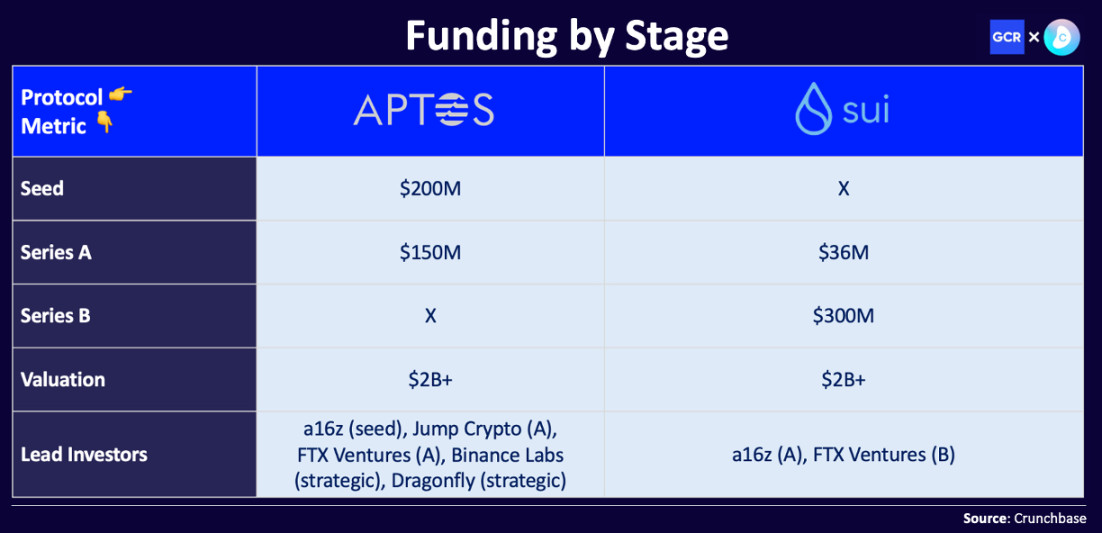
Having said that, the community and investors have strongly criticized these L1s for being overvalued due to the lack of an active ecosystem, governance framework or users to support their double unicorn status in a deep bear market.
Recent fundraising activity tells another interesting story. Exchange money is pouring into both projects, with FTX, Coinbase, and Binance each contributing to recent funding rounds for both protocols. Their parent exchange will list these tokens and get a huge fee from traders rotating into another L1 narrative, while also getting distribution of tokens at an early discount. Beyond ETFs, it’s worth noting the size of the funds backing these protocols — 15 of the top funds in our recent VC rankings made it to the cap tables.
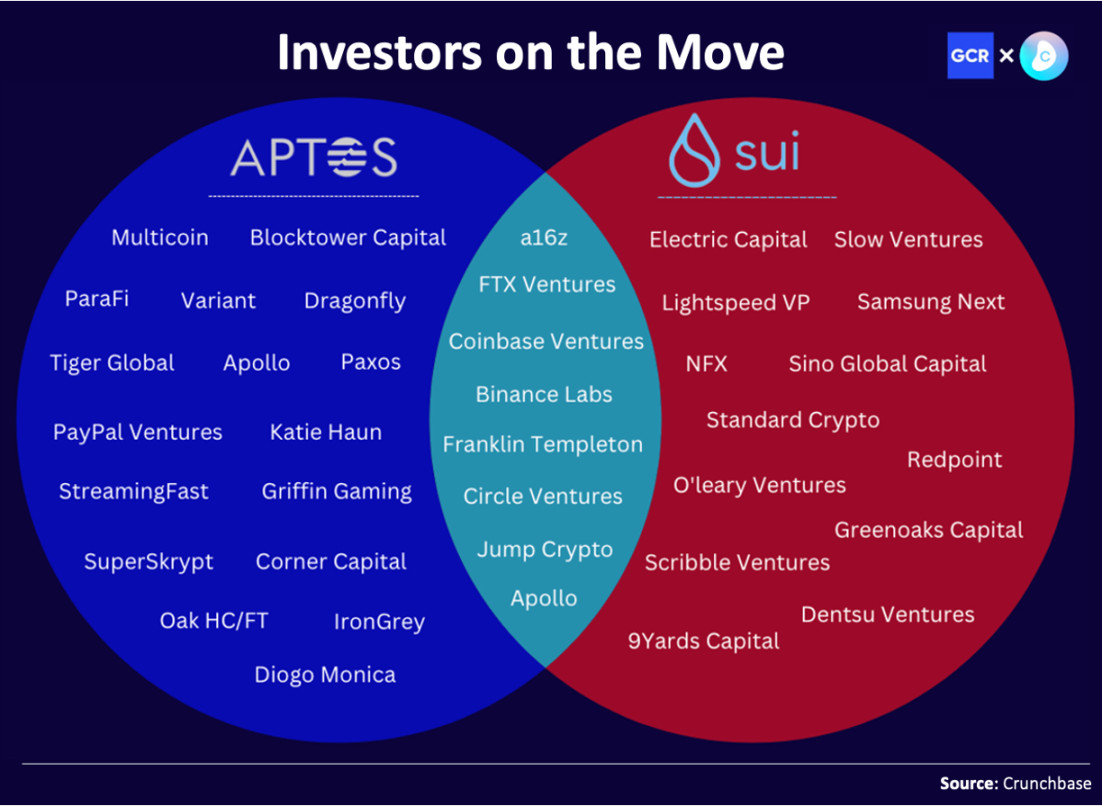
Many Solana investors also find themselves funding these protocols that are similarly looking to maximize network capacity, including: Multicoin, Blocktower, Sino, ParaFi, a16z, and Jump. While skepticism remains about the exorbitant valuation, early backers hope to earn outsized returns through future token warrants.
03 Founder-Market Fit
The founding teams of Aptos and Sui are deeply rooted in the Diem and Novi projects. There's no denying that both projects have the technical capabilities to execute on these visions, which have amassed valuations of over $4 billion. There is no question that both teams have strong founder-market fit. The Mysten Labs team includes two co-authors of the MOVE programming language white paper and additional R&D from the Novi/Diem team.
As CEO of Aptos Labs, Mo Shaikh brings business development and partnerships - an important aspect for any new protocol looking to gain traction in the growing L1 market.
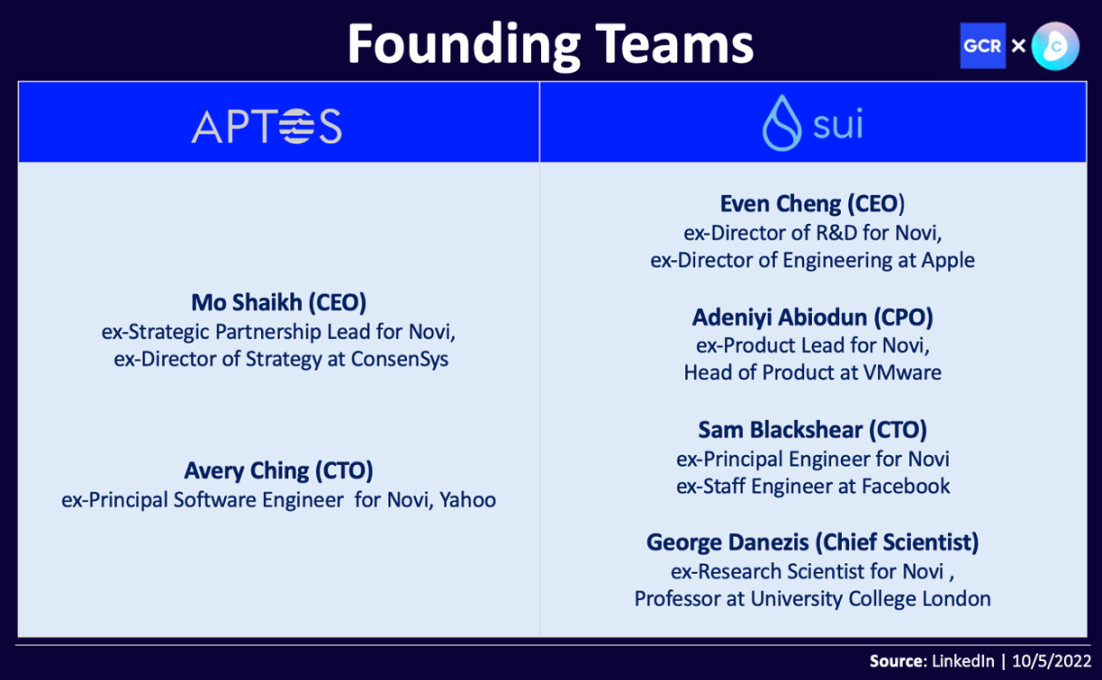
This focus is a stark difference between Solana and Polygon last cycle and more tech-minded protocols like NEAR and Algorand. Aptos also brought in several Solana alumni with first-hand experience scaling alt-L1, including Solana's former head of marketing, to drive the Aptos ecosystem.
04 Architecture and Consensus
HotStuff
Both Aptos and Sui are proof-of-stake (PoS)-based blockchains, and both protocols use a consensus mechanism called BFT (Byzantine Fault Tolerance) — which works on the idea that a third of the validators are offline or malicious. In this case, the network can still operate normally. From here, the designs of the two began to diverge.
Aptos relies on HotStuff, a modified BFT consensus. In HotStuff, the leader changes with each round of voting, he proposes a new block, and validators vote on it. Since all validators communicate with a single leader, the total number of messages sent is much lower than the number of validators communicating with each other. Once a block is deemed valid, it reaches finality in what Aptos claims is less than 1 second. This is a major advantage of Aptos over its competitor Solana, where finality can take ~2-6 seconds.
Narwhal & Tusk
Similar to most L1s including Ethereum, Aptos utilizes an account-based model where transactions are sequentially packaged into blocks and form a blockchain. However, by designing Block-STM, an in-memory parallel execution engine, Aptos claims that "by utilizing the preset order of transactions and combining software transaction memory technology with a novel collaborative scheduling (Collaborative Schedule), it can execute Over 160,000 meaningful Move transactions (130,000 by speed test)” [1].
Sui utilizes the Narwhal & Tusk consensus algorithm for parallelization at the execution layer. Narwhal is the mempool module - it ensures the availability of transaction data. It can also be used alone (without Tusk) with other consensus engines such as HotStuff or Cosmos' Ignite [2]. Tusk is a consensus module that sorts submitted complex transactions for consensus [3].
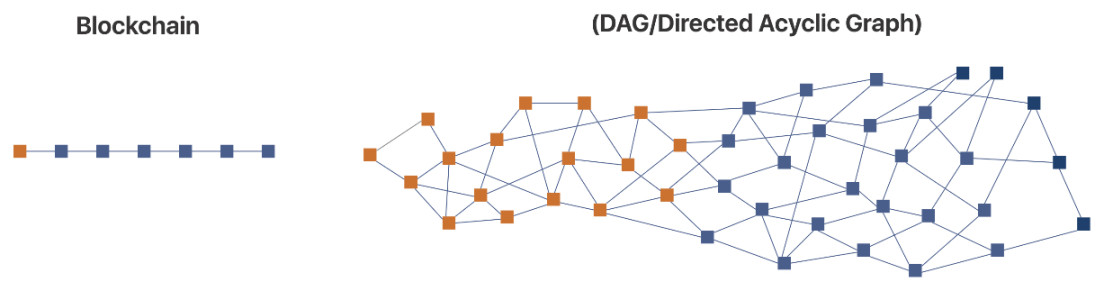
Given this DAG (Directed Acyclic Graph)-based or object-centric data model, some might argue that Sui is a distributed ledger rather than a blockchain. Under this design, transactions are not packaged sequentially into a blockchain, but rather its many elements are linked together as a network graph rather than a chain. Conceivably, the DAG model can enhance scalability by splitting objects and exploiting their built-in properties. This design is also asynchronous, which means it is resistant to DoS (Denial of Service) attacks and helps Sui market as a security-focused protocol.
With this design, Sui takes a dynamic new approach that completely eliminates consensus for many transactions - its owners simply transfer tokens to different addresses independent of any other transactions from them, almost Get instant confirmation. The sender broadcasts the transaction, collects votes from validators (handshake), and receives a so-called certificate of validity.
Thanks to Pontem Network, whose blog helped me put together these highly technical parts.
scalability
scalability
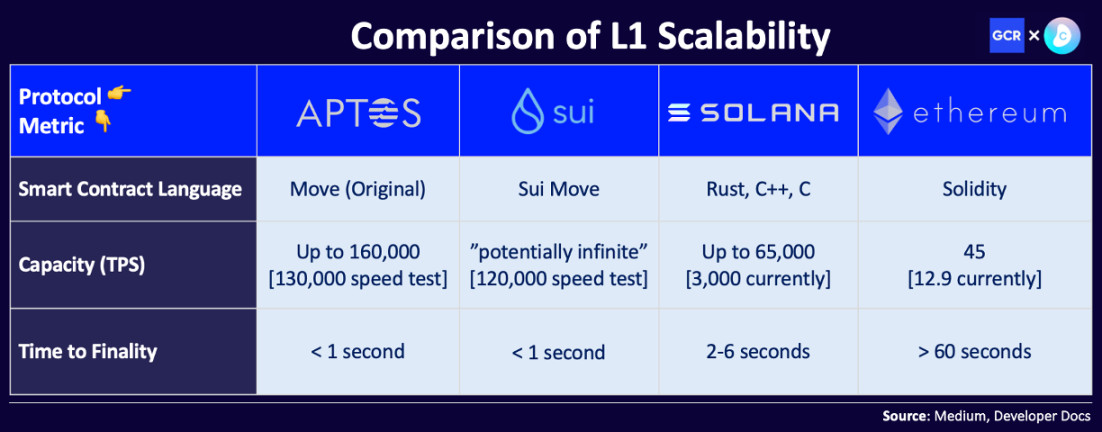
After digging into these novel protocol designs, it is clear that scalability is the main added value of the ecosystem that these projects hope to unlock. With major conversations around network-scale scalability in blockchain, both Aptos and Sui aim to be leaders in this race by maximizing network capacity. The chart below highlights how early speed tests match up with established L1 competition. Time will tell if these teams can deliver on their early promises.
05 Traction
It's too early to say how the MOVE war will affect Aptos and Sui. However, significant capital inflows will undoubtedly enhance the attractiveness of both protocols, and early signs of ecosystems have already begun to emerge. According to the Move Market Cap, there are already 181 projects building or supporting integration with the Move programming language.
Aptos Ecosystem
Since the late summer funding round, a number of Aptos-specific browser wallets have launched on testnet, including Pontem Wallet, Fewcha, Martian, and a few others available in Chrome and iOS. Pontem Network, the Aptos product studio behind the aforementioned wallet, also launched the first AMM LiquidSwap on Aptos. Additionally, a number of NFT marketplaces have already been established on the network, with BlueMove, Topaz, and Souffl3 (currently only supporting Martian Wallet) all launching on testnet beta. The Aptos Naming Service is also established by the Aptos Foundation.
In the early days of the DeFi ecosystem, a few additional dApps attracted attention, including Aptin Finance (a lending platform), Mover (EVM-to-Aptos bridge), Vial (algorithmic liquidity protocol), Mobius (non-custodial liquidity protocol) and AptosLaunch, the first decentralized launch platform on Aptos. LayerZero Labs also recently announced an integration with the Aptos mainnet – which went live on October 17th. Here is a complete list of projects built on Aptos curated by the community.
Sui Ecosystem
Following the launch of the Sui wallet by the core team in July, many independent browser extension wallets have appeared in the Sui ecosystem. These include Wave, Suiet, Hydro and more. MoveEx has become the first DEX built on Sui, and BlueMove, Aptos' NFT marketplace, also integrates with the Sui network. A recent partnership with Axelar Network aims to help Sui developers connect to EVM-compatible applications. A nascent GameFi ecosystem has also started to emerge, but it's too early to know the potential winners. Unlike Aptos, Mysten Labs officially announced the SUI tokenomics, which you can explore in more detail here.
06 Final Thoughts
L1 games are saturated after the last cycle. However, many other top L1s emerged from the previous bear market to rise rapidly in subsequent expansions. As new conversations take hold around continued innovation and web-scale scalability, don't underestimate the ability for this to happen again.
We'll see whole ecosystems and industries emerge based on the Move programming language -- maybe even some replacement L1s for Aptos and Sui -- that can innovate iteratively.
As more builders push the boundaries on scalability innovations, more projects will likely emerge and be funded specifically built on Narwhal and Tusk consensus mechanisms.
Original link
Crunchbase [1] [2]
Medium: Aptos Blog: Block-STM
Medium: Pontem Network Blog: Aptos vs Sui
Boxmining.com: Aptos vs Sui
Sui & Aptos: The Next Ethereum Killers: Presentation by Hang @ GCR 9/19/2022


