






Understand the relationship between Layer2 and ETH2.0 in one article


Original Author: Daniel Li
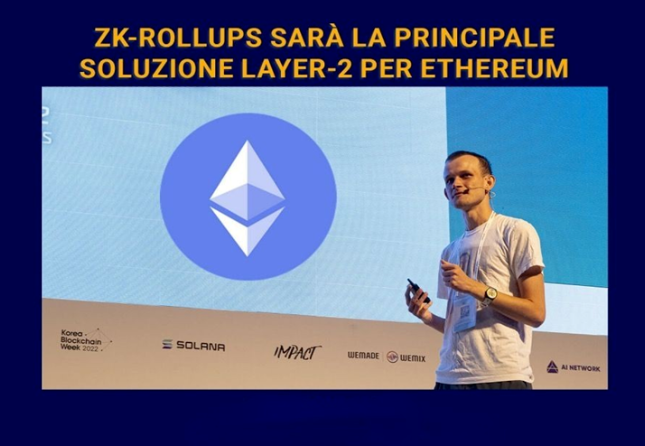
Vitalik Buterin, co-founder of Ethereum recently predicted in a speech at ETHSeoul that ZK-Rollups will defeat Optimistic Rollups in the Ethereum expansion war and become the main Layer 2 solution of Ethereum in the future. For a while, related topics about Layer 2 quickly rushed to the industry's hot searches, so what is Layer 2? What is the relationship between ETH2.0 and Layer2? How does the future of Layer2 develop? Let's find out below.
Layer1——Layer2
secondary title
Want to know what Layer2 is? First of all, let’s start with the expansion of Ethereum. There is no need to repeat the congestion of Ethereum. Everyone is deeply touched. As a solution to improve the performance of Ethereum, expansion has always been a hot spot for users and geeks in the past two years. There are currently two popular solutions, one is to expand on the basis of the Ethereum main chain (Layer 1), which is called Layer 1 expansion. Another solution is to build a new chain next to the main chain to achieve expansion, which is called Layer 2 expansion, and ZK-Rollups is one of the best.
Whether it is Layer1 expansion or Layer2 expansion, its main purpose is to increase the scalability of Ethereum to alleviate network congestion, reduce high Gas fees, and improve network efficiency. In order to make it easier for everyone to understand the two solutions, let's give an example to illustrate.
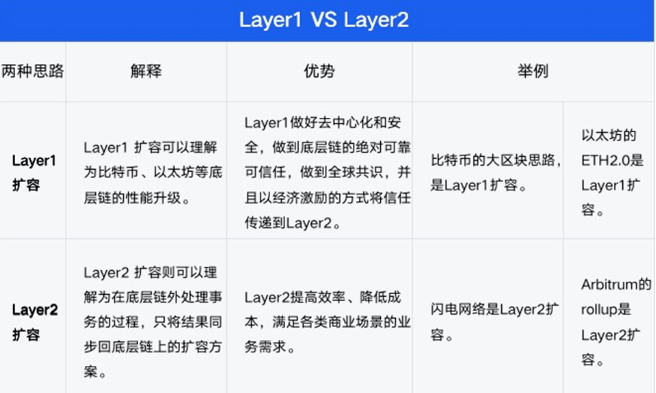
Layer 2 exists relative to Layer 1. When solving the expansion plan, the first thing that comes to mind is to expand the capacity of the public chain itself, that is, the expansion of Layer 1. For example, the early Bitcoin large block idea and Ethereum’s ETH2.0 are both It belongs to Layer1 expansion. Layer 2 is a general term for a series of off-chain scalability solutions. The Layer 2 platform and protocol process data in a way that reduces the burden on the base layer (root chain), and transfers part of the data processing of the main chain to Layer 2, thereby enhancing the entire area. Scalability of blockchain networks. Both Layer1 and Layer2 have their own advantages in the expansion of Ethereum and play an important role.
secondary title
Classification of Layer2
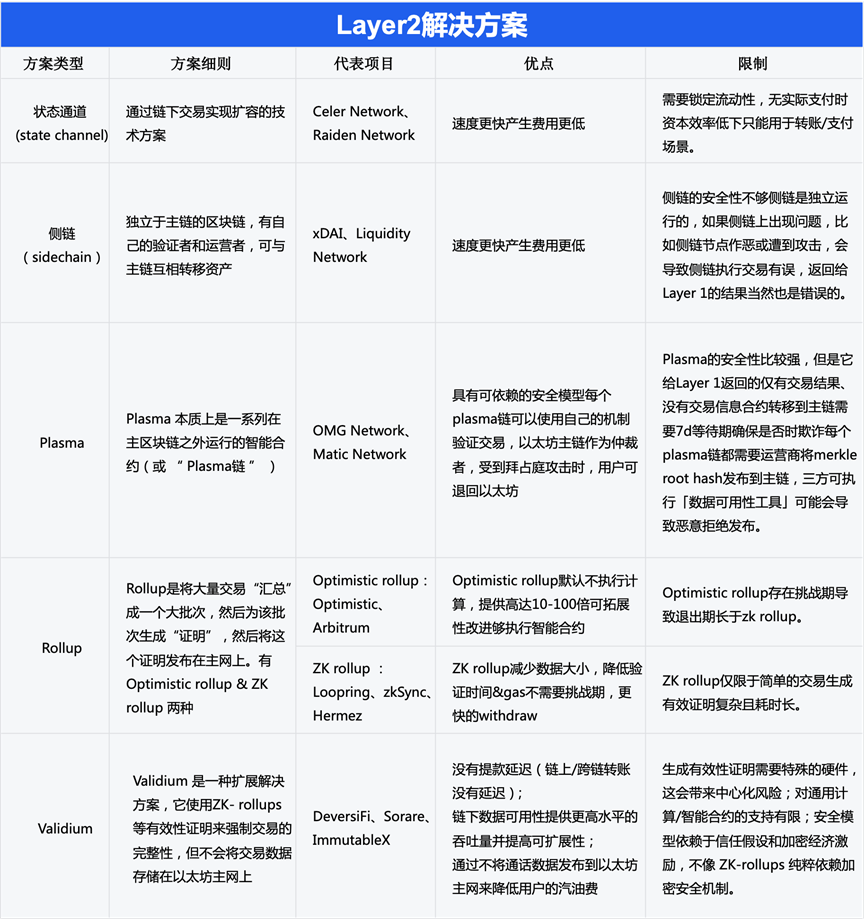
At present, there are several solutions for Layer 2 of Ethereum, namely: state channel, side chain, Plasma, Rollups, Validium and hybrid solutions.
Rollup can be divided into Optimistic Rollup and ZK Rollup according to different schemes for the effectiveness of compressed data (that is, correct data). At present, the general opinion in the market is that Optimistic Rollup is optimistic in the short and medium term, and ZK Rollup is optimistic in the long term.
Optimistic Rollup
secondary title
Optimistic Rollup has obvious advantages, but it also has a fatal shortcoming, that is, it needs to solve the problem of fraud proof, which leads to its withdrawal cycle as long as one week. Users need to wait a week to withdraw their funds from Layer2 exchanges to Layer1, which is unbearable for most users. But this shortcoming is not unsolvable. Some projects such as Optimism DAI Bridge can help Optimistic Rollup shorten this time.
ZK Rollup
secondary title
ZK Rollup is based on the zero-knowledge proof two-layer expansion scheme (Layer 2). ZK Rollup data availability allows anyone to restore the global state of the account based on the transaction data stored on the chain, thereby eliminating the security risks caused by data availability. . Compared with the long withdrawal period of Optimistic Rollup, ZK Rollup avoids this problem through mathematical reliability proof, and its technical security is basically close to Layer 1. At the same time, deposit and withdrawal can also be carried out in real time according to the needs of users. It is the biggest advantage of ZK Rollup.
But this problem is being solved, and Layer2 projects such as Scroll, zkSync, and Polygon have announced their intention to deploy a ZK-EVM computing environment, allowing ZK-Rollups to independently run various forms of general-purpose smart contracts. Once ZK Rollup is fully compatible with EVM, it will have the opportunity to gain the favor of more and more DeFi, and as more DeFi projects adopt ZK Rollup's technology. A trend will gradually form, and finally the interoperability of ZK Rollup on the second floor will be realized. This is why ZK Rollup can be valued by V God and other industry leaders.
secondary title
The current dilemma of Layer2
While Layer 2 is a much-needed and logical solution to scaling Ethereum, it comes with its own limitations and potential issues that could prevent the platform from realizing its true vision of a world supercomputer.
(1) Composability is limited
Layer2 has many solutions. Although the purpose is to solve the problem of ETH scalability, the principles and directions adopted by different solutions are different, which leads to a big problem. If different projects adopt different Layer2 solution, which will lead to the inability to achieve effective value exchange and agreement circulation between them. This will make DApps and DeFi applications on Layer 2 an isolated island. In Layer 1, a single transaction can interact with multiple DeFi protocols to create a new financial product, while in Layer 2 the composability will be greatly limited, because on Layer 2 the transaction can only exist with its own chain It also interacts with the existing DeFi protocols, which also leads to the fragmentation of DApps on different Layer2 chains.
Another reason for the fragmentation of DApps on the Layer2 chain: their related liquidity is also divided. Liquidity is extremely important in any financial market, especially in the blockchain industry, where liquidity is a necessary condition. Without liquidity, some DApps and DeFi carried on Layer 2 chains lose their value. In Layer 2, we see that the existing liquidity is allocated to Ethereum Layer 1 and Layer 2 with different expansion schemes, which leads to liquidity being divided in multi-layer chains, and different chains adopt different expansion schemes, resulting in They cannot flow with each other, which greatly limits the mobility of Layer2.
secondary title
Relationship between ETH2.0 and Layer2
The existence of Layer 2 in the early days was to solve the problem of ETH scalability and high gas fees. At present, it seems that the development of Layer 2 has also realized this. Before ETH2. The Layer 2 solution solves the problems faced by the huge application system for Ethereum. Let ETH retain the position of the king of the public chain.
Complementary to each other, the two are inseparable
The expansion of ETH2.0 is inseparable from Layer2. Similarly, Layer2 cannot exist independently of ETH2.0, because Layer2 is built on the basis of Layer1, not out of thin air. Without Layer1, there will be no Layer2, and Layer1 As the main chain, its decentralization and security are also required by Layer 2. At present, some important information of DApp and DeFi running on Layer 2 still needs to be verified by Layer 1, so not only ETH2.0 needs Layer 2 to achieve expansion, but Layer 2 is also inseparable from ETH2.0. The relationship between the two is complementary. inseparable.
The merged ETH2.0 will realize the self-expansion of the main chain Layer1, and the computing speed will be improved. At the same time, the PoS mode will replace the PoW mode, and the high Gas fee will also be reduced. The future Layer 1 will be able to carry more and more complex DApps and DeFi. This competes with Layer 2, which has the same fast computing speed and low fee rate. In the process of evolution, Layer 1 and Layer 2 will form a DeFi layer, resulting in a certain division, but in the end, Layer 1 and Layer 2 will reach a balanced situation . Layer 2 is the main area where DeFi is carried due to its lower gas fees and faster speed, while Layer 1 is still very important. It carries the security of Layer 2 and will be used as a settlement layer for important data. At that time, the relationship between ETH2.0 and Layer2 will no longer be a subordinate relationship, but a mutual competition and mutual achievement.
secondary title
Will the merged ETH2.0 abandon Layer2?
The merger of ETH2.0 is imminent. Some people worry that after the merger of ETH2.0, the scalability problem and high gas fee of the main chain Layer1 will be greatly alleviated. Will be abandoned, such worries are unnecessary.
First of all, the merger of ETH2.0 is not achieved overnight. Judging from the timetable for the realization of ETH2.0, it is implemented in stages, and each step is a long process from the discussion of the plan to the final implementation, because based on The principle of decentralization requires the consent of the vast majority of community members to implement a certain plan on ETH. The previous stages of the ETH2.0 merger were also due to disagreements from some community members, which led to the continuous delay of the plan. And even if the plan is actually implemented, it will be a slow process for the PoS model to eventually replace the PoW model. So ETH2.0 will still need Layer2 for quite a long time in the future.
Furthermore, even after the merger of ETH2.0, the operation speed of the main chain Layer 1 has been greatly increased, but who would refuse to make it faster? As Harold Hyatt, Product Manager at Trusttoken, explained: "Ethereum-based Layer 2 will scale with Ethereum, so if Ethereum scales, Layer 2 will also scale. If Optimism is 10 times faster than Ethereum mainnet, then Ethereum will scale at the same time." After sharding, it is 10 times, and Optimism is 100 times." Thibault Perréard, Bifrost's strategy director, directly affirmed the necessity of Layer 2 in the future: "The real catalyst to unleash the future potential of Ethereum and truly realize the vision of DeFi is not PoS, but Layer 2 .” So the current ETH2.0 needs Layer2, and it will still be needed in the future.
Layer2 will form an independent ecosystem
secondary title
Summarize
Summarize


