






"The Economist": The battle for the DeFi market is intensifying


Author: The Economist

For believers, an open public blockchain offers a second chance at building a digital economy.Applications built on top of these blockchains collaborate and the information they store is visible to all, a fact that recalls the idealism of the early architects of the internet, before most users had accepted the "walled gardens" offered by the tech giants. Over the past year, as applications built on various blockchains have flourished in scale and functionality, a new type of"Decentralized" digital economybecome possible.
Perhaps the most important part of this digital economy is theDecentralized Finance (DeFi) Applications, these DeFi applicationsEnables users to trade assets, obtain loans and store deposits. Now, the battle for market share in this segment is intensifying.Most importantly, Ethereum, the leading DeFi platform, appears to be losing its near-monopoly status. This race shows how DeFi has been affected by the standards war that erupted in other emerging technologies — think Sony Betamax vs. VHS videotape wars in the 1970s — and how DeFi technology has exploded with lightning speed. General speed of progress.
blockchainblockchaindatabasedatabase——Can help replace centralized institutions like multinational banks and technology platforms. The value of assets stored in this nascent financial system (DeFi) has climbed from less than $1 billion in early 2020 to more than $1 billion today.$200 billionimage description
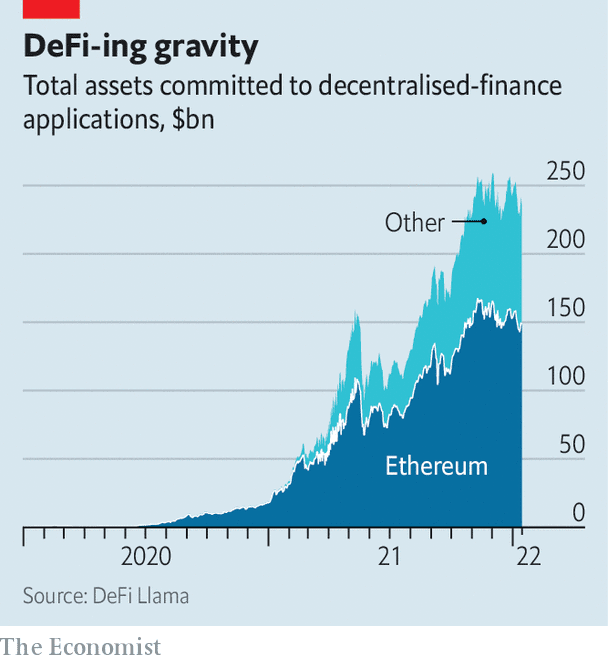
Above: Growth of assets stored in DeFi applications since 2020. Data source: DeFi Llama
Until recently, the Ethereum blockchain was the undisputed dominator of all this DeFi activity. Ethereum was created in 2015 as a more generalized version of Bitcoin. Bitcoin's database stores transaction information for related cryptocurrencies (i.e., BTC), providing proof of who owns what at any time. In contrast, Ethereum stores more information, like lines of computer code. Ethereum applications programmed in code are guaranteed to behave as written, removing the need for an intermediary. But just as Ethereum has continued to improve upon Bitcoin, it is now being preempted by newer and better technologies. Jeremy Allaire, boss of Circle, which issues the popular USD stablecoin USDC, said the competition is like that between computer operating systems.
Current blockchain technology is clumsy and slow. Both Bitcoin and Ethereum use a mechanism called "PoW" (Proof of Work), where computers compete to solve mathematical problems to verify transactions in exchange for rewards. This slows down the network and limits capacity. Bitcoin can only handle 7 transactions per second; Ethereum can only handle 15. During times when the network is busy, transactions are either slow or expensive (sometimes both). When there is high demand to complete transactions on the Ethereum network, transaction fees paid to the computers (nodes) that verify those transactions rise, and settlement times increase. You might spend $70 to convert $500 into ETH, then wait a few minutes to transfer from one crypto wallet to another.
Developers have long been trying to increase Ethereum's capacity. In fact, one of the directions is to change the consensus mechanism of the blockchain. Later this year, developers plan to convert ethereum to an easier-to-scale mechanism called "PoS" (proof of stake). Another idea is to split the blockchain (through a process called "sharding"). These shards will share this load, thus expanding the capacity. Additionally, some developers are also working on ways to bundle transactions (such as Rollups) to reduce the number of transactions that must be verified directly (on the L1 mainnet).
The problem is, with every advancement comes a cost. Proponents of DeFi tout its advantages of being able to conduct transactions safely and without the involvement of centralized intermediaries. But scalability gains must be weighed against security or decentralization losses. Centralize transactions before they reach the blockchain, which is usually done by a centralized entity. It may be easier for a hacker to attack one shard of the blockchain than the entire blockchain. As such, ethereum developers have been slowly making changes to it.
That slowness hurts the network in another way — by fueling the rise of competitors. At the beginning of 2021, almost all assets locked in DeFi applications are on the Ethereum network. But a recent research note from JPMorgan Chase estimates that the share of assets locked in DeFi applications on Ethereum has dropped to 70% by the end of 2021. A growing number of other networks, such as Avalanche, Binance Smart Chain, Terra, and Solana, now use PoS to run blockchains that do the same basic work as Ethereum, but faster and cheaper . For example, two blockchain networks, Avalanche and Solana, process thousands of transactions per second.
What happened to the US dollar stablecoin USDC illustrates these shifts. USDC launched three years ago on the Ethereum network, but has since been rolled out on a number of rival networks, including Algorand, Hedera and Solana. Jeremy Allaire, boss of Circle, the issuing company behind USDC, said transactions on Ethereum are cost- and speed-limited, while transactions on Solana can handle "Visa-scale transaction volumes," with "settlement times of about 400 milliseconds and transaction costs of about twenty-one pennies". Other DeFi applications, such as Ethereum-based exchange SushiSwap, have also launched on several other blockchain networks.
With some of the planned changes in ethereum likely to take at least a year, if not longer, "the risk is that ... the ethereum network will lose further market share," wrote JPMorgan's Nikolaos Panigirtzoglou. For Jeremy Allaire, the current landscape is full of competition. "Just like in the web space, where Windows, iOS, and Android are all competing, there is also competition between blockchain platforms." He believes that the ultimate winner will be the one that attracts the best developers to build applications and thus obtains network effects. network.
But this operating system metaphor may only go so far, in part because of the nature of open public blockchains. Anyone can access the data they generate and view their operating code, which makes it possible to build "bridges" or applications that span multiple blockchain networks, as well as applications that aggregate information between different blockchains become possible. Some applications, such as 1inch, a decentralized exchange aggregator, are already "scanning" exchanges on various blockchains to find the best execution prices for cryptocurrency transactions; while "multi-chain" areas such as Polkadot and Cosmos The block chain operates like a "bridge" between different networks, making it possible to operate across networks.
As long as DeFi has the potential to be successful, the competition around being the network of choice for DeFi will naturally intensify. But the idea of "winner takes all and gaining total control over the digital economy and how it develops" may one day be as obsolete as a videotape.


