






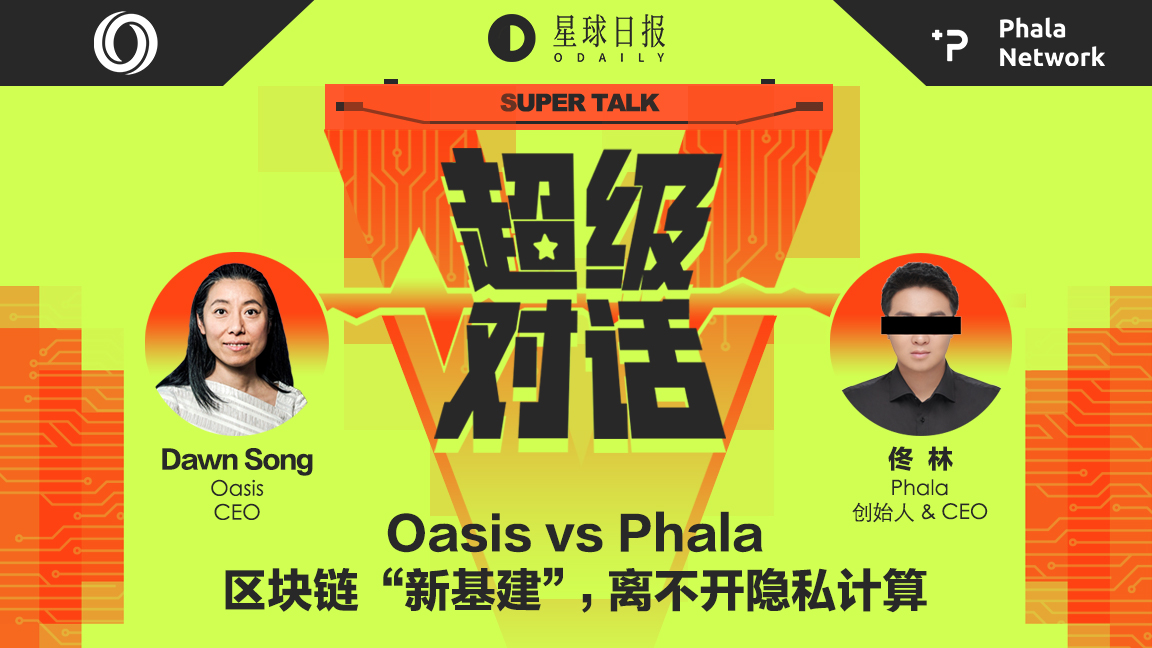
Super Dialogue | Oasis vs Phala: Just as necessary as oracles, why is privacy computing still not popular?


With the continuous advancement of science and technology, a new wave of technology is surging, and people have reached a consensus that "AI will change productivity, big data will change production materials, and blockchain will change production relations".
In the future, information will become sophisticated and efficient from birth to use. The Internet of Things collects real-time, accurate and safe information. The collected information is acquired and stored through cloud computing, and then big data starts to mine, screen and analyze data. Big data provides the analyzed results to artificial intelligence, and artificial intelligence takes massive data for training.
The value of blockchain in this is to ensure that information cannot be tampered with and can be traced. In order to increase cross-subject trust and reduce collaboration costs, privacy computing will also play an important role.
Privacy computing, in a broad sense, refers to computing systems and technologies for privacy protection. After decades of development, privacy computing has played an important role in the industrial Internet, artificial intelligence, financial technology, medical protection and shared data, etc.
In the past two years, with the rise of blockchain technology, the combination of privacy computing and this financial technology has burst into vitality.
At present, in the field of blockchain + privacy computing, it can be divided into three technical schools: TEE technology, zero-knowledge proof and homomorphic encryption.
Phala and Oasis who are in this conversation are the leaders of the "TEE-blockchain hybrid architecture".
Oasis was founded in 2018. The founder, Dawn Song, is a professor at a famous school. The separation mechanism of computing and consensus designed by him allows ParaTime to operate in parallel, providing a higher operating capacity for the network; the rapid advancement of ecological applications, Oasis is applying privacy computing in the real world.
Phala is built on the ecology of the star cross-chain project Polkadot. It naturally has cross-chain capabilities, is convenient for other ecological calls, and has a wide range of application prospects. In addition to the "non-Byzantine" consensus mechanism, the efficiency of reaching consensus is extremely high, and it can realize contract-level parallelism. Interoperability, overall strong practicability.
In the future of the Internet of Everything, privacy computing is undoubtedly an essential underlying technology to ensure information security, and the innovative practices of Phala and Oasis will also help promote the maturity of the industry and the implementation of applications. With privacy technology, we can safely authorize our data to any third party, allowing them to make full use of the data to provide us with more accurate services without worrying about the troubles caused by privacy leaks.
For more working knowledge about privacy computing, welcome to read the essence of the dialogue between the two guests, enjoy~
01 Question
OdailyQ1: Let me briefly introduce myself and the project I am working on. Is there any illustration to introduce the operation mechanism of the project? The current progress of the project, especially the use cases, can also share one or two with you.
Marvin:I'm Marvin, founder and CEO of Phala Privacy Protocol. After graduation, I have been working as a product manager in companies such as Tencent and Didi. I was "brainwashed" by the blockchain by accident, and impulsively started Phala with a few computer science students from high school. We hope to rebuild the Internet through private computing.
Phala Network is the first composable confidential smart contract protocol based on Substrate and Polkadot ecology (Substrate: a framework for building distributed systems in Polkadot), the goal is to provide confidential computing and data protection services for enterprises and users. In the future, it will become a Polkadot privacy computing parallel chain. Phala provides the underlying infrastructure of privacy protection technology for the entire Polkadot ecosystem by releasing the computing power in the CPU with TEE functions.
Next, I would like to focus on three aspects of Phala's technology, use cases and project progress.
Technically, we hope to expand the concept of "privacy protection" into "confidentiality protection". Privacy not only refers to the transaction privacy of users, but also protects any confidential data in smart contracts from being leaked. In the current smart contract technology, all data must be fully disclosed, and we hope that the "Confidential Smart Contract" (Confidential Smart Contract) can perform general-purpose calculations like Ethereum's Turing-complete smart contract, but without exposing confidential data .
Phala adopts a TEE-blockchain hybrid architecture. We encrypt and store the state data on the chain, and anyone can download it without permission. Using the consensus algorithm, each node can get a consistent state. Bitcoin and Ethereum use blockchains to solve the double-spend problem, and the price paid is the need to run an expensive consensus algorithm on each node to achieve the effect of consistent state of all nodes, thus realizing "trustlessness".
What is different from these chains is that Phala's de-trust is guaranteed by trusted hardware, allowing the hardware to act as a third party that cannot do evil, not only can achieve de-trust, but also realize data confidentiality. Therefore, technically speaking, Phala's nodes are "non-Byzantine" in nature, and can guarantee the safe execution of contracts without going through expensive consensus algorithms.
Since Phala miners are non-Byzantine, they get some very useful properties.
The first is contract-level parallelism. Because it is non-Byzantine, we don’t need to go through each node’s consensus once to achieve trustless, so each contract only needs to run on at least one miner, and each miner is only responsible for running its own contract. Contracts are executed in parallel across the network. Therefore, the computing performance of the network increases linearly with the increase of miners, and extremely high performance can be achieved.
The second is to support cross-chain naturally. Phala’s contracts are executed in parallel, so we use the blockchain and TEE to complement each other and design a set of interoperability protocols between contracts. This interoperability protocol is compatible with Polkadot’s XCMP, so Cross-chain calls are as simple as contract calls.
The most typical TEE-blockchain hybrid architecture is Oasis Network. But during our early research, we found that Oasis lacked the foundation of composability - interoperability.
In order to achieve composability, Phala Network introduces a unique layering and event tracing mechanism. Simply put, Phala separates the two types of operations of reading and writing of confidential smart contracts, and the read operations are sorted on the chain, thereby eliminating the Race Condition. Shared security between TEEs is achieved. Allows interoperability between contracts and even with external blockchains.
Regarding the project progress and use cases, I also briefly talk about a few points.
Phala not only determined Phala's community route through the economic white paper, but also introduced a large number of TEE miner equipment. On May 15, we launched a Stakedrop airdrop campaign for the Kusama chain of the Polkadot community. This campaign aims to fairly distribute some PHA tokens to the Polkadot community. At the peak, more than 1 million KSM participated in the campaign.
In the testnet POC-1 stage, we have implemented simple basic functions: people can use Phala to freely mint anonymous coins and conduct private transactions.
The testnet POC-2 stage is the stage of decentralized governance NPOS and nomination. We have realized the two-way verification of TEE and blockchain, registration on the pRuntime chain and other links.
In the near future, our test network will be upgraded to POC-3, which will open free TEE miner registration and mining. But Phala Network is not just "blockchain", we are constantly creating use cases, such as:
pLibra is an application project inspired by the Phala team after Facebook announced the cryptocurrency project Libra in 2019. pLibra is a Libra bridge based on the Phala Network, which provides a privacy solution for data such as transactions and smart contracts on Libra, and was supported by the Web3 Foundation's incentive plan in Q3 2019.
Our data privacy protection product: Web3 Analytics is a product that can help users outside the chain protect their privacy. It directly hopes to replace Google's data platform and allow users to regain control of the Internet. This project has also received a grant from the Web3 Foundation.
Recently, the Kusama community passed a proposal to build a decentralized dark pool using the capabilities of Phala Network, which is used to solve the disadvantages of Defi’s lending protocol that currently exposes user positions and is targeted for liquidation. This is also our most likely near-term use case for ongoing revenue from protocol calls.
Dawn Song: Hello everyone, I am a professor of computer science from the University of California, Berkeley, and I am also the founder and CEO of Oasis Network. My research focuses on deep learning, security and blockchain. During my many years of research career, my practice has also been recognized by some authoritative organizations, some of which include "MacArthur Genius Award", "Guggenheim Award", "National Science Foundation Award", "US Sloan Award" "Acting Award" and the Best Paper Award at top conferences on computer science and deep learning, and was included in the 2009 "Global List of 35 Technological Innovators Under 35" by MIT Technology Review.
Oasis Network is the first generation privacy empowered blockchain platform serving open finance and a reliable data economy. Combining the characteristics of high circulation and security architecture, Oasis Network protects privacy, expands DeFi and reforms open finance, and expands the scope of radiation from traders and early players to the mass market. Its unique privacy features can not only redefine DeFi, but also create a new digital asset model - tokenized data. Users control the data they generate and earn rewards by staking data on the app. Oasis Network is currently trial running the main network candidate network Amber, and looks forward to its early launch.
Oasis Network separates consensus operation and calculation, and creates two layers with their own characteristics, PareTime layer and consensus layer. This multifunctional design enables ParaTime to optimize and provide solutions for various situations, and its network also covers a wide range of user groups.
The Oasis Foundation (Oasis Foundation) currently runs a project called DevAcclerator, which aims to help startups looking to build or integrate their own applications on Oasis. Our partner, Oasis Labs, is also selecting companies that will enhance Oasis' capabilities to support the growth of confidential computing. Here are a few examples:
The first, the Binance CryptoSafe Alliance.
With cryptocurrency theft and attacks on the rise, exchanges urgently need a platform that can identify and ban users with ulterior motives. CryptoSafe, a cryptocurrency security platform jointly developed by Oasis Labs and Binance, realizes the desire of exchanges to share threat intelligence data. Due to Oasis' protection of confidential calculations, the exchange data is kept confidential when compared.
The second, the world's top 500 healthcare providers.
A Fortune 500 healthcare provider wanted to share data with external parties, but still retain control of the data and protect patient privacy. By using an API built by Oasis Labs, when sharing data with third parties, the healthcare provider can track, investigate and control data usage while exchanging data.
The third is a genomics startup that provides direct services to customers.
A genomics company that serves customers directly differentiates itself from the market by giving customers direct control over their genomics data. Using the Oasis architecture, customers can take ownership of their personal genomics data, and the company cannot see the customer's raw data when managing and analyzing the data.
OdailyQ2: After two years of popularization, the concepts of privacy protocols and privacy computing have been deeply rooted in the hearts of the people, but there is still a lack of killer applications. At present, Oasis has implemented some enterprise-level use cases. I would like to ask you how do you think about the path of privacy technology landing, what stage is it currently in, who should be its customers and scenarios in the short term, and how much room for imagination in the future?
Marvin:Regarding the landing path, I think gradual development is a common law, not only for privacy technology, but also for the entire Internet industry. Blockchain practitioners must recognize the reality. Now we are still in the early stages of blockchain and Web3.0. Users who are accustomed to the experience of Web2.0 cannot migrate to Web3.0 overnight. The same is true for privacy protection. We have the most advanced technology, but in order to exert the power of technology, we still have to return to the product as the entry point.
Last year's Maskbook was a good entry point, guiding Web2.0 users into the Web3.0 ecosystem from the user side. I personally think that we can also start from the company's end and gradually open up the privacy protection market. When users generally get on the car, heavier and more thorough solutions can start to show their talents. I think the early customers and scenarios should be finance, data banking, medical care, artificial intelligence and other companies that have high requirements for data privacy and sharing.
In the future of trusted data interaction, users do not need to sign a "false" user agreement, but a real "user agreement". Guaranteed by the smart contract, the user allows the service to use, and the service can use the user's data under the authority agreed by the user, replacing the current ugly trust relationship.
Only when the following separation of powers is formed, can users obtain real "online dignity":
Data ownership: Physically ensure that data ownership only belongs to the user himself, and the key here is privacy protection;
Data computing rights: Computing power is guaranteed by the blockchain and enforced by the authorization system, so it belongs to the confidential smart contract (the purpose of the Phala network is to run the confidential smart contract)
Data usage rights: Transferred by the authority system, the user authorizes the developer, and the third party can use the authorized part.
Dawn Song:We have seen private computing and blockchain bring many new user instances to small startups. This type of company breaks the current mold of the existing industry by providing users with stronger privacy guarantees. Some large corporations are also trying to improve their privacy practices and better protect user data.
The combination of secure computing and blockchain has brought about a new revolution - tokenized data. Blockchain can store data and update usage regulations with high integrity and auditability. Privacy computing ensures that the privacy of the computing process is encrypted and cannot be used without permission. The combination of data and regulation creates a new type of digital asset that requires regulation to be used for a specific fee or transaction value.
With tokenized data, both individuals and businesses can decide how and by whom their data is used. This new class of privacy-preserving apps gives users programmatic control over the data they want to share.
Tokenized data has the same value as a business. Collaborate better with the rest of the industry by increasing control and ensuring data is fully encrypted.
OdailyQ3: Privacy has some similarities with DeFi and oracle machines before the outbreak. Its value is unquestionable, but it is still a niche thing, but this year DeFi has also become popular due to liquidity mining and wealth effects. What do you think about privacy? Can you learn from the incentive mechanism of DeFi products? Where does DeFi and privacy come together?
Marvin:Whether it is Ethereum's Enigma (now called Secret Network) or RenVM, they all show the necessity of privacy facilities in the Defi field. I think it is mainly reflected in the following logic:
Decentralized finance is more credible than centralized finance, but at the cost of data exposure. Data exposure will lead to users’ extremely important data and strategies being understood by opponents, resulting in uncontrollable consequences, such as the recent exposure of ZeusCapital’s position on Aave.
Therefore, I believe that only when privacy facilities are mature and available can DeFi go further. The benefits of privacy to Defi include several aspects:
Protect users' key positions and strategies (such as high-frequency trading, block trading), so that users are more "dare" to use;
Accelerate DeFi to make performance faster and products more usable;
Let the experience of DeFi infinitely approach or surpass the centralized exchange.
As for the current hot incentive mechanism in DeFi, Phala’s TEE mining mechanism is actually very similar to liquidity mining, except that liquidity mining uses liquidity supply or capital pools to obtain greater returns, while TEE mining is more Like "anonymity set mining" - by providing a huge anonymity set, miners can linearly or even exponentially improve the randomness and security of the system, thus ensuring a more secure than all similar products in the world Privacy computing cloud system.
Dawn Song:Oasis Network landed exciting user examples on DeFi. For example, with privacy technology, Oasis can build actual authentication and on-chain finance, and users can safely store and share real-world sensitive data (such as credit ratings). Knowing users’ off-chain credit and storing invariants on the blockchain allows lenders to offer collateralizable loans, expanding the scope of the decentralized marketplace and attracting non-blockchain-native users to experiment with decentralized applications.
02 Phala asks Oasis
Phala question Q1: Did Oasis labs encounter the limitations of the original technical design during the application process? What type of business problem do you want to ask, and how do you iterate?
Dawn Song:We did.
The Oasis platform is able to provide end-to-end encryption for transactions, which requires encryption of program state, transaction payloads, calculation results, and data sets used by calculations. The Oasis cryptographic runtime provides secure computing and uses a viable execution environment (TEE). When it comes to operation, the only option is Intel SGX, but the security domain using Intel SGX has restricted access, which makes it difficult to run demanding applications such as Machine learning (machine learning) training. This means that while we support simpler smart contracts targeting Intel SGX, it is very challenging for other languages and applications.
Oasis has always wanted to try user instances from the perspective of secure computing, to achieve the purpose of landing an ecosystem of data providers and data users, and to make computing data sharing a strong repeating model, so we established Parcel as our SaaS product, Allows an ecosystem with modularity in the architecture to facilitate the use of new technologies, thereby ensuring secure computing with the ability to use decentralized platforms.
We can now use security domain based AMD SEV (soon to be SNP). We also leverage GCP and use their secret management system to ensure secure computing while managing system encryption. We can support more innovative use cases that can be built on any programming language, which also brings us more possibilities, and we also have more funds for demanding workloads like machine learning training.
Phala question Q2: Phala will adopt the method of large-scale TEE miners, so that confidential computing tasks are randomly distributed to TEE miners, thereby reducing the probability of physical attacks. What is the interesting design of Ekiden's economic model for miner incentives?
Dawn Song:The platform provides a clear interface for the consensus layer, and any executable environment (equal to runtime and Paratime) that provides verifiable calculations can participate in the consensus.
Oasis Labs has released Ethereum Compatible WASM Confidential Execution Time in source code form so that it can be used as a reference implementation for any node operator to run Confidential Intel SGX based on Paratime.
Execution times for Oasis on mainnet will apply to the Parcel SaaS product mentioned above. We look forward to more applications appearing in the DeFi space and successfully utilizing confidential execution time. We expect miners to obtain higher transaction fees in a confidential environment, and we also expect the demand for secure computing and blockchain to gradually increase. Ultimately we were able to achieve a competitive platform that provides scalability and security guarantees for Oasis users.
03 Questions from community users
User question Q1: Can you introduce the project token issuance and distribution plan? How is economic model design considered?
Marvin:The token of the Phala project is PHA, with a total of 1 billion tokens, which will be issued after the main network is launched.
Phala's token distribution considers more contribution to the project network, and distributes PHA to participants who provide more value to the network protocol as much as possible. PHA's token distribution includes several items:
70% will be allocated to TEE mining;
15% for private placement to institutional investors;
9% is used for Polkadot ecological incentives & participation in parachain slot auctions;
5% of the tokens are allocated to the team;
The last 1% of tokens will be distributed as incentives when the testnet is running.
User question Q2: I have another question for Dawn Song. What are the conditions for becoming a verification node? There are many PoS chains. Can you introduce the differentiated attraction of Oasis for miners?
Dawn Song:We have a lot of nodes and are always looking for more. You can go to our documentation to view. Next, some small benefits will be sent to them, that is, a 15% mortgage rate of return.
Our consensus nodes are very similar to Cosmos (based on Byzantine consensus), which is very easy for you to understand if you have played with Cosmos or any Cosmos SDK project.
In addition, the participation threshold of our nodes is very low, and the minimum limit for running a node is 100 ROSE tokens. So you can run a node no matter the size!
We use rewards rather than penalties, which makes using our platform much easier.
User question Q3: I still have a question about usage scenarios. If I have a need to train a model but lack sufficient and reliable data sources, can our platform solve this problem? Another question is, I have a data source provider, so how is the cost of using your platform calculated?
Marvin:The TEE I have been talking about in this article is to solve the trust problem in the data trading market. I believe that with the popularization of this technology, data sources will be more willing to enter the trading market.
Regarding the cost of using Phala, the pricing of data costs depends on the data provider. The main resources provided by the Phala platform are trustless, secret-protected computing resources and platform facilities (such as smart contracts, blockchains), so the fee settlement More is the settlement of resource consumption. It is very interesting to read Ocean Protocol’s economic design of the data market for this suggestion:https://blog.oceanprotocol.com/v2-ocean-compute-to-data-guide-9a3491034b64。
Dawn Song:Oasis can indeed solve the problem of lack of data sources. Here are a few problems we can solve.
As I mentioned above, data calls based on the Oasis platform need to go through the regulations of the data provider every time, and every authorization, use and withdrawal are continuously recorded on the ledger.
Once the data is shared, neither the platform's guarantee to the user nor the procedural analysis can be checked by others, and the identification authorization belongs to the data owner. We can also verify whether the shared data has been tampered with before.
If you're building something, try the Oasis platform, where data providers and data users join together for about the same price as you're going to spend on any cloud provider's product. If you choose to run your own execution time, the cost and price is up to you. Transaction fees using the consensus layer are similar to those spent on other blockchain platforms.
If you are a data provider, come to use the Oasis platform, you can control your data on the platform yourself, and you can also tokenize your data (same as tokenizing other irreplaceable assets such as real estate, cars, etc.), It is also possible to participate in the data market, set your rules and pay for using the data. Access your data, make sure your requirements and the Oasis platform meet your requirements, and let's build a new world of reliable data usage together.
Odaily:Okay, finally, thank you two guests for their wonderful sharing.


