


AI Market Shakeup! From Chip Stock Selloff to AppLovin's Surge Against the Trend, Where Is the Market Heading?


1. Why It Fell: Policy Was the Fuse, Crowded Positioning Was the Gunpowder
The trigger was local opposition to data centers. According to tracking by Redbud Consulting, 38 of the 44 local referendums across the US restricting data centers passed; exit polls showed that 76% of voters opposed building data centers in their communities (all as relayed in reports). Senator Sanders subsequently called on social media for an "immediate national moratorium on data center construction."
What needs to be distinguished is that this is still only a political statement—there is no bill text, nor has it entered congressional review. From local opposition to downward revisions of chip companies' profits, there are still several steps in between:
- Local opposition to data centers
- Federal or state policy tightening
- Slower data center construction
- Cloud providers cutting capital expenditure
- Fewer AI hardware orders
- Downward revisions of chip and memory companies' earnings expectations
The stock prices on November 5 jumped straight to the final step, while the intermediate links had not yet been confirmed. The reason for such a sharp drop is more about positioning: over the past two years, AI hardware repeatedly validated by orders and earnings, capital was highly concentrated, and any news that could slow capital expenditure would trigger concentrated profit-taking.
This also explains why memory stocks and AMD fell nearly twice as much as Nvidia: they are more sensitive to incremental data center demand, and their past gains and position concentration were also higher. What is happening now is that the market has used stock prices to cut away some overly optimistic capital expenditure assumptions; AI demand itself has not yet been disproven.
2. Not a Broad Panic: Bonds, Gold, and FX Didn't Follow the Drop, and After-Hours Trading Has Already Rebounded
Looking only at stocks, this is a panic-level decline; but other assets did not collapse along with them. If this were a market-wide liquidity squeeze, gold would be sold to raise margin, and US Treasury yields would be pushed down by dozens of basis points by panic buying—neither of these happened.
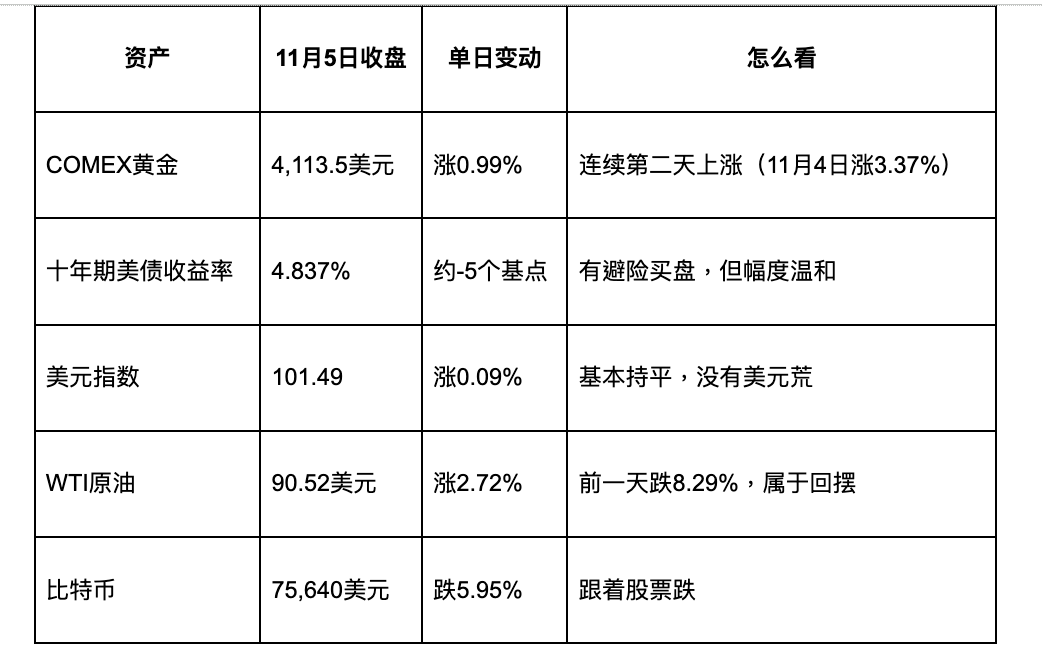
The after-hours market also began to recover. As of 8:40 Beijing time on November 6, Micron was up 5.1%, SanDisk up 4.8%, AMD up 4.4%, Nvidia up 2.0%, and Nasdaq 100 futures turned positive, up about 0.4%.
However, after-hours liquidity is lower, so moves are easily amplified. Whether the rebound can continue depends on the regular trading session on November 6: if the entire AI hardware chain recovers in sync, it looks more like a post-panic rebound; if Nvidia stabilizes while memory continues to weaken, it indicates capital is repricing within the supply chain; if after-hours gains quickly disappear, it indicates deleveraging is not yet over.
3. Who Held Up in the Selloff: Companies That Can Show Profits
On the same day, the market did not abandon all AI companies; rather, it rewarded businesses that can convert AI into profit.
AppLovin released its third-quarter report after the close on November 4: revenue of $2.185 billion, up 55% year over year; net profit of $1.439 billion, up 72% year over year, with a net margin of about 66%. On the same day the Philadelphia Semiconductor Index fell 12%, its stock price rose as much as about 31% intraday.
Cloudflare, meanwhile, was priced by two sets of logic in a single day. During the day it fell 8.03% with the AI infrastructure sector; after the close it released its third-quarter report, with revenue of $782.5 million, up 39% year over year with accelerating growth, and its stock price rebounded 15.1% after hours, not only recovering the day's decline but also closing above the previous day's close.
This contrast shows that capital is distinguishing between "companies that depend on others continuing to spend" and "companies that have already started making money."
4. Hong Kong Stocks and Pharma: Two Signals Whose Timing Must Be Distinguished
Hong Kong stocks: the rise on November 5 reflected the previous night's US stocks. By the time Hong Kong stocks closed on November 5, US trading for that day had not yet begun, so Hong Kong stocks' movement that day corresponded to the divergence in US stocks on November 4: platform stocks rose while compute hardware fell. The Hang Seng Index rose 3.67%, the Hang Seng Tech Index rose 5.55%, with NetEase, Xiaomi, Alibaba, and Tencent up 7% to 9%; Kingboard Laminates and YOFC fell more than 12%. Southbound funds recorded net selling of about HK$21.3 billion that day; an index rise does not equal a return of southbound funds.
The real reaction of Hong Kong stocks to this US stock plunge should be seen on November 6: whether platform stocks can hold their gains, and whether compute hardware continues to underperform.
Pharma: the policy repricing occurred on November 4, and there was no defensive performance on November 5. On the day the election results were announced, the S&P 500 healthcare sector rose 3.06%, and Moderna rose 13.11%, hitting a 52-week high. The market's rationale was that with Democrats controlling Congress, resistance to advancing Medicaid cuts increased. But on November 5, pharma fell with the broader market: Moderna dropped 6.55%, and the biotech ETF XBI fell 6.73%, comparable to the decline in the Nasdaq 100. Over the two days combined, Moderna was still up 5.70%.
The next validation point for pharma is the bill text around the expiration of temporary funding on December 11, including whether Medicare subsidies and Medicaid-related provisions are included. If the provisions fall short of expectations, the gains from November 4 may face a giveback.
5. What to Watch Next
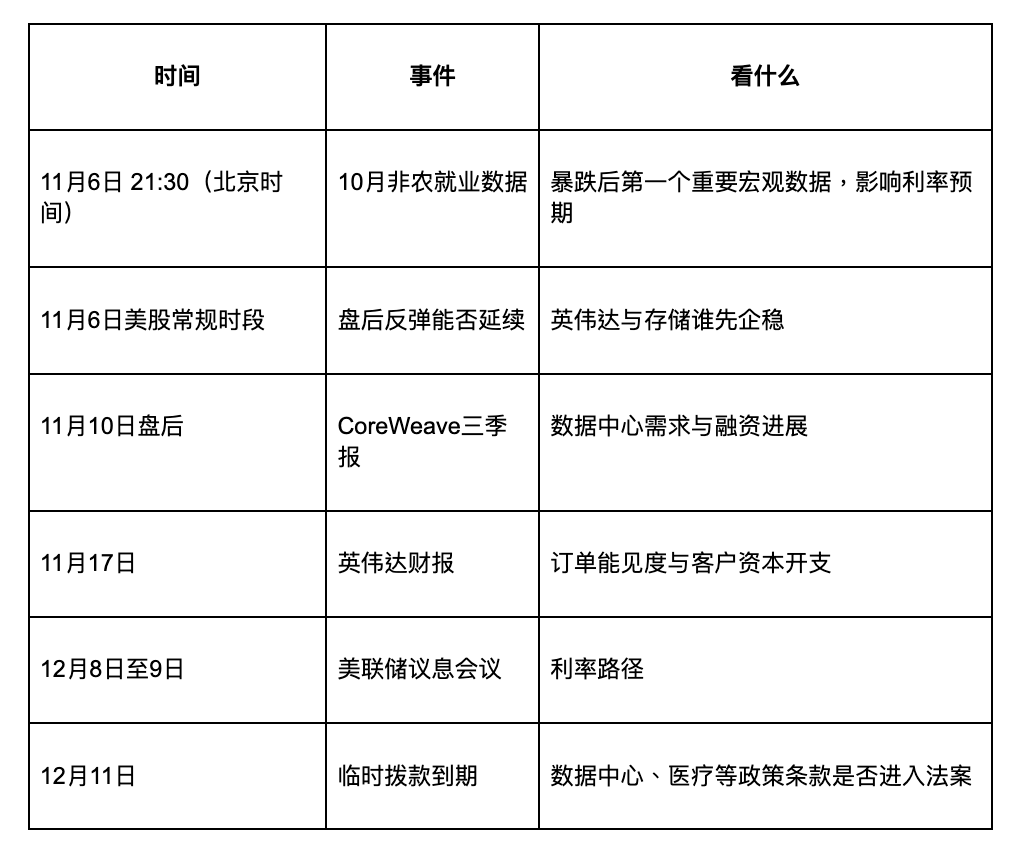
Whether this decline is a clearing out of crowded positioning or a turning point in the AI capital expenditure cycle, the answer lies in three places: whether restrictive provisions enter legislation or state policy, whether cloud providers cut capital expenditure, and who in the AI hardware chain stabilizes first. The near-term verifiable checkpoints are as follows:
Disclaimer:
This content is for general information and market commentary only, based on public materials compiled as of the time stated in the article, and relevant market data, expectations, and probabilities may change as market conditions evolve. The views and investment strategies of third-party institutions, analysts, or other persons cited in this article represent only the views of the relevant third parties at a specific time and do not represent BIT's views or recommendations. This article does not constitute investment advice, investment research, an offer, solicitation, or recommendation of any securities, investment products, or trading strategies, nor should it be used as the basis for any investment decision. Financial markets involve risk; securities prices and market performance may fluctuate, and historical performance and past market trends do not represent or guarantee future results. Investors should independently assess relevant risks based on their own circumstances and seek professional advice when needed. BIT's Hong Kong stock trading services are not provided to Hong Kong residents or users in other restricted jurisdictions.





