NOXA exits the stage, who will claim the crown of Robinhood Chain token issuance?


- Core Thesis: NOXA, the hottest token issuance platform on Robinhood Chain, suddenly ceased its core token issuance business due to ownership disputes and bot attacks. As a result, traffic has been diverted to platforms like Flap and Bankr, but a new leader has yet to emerge, and a high-market-cap representative Meme coin is still needed.
- Key Elements:
- At its peak, NOXA had issued approximately 60,000 tokens, accounting for over 75% of all new token issuances on the chain. It also produced the Meme coin CASHCAT with a market cap exceeding $200 million, generating cumulative protocol fees of over $14.5 million.
- On July 11, NOXA announced a suspension of new token issuances, citing bot-driven mass token creation and Vamp attacks. After relaunching, it retained only historical token trading and fee claiming functions, effectively exiting the competition.
- NOXA's lead developer, Amun Phantom, is anonymous. He has been involved in projects on new chains like Monad and MegaETH, specializing in quickly capturing first-mover traffic but lacking proven sustainable operations.
- Following NOXA's suspension, Robinhood Chain's token issuance volume hit new highs: over 31,000 Meme tokens were created on a single day (July 14). More than 20 launchpads are now vying for traffic.
- Flap has emerged as the biggest beneficiary: it sees over 11,000 token creations per day, accounting for more than 35% of daily issuance volume. However, it has yet to produce a representative token comparable to CASHCAT.
- Bankr focuses on AI Agent-based token issuance, is backed by Coinbase Ventures, and boasts relatively high product maturity. Klik attracts traders through fee rebates.
- The competition among token issuance platforms on Robinhood Chain is currently intense, but no platform has proven itself as the new traffic hub. To become the leader, a platform must first produce a Meme coin with a market cap of tens of millions or even hundreds of millions of dollars.
Original: Odaily (@OdailyChina)
Author: Asher (@Asher_ 0210)
NOXA, the hottest token launch platform on Robinhood Chain, suddenly announced the suspension of its token issuance business during peak traffic.
Over the past ten days, NOXA has almost dominated the Meme hype on Robinhood Chain. The platform issued approximately 60,000 tokens in total, once accounting for over 75% of all new token issuances on the chain. It also gave rise to CASHCAT, a Meme coin with a market cap peaking above $200 million. Additionally, NOXA's cumulative protocol fees exceeded $14.5 million, with daily fees for several consecutive days before the crash even surpassing those of Pump.fun.
However, this explosion lasted less than two weeks before NOXA exited the scene due to ownership disputes. Who can take over from NOXA and become the next leading token launch platform in the Robinhood Chain ecosystem?
From Temporary Suspension to No Resumption: What Exactly Happened to NOXA?
On July 11, NOXA officially announced a halt on new token issuances, citing a massive influx of bots mass-creating tokens, copying popular projects, and conducting Vamp attacks, leading to a severe overload of new tokens. The market widely believed this was just a temporary adjustment at the time.
Subsequently, the NOXA website experienced a two-day continuous outage. The official explanation was that traditional domain names were affected by Cloudflare and IP issues, with the team testing a new ENS-based entry point. Historical tokens could still be traded on Uniswap, and creators could continue to claim fees.
However, the page that relaunched last night painted a picture beyond a mere technical glitch. NOXA only restored a static portal for viewing historical tokens, conducting trades, and claiming creator fees, but the new token issuance function remained offline. Meanwhile, trading fees from historical tokens were adjusted to allocate 100% to creators. This signifies that while NOXA hasn't completely shut down, it has ceased its core token issuance business, effectively withdrawing from the competition for token launch platforms on Robinhood Chain.
The community has consequently begun using the term "rug pull" to describe NOXA. However, as of press time, there is no on-chain evidence suggesting NOXA has drained the already locked historical LP, transferred user custodial assets, or engaged in clear on-chain theft. More accurately, NOXA appears to have abruptly stopped its core business during peak traffic, rather than vanishing after siphoning off assets.
From a team background perspective, there were perhaps some signs of NOXA's sudden halt. Its publicly identified lead developer, Amun Phantom, operates anonymously and has previously participated in new chain projects like Monad, Plasma, and MegaETH, resembling a serial entrepreneur chasing new chain opportunities: adept at rapidly launching products and capturing first-mover traffic in early-stage ecosystems, but whether sustainable operations can be maintained after the hype fades remains unproven.
NOXA Falls, but Robinhood Chain Token Issuance Hits New Highs
Following NOXA's suspension, the frenzy of token issuance on Robinhood Chain has not cooled down.
Dune data shows that while chain-wide token issuance briefly dipped on July 12, it rebounded sharply just one day later: 19,586 Meme tokens were created on a single day on July 13, second only to Solana; on July 14, the number further broke through 31,000, setting a new high since the mainnet launch of Robinhood Chain.
New token issuance on Robinhood Chain has rapidly been diverted to other token launch platforms. Currently, over 20 Launchpads have emerged on Robinhood Chain. Platforms issuing over 1,000 tokens daily include Flap, trench.today, Bankr, and Klik. Meanwhile, products like Virtuals, Clanker, and Bankr, originally active on Base, have also entered Robinhood Chain through cross-chain deployment or external entry points.
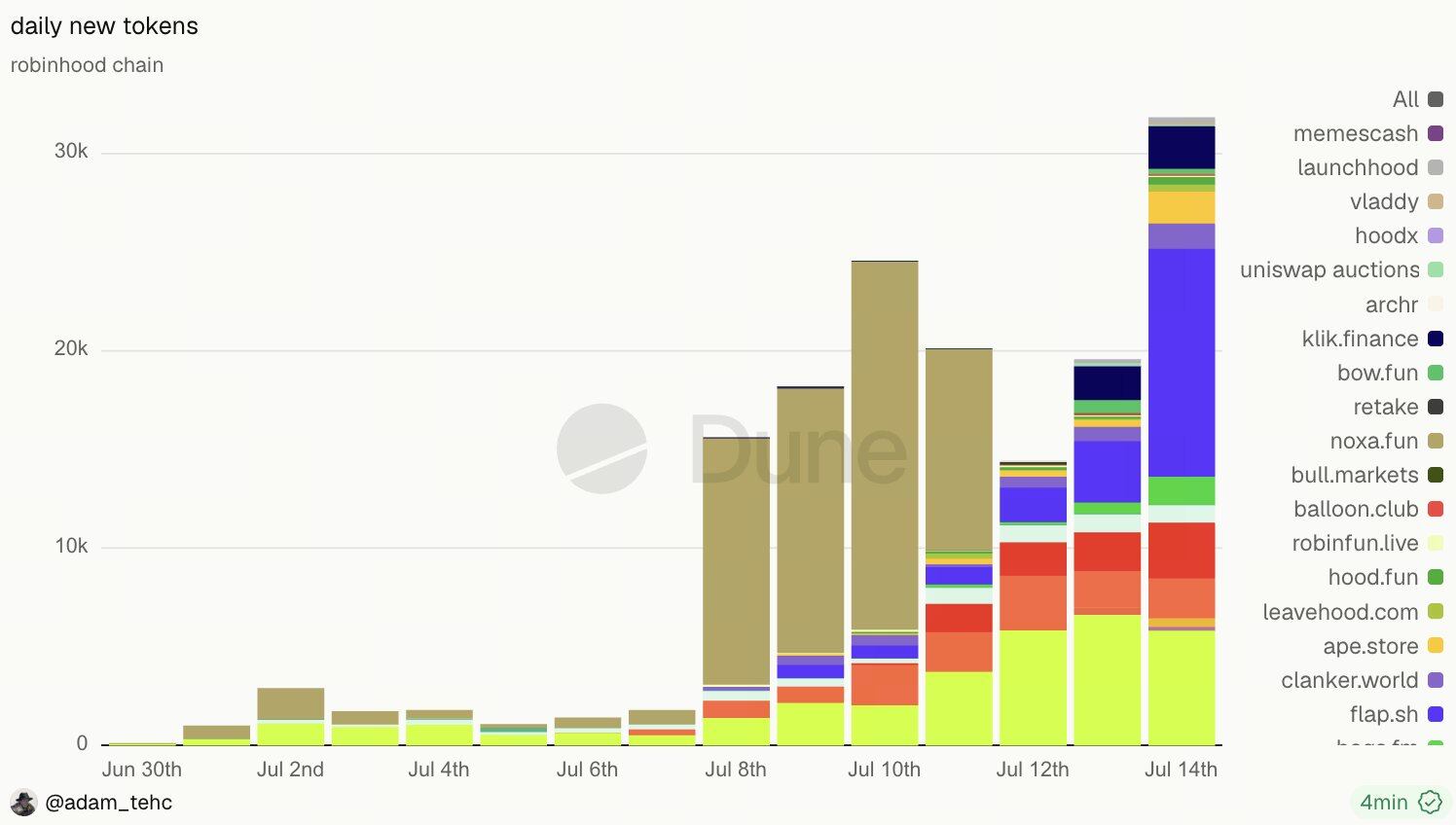
Daily Token Issuance on Robinhood Chain
Flap Becomes the Biggest Beneficiary
After NOXA stopped issuing tokens, Flap was the first to capture this wave of traffic. Flap created over 11,000 tokens in a single day, accounting for more than 35% of Robinhood Chain's total daily issuance, making it the platform with the highest token issuance volume on Robinhood Chain currently.
Flap is not a newly established platform created after NOXA's crash. Previously, Flap had deployed token issuance services on EVM networks like BNB Chain and Base, supporting models such as regular tokens, Tax Tokens, and creator fee distributions. It was also selected for the YZi Labs EASY Residency Season 3.
Although Flap's performance on BNB Chain and Base wasn't particularly outstanding, this multi-chain accumulation enabled it to deploy quickly on Robinhood Chain once the hype picked up. Compared to native token launch platforms starting from scratch, Flap didn't need to rebuild products and contracts. By simply connecting a trading terminal and opening the issuance portal, it could rapidly absorb the massive token issuance demand left by NOXA.
However, Flap currently captures mainly the quantity of issuances, and the platform has yet to produce a representative token that can rival CASHCAT.
Bankr: The Newcomer with the Strongest Team Background
Bankr is not a traditional web-based token launch platform but a token issuance gateway centered around an AI Agent. Users can create tokens directly through Bankr Agent, X, Telegram, or the Console, with Doppler and Uniswap V4 handling the issuance and liquidity deployment. Currently, Robinhood Chain has become a primary issuance network supported by Bankr, alongside Base.
Bankr's biggest advantage lies in its team and resources. Coinbase Ventures has previously supported Bankr through the Base Ecosystem Fund. In contrast to many platforms with anonymous teams and freshly launched products, Bankr boasts greater maturity in terms of product development, funding background, and external channels.
In terms of token issuance volume, Bankr currently struggles to compete with Flap, which offers open APIs and accommodates high-volume batch issuance. However, through AI Agents, social platforms, and developer tools, Bankr has established multiple issuance gateways, making it more likely to attract genuine creators and project teams. Rather than solely focusing on issuance volume, whether Bankr can leverage its distribution capabilities to launch higher-quality tokens with longer lifecycles is a more noteworthy point.
Klik Competes for Traders with Fee Rebates
Klik is also not a new token launch platform on Robinhood Chain. Its official documentation shows that Klik supports Ethereum, Base, and Robinhood Chain. Tokens issued on Klik gain immediate Uniswap V4 liquidity and follow a dynamic fee model that decreases as market cap grows.
Upon entering Robinhood Chain, Klik officially announced that it would return all platform fees to traders, aiming to attract early users and trading volume.
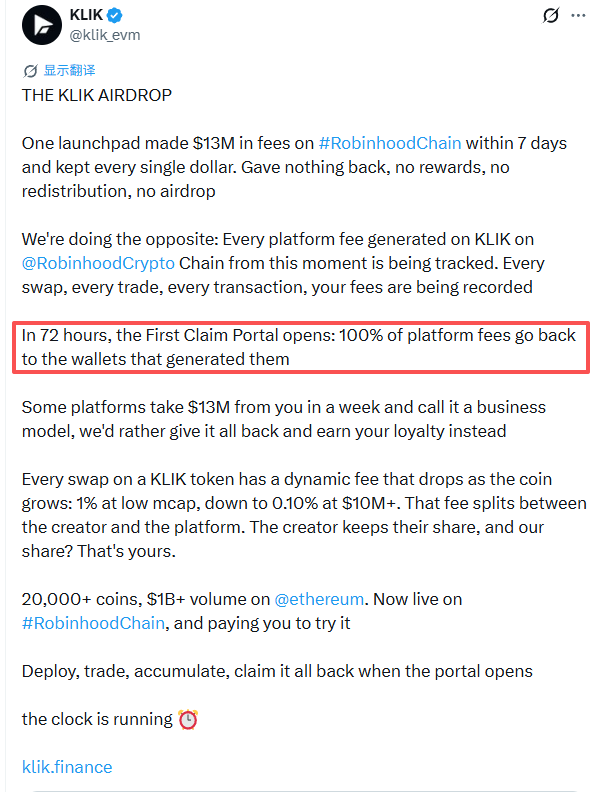
Klik's fee rebates can attract bots and high-frequency traders in the short term. However, whether this subsidized traffic can be converted into long-term users remains to be seen until it produces a truly distinctive flagship token.
trench.today Enters the Top Tier, but Platform Transparency is Lacking
On July 14, trench.today created 2,830 tokens in a single day, placing its issuance volume among the top token launch platforms on Robinhood Chain. The platform uses a Bonding Curve model and emphasizes creator fee sharing. Having previously operated on Ethereum, it quickly expanded its issuance functions to Robinhood Chain.
Based on data, trench.today has successfully absorbed the spillover demand following NOXA's suspension and entered the first tier of current issuance volume. However, trench.today's shortcomings are equally evident. Publicly verifiable team background, fundraising status, and historical operational data remain limited, and the platform has yet to produce a representative token with sufficient recognition.
A Chaotic Battle of Token Launch Platforms: The Next Leader Has Yet to Emerge
Robinhood Chain is an open network where any developer can deploy contracts and create tokens. Having "Robin," "Hood," or "Vlad" in the name, being listed on trading terminals, or even receiving a like or retweet from someone associated with Robinhood is insufficient proof of official Robinhood review, investment, or endorsement.
NOXA's rapid rise and fall also demonstrate that the biggest moat for a token launch platform has never been code. The token issuance page can be replicated in a day, issuance contracts can be deployed across chains, and bots can switch entry points at any time. Therefore, creating thousands or even tens of thousands of tokens in a single day only indicates that a platform has temporarily absorbed issuance demand, not that it has become a new traffic center.
What truly positioned NOXA as the leading token launch platform on Robinhood Chain wasn't just its issuance volume, but the fact that it produced CASHCAT. A Meme coin with a market cap that once exceeded $200 million brought sustained trading volume, user attention, and wealth effects to NOXA, actively attracting more token issuers and traders to the platform.
Therefore, to become the next leading token launch platform on Robinhood Chain, one must first produce a representative Meme coin with a market cap of tens or even hundreds of millions of dollars. Until then, Robinhood Chain remains a chaotic battlefield with numerous entry points but no clear leader.