






Cancun upgrade ushers in the era of fee reduction. How to fully explore the Ethereum and L2 ecosystem through the OKX Web3 wallet?


Original author: 0x ming
On March 13, according to OKLink data, Ethereum officially activated the Dencun upgrade at block height 269568, entering the Layer 2 low-fee era. After cost reduction and efficiency improvement, can Ethereum return as the king?
Ethereum was officially launched on July 30, 2015, ushering in a new era of smart contracts. Due to the prosperity and development of on-chain applications such as DeFi and NFT Summer, it is also due to the low Gas competition of high-performance public chains such as Solana and the popularity of Bitcoin. The ecological siphon effect is a little lonely. Although Ethereum tried to turn around the situation through version 2.0, due to the long and complicated technical iteration process, platform performance was always unsatisfactory in the short term, and high gas fees became one of the key reasons for user transfer. The huge pressure of Ethereum congestion directly promotes L2’s grand narrative. Vitalik Buterin started supporting various scalability solutions. He profoundly wrote in the article, Without the development of Layer 2 and Rollup, Ethereum will fail due to high transaction costs. How to solve the expensive and blocked performance problem has become the core theme of Ethereums current development. According to OKLink data, L2 ecological TVL continues to rise, and the total L2 ecological TVL has reached 38.31 B US dollars.
Mainstream L2 solutions such as Arbitrum and Optimism all share the security of Ethereum. Although the calculation is moved off-chain, the data will be processed by Ethereum nodes and permanently stored on the expensive chain. These costs are ultimately transferred to the users. Therefore, L2 relieves Ethereum transaction pressure and reduces Gas to a certain extent, but compared to Web2 users who have adapted to free use, L2 has an effect, but its effect is limited.
The success of the Cancun upgrade has officially opened the era of L2 fee reduction, which will re-inject new vitality into the L2 ecosystem and Ethereum. On March 15, according to OKLink data, after the Cancun upgrade, the handling fees of L2 networks such as Starknet and OP dropped by more than 90%, and their active addresses, TPS, etc. were significantly improved. As the industrys leading one-stop Web3 portal, OKX Web3 wallet now fully supports Ethereum and L2 ecology, providing an important foundation for users to better explore the world on the chain.
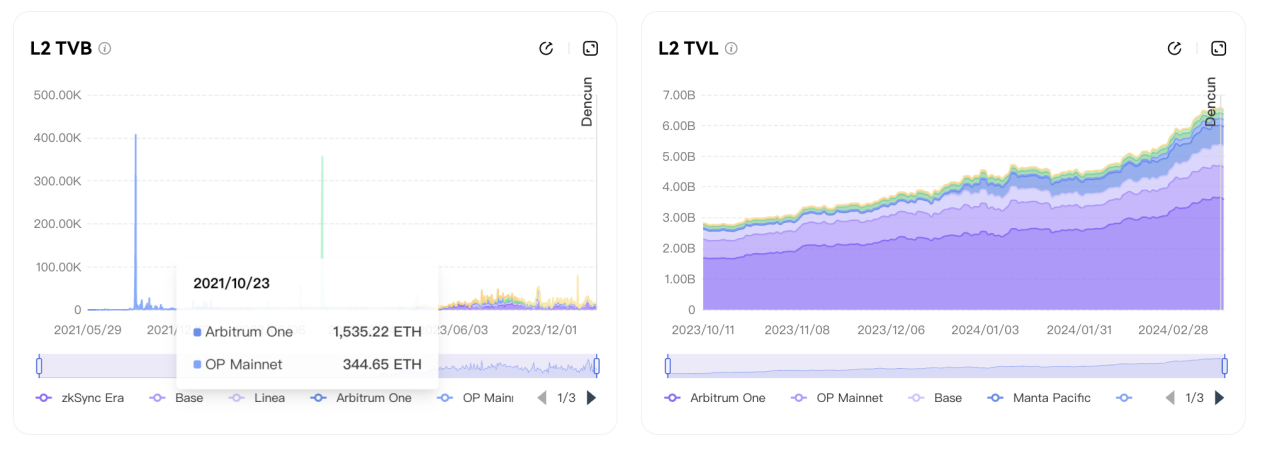
Data source: OKLink
Learn about Cancun Upgrade
Dencun upgrade is the abbreviation for the two upgrades of Ethereum execution client Cancun and consensus client Deneb. The community is accustomed to using Cancun upgrade to refer to Dencun upgrade. The core purpose is to optimize the users Ethereum staking experience while achieving L2 cost reduction and efficiency improvement. . The Cancun upgrade includes a total of 9 Ethereum improvement proposals EIP including EIP-1153, EIP-4788, EIP-4844, EIP-5656, EIP-6780, EIP-7044, EIP-7045, EIP-7514 and EIP-7516. , the most core of which is the EIP-4844 proposal, namely Proto-Danksharding.
The EIP-4844 proposal is the basis for the full version of sharding expansion Danksharding. It introduces a new data storage structure Blob to Ethereum, which will be specially used to store transaction data submitted by L2 to Ethereum. It will no longer need to compete for the storage space of Calldata. Make user transaction fees cheaper and the transaction experience more efficient.
In the context of the contradiction between the prosperity of Ethereum and high gas, competing for limited block resources has caused it to become inefficient, congested, and expensive, and has been criticized by the market. Previously, all transactions of Ethereum L2 were stored in Ethereums Calldata, but Calldata has limited space and the data it stores will be processed by Ethereum nodes and permanently stored on the chain. It is reported that 80% of the transaction costs and gas of the L2 network come from Calldata data storage costs. Blob significantly reduces L2 data storage costs and achieves higher transaction throughput by creating additional temporary data storage space on Ethereum.
According to OKLink data, current mainstream L2s such as Arbitrum, Optimism, Starknet, and Base have integrated EIP-4844, and their network gas has been reduced by more than 90%. For more data, please click on the link: https://www.oklink.com/cn/eth/dencun-upgrade
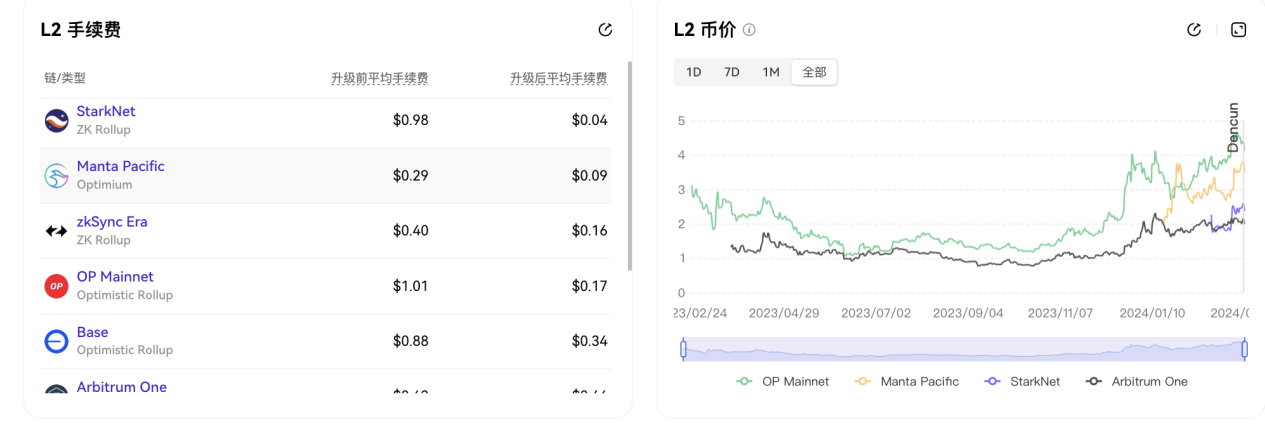
Data source: OKLink
However, it is worth noting that Blob data storage is temporary and is available for 4,096 Epochs, or approximately 18 days. What Ethereum needs to ensure is real-time data availability rather than data retrieval. The value and significance of permanently storing transaction data is not high. Blob clearing data regularly can save storage space, which overall helps Ethereum maintain its core competitiveness. The public chain track maintains or even captures more market share.
However, some of the data discarded by the blob still has potential value, such as preventing nodes from doing evil, rug the public chain operator, and helping to establish an escape hatch mechanism or forced withdrawal mechanism. For this reason, OKLink will be responsible for safely storing all blob data. , ensure the security and retrieval of historical data to support the healthy development of the Ethereum ecosystem, and can provide services to individuals and public chain teams who have needs for Blob data at any time.
In addition, EIP-4844 will introduce a new fee market for Blobs, which will be more conducive to maintaining better prices. The introduction of the data storage structure Blob will help Ethereum L2 significantly reduce costs on the existing basis. For example, zkSync is the first L2 to use Blob, and its sorter cost is reduced by about 88%. The actual gas fee of Starknet is as low as 0.01 US dollars, etc., but The actual situation depends on various factors of L2 itself. In addition, it will help speed up L2 transactions by 10 times or even 100 times. Of course, in addition to EIP-4844, this upgrade also includes EIP-1153, EIP-6780, etc. In short, the Cancun upgrade can encourage more trading activities and support the ecological development of L2 and Ethereum in the long term.
How to fully explore Ethereum and L2 ecosystem through OKX Web3 wallet?
After the Cancun upgrade, users can use very low-cost GAS to conduct on-chain transactions. As the industry-leading one-stop Web3 entrance, OKX Web3 wallet now fully supports Ethereum and L2 ecology, providing users with better exploration of the world on the chain. important foundation.
Currently, OKX Web3 provides complete Ethereum and Ethereum second-layer ecological support, and has taken the lead in connecting to mainstream L2 networks such as Blast, Optimism, Arbitrum, Starknet, zkSync Era, Manta Pacific, etc. Users do not need to manually configure and can switch to these with one click. The network conducts corresponding currency management.
In order to improve capital efficiency, users can interact with the Ethereum re-pledge protocol through the OKX DeFi section. The concept of re-pledge was first proposed by Eigenlayer, which allows users to pledge the ETH pledged on the Ethereum main network again through Eigenlayer on other consensus on the agreement. Not only can these protocols share Ethereum security, but users can also receive additional rewards. The Re-Staking Earn Token Activity launched by OKX Web3 DeFi has now been integrated into various types of re-staking protocols to provide users with additional points or token rewards. By “re-staking ETH”, “liquidity staking” or “liquidity re-staking”, users can receive additional rewards. For example, participating in Kelp will get an extra 30% points bonus, participating in Renzo will get an extra 10% point bonus, and up to 20% interest rate increase bonus, etc. Click the link to participate immediately: https://www.okx.com/cn/ web3/defi/activity/8
Users can exchange Ethereum and L2 assets and cross-chain through OKX DEX, enjoy the best liquidity on the chain, the best price, and 0 transaction service fees, and easily trade any assets. Currently OKX DEX supports multiple Ethernet layer 2 networks, such as Avalanche C, Arbitrum, Optimism, zkSync Era, Polygon zkEVM, Linea, Base, Mantle, Starknet, Scroll, etc. OKX DEX is a powerful DEX and cross-chain aggregator. It has now aggregated more than 20 cross-chains, more than 20 public chains, more than 400 DEXs, etc., and also has functions such as DEX market section, limit orders, KYT security detection, etc. An intent transaction mode has also been added to help users enjoy a GAS-free transaction experience.
In order to help users lower the threshold for entering Web3 and reduce search costs, they can also use fragmented time to interact accurately. Cryptopedia has launched ecological interactive tasks such as zkSync Era and other L2s. By aggregating and selecting high-quality DApps and setting up interactive tasks, it helps users experience the smooth on-chain world and obtain multiple rewards. For example, users can experience the selected zkSync Era ecological DApp through OKX Cryptopedia, and can better explore the L2 ecosystem and obtain rewards. OKX Cryptopedia is a one-stop DApp exploration and reward interactive platform. The platform will regularly launch activities themed on different blockchain networks, and work with corresponding partners to jointly set up DApp interactive tasks.
OKX Discover is the first to launch Layer 2 ecological exploration to support the Ethereum Cancun upgrade as soon as possible, helping users quickly and safely participate in the Ethereum and L2 ecosystem. In addition, in order to more extensively explore the Ethereum and L2 ecology, as well as discover and interact with popular DApps, users can discover and jump to popular DApps through the OKX Discover section, making it easier and more convenient to explore the world on the chain. For example, OKX Discove has added multiple hotspot areas such as re-staking, Solana ecology, inscription, Bitcoin ecology, essential tools, and popular chain games to provide users with the latest and most popular on-chain dynamics.
In addition, users can view Layer 2 network-related data anytime and anywhere through the OKX browser or the Dencun upgrade special page launched by OKLink, including the most intuitive data, the reduction of currency prices and handling fees; possible changes caused by changes in handling fees and TPS The development caused by it, TVL, TVB, number of active addresses; and the changes brought by the upgrade to Ethereum data, etc. In addition, you can also view ETH’s complete development history, upgrade review, and more.
OKX Web3 Wallet supports Ethereum and L2 ecology through various sectors, helping users to explore the world on the chain simply, safely and efficiently, becoming an indispensable Web3 tool for users.
Cancun upgrade breathes life into Ethereum and L2
Ethereum has opened up a differentiated path from Bitcoin’s peer-to-peer electronic cash system. As the worlds largest open source platform, Ethereum introduces smart contracts into the blockchain world for the first time, leading the development direction of the encryption industry and laying the foundation for a decentralized future. Ethereum not only creates a cryptocurrency, but also a new type of financial infrastructure that provides people with a more free, secure and open trading environment and promotes innovation and progress in the entire industry.
As L1 with the largest developer community, the legitimacy of Ethereum still cannot be replaced. Although it is embattled from all sides due to its congested and expensive performance and fierce competition on the public chain track, with various expansions such as L2 and Rollup The innovation of the plan will surely shoulder the huge transaction pressure of the main network and win time and space for the arrival of Ethereum 2.0.
Throughout the iteration process, OKX Web3 wallet, on the one hand, assists the construction of the Ethereum community by supporting Ethereum and L2 ecology, and on the other hand, it brings huge amounts of liquidity to Ethereum and L2 ecology by connecting users, becoming the first choice for Ethereum and L2 ecology. important builder. OKX Web3 wallet now fully supports Ethereum and L2 ecology. With good technology accumulation and continuous innovation, it greatly lowers the threshold for user participation by providing the most advanced market tools, helping them to play the world on the chain in one stop.
Despite its slow pace, Ethereum, a huge creative machine, has never stopped. From borders, homes, metropolises to tranquility, after several upgrades and numerous EIP proposals, every step is closer to becoming a scalable, decentralized The vision of a centralized and globally accessible settlement layer is getting closer. In addition, as the market shifts its focus from Bitcoin spot ETF to Ethereum spot ETF, it will also bring more attention and vitality to Ethereum.





