






FDV「超标」的 WLD一直涨,FDV还有参考价值吗?


Original author: Kaori, BlockBeats
Original editor: Jack, BlockBeats
WLD rose from $2 to $9 in a week, causing a commotion both inside and outside the AI sector. However, there is disagreement in the crypto market regarding WLD's FDV.
FDV (Fully Diluted Valuation) refers to the fully diluted value of a token, which corresponds to the market cap obtained by multiplying the current token price by the current token circulation. FDV is an indicator obtained by multiplying the current token price by the total token supply.
This is a familiar term for Degen, but if you have just heard of it, don't worry. This article will use WLD as an example to explain the significance of FDV, whether we should still use FDV as a reference indicator for speculative trading in the new cycle, and what new perspectives on the market are reflected by FDV.
Does WLD's FDV have reference value?
WLD's current circulating supply is approximately 130 million, with a market cap of $1.1 billion at the time of writing, ranking 76th. However, its total supply is 10 billion tokens, resulting in an FDV of $85.6 billion. It has surpassed leading public chains such as SOL and BNB, and even the market cap of the world's leading AI concept, OpenAI.
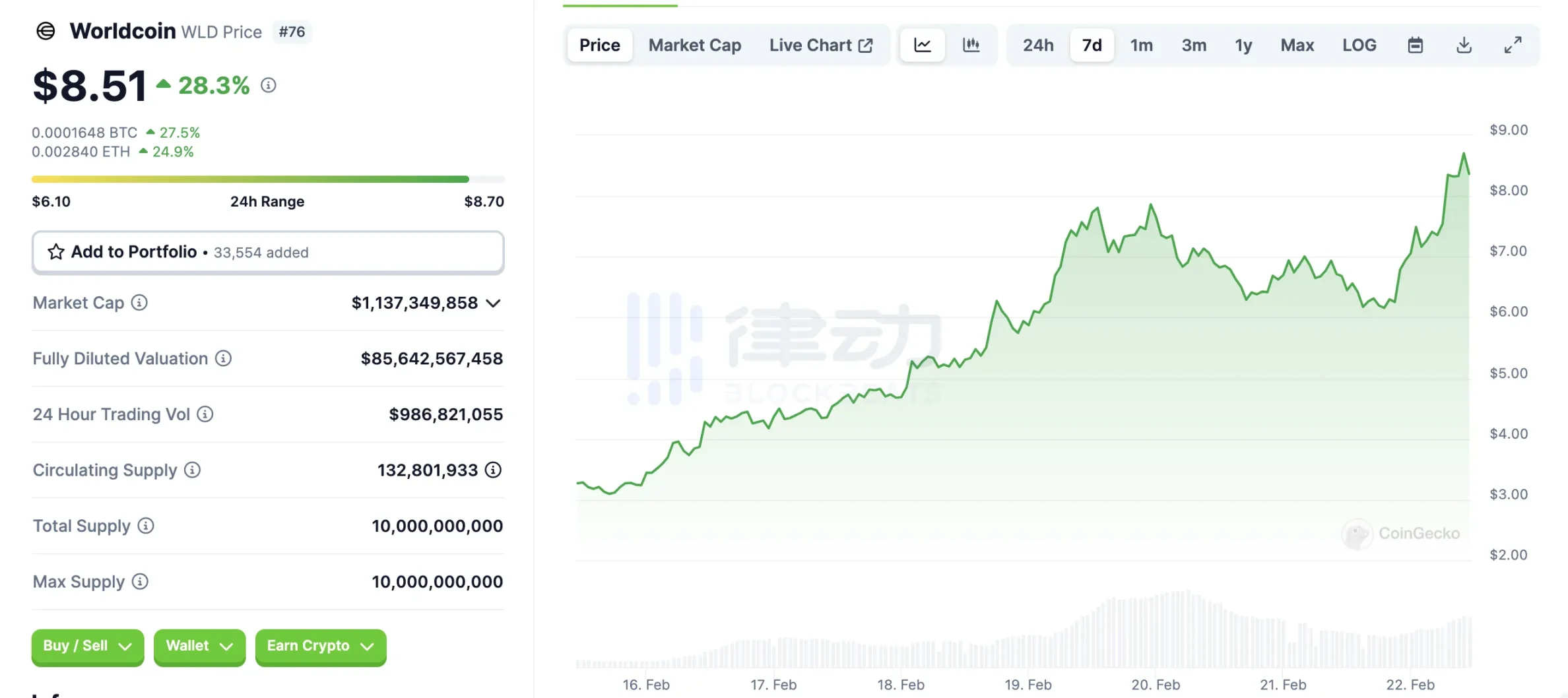
Market disagreement arises here. Some believe that WLD's FDV is ridiculously high and unsustainable. It is merely a bubble riding on the AI hype. On the other hand, some believe that WLD's circulation supply is unreasonably low and it depends on how market makers are willing to push it. FDV is just a bluff.
The Worldcoin whitepaper shows that the maximum circulating supply of WLD at launch was 143 million, with 100 million WLD loaned to market makers outside the United States, and 43 million WLD allocated to users who passed the Orb verification during the testing phase. Since the official launch of the World App, a single user can receive a total of 77 WLD allowances. However, WorldCoin faces significant regulatory pressure in France, Hong Kong, and other places, and devices and sites for offline iris scanning have been restricted, making it impossible for many users to withdraw their tokens.
On the other hand, 5 WLD market makers returned 25 million WLD at the end of October last year. The remaining 75 million WLD were returned to the Worldcoin team on December 15th. Subsequently, Worldcoin announced that it had reached a new loan agreement with these 5 market makers, which will take effect on December 16, 2023. The total amount of this loan is 10 million WLD, with a term of 6 months.
Therefore, the current market's WLD circulating tokens include only two parts. One is the portion of tokens in the hands of users who have received daily allowances through the APP and have already withdrawn them. The other is the 10 million tokens in the hands of market makers. This circulating supply accounts for only 1.33% of the total supply of WLD. In addition, WLD's unlocking period is 150 days later. Therefore, in the short term, WLD's FDV is not indicative, and the claim of surpassing OpenAI's market value is more like an AI meme.
What should we focus on instead of FDV?
Why should we pay attention to FDV when trading tokens?
For those who need to hold a certain coin for a long term, such as institutions or conservative investors, they need to manage their investments or positions through FDV. At this time, FDV combined with market value is an effective indicator for monitoring the prospects of tokens, allowing investors to better judge whether a project's value deviates significantly from the norm. But for ordinary retail investors, when engaging in short-term trading, they should mainly consider the supply and demand relationship of tokens, as well as narratives and emotions. And if you want to pay attention to FDV, you also need to consider the token's issuance schedule.
FDV has become less important, which actually reflects some changes in the crypto industry, and it is these changes that require us to focus on things beyond FDV.
Supply and Demand Relationship
First of all, there are more and more people in the entire crypto industry. In the past, there were only ICOs and retail investors, but now there are more and more buyers, and more stakeholders are involved. A major project involves multiple rounds of financing, token sales, airdrops, market makers, CEX, and many other factors that affect the supply and demand relationship of tokens. In the context of such industry development, the FDV reflected by the total token supply does not hold reference value for a certain period of time.
With increasing demand, the total token supply is also growing. The linear unlock time period is getting longer. From a positive perspective, projects hope that new participants can still buy their own tokens. It is a manifestation of a certain long-termism. And if you want to reduce the impact of FDV on token prices, project teams also need to continue to deepen their understanding of unlock timing and create demand.
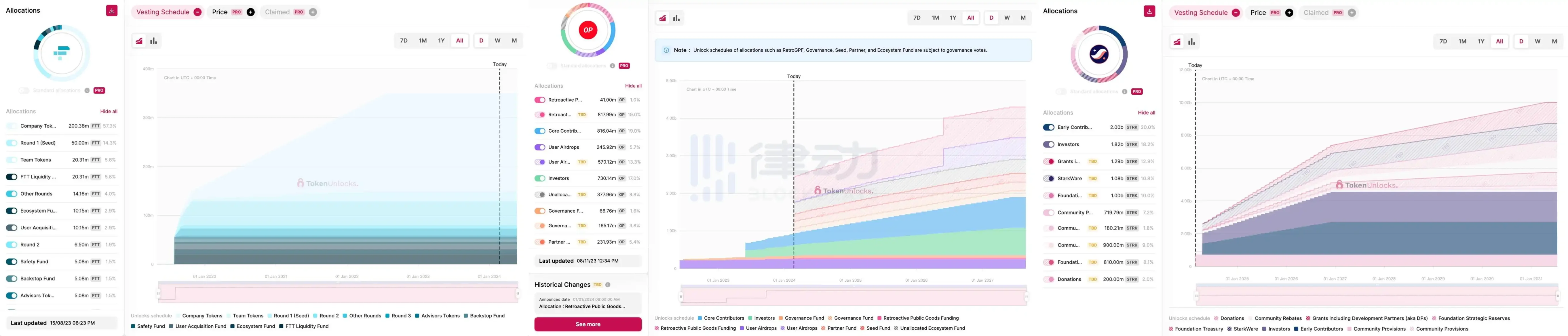
Left: FTT Unlocking Timeline; Middle: OP Unlocking Timeline; Right: STRK Unlocking Timeline (not updated to the latest version)
The impact of unlocking the timeline on the coin price can be illustrated by the recent airdrop completion of the Starknet project. StarkWare announced an adjustment to the unlocking plan for its early contributors and investors, reducing the release of STRK tokens from 1.3 billion tokens on April 15th to only 64 million tokens, which will be gradually released. After this announcement, the price of STRK surged by 14% to over $2. At this point, the FDV of STRK remains high, but the market reaction shows that it has digested this positive news.
STRK 24-hour price trend
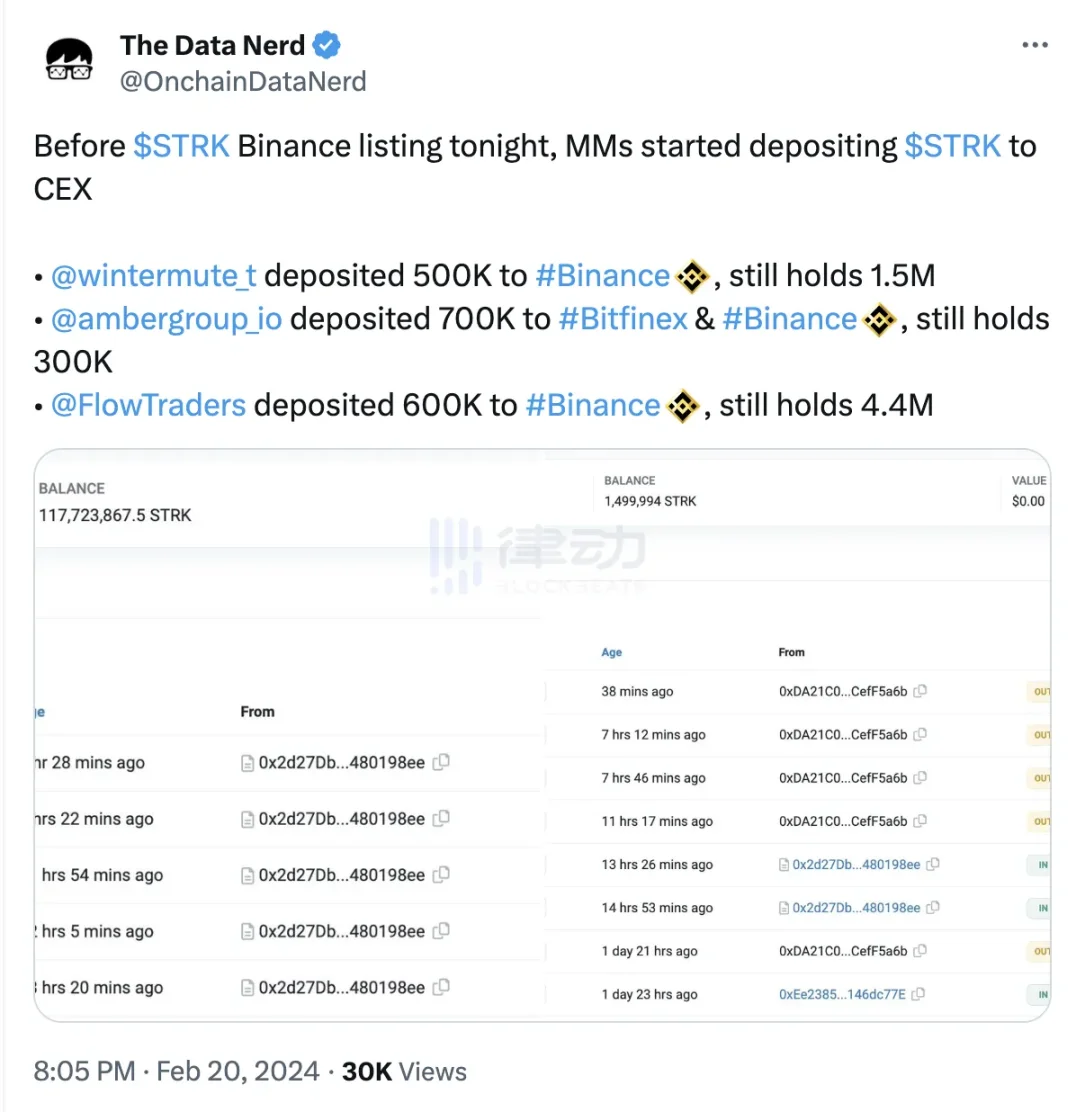
When STRK is listed, we can get a glimpse of the short-term price impact of supply and demand on a major project token. Why did Starknet's listing on Binance cause a surge to $7 and create a cult following? Because at the time, the on-chain airdrop was stuck, preventing large holders from selling, while major market makers deposited tokens into CEX, resulting in relatively high short-term demand and limited supply. As for the long-term supply and demand relationship, the project team needs to balance the interests of all parties. However, the FDV is no longer the crucial factor considered by longer-term projects with longer unlock timelines.
Let's take WLD as another example. As mentioned earlier, the circulating supply of WLD in the market accounts for only 1.3% of the total supply, and market makers hold 1% of it. From the perspective of price manipulation, the FDV of WLD at this point has no reference value because there are very few orbs that determine the release of WLD and very few people who can actually withdraw from the app.
Short-term trading: Emotions are king
In addition to supply and demand, the upward logic of WLD also needs to consider the power of narrative. A week ago, OpenAI launched the Sora model for generating lifelike videos, and WorldCoin, being an AI project associated with Sam Altman, benefited from the current AI enthusiasm. Despite a slight decline yesterday, the price of WLD remains within the $8 range due to NVIDIA's revenue growth in its latest financial report.
Arthur Hayes once said, "I would rather invest in tokens with a perceived success rate of 0.01% and a viral growth narrative than tokens with a perceived success rate of 50% but a common sense narrative. If the success rate increases from 0.01% to 1%, because this narrative quickly infects many people, my money will increase 100 times."
When the strong dealer encountered the fiery AI industry, the logic behind the rise of WLD is actually easy to understand. On the contrary, those who are now talking about FDV remind people of the somewhat humorous phrase, "Say FDV during FUD and shout MC when giving orders."
Real Money
The market is good because of sufficient liquidity. The February market of BTC can be verified through the inflow and outflow of ETF funds. On February 14th, CoinShares Research Director James Butterfill stated that the net inflow of Bitcoin spot ETFs has exceeded $4 billion since its launch. A week later, the cumulative net inflow of Bitcoin spot ETFs exceeded $5 billion, reaching $5.52 billion.
Yesterday, according to BitMEX Research data, on February 21st, all US Bitcoin spot ETFs had a net outflow of $35.7 million, the first net outflow since January 25th (accumulated for 17 trading days).
Due to the popularity of re-collateralization, a large part of ETH has been invested in hot projects in this track. From the lock-up collateral of Blast to the rise of LRT driven by Pendle's rally, and the continuous attraction of top projects like EigenLayer, the circulation of ETH decreased during this period, which is also reflected in the price level.
We cannot accurately predict the price performance of token markets, but we can pay attention to money, which provides more timely feedback on market conditions than the ratio of market value to FDV.
Does FDV still have value?
This market is becoming more and more professional, and its price discovery ability is becoming stronger. Does FDV still have value? At least in some large leading projects, we can still see the influence of FDV on pricing.
For example, the two leading Layer 2 projects, OP Mainnet and Arbitrum, with OP's price basically staying at twice that of ARB. The price difference between the two is because OP's FDV used to be half of ARB's, even though OP has a circulation supply of only about 300 million coins less than ARB.
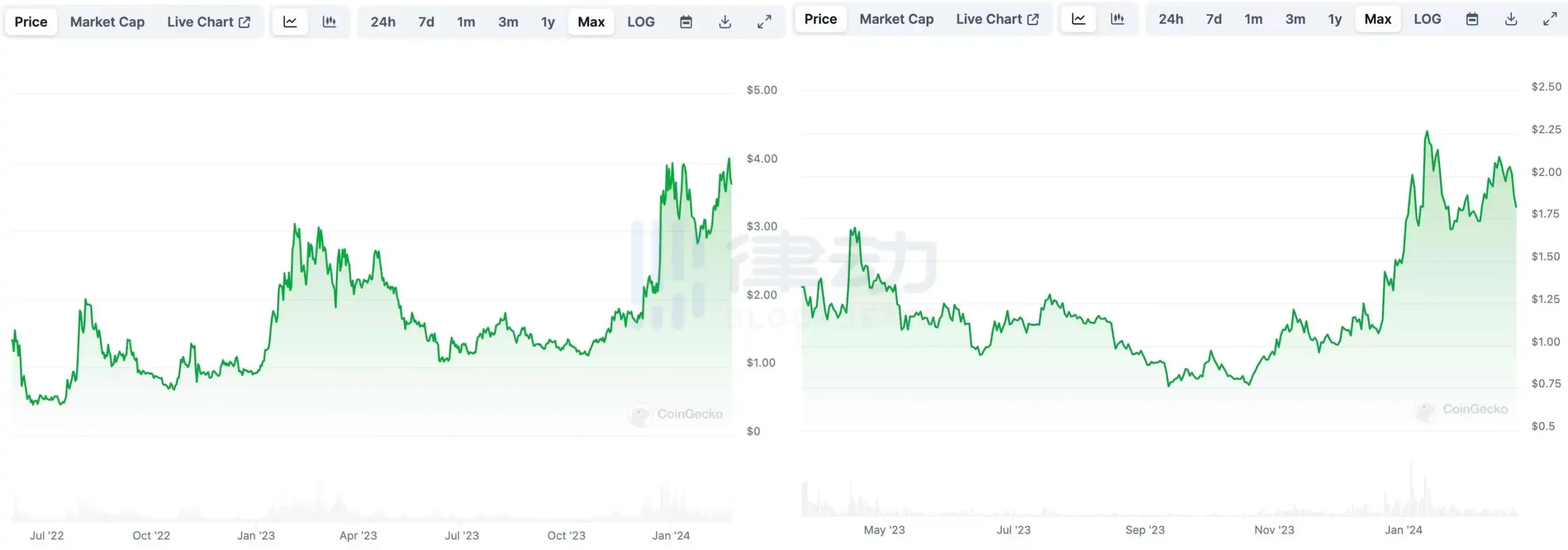
The left image shows the price trend of OP, and the right image shows ARB.
OP Stack's widespread adoption has laid a solid foundation for the demand for OP, but the marathon competition between Layer 2 solutions is far from over as Arbitrum Orbit continues to improve its technology stack and decentralized governance. With intensified competition, if the future demand for ARB exceeds that of OP, even if ARB's FDV is still higher than OP, the price of ARB will also surpass OP.
From this perspective, market logic and standards are also changing, and the substantial difference between ARB and OP can be seen as an indicator of the success or failure of FDV theory. If ARB's market value gradually exceeds that of OP in the future, investors who adhere to the supremacy of FDV may need to rethink market logic. However, regardless of the circumstances, focusing on a single indicator in the cryptocurrency market will not lead to progress.





