Syncus, the zkSync ecological stablecoin protocol, will launch a new paradigm DeFi lending platform


On December 19, the zkSync ecological project Syncus announced that it will soon launch a new paradigm of DeFi lending platform. After users pledge $SYNC, they can borrow USDC or ETH at a rate of 85% to regain liquidity.
Syncus (https://twitter.com/Syncus_Fi) is a decentralized stablecoin ecological protocol that distributes transaction tax revenue to staking users. It aims to repair and improve the sustainability issues of Olumpus and build a stable currency through positive incentives. self-growing treasury system,
Different from the traditional lending model of MakerDAO, AAVE and other platforms that pledge mainstream currencies to borrow stablecoins, Syncus realizes that you can obtain liquidity by pledging its DAO governance token $SYNC. This is because Syncus adopts a similar method to Olympus (OHM) ( 3, 3) Growth flywheel model, the economic model mechanism will drive its governance token $SYNC to grow in a positive spiral upward.
If the user chooses to sell directly without pledging, he will need to pay 15% tax to the Treasury and can only obtain 85% of the liquidity; if the user participates in pledge lending, only if the price of $SYNC falls below the amount of the loaned asset, the collateral will be Liquidation is the same as the liquidity obtained by selling; Syncus tends to let users give priority to staking. More and more users choose to pledge. The treasury fund pool is also getting larger and larger, and APY income increases accordingly, which will drive users to further pledge. , thereby stimulating the growth of $SYNC value, and if the user chooses to sell, a 15% tax will be charged, which also limits the users willingness to exit to a certain extent.
Therefore, this operating mechanism will eventually produce a growth flywheel: high yields - more demand - more transaction volume - treasury growth - higher yields - and repeat.
In contrast, Olympus uses a bond design, which means that as OHM tokens grow, users will always receive discounted tokens, which is equivalent to a discount sale. This mechanism relies too much on the continued growth of OHM tokens. Only when the price of OHM increases will users have the incentive to buy discounted futures bonds. But the problem is that if the price of OHM increases to a certain level, someone will always be able to obtain discounted tokens, which will undoubtedly allow the token value to be violently extracted by a third party.
Syncus recognized the potential risks of the Bonds bond mechanism, removed the bond discount sales mechanism, and instead adopted a more robust and sustainable mechanism of two-way tax collection + continuous dividends from the treasury.
Coupled with the pledge of $SYNC on the Syncsu lending platform, you can obtain 85% of the liquidity of the mainstream token model. Users will have no pressure to choose to pledge their Tokens, thus greatly reducing the token selling pressure and providing opportunities for its growth. Sustained momentum. Compared with Syncus discounted bond sales model, the discounted cash-out model of pledged Tokens will be more attractive and also reduce the cumulative risk of a positive spiral collapse.
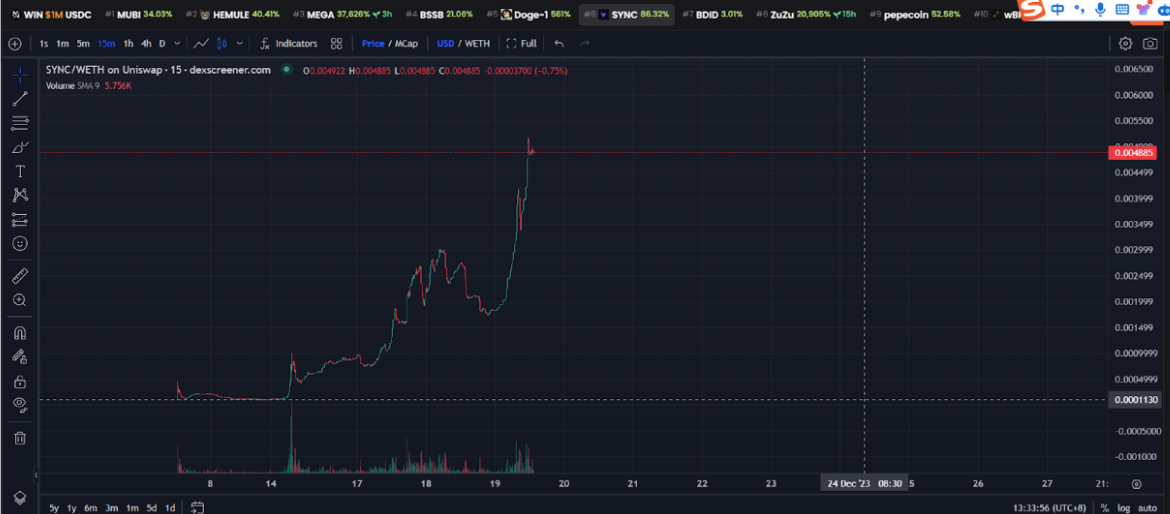
It is understood that zkSycus IDO raised 187 ETH in 5 minutes, with a current market value of US$20 million, Treasury assets of US$1.6 million, APY 116.4% (dynamic floating), and dividend assets of US$1.23 million. The $SYNC market has also performed particularly well in the past week, with its market value increasing more than 7 times.