


An overview of the current status of the stablecoin market: USDT is a steady winner, and exchanges consistently show an inflow trend


Original author:Pedro M. Negron, IntoTheBlock
Original compilation: Felix, PANews
Over the past year, the stablecoin circuit has undergone significant transformations, driven by regulatory changes, crises, and emerging opportunities, each of which has left its mark on the industry. USDT has experienced significant growth, while USDC has shrunk following the regional banking crisis. DAI has taken center stage in on-chain trading volume recently, thanks to its innovative stablecoin strategy of depositing funds into short-term U.S. Treasuries, which currently offer high APY. Finally, the article also examines how the recent crypto market resurgence affects the flow of stablecoins on exchanges.
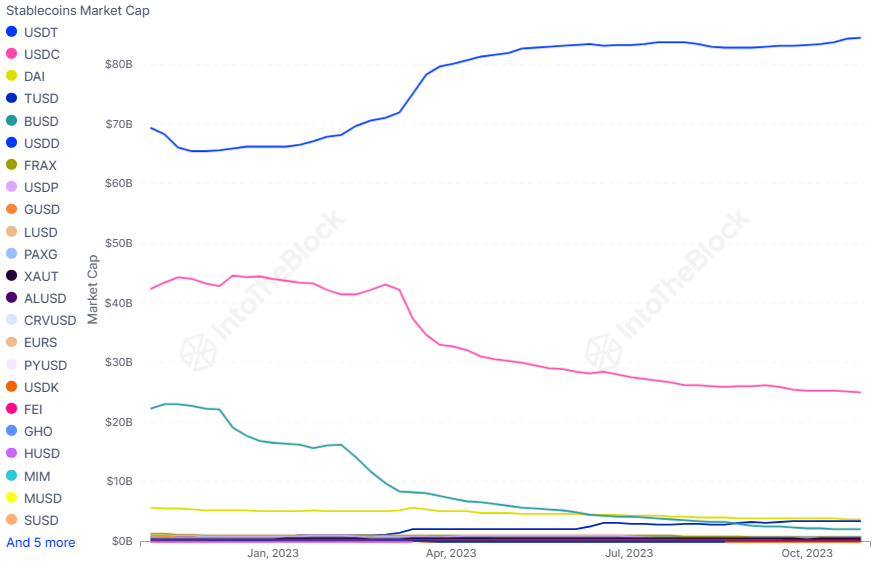
USDT’s market capitalization recently reached an all-time high, solidifying its position as the most widely adopted stablecoin in the crypto market.
Source: IntoTheBlock
Several major players in the stablecoin market have experienced various events over the past year. BUSD was once the third largest stablecoin on the market, but had to cease operations due to legal issues with US authorities. Since the incident, PAXOS, the operator of Binance BUSD, has only been able to process user withdrawals, causing the market cap to gradually decrease as withdrawals are made. USDC has $3.3 billion in foreign exchange reserves, which were revealed to be held at the bankrupt Silicon Valley Bank, which is crucial to maintaining its peg to the dollar.
This series of events allowed USDT, already the leading stablecoin, to attract a wave of new users and further expand its market share.
Source: IntoTheBlock
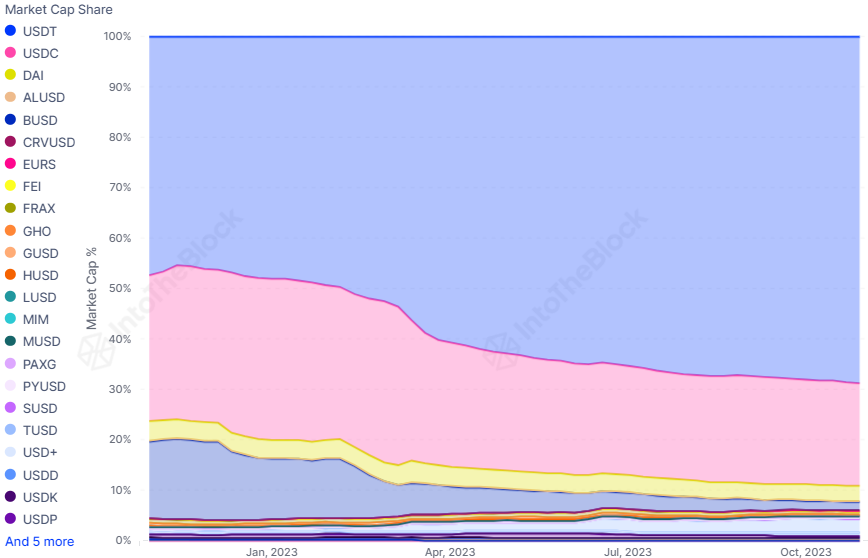
With the successive events on the stablecoin track, Tether, the entity behind USDT, has continued to develop, and USDT has taken a dominant position in the market. USDT’s current market capitalization is US$85 billion, accounting for 68% of the stablecoin market share, consolidating its position as the leading stablecoin provider.
Although Tether holds more than half of the market share, there is still potential for further growth and innovation in the stablecoin track. This trend is especially noteworthy as some stablecoin providers are now offering crypto users the opportunity to generate revenue. These stablecoins were then used to purchase short-term U.S. Treasuries, which are currently generating the highest returns since 2007. This mechanism allows stablecoin holders and crypto users to access the U.S. bond market without directly participating.
Source: IntoTheBlock
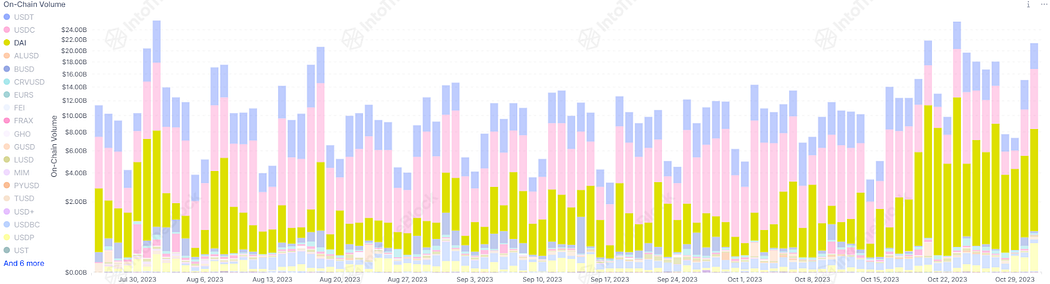
MakerDAO, the protocol behind DAI, has played a key role in leading this trend. With the relaunch of the DSR (Dai Savings Rate), MakerDAO enables users to earn rewards by locking their Dai assets in smart contracts. This new effort to buy U.S. bonds was launched in August 2023, when DSR rates reached their highest levels. Since then, DAI’s on-chain transaction volume has increased significantly. Clearly, big traders are hungry for a return on their investment, as transactions over $100,000 account for more than 90% of total DAI trading volume. For the past two weeks, DAI has maintained its top spot in trading volume on the stablecoin chain. This achievement is significant, especially considering that DAI is the third largest stablecoin by market capitalization.
Finally, the recent rise in cryptocurrency prices is also clearly reflected in the stablecoin market.
Source: IntoTheBlock
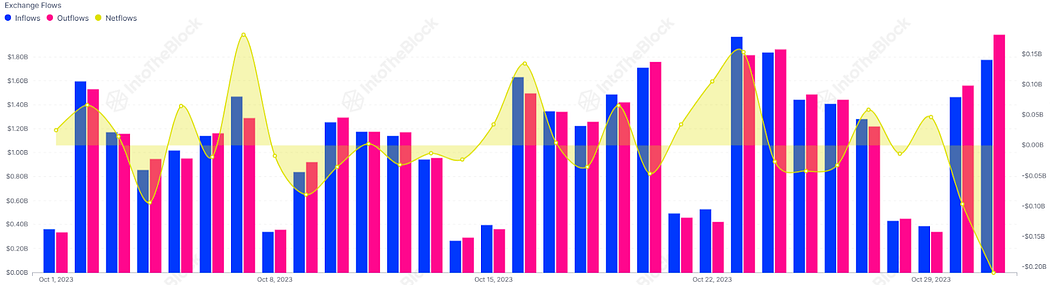
Flow metrics (which refer to assets moving in and out of the exchange) across exchanges consistently show inflow trends. Inflows are often associated with users dumping assets on exchanges, which is why they move their assets to these exchanges. This suggests that users are currently using previously held stablecoins to purchase crypto assets, coinciding with the recent surge in prices.
In summary, the stablecoin market has undergone significant changes over the past year, characterized by regulatory challenges, crises, and innovative strategies. While some mainstream stablecoins such as BUSD and USDC have suffered setbacks, USDT is firmly in the driver’s seat, with a market capitalization of $85 billion and a 68% market share. However, there is still room for growth and innovation on the stablecoin track, as evidenced by the trend of locking in stablecoin returns by investing in short-term U.S. Treasury bonds. MakerDAO was instrumental in pioneering this initiative, particularly in relaunching the DSR. The recent surge in cryptocurrency prices has also been reflected in the stablecoin market, particularly with users purchasing crypto assets, resulting in continued inflows into exchanges.





