






With yields soaring, what are the hidden concerns in tokenized fixed-income products for U.S. debt?


Original author: Frank, Foresight News
Crypto market benchmark interest rate? In 2022, UST/Anchor, after achieving a fixed annualized return of 20% in the form of a ladder with the left foot and the right foot, personally destroyed this grand vision, and also started the painful stage of declining interest rates in the DeFi market.
Time has changed, but the yield on the 10-year U.S. Treasury note, known as the anchor of global asset pricing, has been rising steadily in the past two quarters. Last night, it once exceeded the 5% round number mark, hitting a record high in July 2007. However, as the Epidemic God Bill Ackman, Old Bond King Bill Gross and other major U.S. bond short sellers suddenly turned against each other, U.S. bond yields fell rapidly during the session and fell back below 5% at the close. .
Amidst this ebb and flow, the soaring U.S. Treasury bond yields have also stimulated a number of institutions to launch a large number of tokenization projects supported by U.S. Treasury bonds through the RWA channel, and the fixed income track in the crypto market has also begun. usher in a new golden era.
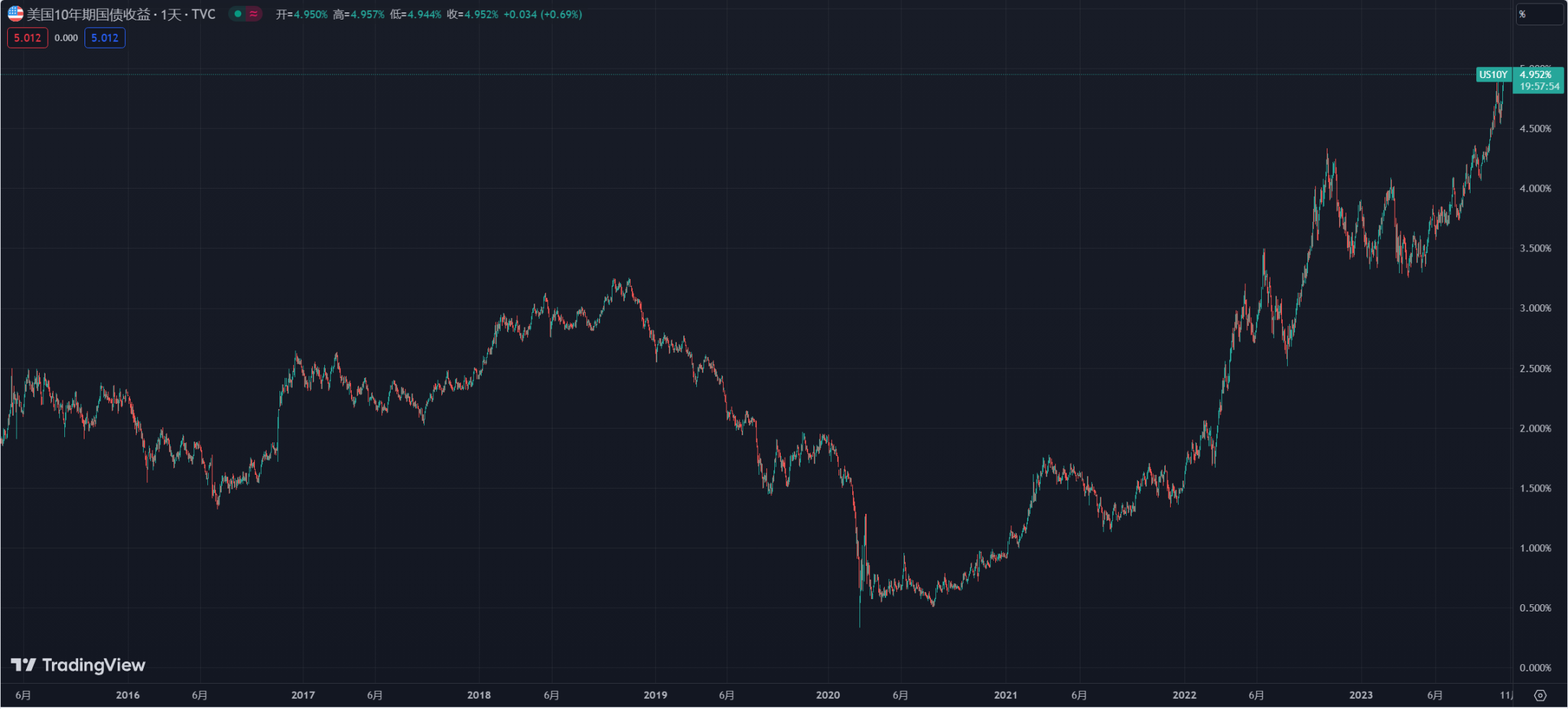
This article, Foresight News, aims to provide you with an overview of the current DeFi fixed-income projects that hedge U.S. Treasury bonds in the crypto market, and explore the sources of 4%, 5% or even higher returns behind them, as well as against the backdrop of rising U.S. bond interest rates. , possible future worries for these projects.
List of government bond “tokenization” fixed income products
Fixed-income projects involving the tokenization of U.S. Treasury bonds mainly refer to linking cryptocurrencies to U.S. Treasury bond assets. That is, users holding tokens on the chain are equivalent to owning the underlying financial assets corresponding to the traditional market - U.S. Treasury bonds. .
And the underlying financial assets such as U.S. bonds are often held in custody by institutions to ensure redemption, and tokenization on the chain can give the underlying financial assets better liquidity, and further financialization (leverage, lending, etc.) with the help of other DeFi components Chance.
In the current encryption market, in addition to the expansion of established projects such as MakerDAO and Frax Finance, projects such as Mountain Protocol and Ondo Finance have also entered the market.
MakerDAO’s EDSR
It goes without saying that MakerDAO is currently the leading project on the RWA track. However, the proportion of assets at the bottom of MakerDAO that can be used to purchase treasury bonds is limited. Previously, MakerDAO has been using USDC in the PSM module to withdraw cash to purchase treasury bonds, but if you deposit DAI, you can receive interest. If there are too many users, the interest may even fall below the national debt interest rate.
The current Enhanced DAI Savings Rate (EDSR) is 5%, and a total of 1.73 billion DAI is in DSR, making the overall utilization rate of the DSR contract (amount of DAI in the DSR contract/total supply of DAI) far more than 20% threshold, as high as 31%.
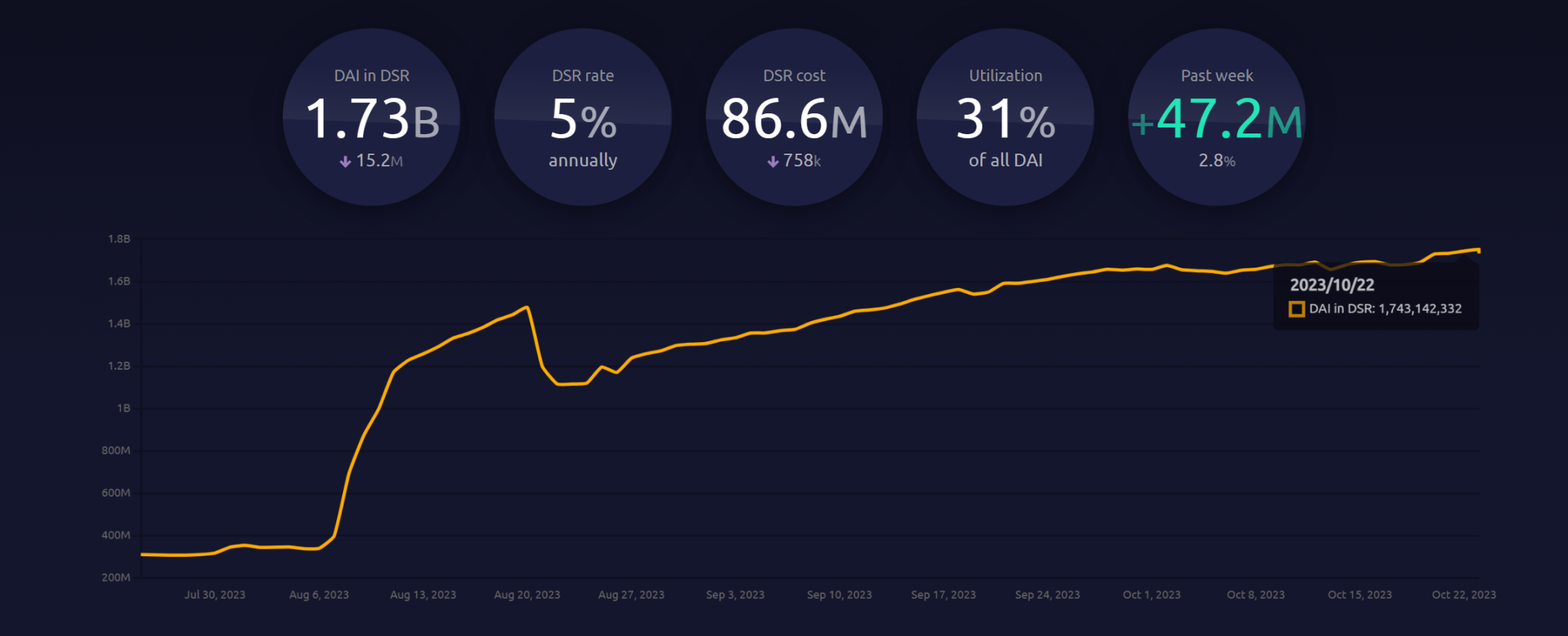
If the subsequent DSR utilization exceeds the 35% threshold, EDSR income will continue to decline:
When within the range of 35% - 50%, the increase rate of EDSR is 1.35 times the basic DAI savings interest rate, that is, the EDSR value will be approximately 4.15%;
When it exceeds 50%, the EDSR will no longer take effect and the contract will only use the basic DSR value, which is 3.19%;
Mountain Protocol’s USDM
As an income stablecoin protocol invested by Coinbase Ventures, the income stablecoin USDM launched by Mountain Protocol is mainly supported by short-term U.S. Treasury bonds. After completing KYB certification, investors around the world will be able to obtain the opportunity to share the U.S. Treasury bond yields.
In addition, USDM provides users with daily rewards in the form of Rebase, which is similar to the mechanism of stETH. The current annual interest rate is 5%, and the crvUSD-USDM liquidity pool has been launched on Curve, which means that non-U.S. users can also indirectly purchase and hold USDM Earn revenue.
OKLink data shows that the current total issuance and circulation of USDM is approximately 4.81 million, and the total number of holding addresses is 116.
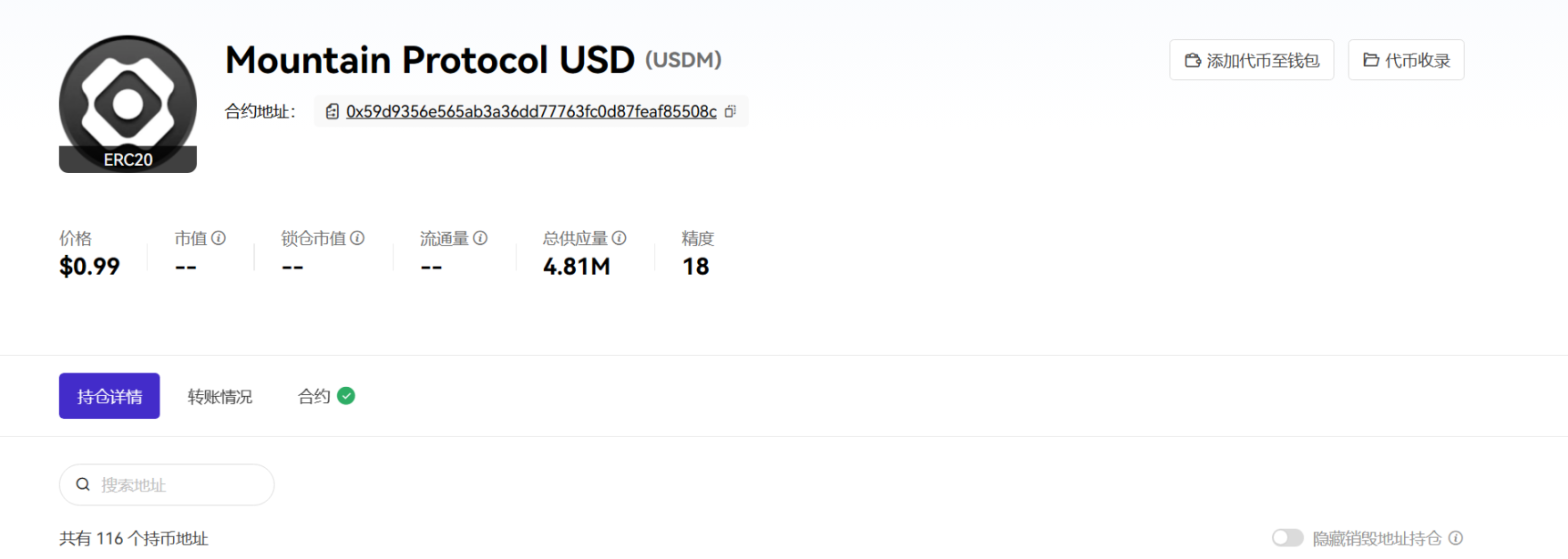
Official documents state that at least 99.5% of its total assets are invested in cash, U.S. Treasury bills, notes and other debt issued or guaranteed by the U.S. Treasury for principal and interest, and repurchase agreements secured by such debt or cash, and are therefore considered Fully backed by U.S. Treasuries, with specific asset details updated monthly.
Angle Protocol stEUR
As a euro savings solution launched by the decentralized stablecoin protocol Angle Protocol, stEUR allows users to pledge the euro stablecoin agEUR to obtain stEUR, and at the same time earn 4% annualized income paid in agEUR, but this 4% income is only the initial setting. It will be updated regularly in the future based on the usage of the contract.
It is mainly backed by short-term European debt with a theoretical yield of about 3.6%, but the agreement distributes part of the income to agEUR holders, and the current return on assets of the agreement is about 1.6%.
And its income distribution idea is also very simple: subsidize the income of unpledged agEUR holders to pledged users. Since not all agEUR holders will pledge stEUR, the income of stEUR users will definitely be greater than 1.6%.
For example, only 50% of the agEUR in circulation is in the stEUR contract, which means that 50% of the stEUR has obtained the entire agEUR income, which is a 3.2% rate of return.
sFRAX by Frax Finance
Frax Finance has been the most active DeFi project to move closer to the Federal Reserve - including applying for a Federal Reserve Master Account (FMA) (Foresight News notes that the Federal Reserve Master Account allows holding U.S. dollars and trading directly with the Federal Reserve), thereby getting rid of USDC as collateral The limitations of the product and the risk of bank failure make FRAX the closest thing to a risk-free dollar.
On the 12th of this month, Frax Finance also launched sFRAX, a pledge vault that utilizes the proceeds of U.S. Treasury bonds. It opened a brokerage account in cooperation with Lead Bank in Kansas City to purchase U.S. Treasury bonds and can track the Federal Reserve interest rate to maintain relevance.
Users can deposit funds into sFRAX and receive a 10% rate of return. Then as the scale grows, the corresponding rate of return will gradually shrink to the Federal Reserves current IORB interest rate, which is about 5.4%.
As of the time of publication, the total pledged amount of sFRAX has exceeded 43.46 million. This achievement was achieved in less than half a month. It can be said that the growth rate is amazing. At the same time, the current annualized interest rate has also dropped to 6.18%.
Ondo Finance USDY
In August, Ondo Finance also launched USD Yield (USDY), a tokenized note guaranteed by short-term US Treasury bonds and bank demand deposits. However, US users and institutions cannot use USDY, and it can be transferred on the chain 40 to 50 days after purchase. .
As a bearer note, USDY can pay variable yields to holders, with annual interest rates starting from 5%. Individuals and institutions do not require any certification and can directly cooperate with Ondo to mint or redeem USDY on a daily basis.
Ondo currently launches four bond funds, namely U.S. money market fund (OMMF), short-term U.S. Treasury bond fund (OUSG), short-term investment grade bond fund (OSTB) and high-yield corporate bond fund (OHYG). Among them, OMMF annualized return Reaching 4.7%, while OUSGs yield can reach 5.5%.
Generally speaking, most projects are allocated to short-term treasury bonds and treasury bond reverse repurchases, and the interest rates provided to the outside world are mostly concentrated between 4% and 5%, which is also in line with the current interest rate space of U.S. debt. Some high-yield Most of the time, the agreement uses other income to subsidize (such as EDSR), or sacrifices some non-secondary staking users to compensate staking users (such as stEUR).
Where do high returns come from?
Where do high returns come from? Very simply, it comes from the rising risk-free interest of U.S. Treasury bonds (a few items such as stEUR above are anchored to the government bonds of the country/region where they are located, the same below).
We need to be clear that as of now, the possibility of a default on the U.S. national debt is still extremely small, so the U.S. Treasury yield is generally regarded by the capital market as a risk-free rate, which means that the risk profile of holding U.S. Treasury bonds is similar to holding U.S. dollars. , but at the same time, you can obtain additional interest income.
So to briefly summarize the core idea of these fixed-income projects, it is to raise US dollars from users, then buy U.S. Treasury bonds, and share (part of) the interest generated with users.
In a nutshell, these fixed income projects will launch income stablecoins backed by U.S. Treasury bonds. Holders only need to hold the stablecoins as certificates to obtain the interest income of the U.S. debt as the underlying financial asset. :
Users who complete KYC/KYB mint/exchange with 1 US dollar, and the project party buys the corresponding treasury bonds, giving stablecoin holders the opportunity to enjoy the income from treasury bonds, which also maximizes the interest on treasury bonds and transmits them to stablecoin deposit users.
The current yields on short- and medium-term U.S. Treasury bonds are close to or exceeding 5%. Therefore, the interest rates of most fixed-income projects currently supported by U.S. bonds are mostly in the 4%-5% range.
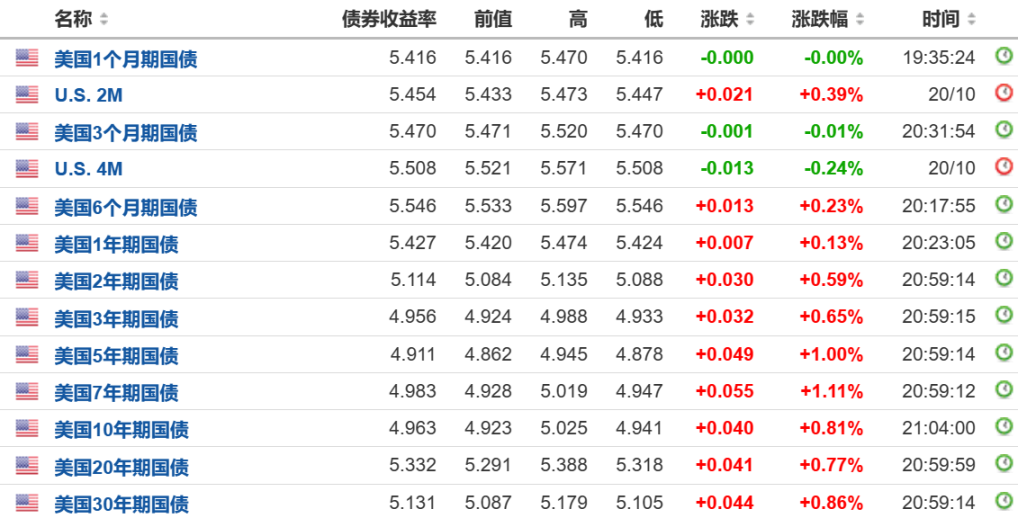
For example, it may be more intuitive to understand - these income-generating stablecoins actually distribute the interest income of the national debt absorbed by Tether/USDT to the majority of stablecoin holders:
You know, the process of Tether issuing USDT is essentially the process of crypto users using US dollars to purchase USDT - Tethers issuance of US$10 billion in USDT means that crypto users deposited US$10 billion into Tether to obtain this $10 billion in USDT.
After Tether obtains the US$10 billion, it does not need to pay interest to the corresponding users. It is equivalent to obtaining real US dollar funds from crypto users at zero cost. If it buys US Treasury bonds, it will be zero cost and no cost. Risky interest income.
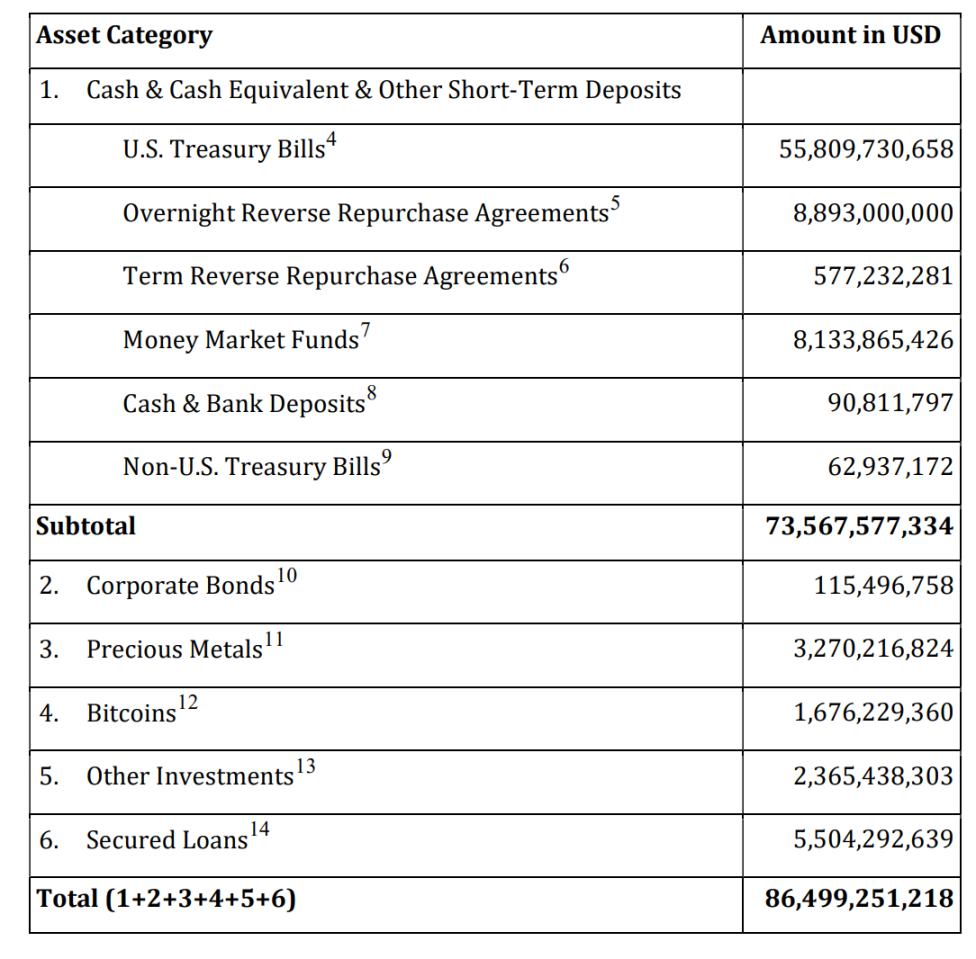
According to the second quarter assurance report disclosed by Tether, it directly holds US$55.8 billion in US government bonds. Based on the current Treasury bond yield of about 5%, it means that Tether earns about US$2.8 billion per year (almost US$700 million in the first quarter). ), Tether’s second-quarter operating profit of more than US$1 billion also confirms the huge profits of this model.
In addition, these stablecoins can also be used freely in DeFi, including realizing derivative needs in scenarios such as leverage and lending through other DeFi protocol components.
Hidden worries about the U.S. debt crisis
Generally speaking, the current potential risks faced by fixed-income projects supported by government bonds and the stablecoins they launch mainly come from three aspects:
The psychological risk of continued decline in U.S. bond prices. Assets (the value of U.S. debt) are insolvent (the market value of stablecoins). Once it falls to the psychological critical value, it may trigger an avalanche of anchoring;
Liquidity risk under maturity mismatch. If the crypto market experiences significant fluctuations and users sell stablecoins to replenish liquidity, a run and stampede is very likely to occur;
Custody risk. Overall, it still relies heavily on trust in the underlying government bond asset custodian;
Risk of U.S. Treasury Bonds Falling
As we all know, the yield and price of bonds have always been two sides of the same coin. Therefore, as mentioned above, the yield of U.S. bonds continues to rise and hit a new high, which means that the price of U.S. bonds continues to fall during the same period, hitting a new low.
Including the 10-year U.S. bond yield mentioned at the beginning of the article exceeding 5%, the incentive behind it is naturally inseparable from the fact that since the debt ceiling negotiations were passed in June this year, the scale of U.S. bond issuance has far exceeded the same period in history:
From a data perspective, as of the end of May, the scale of U.S. government debt was US$31.4 trillion. After the debt ceiling was lifted in June, the total debt size has now exceeded US$33 trillion, causing the supply and demand relationship of national debt to disrupt market liquidity.
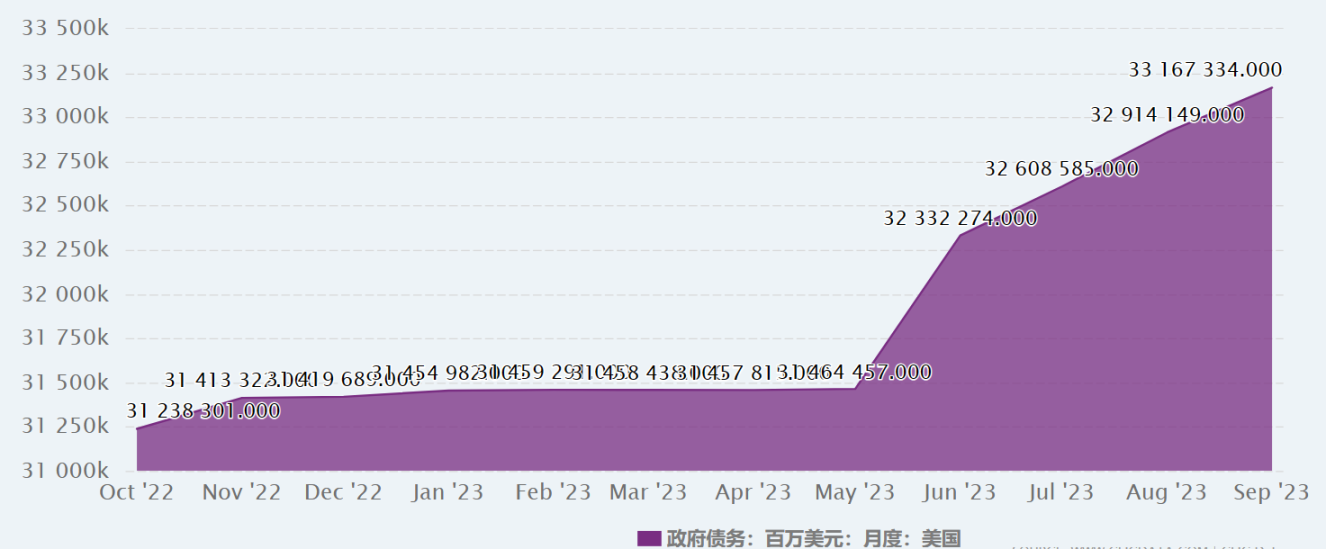
This also means that the market value of the underlying financial assets (i.e., U.S. bonds) that support these income-generating stablecoins is actually continuing to depreciate as yields continue to rise. However, as long as they are not actually sold, they are still just The floating losses on the books represent an implicit insolvency.
It is predicted that U.S. Treasury bond issuance may still be at a high level in the fourth quarter. If this supply and demand divergence continues, U.S. bond prices will undoubtedly remain under pressure.
This is also the key point of risk accumulation - if the yield on U.S. debt continues to rise, the price of U.S. debt will continue to fall. Once users find that the price of the assets behind them has shrunk to an unacceptable level and reaches a psychological threshold, they will initiate redemptions. Then floating losses turn into real losses and insolvency will become a reality, eventually triggering an avalanche.
Liquidity risk
Liquidity risk is also a potential technical risk that the author believes deserves attention. If the decline in U.S. bond prices passively leads to a decline in the value of assets behind stablecoins, then it is actively exacerbating this problem through the imbalance of the asset-liability structure.
The core point is that the income earned by the project team from holding U.S. bonds will be paid upon maturity, but users holding the tokenized RWA assets of U.S. bonds (that is, their respective stablecoins) will receive income without the maturity of the U.S. bonds. Can be redeemed, where does the money come from?
For example, take the 10-year U.S. bond with a yield that has just exceeded 5%. Even if the project party buys it now, it will mature in 10 years before it can secure an average annualized return of 5%. However, at the same time , but token holders on the chain can redeem it almost instantly. Why?
Term mismatch.
From the sources of high returns analyzed above, we can see that since the main purpose of the stablecoins launched by each company is not to directly serve as a medium of exchange, but to provide income to the holders, the underlying financial assets are basically government bonds of different maturities.
And in order to ensure the risk and return matching of the investment portfolio and provide the highest possible fixed income to token holders on the chain (not to mention the inversion of short-term and long-term yields on U.S. bonds, the same below), there is no doubt that long-term bonds and short-term bonds Bonds are combined to take into account liquidity (preventing user redemptions) and income (providing fixed income).
This is understandable. One of the essences of finance is maturity mismatch, which is one of the main sources of income in the financial industry. But don’t forget that it is also an important source of liquidity risk.
We only need to imagine a scenario - the crypto market experiences significant fluctuations, investors generally liquidate their positions or are close to liquidating their positions, and holders may sell RWA to replenish liquidity.
Under the impact of such liquidity risk, the project side can only recover liquidity by selling U.S. debt. Naturally, it will be short-term bonds with good liquidity and small discount at the beginning. However, once the user redemption demand exceeds the short-term debt balance, then The only option is to sell unmatured long-term bonds at a discount.
In particular, the underlying financial assets (i.e., U.S. Treasuries) are only traded during the trading hours on working days, but the tokenized assets on the chain are traded 24/7. This mismatch in trading time may also cause This prevents project parties from selling U.S. bonds in a timely manner to recover liquidity, further aggravating the selling pressure when the market changes.
At this time, the project party can either reduce the advertised fixed rate of return, or it can only silently accrue losses. However, once the advertised fixed rate of return is reduced, it is likely to trigger a crisis of trust and a run, exacerbating the selling trend. This will easily cause the stable currency to become unanchored, thereby exacerbating liquidity risks.
Does it look very familiar?
Yes, this is the almost identical risk chain and transmission path in the Silicon Valley banking crisis that began in March this year. This also led to the bankruptcy of many banks such as Silicon Valley Bank and Signature Bank, and almost led to systemic risks.
Custody risk
Of course, to a certain extent, the correlation between the tokenized fixed-income projects of U.S. Treasury bonds in the crypto market and the traditional financial market is also two-way. Extreme fluctuations in the crypto market may be transmitted to the traditional financial market through RWA-Treasury Bonds.
However, the current scale of fixed-income projects that tokenize U.S. Treasury bonds is still very limited, and the liquidity of the U.S. bond market is sufficient to cope with such a large-scale impact, so it is difficult for such sell-offs to affect the prices of underlying financial assets.
That brings up another potential risk point - the reliability of the custodian. Take for example Circle, a leading crypto project that holds a huge amount of U.S. debt. Most of them are hosted by U.S. financial institutions such as BlackRock (Circle Reserve Fund). , relatively safe.
At present, the stablecoins backed by fixed-income government bonds generally rely on trust in the underlying government bond asset custodians, and the information disclosed is very limited. This is also a risk point that cannot be ignored.
summary
Under the feast of interest rate hikes, will this cruel joy eventually end in cruelty?
For ordinary investors, although most of the fixed-income projects that use RWA as a channel to tokenize U.S. debt have corresponding entry barriers, they are also a rare opportunity to participate in sharing the income of U.S. Treasury bonds.
At the same time, it can also introduce more abundant funds and underlying high-quality assets into the DeFi field and the encryption market, which are positive factors for the entire encryption market.
However, the autumn wind has not yet begun. The surge in the supply of short-term U.S. debt since June has enabled the U.S. government to overcome the dilemma of issuing bonds to alleviate the funding gap. Therefore, although the 5% mentioned above is an important psychological threshold, it is also This means that actual yields cannot remain in the current high range for a long time.
So for users who currently hope to obtain income through the tokenization channel of U.S. debt, they undoubtedly need to do a good job in expectation management and risk control:
On the one hand, it is necessary to understand that no one can guarantee that the U.S. bond yields of 4%, 5% or even higher will continue, and there is a critical value between the fluctuation of yield-price. If the price falls below a certain point, assets (the value of U.S. debt) will become insolvent (the market value of stablecoins), and an avalanche of anchoring may occur in an instant.
On the other hand, the higher the fixed rate of return provided by the project side is above 5%, it may mean a more complex long-short bond maturity mismatch - as mentioned above, this also means that projects with higher fixed rate of return have potential The higher the liquidity risk, the more likely it is that a squeeze will occur.
There is no eternal feast in the financial market, especially in the crypto industry.
Take everything and get it all in one place. Those of us who have experienced UST/Anchor should probably understand that no matter how grand and high-yield the narrative is, if it cannot be completely eliminated, it will only be a mirror image.
Time will give us the answer.





