






The scale is far more than 9 billion US dollars. How big is the imagination of Bitcoin RWA?


Original author: Sharon, BlockBeats
Original editor: Jack, BlockBeats
As the fourth Bitcoin halving approaches, a new paradigm shift has occurred in Bitcoin and its computing power market.
On June 20, Bitcoin mining company HAG Holding Limited (HAG) announced the official issuance of the world’s first compliant digital securities (STO) based on Bitcoin’s sustainable computing power, and provided investors with monthly Bitcoin dividends. ; On September 23, the decentralized computing power routing protocol Lumerin announced that it would launch a decentralized Bitcoin computing power market on Arbitrum; on October 2, the Bitcoin RWA project Merlin Protocol announced that it had completed testing on the test network.
Tether, the issuer of the U.S. dollar stablecoin USDT, is also actively planning. On the one hand, it announced that it will launch the Real World Ecosystem (RWE), and on the other hand, it is also intensively developing Bitcoin mining operations.
Compared with making profits through centralized Bitcoin mining companies (hereinafter referred to as mining companies) in the past, Bitcoin computing power and RWA may be becoming a new outlet in the Bitcoin mining market.
Centralized mining companies: Increase leverage in the bull market and find a way out in the bear market
Since the inland comprehensive ban on Bitcoin mining activities in June 2021, the Bitcoin computing power center has been transferred from China to North America. The migration of this computing center has actually started in 2020, and by the end of 2021, the changes have been visible to the naked eye. According to the Bitcoin mining map developed by the Cambridge Bitcoin Power Consumption Index, if the average monthly hash rate share is used as the standard, the global Bitcoin mining center is still in China in January 2021, but by 2021 In December of this year, the center was moved to North America.
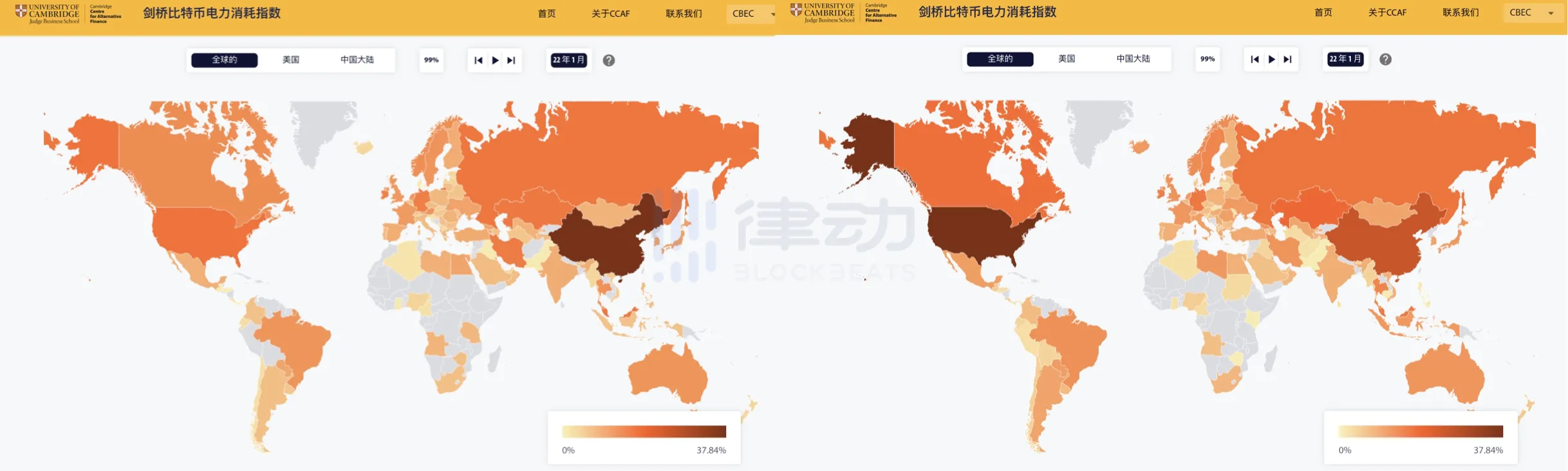
Left: January 2021; Right: December 2021. Image source:Cambridge Bitcoin Power Consumption Index
Behind this change is the continuous rise of mining companies in North America. Since 2020, North American mining companies, led by Core Scientific (NASDAQ: CORZ), Riot Platform (NASDAQ: RIOT), Bitfarms (NASDAQ: BITF), Iris Energy (NASDAQ: IREN), etc., have begun to purchase mining machines in large quantities, and have gradually Listed in North America and embarked on the path of compliant operations.
In February 2020, Bit Digital (NASDAQ: BTBT)) was listed; in June 2021, Bitfarms, Hut 8 (TSE: HUT), and HIVE Digital (CVE: HIVE) were listed; in November 2021, Iris Energy was listed; in 2022 In January, Core Scientific went public; Riot Platform, formerly a biopharmaceutical company, took off after jumping on the mining wave.
The main business of these mining companies is Bitcoin mining, so their development is also highly related to the price of Bitcoin. During the bull market from January 2021 to May 2022, the stock prices of these companies took off. According to Nasdaq data, compared with the initial stage of listing, the stock prices of Core Scientific, Bitfarms, Hut 8 and HIVE Digital rose by as much as 57%, 707%, 371% and 228% respectively during the bull market in the crypto market.
Bull market conditions from January 2021 to May 2022. Source: Coingecko
During this period, most mining companies achieved profitability through computing power mining + debt/equity financing. Take Marathon Digital (MARA) as an example. Its main business is self-operated Bitcoin mining. Its strategy is to purchase mining machines and deploy mines through financing. After paying the cash operating costs of production, it holds Bitcoin as a long-term investment. Data shows that in 2021, Marathon Digital spent US$120 million to purchase 30,000 Antmining machines from Bitmain, and also obtained a US$100 million revolving credit line from Silvergate Bank, and plans to issue senior convertible notes through In this way, it raised US$500 million in debt to continue to purchase mining machines, and once became the mining company with the largest Bitcoin holdings in North America.
Coincidentally, Core Scientific is even more exaggerated. It once operated more than 200,000 Bitcoin mining machines in 5 states in the United States, and in June 2022 alone, it produced more than 7,000 Bitcoins. In addition, Core Scientific has received an investment of US$54 million from Celsius and signed a US$100 million equity investment agreement with investment bank B. Riley.
However, due to their highly leveraged business attributes, these mining companies were caught off guard by the sudden bear market.
The first is Marathon Digital, which recorded a net loss of US$686.7 million throughout 2022; Riot Platforms net loss in 2022 was US$509.6 million; Bitfarms net loss in 2022 was US$239 million; and Core Scientifics net loss was only in the first nine months of 2022. It has lost more than US$1.7 billion, so much so that by the end of 2022, Core Scientific was on the verge of bankruptcy.
According to a report by Hashrate Index, the total collective debt of mainstream centralized mining companies will exceed US$4 billion by the end of 2022. Core Scientific has the largest debt, owing creditors US$1.3 billion as of September 30, 2022; Marathon Digital owes approximately US$4 billion. US$851 million, but most of it is convertible notes; the tertiary debtor is Greenidge Generation, which owes US$218 million.
Source: Hashrate Index
Many institutions believe that the development of centralized mining companies is highly related to the price of Bitcoin. Therefore, the business model of financing the purchase of Bitcoin mining machines for mining will test the companys cash flow management capabilities in a bear market. At the same time, it is also easy to face Risk of insolvency.
Many listed Bitcoin mining companies borrowed heavily during the bull market in 2021, causing their profitability to be very negatively affected during the subsequent bear market.
The difference between the business models of buying mining machines for mining and hoarding coins (Mara, Hut 8, Riot) and producing and selling mining machines (Cannan) is that the RD expenditure is small, but the capital expenditure is large, and the income is not resilient, so it can only rely on increasing BTC mining. Profitable from efficiency and BTC appreciation, the debt ratio is high and the leverage is large. Therefore, the revenue of listed mining companies has a stronger correlation with the price of Bitcoin, and the price fluctuations are more violent. At the same time, the bear market faces the potential threat of insolvency. .
Today, Core Scientific is facing restructuring, Marathon Digital is struggling to survive by selling Bitcoin + private equity financing, Riot Platform is once again using name change as a means to strive for strategic transformation (the company was previously named Riot Blockchain), and Iris Energy is seeking to transform into generative AI. market. Some centralized mining companies are looking for new ways out in the bear market, while others continue to promote the layout of the Bitcoin mining market, sticking to the dark night before dawn, waiting for the arrival of the bull market.
In addition to the development narrative of centralized mining companies, the value of Bitcoin itself is still optimistic by the entire market. It is precisely because of this that even in the current bear market, the market still has new narratives emerging.
Bitcoin RWA: A Paradigm Shift in Decentralized Dividends
Centralized mining companies raise funds through U.S. stock listings, and investors buy their stocks and realize profits by relying on rising stock prices. This also resulted in the stock prices of mining companies taking advantage of the situation to take off during the bull market, but fell again and again during the bear market. Therefore, many people who hope to profit from mining and rising currency prices have turned to a new paradigm other than centralized mining companies - Bitcoin and its computing power RWA.
RWA (Real-World-Assets) refers to mapping assets in traditional markets to the chain in the form of tokens for Web3 users to buy and sell. It is also considered to be a channel for traditional financial markets to enter the Web3 industry. .
BlockBeats learned that there are currently two new methods of Bitcoin RWA, one is to anchor Bitcoin computing power, and the other is to anchor Bitcoin price.
Anchored computing power: Mining dividends are tokenized, and arbitrage relies on the floating price of mining machines.
As the worlds first STO issued in accordance with U.S. securities laws and based on sustainable Bitcoin computing power, HAG Holding Limiteds core members come from Goldman Sachs, TSMC, SoftBank, and Bitmain, and issue STO (securities) in an SEC-compliant manner. tokens), and then bring Bitcoin computing power income to Ethereum and the DeFi world through a form similar to currency holding dividends.
On June 20, HAG Holding Limited issued a total of US$500 million in HAG tokens on the U.S. digital securities issuance platform INX. Each HAG token is anchored to 1 TB of Bitcoin computing power in the companys operation and maintenance mine. Of the Bitcoin corresponding income generated by the mine, 30% is used for the operation and maintenance of the project, and 70% is distributed to HAG token holders in the form of WBTC.
According to the HAG team to BlockBeats, this distribution is paid monthly through an INX-compliant transfer agent, and all earnings and distributions are transparent and public. Joe, a founding member of HAG, revealed to BlockBeats that the team is already negotiating with Bitmain about the purchase of the new mining machine S 21, and more new developments are expected in January 2024.
In this way, the underlying value of HAG is highly positively correlated with the mining machine. We use decentralized crowdfunding to allow more Web2 people to enter the Web3 world, buy and hold Bitcoin in this way, and make profits from it, Joe told BlockBeats in an interview.
Traditional mining companies control a large amount of computing power and are highly centralized. Todays Bitcoin RWA will, to a certain extent, lead Bitcoin back to the path of decentralization and iterate the narrative of Bitcoin mining.
The liquidity of web3 is not enough. Efficient economies of scale + effective mine operation and maintenance are the core. Joe believes that current Bitcoin mining needs to accommodate more participants outside the encryption industry, so as to achieve more Large-scale popularization and development, on the other hand, the operation and maintenance of mines need to be sustainable. Therefore, to a certain extent, the mining currency + bond financing form of some centralized mining companies cannot achieve sustainable development.
In addition, Lumerin, which is also a Bitcoin computing power RWA project, was officially launched on September 26. Its essence is also a DEX/DeFi of computing power. It commercializes Bitcoin computing power through smart contracts, allowing Bitcoin computing power to be used. Traded by anyone. Community users rated it as the worlds first P2P exchange to mine Bitcoin on Arbitrum.
Image source: Introduction to its operating mechanism in Lumerin white paper
Anchoring BTC: catching up with WBTC and seeking compound interest based on the currency standard
Compared with HAG, which focuses on the compliance path of protecting investors, Merlin Protocol’s mechanism is similar to MakerDAO and is more native to the encryption industry.
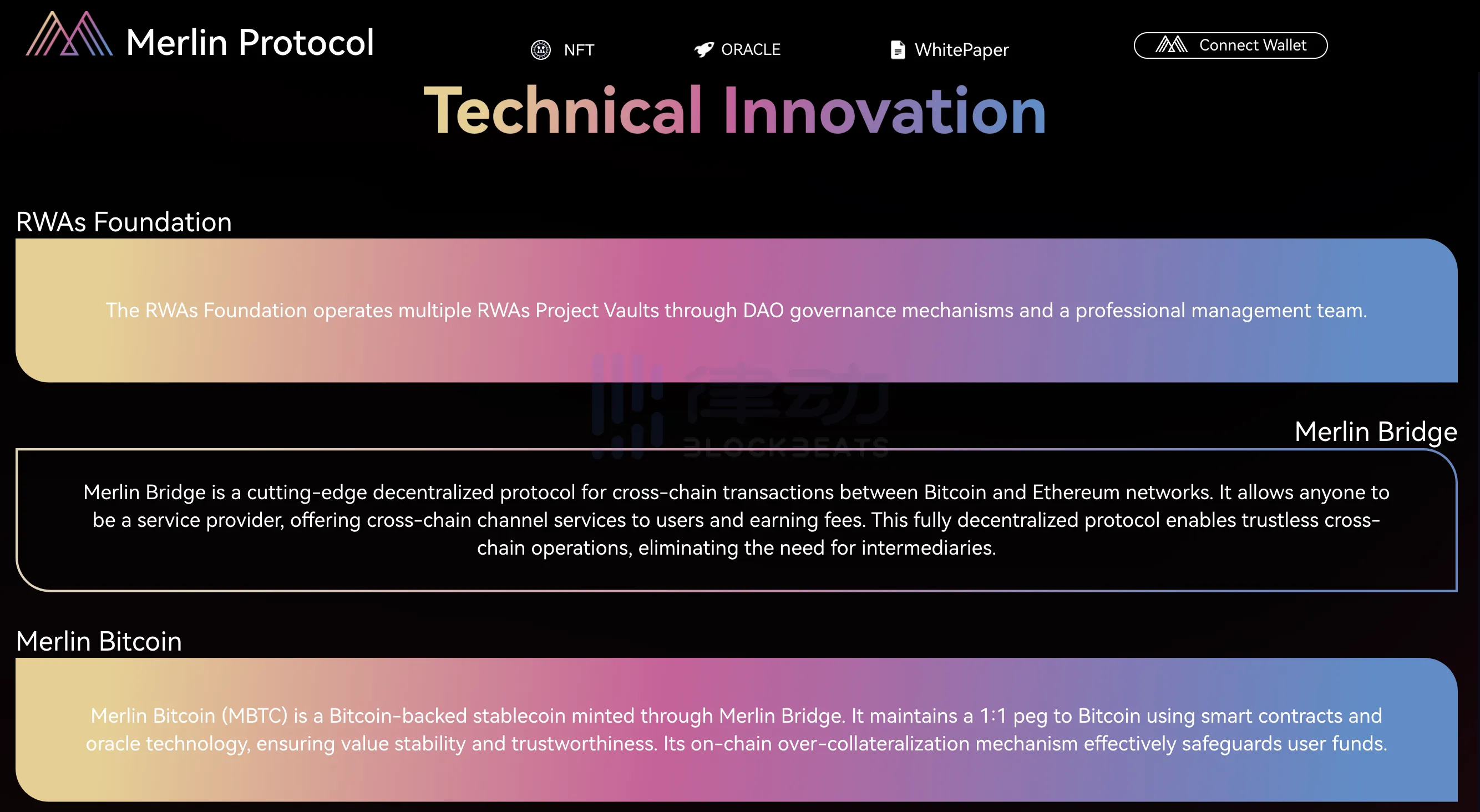
Source: Merlin Protocol official website
On the one hand, Merlin Protocol provides space for miners to arbitrage, and on the other hand, it provides fund custody and secure transactions for cross-chain traders. Its operating mechanism is that Merlin Protocol issues MBTC anchored to Bitcoin. Miners can mint MBTC in equal amounts by locking the mined Bitcoins, and can also make arbitrage through ghost Bitcoins.
Ghost Bitcoin is a special type of transaction provided by cross-chain service channels. These transactions do not require real Bitcoin to issue additional MBTC. Ghost Bitcoin transactions require the issuance and destruction of MBTC in one block and the payment of corresponding transaction fees.
When there is room for arbitrage in MBTC transactions on Ethereum, users can quickly perform liquidity arbitrage through ghost Bitcoin without principal requirements. Ghost Bitcoin is a unique technical feature of MBTC. Based on ghost Bitcoin, MBTC will gain richer market liquidity.
MBTC hopes to solve the existing problems and pain points of the stable currency WBTC. Firstly, WBTC is controlled by a centralized organization. Secondly, it is difficult for WBTC to help users earn income.
Users can host their Bitcoins on Merlin Bridge, and Merlin Bridge disperses users Bitcoins in multiple cross-chain channels to ensure the safety of users funds. On Merlin Bridge, anyone can become a cross-chain channel service provider through over-collateralization. This pledge ratio is 150%. For example, if you want to keep 1 Bitcoin, you first need to pledge the equivalent of 1.5 Bitcoin’s Ethereum or USDT is used as a deposit to become a service provider,” Merlin Protocol co-founder Eason told BlockBeats. At the same time, service providers can receive a 1% transaction fee from each transaction, and the treasury collects an additional 0.5% from the transaction.
In the past, we raised funds through the issuance of NFTs on the chain, and then gave the funds to miners for mining, and then shared the profits with investors; in the future, it will essentially be the same in our ecosystem. Everyone will use a DAO A management system to raise the MBTC we issue, and then after the miners get this MBTC, they go to the real world to engage in mining business, and then get more BTC, and then share it with the entire ecosystem. Investors can raise funds through Bitcoin earns more Bitcoin. Essentially, the only thing that can achieve currency-based compound interest is Bitcoin mining.”
Image source: Merlin Protocol white paper
Building factories and buying coins, is Tether also planning Bitcoin RWA?
Compared with the above-mentioned projects, Tether seems to be quietly laying out Bitcoin RWA. Currently, Tether not only operates its own Bitcoin mine, but also purchases a large amount of Bitcoin, and regards Bitcoin mining, RWA, etc. as strategic priorities in 2024.
On September 22, Tether Chief Technology Officer Paolo ArdoinoExpressed on its social platform, Tether’s new global strategy will be fully implemented in 2024. According to his hints, the new global strategy may include investment and financing cooperation, AI, new energy Bitcoin mining, education, global business expansion, etc.; in October, the chief technology officer announced that Tether Real World Ecosystem (Real World Ecosystem) Ecosystem (RWE for short) will be launched soon.
In fact, as early as August 26, Paolo posted on social media that Tether’s Bitcoin mining farm in Latin America planned to start operations within a few weeks. According to previous reports by Bitcoin Magazine, Tether participated in the investment in a renewable energy power generation park in El Salvador, which plans to build 169 MW of photovoltaic solar energy and 72 MW of wind energy. It also plans to build a Bitcoin mining farm in the park.
Tether has also previously cooperated with a licensed company in Uruguay to launch a sustainable Bitcoin mining business. It also launched the Tether Energy plan a few months ago to build renewable energy production and Bitcoin mining farms. At the same time, as of August 6, Tether may have become the 11th largest Bitcoin holder in the world, with an estimated 55,022 Bitcoins worth US$1.6 billion.
Launching RWE, investing in building Bitcoin mines, and holding a large amount of Bitcoins, various signs indicate that Tether may make a larger layout in the Bitcoin RWA market.
Whether it is HAG, Merlin Protocol, Lumerin, or the layout of Tether, although their operating mechanisms and revenue models are different, it can be seen overall that Bitcoin is becoming an important part of the RWA narrative, and many teams choose to work here There are multiple reasons behind Shis entry into the game.
The market size far exceeds 9 billion US dollars, and the imagination space of Bitcoin RWA
In fact, it is not difficult to understand why you chose this time to enter the Bitcoin RWA market. On the one hand, the price of mining machines was at a low point in the market during the bear market. Now that you are entering the market, you can purchase a large number of mining machines at a relatively low price, and the basic cost is lower. On the other hand, as the RWA concept becomes more and more popular, a good underlying asset can help the project team achieve stable development, and can also help investors make profits with lower risks, and Bitcoin is recognized by most people in the cryptocurrency industry. Good underlying assets.
What’s more noteworthy is that the future space and scale of this market may exceed many people’s imagination.
RWA narrative mainstreaming
In addition to the renewed focus on the value of Bitcoin itself, the concept of RWA, which has gradually been widely mentioned in recent years, is also the main reason for the rise of Bitcoin RWA.
The crypto market is not in a bull market now, and there is not enough narrative even in the native crypto market. RWA is one of the few tracks currently seen with solid revenue support and may achieve explosive growth in business.
Joe, a founding member of HAG, pointed out that with the recent resurgence of the RWA narrative, Bitcoin computing power has received renewed attention. How to allow ordinary people to participate in computing power while protecting everyone who invests is the focus of HAG. In this regard, Merlin Protocol also expressed its recognition. As the cycle rotates, RWA, like public chains, DeFi, GameFi, etc., will become a long-lasting narrative after the wave. Merlin co-founder Eason told BlockBeats in an interview.
Eason also mentioned MakerDAO, the most well-known in the RWA field, and believed that its most successful part is to empower its own DAI ecosystem through U.S. Treasury bonds: Finance is about higher utilization of funds and greater release of productivity. MakerDAO In fact, it is quite meaningful. It uses its own general equivalent for RWA investment, which is actually not available in most projects. So we also want to issue an anchor currency anchored to Bitcoin. , we will further develop and expand the RWA industry in the future.”
The highly imaginative “Bitcoin Financial World”
This market is actually very large. More than 9 billion US dollars of Bitcoin need to be processed every year, and more than 70% (100,000 to 200,000 miners) of BTC are traded over the counter rather than on exchanges. We only deal with this market 10% -20%, the income in one year is also very impressive, Merlin co-founder Eason told BlockBeats. According to team estimates, the Merlin protocol’s annual revenue from cross-chain service fees alone can reach US$14 million, while node revenue can reach US$30 million.
According to BlockBeats, the OTC market size of Bitcoin mining is even larger, and there is even a To G business. An insider revealed to BlockBeats that the magnitude of these transactions is far beyond many peoples imagination.
Eason pointed out that the future financial market based on Bitcoin RWA will be very large. Especially for many miners, as the fourth Bitcoin halving cycle approaches, miners also need to formulate strategies in advance for the situation in 2024, find new income-generating opportunities, and at the same time improve machine efficiency, reduce power costs, or reduce other operating costs. way.
In addition, there are more and more voices in the industry that Bitcoin may achieve a revival, which has also contributed to the expansion of the Bitcoin RWA market to a certain extent. On October 20, Tether Chief Technology Officer Paolo Ardoino said in an interview that it is expected that the adoption of Bitcoin expansion solutions will achieve a huge leap in the next few years.
On the same day, Lightning Labs CEO and co-founder Elizabeth Stark also said in an interview that Taproot Assets can help Bitcoin usher in a revival, making the Lightning Network a multi-asset network, and potentially consolidating Bitcoin as a currency Internet Status: “With the next halving approaching, now is the time to accelerate Bitcoin’s development.”
According to BlockBeats’ observation, behind the topic of “Bitcoin Renaissance” is not only the development of the Bitcoin network and ecosystem itself, but also the boost of the traditional world. Also on October 20, Coinbase Chief Legal Officer Paul Grewal stated in an interview with CNBC that Coinbase is confident in the US Securities and Exchange Commission’s approval of the Bitcoin ETF. Analysts at JPMorgan Chase had previously predicted that a Bitcoin ETF would be approved in the coming months.
With the arrival of the halving cycle, if the Bitcoin ETF is officially approved, it may bring more opportunities and positive sentiments to the Bitcoin mining market. In addition, at a time when miners are looking for diversified ways to make profits, mining machine prices are at market lows, and RWA narratives have become mainstream, Bitcoin and its computing power market may usher in a greater turning point and revival.





