






Coinbase invests in Circle, the reshaping of the stable currency pattern behind USDCs market value cut in half


Original author: flowie, ChainCatcher
Circle CEO Jeremy Allaires sense of crisis seems palpable. Recently, Jeremy Allaire responded through an interview with Bloomberg that in the face of competition from non-cryptocurrency companies such as PayPal, Circle has more than $1 billion in cash to cushion the pressure. Yesterday, Circle officially announced that Coinbase is about to take a stake, and USDC will be launched on 6 new chains under the support of Coinbase.
For Circle, its sense of crisis may not only come from the invasion of Web2 giants such as PayPal, but also from the repeated pressure from old stablecoin competitors such as USDT and DAI.
A fact that is currently facing Circle is that the market value of USDC has dropped from US$45 billion at the beginning of the year to about US$26 billion, almost cut in half, and hit the lowest level in nearly two years. However, the market shares of rivals such as USDT and DAI are rising or retracing significantly. Compared with the USD 66 billion at the beginning of the year, the market value of USDT has risen by 25.7% to USD 83 billion; and DAI has experienced a period of trough after the USDC unanchored storm, but with the help of RWA, its market value has increased by more than 10% in the past two months. 20%.
Under the USDC market value decline crisis, we can also see the reshaping of the stablecoin market this year. On the one hand, after experiencing the regulatory crackdown on BUSD and the de-anchoring crisis of USDC, the guests of the top five stablecoins by market value have also changed significantly; on the other hand, old blue-chip DeFi such as Curve and Aave are actively launching native stablecoins; some New forces of interest-bearing stablecoins leveraging LSD and RWA are also on the rise. With the launch of the stablecoin PYUSD by the Web2 payment giant PayPal, another important driver has been added to the stablecoin market.
In addition to the changes in the structure of the stablecoin project side, the core areas of encryption such as the United States, Singapore, and Hong Kong are also undercurrents in the stablecoin regulatory competition. At present, the Monetary Authority of Singapore has taken the lead in releasing the MAS Finalizes the Regulatory Framework for Stablecoins, which provides a reference for promoting compliant stablecoins.
The market value is almost cut in half, USDCs anxiety and coping
Regarding the decline in the market value of USDC, although Circle CEO Jeremy Allaire attributed it in part to the decision a year ago to reduce the adoption of USDC to promote its own stable currency BUSD, it was partly attributed to it in an interview with Bloomberg.
But in fact, in addition to Binance’s reduction in the adoption of USDC, USDC is still shrouded in the shadow of this crisis since the bank run in Silicon Valley at the beginning of the year triggered the unanchoring of USDC.
Based on the consideration of the security risks brought by USDC de-anchoring, the original USDC majors led by Binance and MakerDAO have reduced or even completely sold their reserves of USDC. Recently, Binance was exposed to have sold a large amount of USDC in exchange for BTC and ETH as reserve assets. Binance’s latest Proof of Reserve (PoR) release shows that Binance’s USDC balance decreased from $3.4 billion on March 1 to $23.9 million on May 1. Aleksandar Djakovic, an analyst on the chain, pointed out that after the collapse of Silvergate and Signature Bank, Binance purchased about 100,000 BTC and 550,000 ETH between March 12 and May 1, totaling about $3.5 billion. The surplus amount of USDC owned is the same, implying that Binance sells USDC in exchange for BTC and ETH.
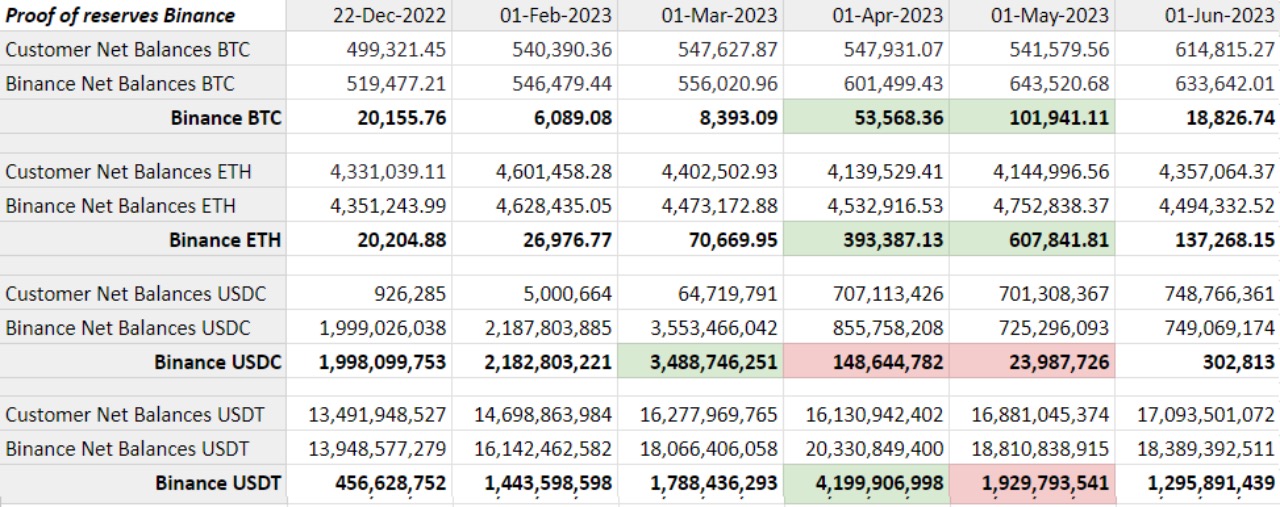 Binance Reserve balances from December 2022 to June 2023, source: Binance
And MakerDAO exchanged a large amount of USDC for U.S. dollars to buy U.S. bonds. From 2021 to May 2023, in MakerDAOs balance sheet, PSM stablecoin (more than 70% is USDC) assets account for more than half of MakerDAOs assets in most cases. After mid-May this year, the proportion of MakerDAOs RWA assets soared, accounting for about half, while its stablecoin assets fell below 15%. As of now, MakerDAOs stablecoin assets are about $700 million, while RWA assets are about $2.5 billion. In March before USDC was unanchored, MakerDAOs stable currency assets once reached nearly 4 billion US dollars. Equivalent to USDC in MakerDAOs asset reserve, at least more than 2 billion US dollars may have been converted into RWA assets such as U.S. bonds.
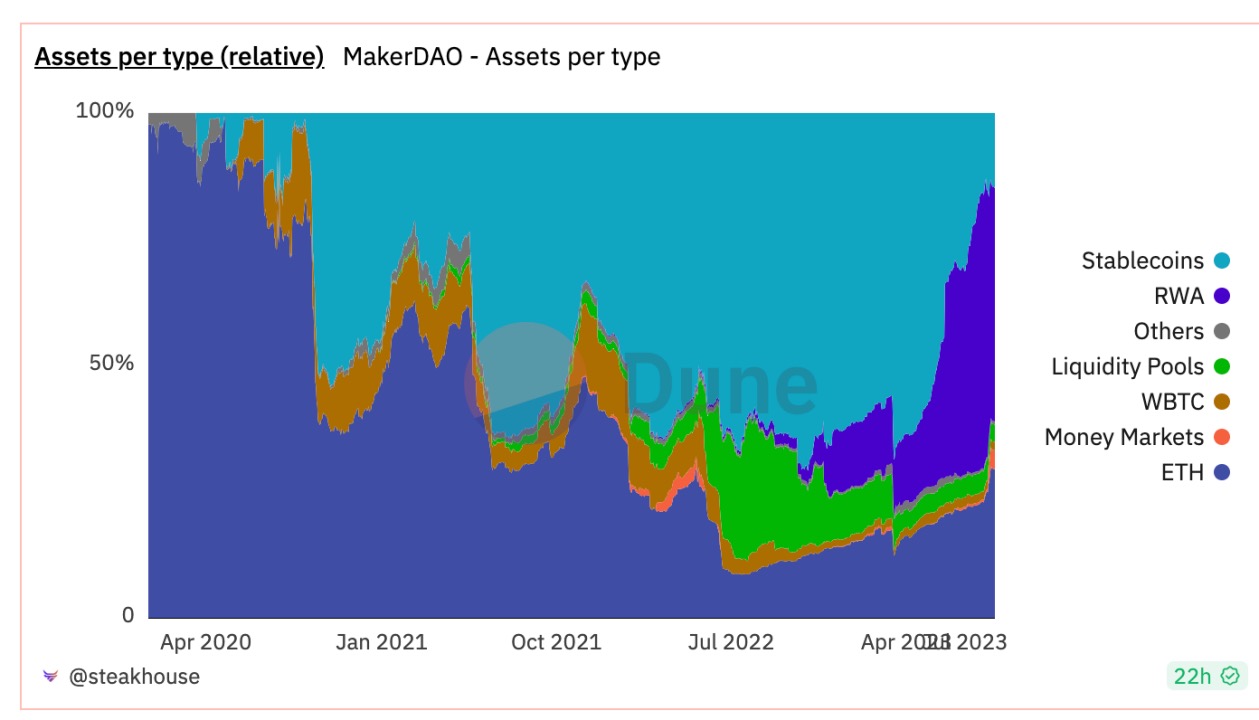
source:Dune Panel @SebVentures
Not only the decentralized stablecoin protocol MakeDAO has greatly reduced USDC assets, but the algorithmic stablecoin Frax has also continued to explore the introduction of RWA to reduce its dependence on USDC after USDC was unanchored. The upcoming Frax Finance V3 upgrade will focus on changing this situation. Sam Kazemian, founder of Frax Finance, mentioned the idea behind this upgrade in the process of interacting with the community: Since its establishment, FRAX has operated under the assumption that USDC will not be decoupled. But when USDC is depegged, the redemption value of 0.95 USDC + $0.05 FXS is less than $1.00. So FRAX v3 will change this with many new AMOs and features with a sovereign dollar peg.
As Binance, MakerDAO, etc. dumped a large number of USCD, the market value of USCD also continued to decline. According to CMC data, the market value of USDC has dropped from US$45 billion at the beginning of the year to about US$26 billion, a decline of 42%, and it has been in a downward trend for half a year.
With the recent announcement of the traditional payment giant PayPal to launch PYUSD, the competitive pressure facing USDC has further intensified. USDC and PYUSD can be said to face the most direct competition. As stablecoins that are also regulated by the United States, they have similar customer groups. As a Web3 payment giant, PYUSD has the advantages of 400 million peoples traffic and brand.
Under the anxiety of competition between old and new forces, Circle and Circle CEO Jeremy Allaire have been active recently. On the one hand, Circle CEO Jeremy Allaire disclosed Circle’s revenue proof in an interview with Bloomberg. Although Circle’s market value has declined, it is still operating well. Jeremy Allaire said that Circle’s revenue in the first half of this year was US$779 million, which has exceeded the US$772 million in the full year of 2022; the adjusted EBITDA in the first half of the year was US$219 million, which also exceeded the US$772 million in the full year of 2022. Annual revenue of $150 million. However, the USDC stablecoin is only one of Circles businesses, and the USDC part of the revenue is not disclosed.
In the face of competition from PYUSD, Jeremy Allair said that it has $1 billion in assets and liabilities, and has enough funds to deal with the competition. In addition, Jeremy Allaire also posted that despite the constant hype about the United States, the adoption rate of USDC outside the United States has reached 70%, and some of the fastest growing regions are emerging and developing markets. Jeremy Allaire seems to imply that the main customer base of PYUSD is in the United States, while USDC is mainly in regions outside the United States, and the competition between the two is not so exciting.
In addition to anxiety, USDC is also taking some measures to try to deal with the decline in USDC market value and the pressure of new competitors. On the one hand, Circle is focusing on developing emerging markets outside the United States, such as obtaining an encryption payment license in Singapore, and considering issuing stablecoins in Japan according to new regulations.
On the other hand, Circle is also working hard on ecological partners. According to Coinbase’s official announcement yesterday, Circle will welcome Coinbase’s shareholding. With Coinbase’s support, USDC also plans to launch on six new blockchains. It is worth mentioning that the cooperation between stablecoins and exchanges has long been successful. For example, the cooperation between USDT and Bitfinex, BUSD and Binance has indeed brought about a win-win situation.
Previously, Circle also reached an agreement with OKX to use USDC as payment for gas fees. In addition to listing USDC on Arbitrum, it also launched a wallet as a service platform for developers. In the future, it will also launch stablecoin cross-chain payment and a simplified smart contract development platform. At the same time, Circle recently announced the launch of an ecosystem funding plan supported by US$100,000 USDC to attract more ecological partners to use USDC. In addition, Circle has also cut costs and restarted the purchase of U.S. Treasury bonds as USDC reserve assets to obtain higher returns; it has also cut operating costs through layoffs.
Stablecoin New Battle: Regulation, RWA, Interest Generation, Web2 Giants
The market value of USDC continues to decline, and the stablecoin market structure is also being reshaped.
First of all, according to the Stablecoin and CBDC Report released by the cryptocurrency analysis platform CCData, the current total market value of stablecoins continues to decline to a range of 124 billion US dollars, setting the lowest record for the market value of stablecoins since August 2021. 17th month down.
During the period when the overall market value of stablecoins continued to weaken, the stablecoin market has been changing from the beginning of the year to the present, with great fluctuations. Almost all the major mainstream stablecoins with the highest market value have been affected to varying degrees. There have also been major changes.
First, in February this year, BUSD encountered a regulatory crackdown. The New York Department of Financial Services (NYDFS) announced an investigation into BUSD issuer Paxos, shortly after the US Securities and Exchange Commission (SEC) announced that it was suing Paxos for BUSD-related issues. BUSD, which has been strangled one after another by supervision, has seen its market value drop from US$16 billion in February to US$3.3 billion, a drop of nearly 80%. Its position as the third largest stablecoin after USDT and USDC has also given way to DAI.
Furthermore, due to the bank run in Silicon Valley, USDC, which has reserves in it, has also experienced the risk of a run and de-anchor. This also caused the above-mentioned Binance, MakerDAO and other large holders of USDC reserves to sell USDC and reduce their dependence on it. At present, USDC has dropped from US$45 billion at the beginning of the year to about US$26 billion, which is almost cut in half and hit the lowest level in nearly two years.
DAI, which was originally ranked after BUSD in market value, first saw a sharp drop in market value after the USDC de-anchoring incident, and was reborn due to the strategy of exchanging a large amount of reserve assets USDC for US bonds. At present, the market value has increased by more than 20% in the past two months, and it has jumped to the third largest stable currency.
USDT, which has been stable at the top, has been criticized for its lack of transparency in assets, but after the turmoil of BUSD and USDC, it has reaped the benefits of a fisherman, and its market value has continued to rise. Compared with the US$66 billion at the beginning of the year, the market value of USDT has risen 25.7% to $83 billion.
At present, the fifth largest stablecoin, TUSD (TrueUSD), has risen quietly and rapidly under the disputes of the top four stablecoins. Since March, its market value has more than doubled to about 3 billion US dollars, and it is the fastest growing stablecoin. one.
TUSD’s share of stablecoin trading volume on centralized cryptocurrency exchanges has climbed to 20 percent from less than 1 percent at the start of the year, according to data provider Kaiko.
The rapid rise of the little-known TUSD has also attracted a lot of speculation. The Wall Street Journal recentlyCurrency Doubts: Who Is Controlling Fast-Growing Stablecoin TrueUSD? An article raised questions about the people behind TrueUSD. The article mentioned that TrueUSD was founded in 2018, but was later renamed Archblock, and received financing from Peter Thiel’s Founders Fund, StartX affiliated with Stanford University, Andreessen Horowitz and Jump Trading.
The current TrueUSD co-founder is currently locked in a bitter legal battle over the circumstances surrounding An’s departure from the company. An said in a recent lawsuit that Justin Sun negotiated to acquire TrueUSD in 2020, but that An, as CEO, was ousted from the stablecoins parent company before the deal was finalized. His comments fueled speculation that Justin Sun was behind TrueUSD’s sudden growth. Previously, in July, a partner of crypto investment institution Cinneamhain Ventures broke the news that TUSD was related to Huobi Sun’s family and partners.
Another fastest-growing stablecoin other than TUSD is First Digital Labs’ FDUSD. After its launch on Binance last month, its market value jumped 1410% in August to $305 million. The current stablecoin market value ranks 11th. Second only to Frax. It is reported that DFDUSD is issued by FD 121 Limited (brand name First Digital Labs), a subsidiary of Hong Kong-based custodian company First Digital Limited. On June 1 this year, Changpeng Zhao announced that First Digital would issue stablecoins on the BNB smart chain. Due to the connection between FDUSD and Hong Kong and Binance, it is speculated that it is an alternative to BUSD chosen by Binance.
We have seen that among the top five stablecoins, DAI achieved a turnaround against the wind by exchanging the original stablecoin reserve assets for RWA assets such as U.S. bonds to obtain income and distribute part of the income to users. This year, like DAI, it launched an interest-bearing stablecoin in order to gain more market share. Such as Curve, Aave, but such old blue-chip DeFi, as well as new DeFi such as Lybra Finance and OpenEden, are more or less using interest-earning assets such as LSD and RWA to promote the development of their interest-bearing stablecoins.
In May of this year, Curve’s native stablecoin crvUSD was officially launched. Currently, crvUSD supports ETH, wbtc, wsteth, and sfrxETH three liquid pledge products as collateral, and over-mortgage mints crvUSD.Curve website dataIt shows that the minting of Curve’s native stablecoin crvUSD exceeded 120 million. Aave followed closely and launched the native stablecoin GHO in July. The principle of GHO and DAI is similar. It can be minted using Aaves aTokens as collateral assets. The difference is that aTokens is an interest-bearing asset. Aaves minting volume has already Breaking through 20 million coins.
Similar to Curve’s native stablecoin crvUSD, there are new LSD stablecoin protocols such as Lybra Finance and Prisma Finance that support LSD assets to mint interest-bearing stablecoins. Currently, the market value of Lybra Finances stablecoin eUSD has exceeded US$180 million, ranking fifteenth among stablecoins in terms of market value. In addition, the on-chain U.S. debt protocol represented by OpenEden allows users to invest in U.S. debt through its native stablecoin TBILL to obtain annualized returns. Currently, OpenEden’s TVL exceeds 12 million U.S. dollars.
In addition to the changes in the pattern of mainstream stablecoins, the competition for interest-bearing stablecoins has intensified. The profiteering business of stablecoins is also attracting Web2 payment giant PayPal. The current circulation of its stablecoin PYUSD has exceeded 30 million. With PayPal entering the stablecoin market, cryptographers such as Circle CEO predict that more non-encryption practitioners will flood into the stablecoin market.
As the regulatory framework is gradually implemented, will compliant stablecoins lead crypto into the mainstream?
Although the total market value of stablecoins has declined, the addition of Web2 giants such as PayPal may force the implementation of compliant stablecoins. At present, the regulatory framework for stablecoins in the core areas of encryption such as the United States, Singapore, and Hong Kong is gradually becoming clear.
At the beginning of the year, the U.S. SEC’s regulatory crackdown on BUSD once gave confidence to the stablecoin market; and the launch of PYUSD after half a year is considered to accelerate the implementation of the U.S. stablecoin bill.
When Paypal announced the launch of PYUSD, Patrick McHenry, chairman of the US House of Representatives Financial Services Committee, supported, Stablecoins issued under a clear regulatory framework are expected to become the backbone of our 21st century payment system. PayPals stablecoins continue to push legislation more than ever before. Time is more important.
At the end of July, the Financial Services Committee of the U.S. House of Representatives announced the passage of the Payment Stablecoin Transparency Act (Draft), which determines the regulatory path for approving and supervising stablecoin issuers, and also creates a unified federal payment stablecoin. Minimum Standards.
In addition to the United States, the Monetary Authority of Singapore was the first to publish the MAS Finalizes Stablecoin Regulatory Framework. This legal stability framework determines the scope of regulatory use, as well as key requirements in multiple dimensions such as reserve assets and information disclosure that issuers need to meet before issuing stablecoins.
Regarding the regulation of stable currency in Hong Kong, in July, Xu Zhengyu, director of the Hong Kong Treasury Bureau, revealed in a public interview that the Hong Kong Monetary Authority is drafting a regulatory framework for stable currency and plans to conduct a second round of public consultation within this year. Implementation of regulatory arrangements in 2023/2024.
Many crypto insiders believe that with the gradual implementation of regulations, compliant stablecoins may be one of the keys for crypto applications to be involved in the main economic cycle.





