






Ecological landing is imminent, what surprises will the AA wallet bring?


On August 9th, OKX Chinese Community and Odaily jointly organized a Twitter Space event. OKX Wallet builder Degen Yin, Bitizen Wallet core developer Winson, dappOS CTO Andy, CyberConnect co-founder Zhimao, Mantle infrastructure growth leader Zuki, UniPass Research Institute cyberorange, and Odaily author Qin Xiaofeng had a comprehensive discussion on the development and related issues of the AA wallet.
Recently, OKX launched the AA smart contract wallet and will open source the smart contract code of the wallet this week. Users can interact with multiple contracts in a single transaction through the AA smart contract wallet. As one of the first wallets to support multi-chain abstraction, OKX Web3 wallet can meet the needs of experienced users at different levels, as well as provide convenience and a user-friendly wallet experience for beginners.
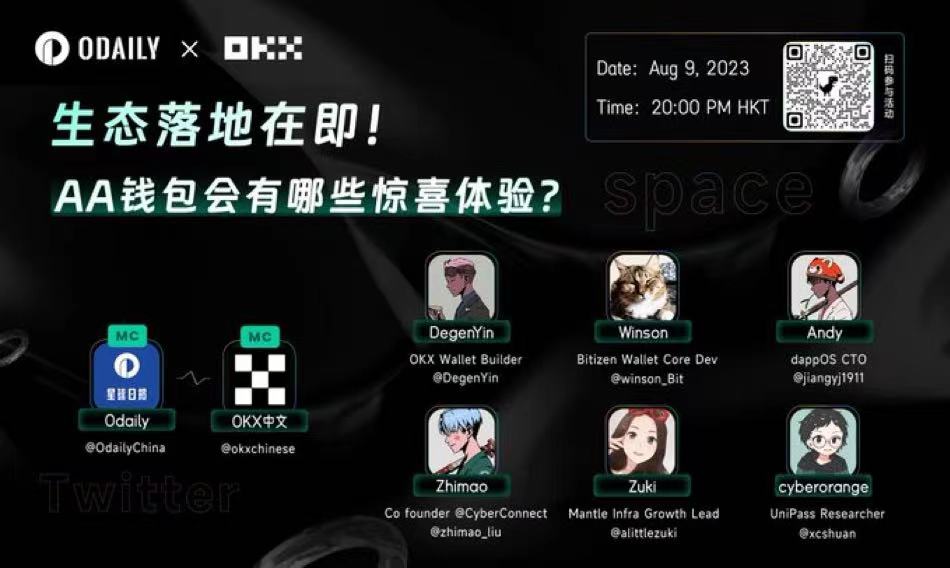
Qin Xiaofeng: First, let each guest introduce themselves and their respective projects.
Andy: Hello, everyone. I am Andy, the technical director of dappOS solution. Our main focus is on account abstraction and chain abstraction. In June, we received seed funding from Redshirt Capital and OKX Ventures. The main direction of our project is to aggregate liquidity from different chains. Users can interact with any DAPP on any chain by signing a transaction once on our platform.
Winson: Hello, everyone. I am Winson, the founder and developer of BitzenWallet. BitzenWallet is an MPC wallet launched by a Chinese team. We implement the MPC+AA solution. The technical feature is that the underlying architecture is MPC, and the upper layer supports EOA or AA. Our own AA wallet will be launched soon.
Zhimao: Hello, everyone. I am Zhimao, the founder of CyberConnect. As a Web3 social protocol, in the V3 version, we integrate account abstraction, ERC-4337, ERC-3600, and other popular ideas into the protocol design. With a focus on user social interaction, we will soon launch our own AA wallet.
Zuki: Hello, everyone. I am Zuki, responsible for the infrastructure and tools growth at Mantle Network. Mantle Network is an L2 based on OP and went live on the mainnet in July. It was incubated by the largest DAO organization, BitDAO. Currently, it has partnered with BitDAO and is working on integrating various protocols to simplify liquidity aggregation.
Restructuring. Currently, the TVL of Mantle Network has reached $100 million, deploying over 100 DAPPs. In addition to supporting ERC 4337, Mantle also cooperates with AA infrastructure to build corresponding infrastructure. As a modular network, Mantle serves as the settlement layer, with consensus relying on L1, and data availability (DA) layer, allowing us to save 50%-70% on Gas Fees compared to other L2 solutions.
Cyberorange: Hello, everyone, I am Cyberorange, a researcher at UniPass ID. UniPass ID is an early team in China focusing on smart wallets, including continuous follow-up on new EIPs. We are a wallet that implements email and Google login on the chain. We will soon launch a swap product for MetaMask.
Yin: I am Yin, the person in charge of the development of the OKX mobile wallet. The OKX wallet has launched the MPC wallet and AA wallet. As a widely used application in the industry, the OKX wallet hopes to drive the industry development and ecosystem construction of AA smart contract wallets.
Qin Xiaofeng: What is the evolution path of Web3 wallets?
Winson: I have been involved in this industry since 2013. The development of Web3 wallets has progressed from early command-line wallets to PC clients, from mnemonic wallets to HD wallets with the development of BIP. We can look at the development of wallets from other perspectives as well, such as plugin wallets, mobile wallets, client wallets, browser wallets, and web-based wallets. However, mnemonic wallets are still the mainstream in terms of technical principles.
aph text-align-type-left">Subsequently, the new type of MPC wallet introduced in 2019 is actually used to replace the private key entity. Smart contract wallets were actually introduced as early as 2018 and 2019, but there was no unified standard at the time. It was not until recently with the introduction of ERC 4337 that a new standard was set for AA wallets, forming a unified industry specification and providing a better foundation for ecosystem development.
Yin: From a historical perspective, Winson has already discussed it in detail. I was fortunate to attend V-God's speech in 2017, where he was already promoting smart contract wallets as the mainstream on-chain interactive wallet type. However, due to some resistance, it was not until recently that ERC 4337 was introduced. Subsequently, I had the opportunity to have a direct conversation with V-God in Paris as an OKX representative regarding ERC 4337. I also communicated with relevant teams and learned that the standard of ERC 4337 is still evolving but will soon be established as the final standard.
Qin Xiaofeng: AA wallets have been developed for many years. Is the development of AA wallets driven by user demand or the new ERC 4337 standard introduced by Ethereum?
Cyberorange: Actually, before the appearance of ERC 4337, smart wallets already existed as a track, similar to Urgent. However, I think the current trend of AA wallets, the narrative of ERC 4337, and the promotion by the Ethereum Foundation have attracted more attention to this track and attracted more funding.
First of all, we can see that there is definitely more demand. Compared to previous smart contract wallets, which had relatively limited functionality, mostly for account recovery through setting a manager, the evolution of smart contract wallet functionality now includes features like strategic rebalancing and flash loans, which better meet user needs. Additionally, compared to the previous bull market, there are now more EVM chains in the market, and everyone's assets are fragmented. Therefore, there is a need for smart contract wallets to perform cross-chain transactions.
Furthermore, the current infrastructure is alsoIn progress, if you implement these functionalities on Ethereum, the Gas Fee will be high. However, Ethereum is currently pushing for scalability solutions centered around Rollup. At least for now, on Layer 2 solutions like Mentle, using an AA wallet is not much more expensive compared to an EOA wallet. Moreover, more and more Rollup projects are incorporating AA wallets as a built-in feature, such as Starknet or zk-Sync. So, overall, the development of AA wallets is driven by demand, infrastructure, and narratives. Zhimao: Personally, I think the development of AA wallets is mainly driven by user demand, considering two aspects: Firstly, when wallets enter the upstream infrastructure of blockchain systems as regular users, there are two major obstacles. The first obstacle is the complexity of managing private keys and mnemonic phrases, which is slightly higher for ordinary users. The second obstacle is the source of Gas Fee. When you interact with any blockchain system, you will encounter Gas Fee. Based on these two points, I believe that the development of AA wallets, as well as the latest ERC-4337, offer more solutions, resulting in a flourishing ecosystem of wallets. For the account abstraction provided by AA wallets, it essentially separates the account interaction with the blockchain from the underlying authentication and verification logic, enabling use cases such as MPC sharding or application delegation through a studio's agents. For example, Twitter, Gmail, or Discord can be used for account verification, reducing the complexity of key management for users. Secondly, regarding the Gas Fee mentioned earlier, the core innovation of ERC-4337 is to change the lifecycle of existing transactions and provide a good way to obtain threads. The market allows third parties, agents, or wallet projects to define flexible Gas Fee and authorization strategies to assist new users entering the blockchain system. Additionally, in the account abstraction system, wallets can better manage Gas Fee.The management and payment logic.
From these two points, I think the development of AA wallet and ERC 4337 is a user-driven process.
Winson: Regarding this issue, my opinion is slightly different from everyone else. I still believe that the development of ERC 4437 may be driven more by the Ethereum Foundation. In fact, AA wallet has been providing users with a good experience for a long time, and this method of paying gas with stablecoins was already present in the early days. Paying gas fees with other tokens, similar to batch transactions, social recoveries, and the benefits that AA wallet brings to C-end users, have existed in previous years. Just like the Urgent Wallet that everyone is familiar with now, a subsidy program for users' gas fees was available two or three years ago. So I do not think the development of AA wallet is driven by user demand, but rather by the Ethereum Foundation, especially since Vitalik is a programmer who prefers programmable products. Therefore, promoting the development of AA wallet has its own vision and mission. At the same time, Vitalik believes that EOA (externally owned account) cannot be programmed and will limit the development of Ethereum. In fact, Vitalik has put a lot of effort into pushing this, including supporting many early projects. Taking Urgent Wallet as an example, during the DeFi summer, the number of users was not yet in the millions. It is also evident from the traces that the application of smart wallets is driven by the Ethereum Foundation, or more specifically, by Vitalik's significant efforts.
Zuki: I actually agree with what Wilson said because many people compare AA wallet to the iPhone in the cryptocurrency world. However, I don't think the birth of the iPhone was driven by user demand either. Although the result is beneficial to users, in reality, users themselves don't know what they want.
From an industrial construction perspective, the driving force behind demand is the need for products and projects to attract more users, such as the introduction of ERC 4337, in order to lower the barriers and costs for users. Even project owners...Can help users pay upfront fees so that new users can participate in Web3 applications without making a deposit, which also promotes the entire industry. Yin: Through communication with Julian, the founder of Urgent, it was found that in the face of developers, AA and EOA, they prefer the latter because of their first-mover advantage and the fact that users are more accustomed to the EOA wallet model. At the same time, the development of the old model costs less. So my opinion is more inclined to rely on the Ethereum Foundation in the early stages to promote more developers to enter this sector, and create new features based on user needs in the later stages. Qin Xiaofeng: What are the specific application scenarios for AA wallets compared to EOA and CA accounts? Zhimao: I think innovation in social and gaming scenarios would be interesting, with the more flexible Gas Fee reimbursement logic as a standard process. For example, in a full-chain game, you need to repeatedly sign to proceed to the next step, but with an AA wallet, the overall gaming experience will be greatly improved. Cyberorange: I believe that when looking for application scenarios for AA wallets, we should consider them from the perspective of application needs. AA wallet involvement can help improve the overall use of certain aspects of the application. For example, flash loans are usually used by scientists, as regular users wouldn't write smart contracts. But AA accounts can open corresponding modules to help regular users participate in this way. Or, in the case of full-chain games that require frequent interaction, AA wallets can also be used. Winson: I think AA wallets are more suitable for advanced application scenarios, such as combining multiple interactions into one or automating operations. If we only consider regular frequency interactions, then EOA wallets are already sufficient. Zuki: Since AA wallets are smart contracts, they have strong scalability in different scenarios, providing additional capabilities for many projects.The custom function. For example, in Dex, steps that require multiple interactions can be bundled into one, enhancing user experience even though Gas Fee remains unchanged. Or for features that haven't been implemented yet, such as social recovery or intimacy payment in traditional transactions. It can also simplify the user experience of browsing Web3 without the need to pay specific Gas requirements in a network, attracting more users.
Andy: Coincidentally, dappOS is developing in this direction. The first is multi-operation aggregation, and the second is the ability to interact on different chains without the need for corresponding chain tokens. Gas Fee can be paid using stablecoins or tokens on other chains. A better scenario is when a large account wants to do asset management, it is normally high-risk to directly entrust the account to a third party. However, with an AA wallet, specific authorization can be given to a quantitative team, allowing them to manage your funds. Currently, for me, the most advanced feature is the realization of chain abstraction. Due to the different Chain IDs, a transaction can only be used once on a specific ID during signing and cannot be replayed. This makes it impossible to aggregate liquidity. However, the current solution treats the money in each wallet on each chain as a whole account, just like a centralized exchange.
Qin Xiaofeng: Which will have a better development, the MPC wallet or the AA wallet?
Yin: In the short term, from a user experience perspective, the MPC wallet is more convenient than the AA wallet as it can ignore mnemonic phrases and achieve fragmentation. However, in the future development of wallets, the MPC wallet, based on old features and recovery from a previous perspective, may never be able to avoid attacks. On the other hand, the AA wallet can replace the original with social recovery or other methods, making it more secure. Therefore, OKX wallet will empower users to freely choose between MPC+EOA or MPC+AA accounts to experience. At the current stage, the decision-making power is given to the users to choose for themselves.
Winson: Regarding this issue, I wrote an article specifically addressing this last month. In it, I believe that Vitalik Buterin (V God) has great resistance to this matter. I think these are two different technologies, so why can't they be combined and used where they are most suitable? In other words, based on the scope of my current knowledge, I believe that...A is inseparable from MPC. If AA leaves MPC, there is a fundamental flaw. The core value of MPC is to solve the single point failure problem of private keys. This is actually a very big contribution. At the same time, the AA wallet also needs a private key and needs to solve the single point failure problem. For example, when your private key is stolen without your knowledge, how do you recover socially? In addition, it will be difficult for the AA wallet to introduce social recovery functionality. For example, if you make changes to a wallet's social recovery on a chain, how do you synchronize this state with other addresses and columns? This problem has always existed. At the same time, how to solve the problem of high Gas Fee. So, I think MPC and AA should coexist. Zhimao: I think that MPC, as a technology, does not stand in opposition to AA. I believe that in the future, the two should be combined. Cyberorange: I think there are still some advantages to using MPC wallets compared to AA wallets. Firstly, the Gas Fee is lower and it is more compatible with heterogeneous chains. AA currently supports EVM, but it is more difficult for other chains. The role of MPC wallets is relatively static, but AA wallets can continuously evolve with the project. In the future, AA will become mainstream, and MPC will also be an important key management method in AA wallets. Andy: I agree with what Teacher Winson said just now. The two are not opposing concepts. As a developer, I also want to explain why this is the case. The biggest problem with AA contracts is that they cannot initiate transactions actively. Who can prove that you can control the contract and the money in it? It needs someone to execute transactions on your behalf. So, there is always an unavoidable problem - permission control. Ultimately, the issue of private keys cannot be avoided. To avoid single point failures, AA wallets need to introduce MPC solutions. Qin Xiaofeng: What is the current development status of AA wallets?g>
Yin: It's not yet a hot topic to consider AA wallet, and there are no airdrop expectations. However, recently, OKX AA wallet has introduced a guide and prompted users to claim under AirDrop. For example, you can claim the airdrop of Cyber Connect on the OP chain through OKX wallet.
Zhimao: From the perspective of project developers, since the promotion of ERC 4337, there have been many interesting solutions. For example, making the accounts more elegant and flexible. From the perspective of practical issues, projects should address corresponding needs.
From a data perspective, ever since the creation of the ERC 4337 standard, the entire track is still in a very new field. Project developers are still designing around the standard.
Cyberorange: AA wallet needs to find breakthroughs in user demands. With the introduction of ERC 4377, some projects can lower the user entry threshold by accepting fiat payments. Initial focus should be on meeting the demands of large account holders and automating the interaction.
Winson: AA wallet is still in its early stages, and there are still some unresolved issues in the development process. More EIP standards are needed for improvement. However, ERC 4337 has laid down the basic standard, and further improvement will take time.
Zuki: Currently, AA smart contracts are focusing on two directions. One is from the application perspective, such as the wallet as an entry point, and the other is in the infrastructure domain, how to lower the user entry threshold. I believe that from the perspective of the wallet, project developers can consider integrating advancements in new infrastructure to make it more usable and commercially viable.
Qin Xiaofeng: Will gas be an obstacle to the development of AA wallets?
Yin: Indeed, the issue of Gas Fee is quite troublesome, especially on the Ethereum network, where deploying contracts is the most expensive step. This problem cannot be completely solved in the short term. However, on other chains besides Ethereum, such as L2, the user experience is very good. Therefore, OKX will continue to optimize and explore new solutions, and currently, we recommend everyone to experience L2.
Zhimao: The Gas problem will exist in the short term, but in the future, we will move towards L2 or L3, and there won't be a Gas WAR issue. For example, Ethereum's upgrade increased the data blocks, which can reduce Gas Fees on L2. More applications will develop their own dedicated chains, so the Gas problem will not be too high.
Cyberorange: Using Ethereum as an AA wallet usage scenario, the issue of high Gas Fees needs to be solved through Ethereum's upgrade. After ERC-4844 is released, using AA wallets on L2 will be no different from using EOA wallets.
Winson: This problem mainly arises from the high cost of Ethereum tokens. Currently, it is mainly reflected in the high Gas Fees for initial contract deployment. The best solution is for the project party of AA wallets to subsidize and reduce the user's usage costs.
Qin Xiaofeng: What role does integrating AA wallets into the existing products of OKX Wallet and making it open source play in popularizing AA wallets?
Yin: Of course, we hope that OKX Wallet, as a carrier with a certain user base in this industry, can promote industry-level innovation and the vigorous development of the ecosystem. We hope to have a positive impact on industry developers. In the future, we will also open APIs to make it easier for third-party developers to integrate OKX AA wallets. Together, from different aspects, we can promote the development of smart contract accounts.





