






LD Track Weekly Report (2023/07/10): RWA continues to be a hot topic, with trading volumes remaining at a low level.


Summary
Lending: RWA narrative continues, Maker buyback case attracts market attention.
LSD: Last week, the ETH collateralization rate rose to 19.89%, a 0.92% increase compared to the previous period. The activation speed of beacon chain validators has increased from activating 2025 validators per day to 2200 validators per day. Last week, there were 2390.91 million ETH locked in the beacon chain, corresponding to a collateralization rate of 19.89%, a 0.92% increase compared to the previous period, with the growth rate remaining but slowing down; among them, there were 655.6 thousand active validation nodes, a 1.60% increase compared to the previous period, and 85.5 thousand validation nodes in the queue, a 5.74% decrease compared to the previous period; the number of active validators has exceeded the threshold of 655,360, and the number of validators activated per day has increased to 2200.
Ethereum L2: Layer 2 TVL decreased by approximately $300 million compared to last week, with a total locked amount of $9.64 billion. Zksync era ended its continuous upward trend lasting nearly two months last week, and TVL subsequently dropped to $642 million, a decrease compared to last week. 12% .
DEX: Dex combined TVL 15.32 billion, decreased by 0.41 bln compared to last week. Dex 24-hour trading volume 1.32 billion, 7-day trading volume 14.99 billion, decreased by 1.54 billion compared to last week.
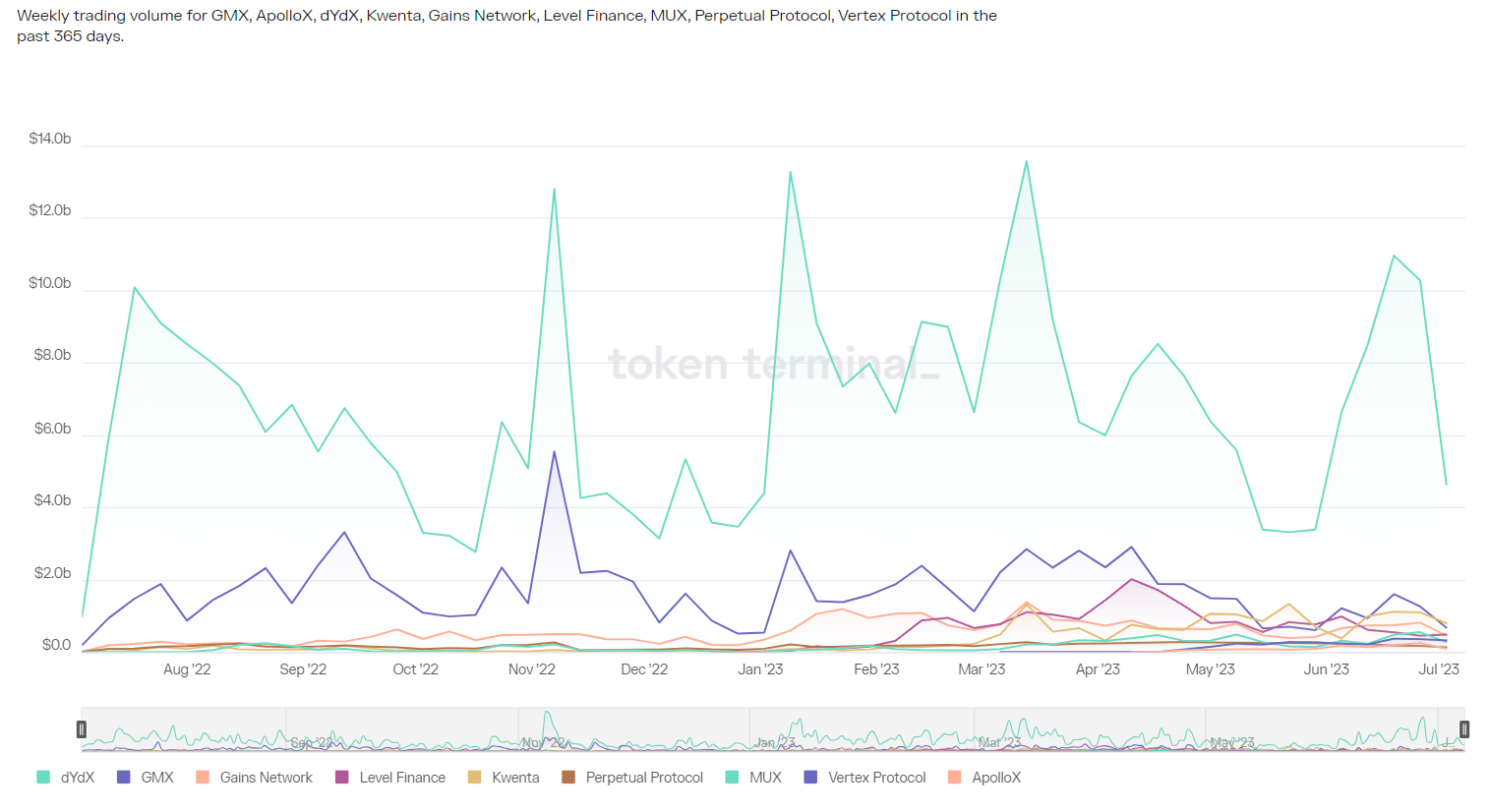
Derivatives DEX: The overall trading volume of derivatives DEX decreased significantly compared to the previous week (July 3rd to July 9th). The weekly trading volume of 9 major derivatives DEX protocols was approximately 8.6 billion USD, while the previous week's weekly trading volume was approximately 15.2 billion USD, a decline of 43%. Overall, the trading volume this week is at a relatively low level within this year. The weekly trading volume at the end of May and the beginning of June was the lowest level in 2023, at around 6.6 billion USD.
Lending
MakerDAO
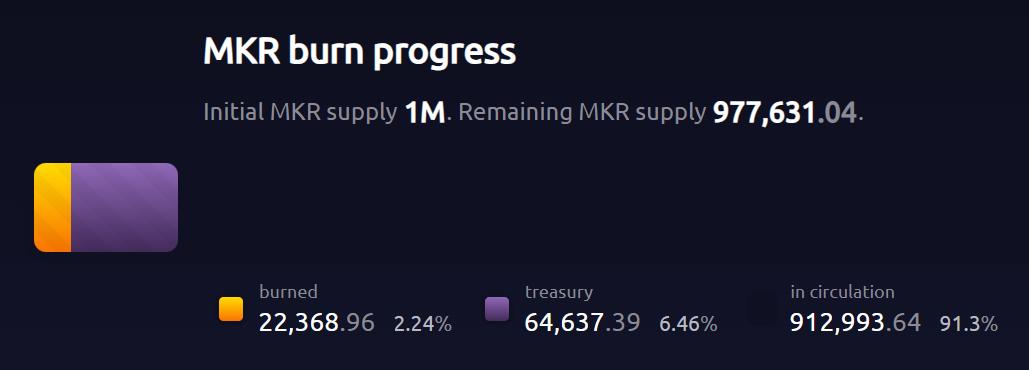
MakerDAO is one of the most popular projects recently, and there is a discussion on "Maker's introduction of smart destruction.Engine, change the protocol surplus usage proposal was officially passed through the Maker community governance survey on June 29, which also led to a significant increase in the price of MKR tokens. The strategy that Maker previously implemented was to repurchase MKR tokens with the protocol surplus and destroy them, thereby causing the MKR token economy to enter deflation. The repurchase mechanism would only be triggered when the protocol surplus reaches 250 million US dollars. Currently, the protocol surplus is around 70 million Dai, which is far from reaching the repurchase standard. MKR has been launched for 5 years, with a total token supply of 1 million. The burn rate is only 2.24%, which has a limited impact on token circulation. Additionally, MKR can only serve as a governance token with limited captured value.
Source: makerburn
If the new proposal is implemented, the buyback mechanism will be triggered when the protocol surplus reaches 50 million Dai. Half of the amount exceeding this threshold will be periodically repurchased as MKR. The repurchased MKR will be combined with the other half of the Dai to provide liquidity in the Uniswap market. This means that currently 10 million Dai will be repurchased as MKR and the other 10 million Dai will be used to provide liquidity in the market.
It's important to note that the Maker governance process consists of two steps: the governance poll proposal is only for obtaining community consensus. After the governance poll proposal is approved, the team will implement the proposal online. The proposal will formally take effect only after it is approved in the execution proposal vote. This means that the "MKR surplus usage method" will require another round of execution proposal to take effect, and the execution proposal is not currently online.
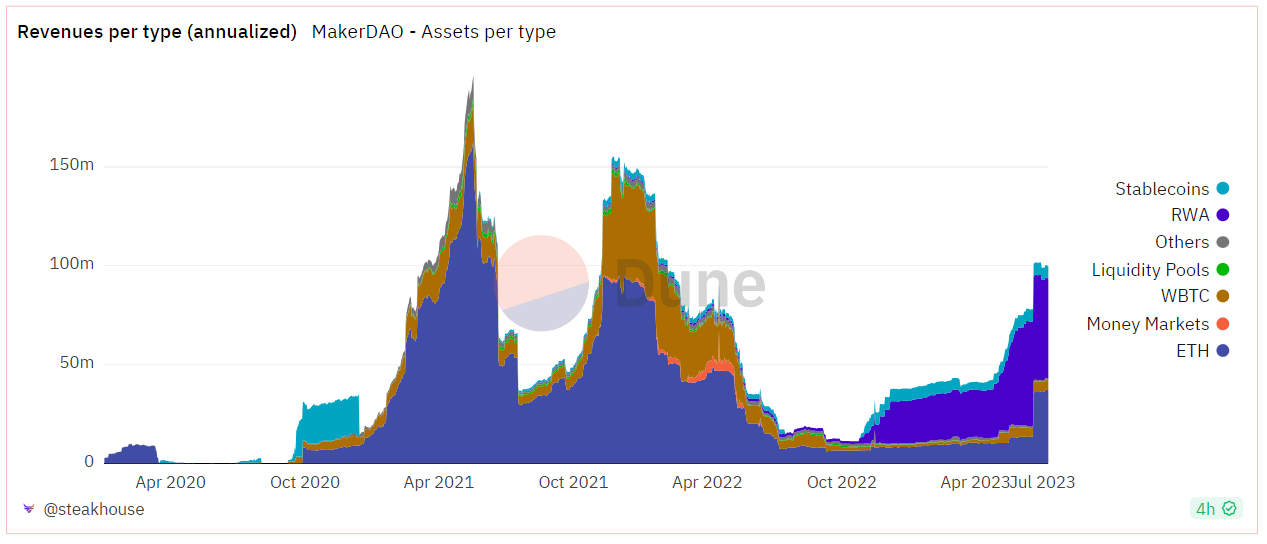
The main sources of revenue for the Maker protocol are: 1) minting Dai.i 's stable fee income, namely borrowing Dai interest; 2) liquidation penalty income from insufficient collateral assets; 3) RWA asset income. Since November 2022, RWA has become Maker's largest source of income.
Source: Dune Analytics
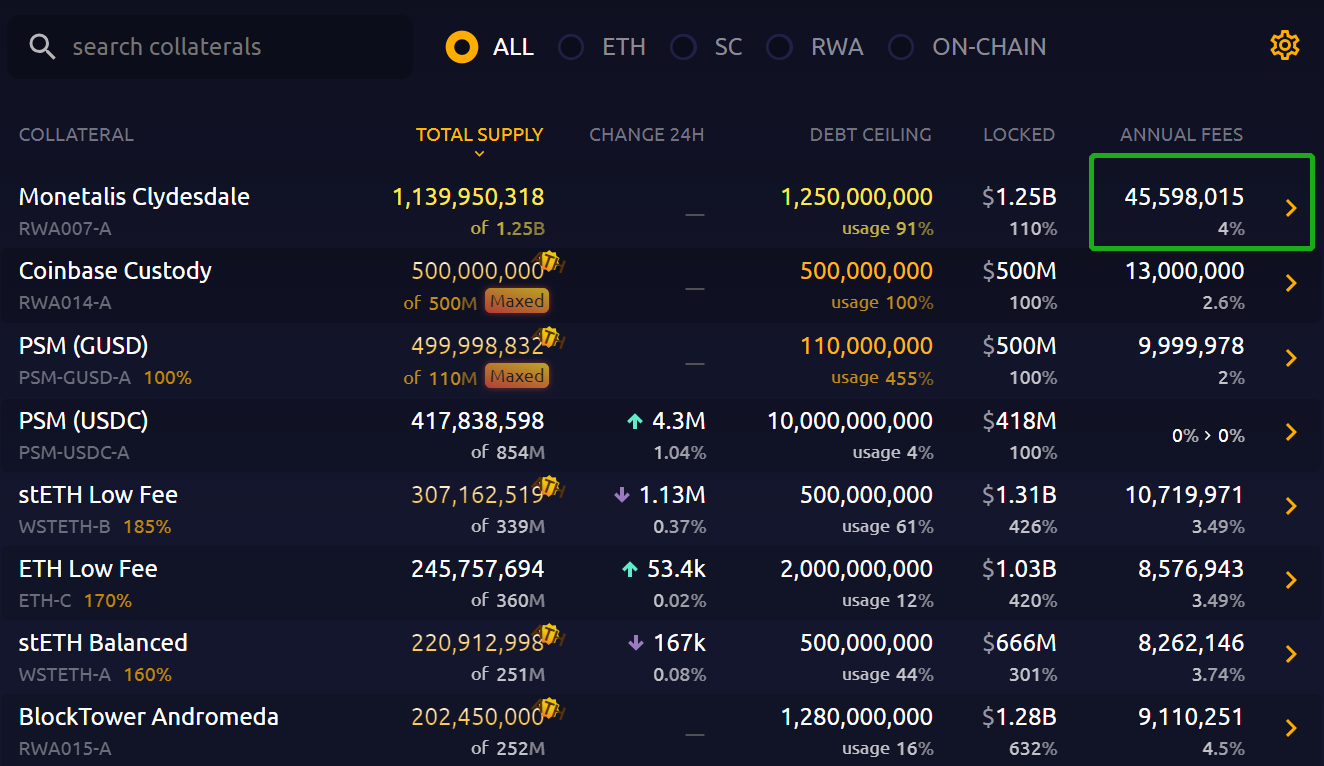
Among these, the annualized return of US Treasury bonds managed by Monetalis Clydesdale is the highest, about 4.5 times the income from Maker's largest CDP collateral stETH, and it plays an important role in improving the income and expenditure of the Maker protocol.
Source: makerburn
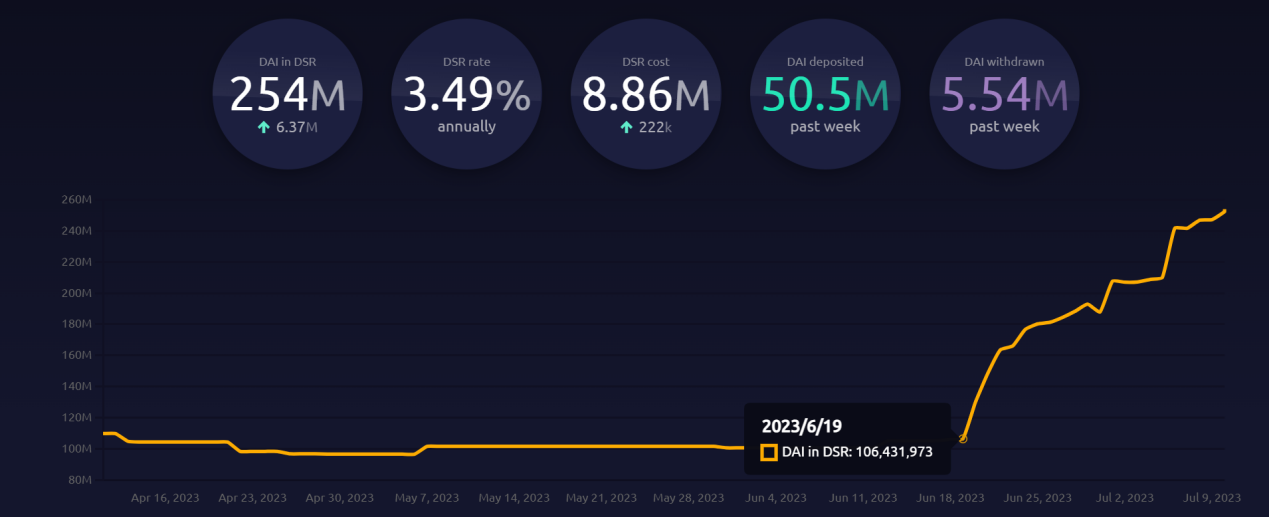
Macro environment background, the yield of 10-year US Treasury bonds continues to climb to around 4%, which also enhances the confidence of the Maker community in the continuous expansion of RWA scale, by "sucking blood" from the US Treasury to increase revenue. To achieve this goal, Maker has also recently raised the DSR deposit interest rate to 3.49%, encouraging USDC holders to exchange USDC for DAI through PSM, and the team can redeem the absorbed USDC for dollars for reinvestment.
Since the announcement of the DSR rate increase on June 19th, DAI in the DSR has increased from 106 million to 254 million, an increase of nearly 140%, with a growth of 50 million DAI in the past week, still maintaining a relatively high growth rate.
Source: makerburn
Compound
Compound founder Robert recently announced the establishment of a new company, Superstate, and received $4 million in seed funding, targeting the current narrative hotspot RWA, committed to purchasing short-term US Treasuries and putting them on the blockchain. Compound token prices have also experienced significant increases recently.
On July 7th, Compound Labs released the non-custodial DeFi mechanism "Encumber", which separates token ownership and transfer rights. With this mechanism, token owners can retain ownership interests while participating in DeFi activities, such as airdrops, governance, etc. For example, users can use tokens as collateral for loans while retaining token ownership and corresponding earnings.
Venus
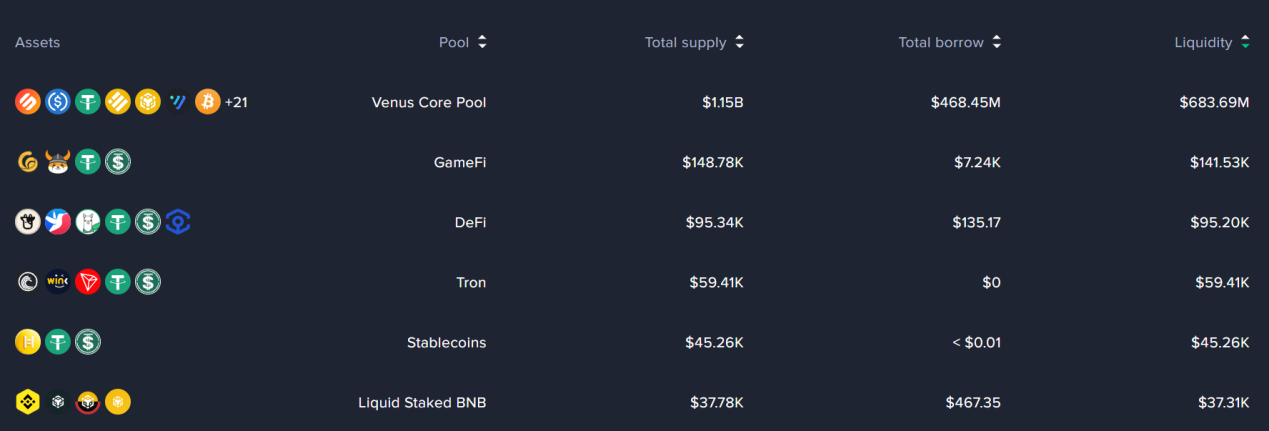
Venus officially launched the isolated mode lending pool on July 7th. In addition to the core high liquidity lending pool, Venus has added pools for GameFi, Tron, BNB derivative pledge assets, etc. The purpose is to provide liquidity for long-tail assets while isolating potential security risks associated with these assets.
Currently, the isolated pool has attracted assets of about $38.7 thousand, with only $7,000 in loans. The protocol's boost is not significant, so further development needs to be observed.
Source: Venus Protocol
LSD
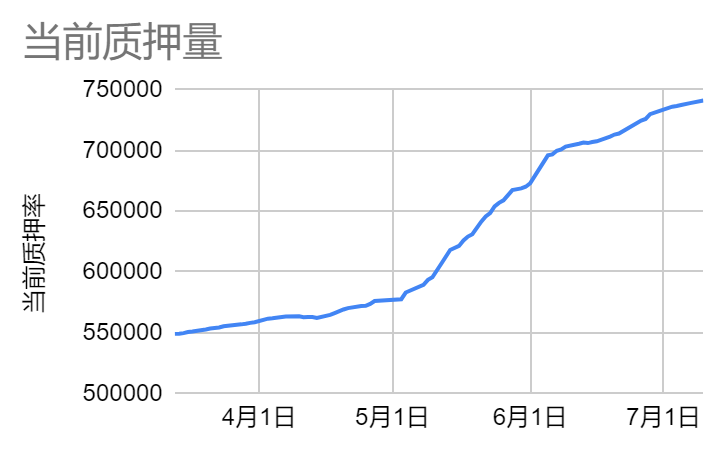
The ETH staking rate rose to 19.89% last week, an increase of 0.92% compared to the previous period. The activation speed of validators on the beacon chain has increased from activating 2025 validators per day to 2200 validators per day. Last week, a total of 2390.91 million ETH were locked in the beacon chain, corresponding to a staking rate of 19.89%, with a 0.92% increase compared to the previous period. The growth is sustained but the growth rate has slowed down. There were 655.6k active validation nodes, a 1.60% increase compared to the previous period, and 85.5k validation nodes in the queue, a 5.74% decrease compared to the previous period. The number of active validators has exceeded the threshold of 655,360, and the number of validators activated per day has increased to 2200.
The overall staking amount continues to grow, but the growth rate has slowed down.
Source: LD Capital
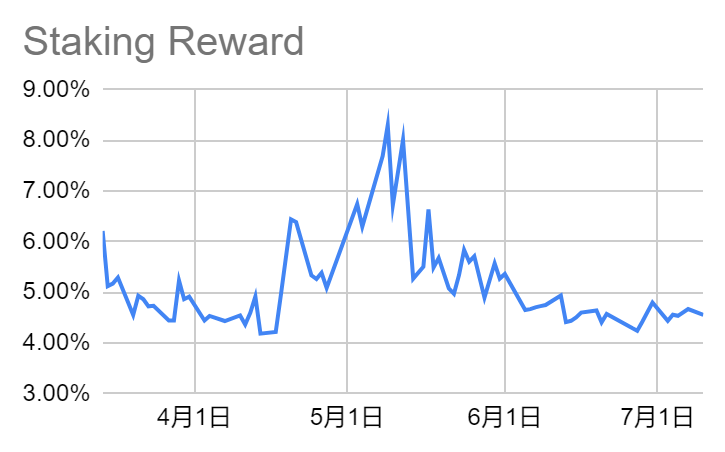
ETH staking yield remains around 4.5%
Source: LD Capital
In terms of price performance in the three LSD protocols, LDO fell 12.3% in the past week, RPL fell 6.3%, and FXS rose 6.8%; in terms of ETH staking volume, Lido rose 1.15% in the past week, Rocket Pool rose 1.02%, and Frax rose 0.55%; Currently, there are 92 nodes in the Rocket Pool minipool queue, and the deposit pool is being cleared; Frax has recently received some attention due to the attack on Multichain and the consistent security of Fraxferry cross-chain bridge.
Last week, SSV released the mainnet online plan, clarifying the participants, work objectives, and launch time of each stage of the protocol. The mainnet launch of SSV is divided into four stages: Currently in the first stage Pre-Launch, the operators, nodes, and ETH staked are all from the team; the second stage Limited Launch is expected to go live in August, introducing partner operators, nodes, and ETH staked by the team; the third stage Launch is expected to go live in September, maintaining partner operators, introducing partner nodes, andnbsp;ETH staking, this phase will incorporate the protocol TVL into the team's work goals; the fourth phase, Permissionless Launch, will fully open up the scope of operators, nodes, and ETH staking, and is expected to launch in November.
SSV mainnet launch phased plan
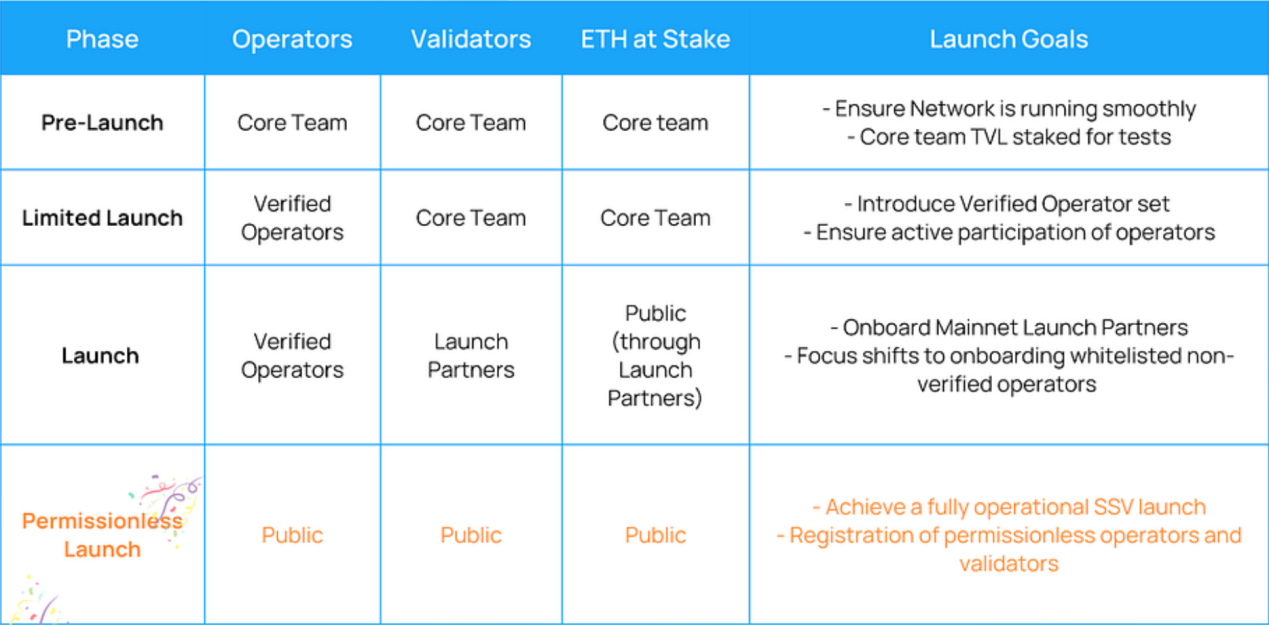
Source: ssv.network, LD Capital
The downstream protocol Pendle has launched on BNBchain, currently supporting Ethereum, Arbitrum, and BNBchain. TVL has grown to 133.95M. The vePENDLE staking amount is 37,621,376, a decrease of 31,000 tokens compared to 7 days ago, and a decrease of 1.1 million tokens compared to 30 days ago.
Penpie and Equilibria have jointly converted 15.05M PENDLE tokens. Although the staking amount has increased by 350,000 tokens compared to last week, there is no significant increase in the conversion of PENDLE between the two protocols during the peak period in the middle of the week. Equilibria is partnering with Maverick and plans to open the ePENDLE/PENDLE pool on July 14th at 6 PM, potentially creating selling pressure.
Ethereum L2
TVL
Layer 2 TVL decreased by approximately $300 million compared to last week, with a total locked amount of $9.64 billion.
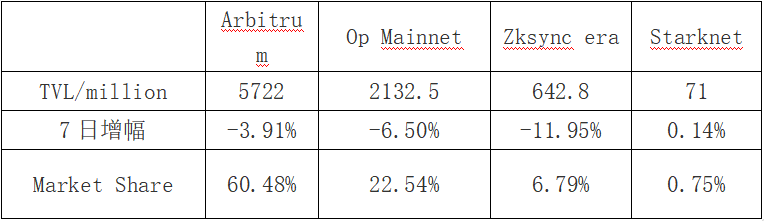
Data Source: l 2 b eat
Zksync era ended its continuous upward trend that lasted for nearly two months last week, and the TVL fell to 642 million US dollars, a decrease of 12% compared to last week.
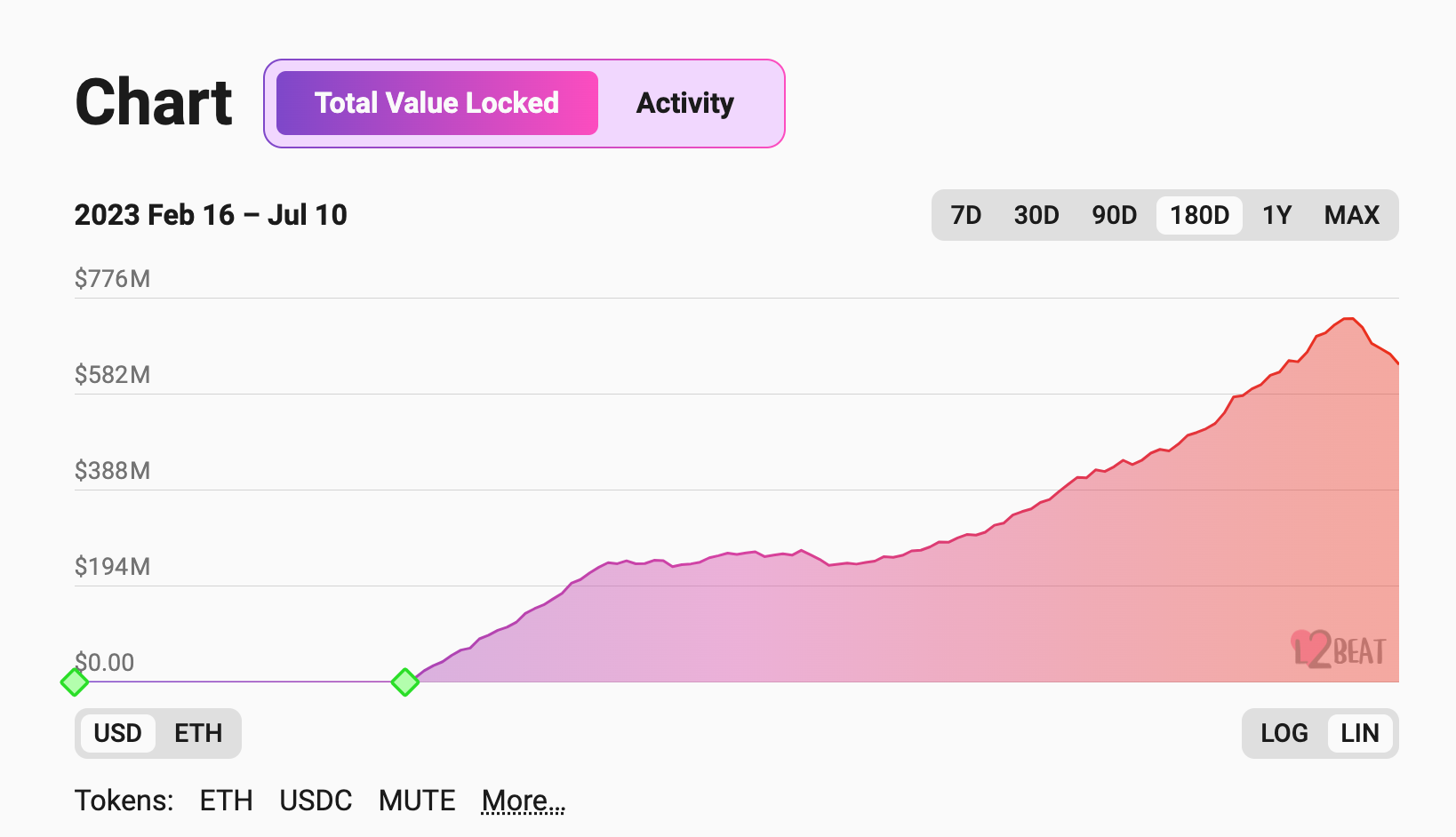
Cross-chain funding situation




Cross-chain funds on the four chains have decreased compared to last week. Zksync still has the highest cross-chain funds, which have decreased from last week's 75,000 ETH to 55,000 ETH. However, it still has a TVB of up to 55,000 ETH.
On-chain activity
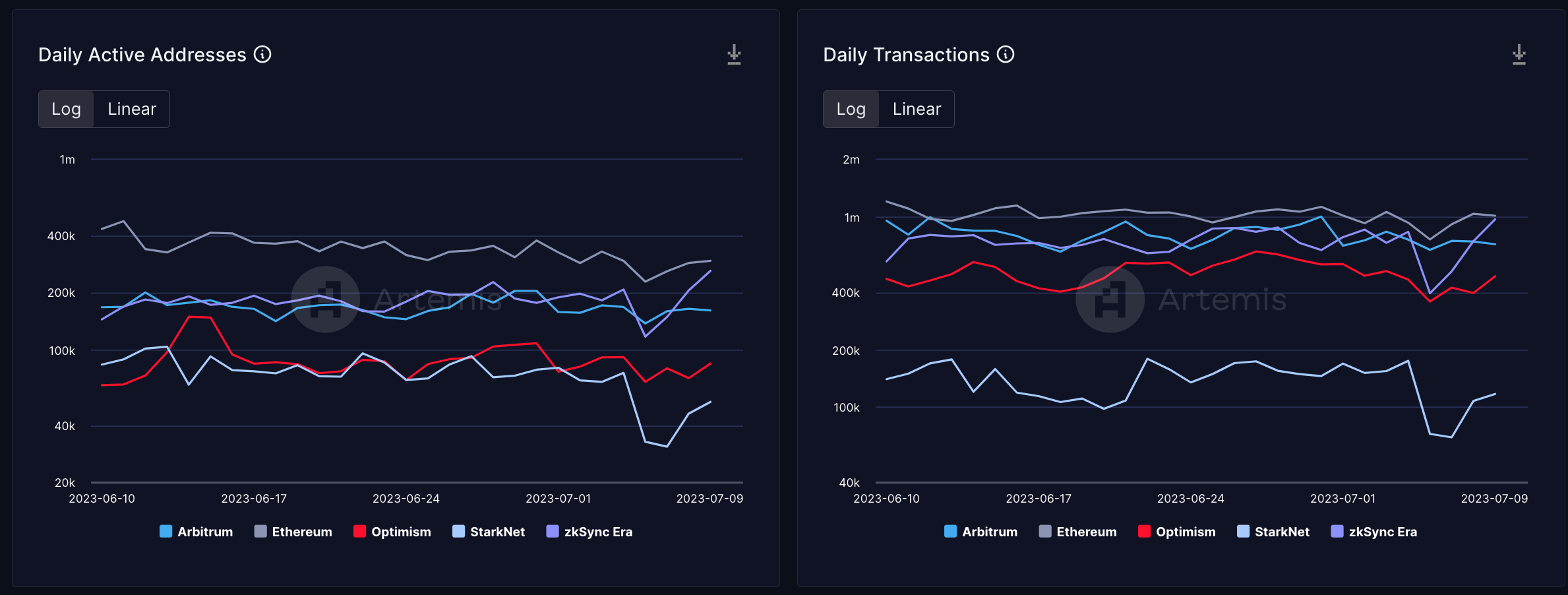
DEX
Dex combined TVL decreased to 15.32 billion, a decrease of 0.41 billion compared to last week. Dex 24-hour trading volume is 1.32 billion, and 7-day trading volume is 14.99 billion, a decrease of 1.54 billion compared to last week.
Ethereum
ETH L 2/sidechain
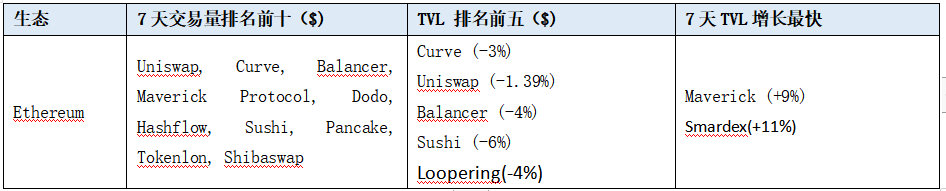
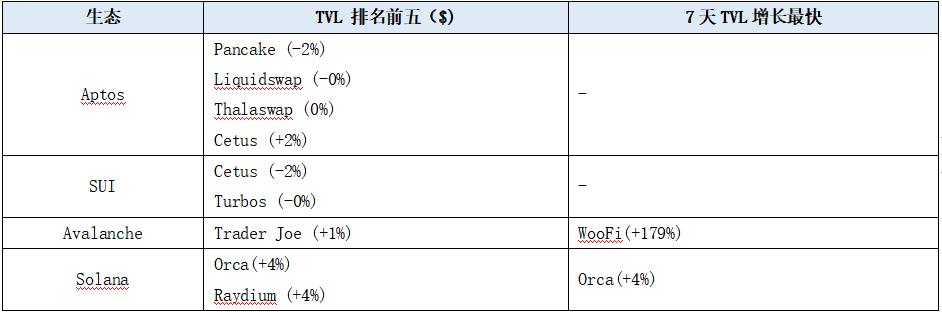
Balancer V 2 on Arbitrum has a TVL surpassing Curve, with a significant increase of 35% in 1m TVL; PearlFi, the concept of RWA ve(3,3), has shown significant growth for two consecutive weeks on Polygon and currently ranks fifth in TVL; WooFi has shown significant growth in TVL on several L 2 chains; Myswap TVL on Starknet has shown significant growth.
BTC L 2/sidechain

Alt L 1
Derivative DEX
Last week (July 3 to July 9), the overall trading volume of the Derivative DEX showed a significant decrease compared to the previous week. The weekly trading volume of the 9 major Derivative DEX protocols was about 8.6 billion US dollars, while the weekly trading volume of the previous week was about 15.2 billion US dollars, a decrease of 43%. Overall, the trading volume this week is at a relatively low level for this year. The weekly trading volume at the end of May and the beginning of June was the lowest level in 2023, at around 6.6 billion US dollars.
Source: tokenterminal
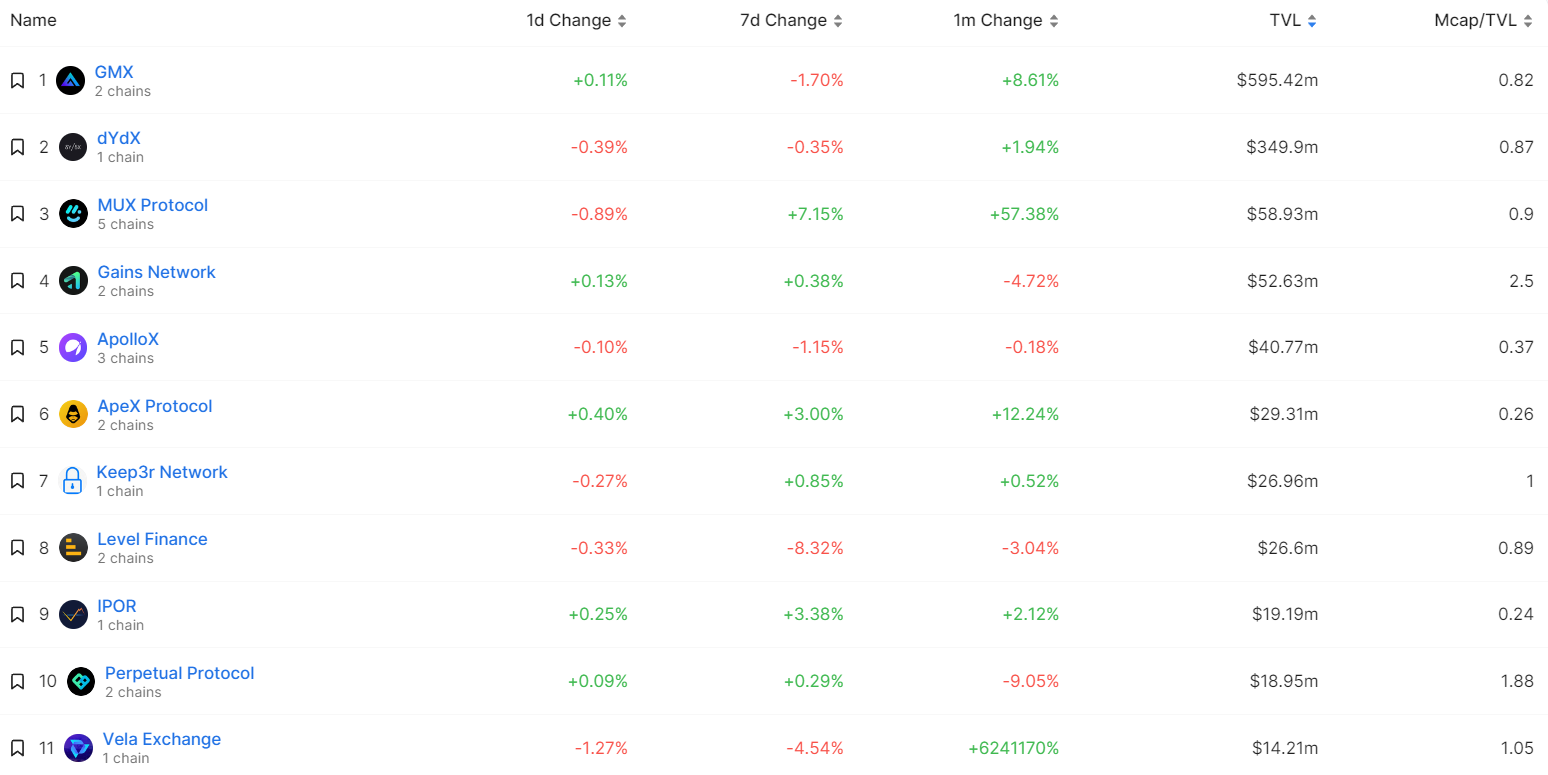
In terms of Total Value Locked (TVL), MUX's TVL continues to grow, with a 7-day increase of 7.15% and a 30-day increase of 57.38%, which is significantly higher than Gain Network. The official version of Vela Exchange was launched on June 26th, with a current TVL of $14.21 million. On its launch day, the TVL reached $14.90 million, but has slightly decreased during the week.
Source: Defillama
DYDX Community has proposed a new proposal to reduce LP token distribution and increase market maker rebates.
DYDX adopts an order book model, and its liquidity is primarily provided by market makers who receive incentives from the platform as a reward. The current incentives come from two main sources: rebates from trading fees and incentives from DYDX tokens.
Under the previous incentive scheme, the trading fee rebate was 0.5 bps, and LP incentives provided approximately 1.15 million DYDX tokens per epoch (28 days). LP incentives are allocated based on market makers' Q score, which is calculated using various data such as their uptime, depth, and spread.
Indicators. The community believes that Q score is not directly related to trading volume and is not efficient enough.The proposal suggests increasing the transaction fee rebate to 0.85 bps and reducing token incentives by 50%, which means providing approximately 575,000 DYDX tokens per epoch as incentives. The reduced portion of the incentive tokens will flow into the treasury and be held by the treasury.
The proposal believes that for market makers, although DYDX token incentives have been reduced, the increase in transaction fee rebates is beneficial for improving the liquidity of the exchange; in addition, the token release of DYDX will be reduced.
According to the current release rules of DYDX, the token release amount for LP incentives is 1.15 million per epoch, and the token release amount for transaction incentives is 1.58 million, with a total of approximately 2.73 million, which is calculated at a market price of approximately $4.9 million. If the token release amount for LP incentives is halved to 575,000, the monthly release amount will decrease by about 21%, reducing the release of $1 million per month. Therefore, if the proposal is passed, the selling pressure on DYDX will decrease in the near future.
According to the proposal, market makers will receive a larger share of transaction fees. Currently, DYDX protocol collects fees upfront and then partially refunds them to market makers. DYDX has generated $6.39 million in fees in the past 30 days and $77.74 million in fees in the past year. The specific details of the fee refund to market makers have not been disclosed. This proposal is currently in the community proposal discussion stage, and we will keep an eye on future developments.





