






A glimpse of the new narrative of old blue-chip DeFi: application chains, RWA, LSD, stablecoins.


Original author: Xiyu
In the second half of 2023, the successive rise in prices of tokens such as COMP, MKR, and Aave has brought back the buzz to the long-silent blue-chip DeFi projects.
In the past 30 days, COMP token has risen by 150%, currently priced at $70; MKR, AAVE, YFI, UNI, FXS, and other tokens have all seen gains of over 30%. The price volatility has naturally garnered attention, leading to discussions about the driving force behind the price surge and the related products.
These once blue-chip projects have been quietly exploring their own development paths, with increasingly evident product differentiation. Some have issued stablecoins, some have ventured into new tracks, some have built their own application chains, and some have transitioned from being tool-based products to infrastructures.
For example, the ultimate plan of the lending giant MakerDAO is to launch a New Chain, Aave is focusing on stablecoin GHO, Compound is positioning itself in the RWA track; Yearn has opened up LSD product yETH for the first batch of LST asset applications; dYdX has launched the public testnet for its application chain; Frax has announced the new L2 network FraxChain, and so on.
So, what new developments and narratives do these once blue-chip projects have in terms of products? Are they the underlying reasons for the increase in token prices?
1. The Lending Trio: MakerDAO launches Spark Protocol; Aave focuses on stablecoin GHO; Compound lays out RWA
MakerDAO introduces lending product Spark Protocol, with the ultimate plan of building a NewChain
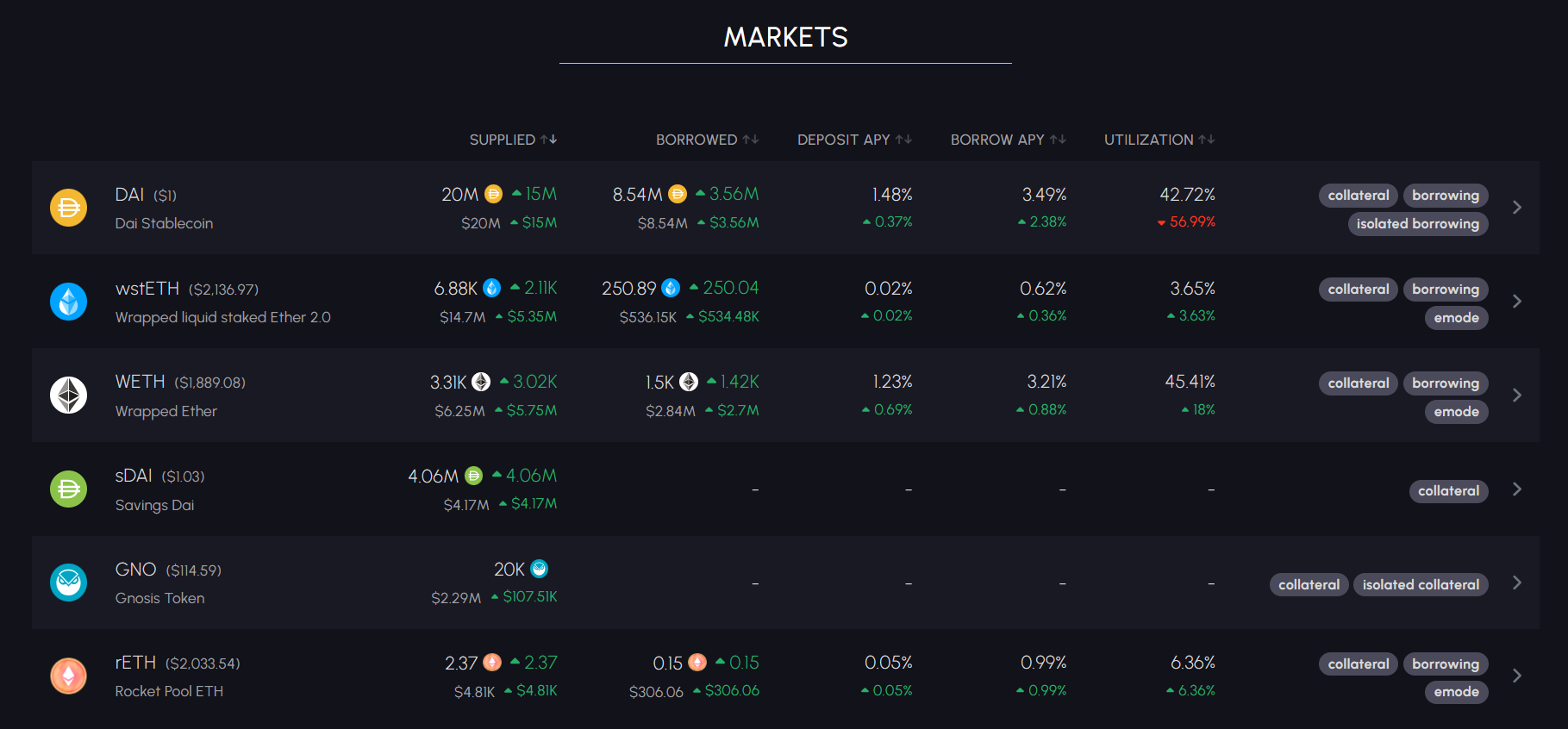
Since the launch of lending protocol Spark Protocol on May 9, the assets deposited (Supply) on the platform have exceeded $47.37 million, and the assets borrowed reach $11.92 million. The current TVL is $35.45 million.
Spark Protocol is the first product developed by Phoenix Labs, a core member of the MakerDAO community, aiming to develop new decentralized products to expand the MakerDAO ecosystem. This protocol is a decentralized lending market built on the open-source code of AAVE V3, mainly used for overcollateralized lending with DAI-centered crypto assets.
Incorporated into Spark Protocol is the MakerDAO DSR (DAI Savings Rate) feature, which is a monetary policy adjustment tool that helps balance the supply and demand of DAI by adjusting the DAI Savings Rate (DSR).
For example, when the DAI Savings Rate (DSR) is increased, DAI holders will withdraw DAI circulating in the market or exchange other stablecoins for DAI, thus reclaiming them back into the Maker system, reducing the circulating supply on the market; when DSR decreases, users will withdraw DAI from the Maker system and invest it in the market to seek other returns, thereby increasing the market supply of DAI.
Currently, the deposit interest rate (DSR) for DAI obtained by users is 3.49% . The collateral assets supported by the Spark Protocol platform include DAI, sDAI (DSR version of DAI), GNO, WETH, and liquidity staking certificate wstETH (wrapped version of stETH), rETH.
On July 5th, MakerDAO announced that its lending protocol Spark Protocol will expand to multiple chains and disclosed the steps and processes for deploying its protocol in various blockchain networks.
In addition, according to the original plan, MakerDAO enters the LSD market through EtherDAI (referred to as ETHD) and then guides the use of ETHD through the Spark protocol, supporting ETHD as collateral to borrow DAI, ensuring that the ETH tokens involved in pledging are under the control of the MakerDAO application.
From this perspective, MakerDAO has increased the use cases of DAI, deployed a multi-chain market, and entered the LSD track through the Spark Protocol, achieving multiple benefits.
In fact, these are just parts of MakerDAO's endgame plan announced in May. The plan aims to reshape the MakerDAO brand and deploy a new blockchain network, transforming it from a stablecoin lending product to Layer 1 infrastructure. By establishing several SubDAOs, MakerDAO's new functions and products are separated, autonomously built, and new decentralized products are created based on the Maker system, allowing the ecosystem to grow. Spark Protocol is the first product of this ecosystem, and there will be more and more ecosystem applications based on MakerDAO in the future. At that time, MakerDAO's narrative will open a new chapter, as for the roles that MKR and DAI tokens will play in this ecosystem, it is still unknown.
In addition to exploring and planning new products and business development routes, MakerDAO has also made more attempts in asset income, making it the first decentralized financial product to enter the RWA.
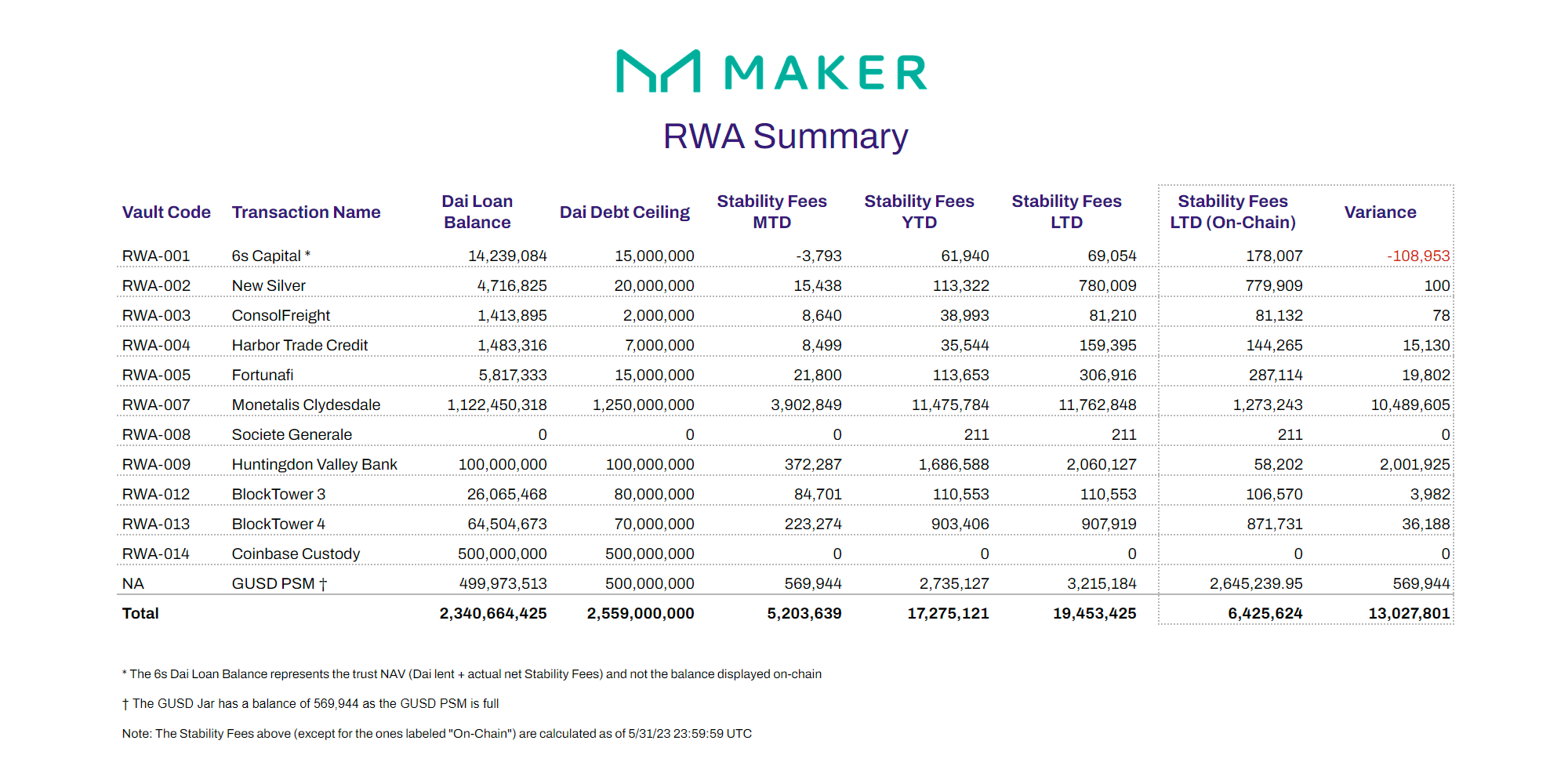
According to official data, as of May, MakerDAO's RWA investment portfolio reached 2.34 billion DAI, mainly used to purchase US Treasury bonds. According to makerburn's statistics, MakerDAO's projected annual income from RWA alone is as high as nearly 71 million US dollars, becoming an important source of income for its protocol.
As the user said: Now Maker DAO = DeFi + LSDfi + RWA + DAO + Incubator + L2/L1.
However, there are different views on this. In the proposal of the MakerDAO Endgame Plan, users commented that issuing a new chain for Maker DAO is not a good idea, even a bit foolish. Instead, they should focus on empowering the MKR token and expanding the scale of DAI.

Two explosive products by Aave: GHO and decentralized social product Lens Protocol
Entering July, Aave has been taking more public actions regarding the stablecoin GHO. On July 11th, the Aave community initiated a proposal vote to launch the decentralized stablecoin GHO on the Ethereum mainnet. If the proposal is approved, Aave V3 users on Ethereum can use their collateral to mint GHO. The current voting support rate is 100%. The voting deadline is July 14th.
GHO is a stablecoin backed by multiple cryptocurrencies. Similar to DAI, this stablecoin can be minted by using Aave's aTokens as collateral. The only difference is that aTokens are interest-bearing assets, so users can earn interest income while minting GHO. The specific interest rate depends on the supply and demand of the lending market.
On the day before the proposal was initiated (July 10th), Aave founder Stani Kulechov tweeted that they will focus on DeFi payment use cases in the second half of the year. He explained that for the DeFi industry in the second half of 2023, it is important to focus on suitable payment use cases, and transparent and decentralized stablecoins are very suitable for payment settlements. Users interpreted this statement as GHO stablecoin being the project that Aave will focus on in the second half of the year.
In addition to the stablecoin GHO, Stani Kulechov is currently talking the most about the decentralized social product Lens Protocol and will release version 2 during the Ethereum Community Conference (EthCC) in Paris.
Many users have speculated whether Lens Protocol V2 will open up profile NFT applications (which were suspended in April this year) or announce token governance-related content. Previously, an Aave executive revealed in an interview that the Lens Protocol ecosystem will use the GHO token. For example, users can use a credit card to directly purchase GHO on the Lens Protocol ecosystem to support or reward their favorite creators.
Although Aave focuses on financial scenarios and Lens Protocol focuses on the social field, they can be interconnected through the stablecoin GHO.
In addition, Aave-like DeFi applications can also integrate with decentralized social applications to develop new types of social financial products. For example, Lens Protocol's social graph can introduce an on-chain reputation system for Aave and develop partially collateralized or uncollateralized lending products to lower the lending threshold. This means that users don't need to pledge any assets and can borrow money based solely on their on-chain profile NFT reputation and identity system.
Currently, the Lens Protocol ecosystem has integrated or developed hundreds of social applications for user experience.
Since participating in Lens Protocol ecosystem applications requires a profile NFT, which is currently not open for new registrations and has not been fully developed for users, and the stablecoin GHO has not been officially launched, it can be understood that Aave's two main tools have not been put into full operation yet.
However, based on the current product development roadmap, Aave's emphasis on social products stands out from other lending products. Whether it will generate the expected positive flywheel effect in its ecosystem remains to be seen after the product goes online and operates.
Compound founder establishes new company Superstate to enter the RWA track
The price of COMP tokens has more than doubled in the past 30 days, but compared to the skyrocketing price, Compound's product itself seems to have entered a stagnant phase of development.
The recent publicly available information about the product is that on July 7th, Compound Labs introduced the Encumber mechanism, which allows users to separate token ownership from transfer rights. With Encumber, token holders can retain auxiliary ownership interests, such as airdrops, governance rights, or access to content and activities, while still participating in DeFi and obtaining profits.
However, this seems to have little relevance to its lending business. For Compound, the only positive news is that its founder has entered the RWA track.
On June 29th, Robert Leshner, the founder of Compound, announced that he has submitted the necessary documents to the US securities regulator to establish Superstate, a bond fund company dedicated to purchasing short-term US Treasury bonds and putting them on the blockchain. The fund's ownership shares will be tracked and can be directly traded on the blockchain. In addition, Superstate has completed a $4 million seed round of financing with participation from ParaFi Capital, 1kx, Cumberland, CoinFund, and other institutions.
However, Superstate is currently still in the application stage.
Second, DEX leader: Uniswap launches V4 as infrastructure; Curve introduces stablecoin crvUSD
Uniswap V4 transitions from a utility product to a composable infrastructure
According to the latest news from the Uniswap Foundation, the Uniswap V4 code is currently undergoing an audit, and the specific deployment time will depend on the successful upgrade of the Ethereum mainnet and completion of the code audit.
In the Uniswap V4 code released in June, the core upgrade is the introduction of innovative Hooks functionality. This feature allows anyone to deploy a liquidity pool using custom contracts and attach various functionalities. Previously, Uniswap V3 integrated liquidity pools, meaning liquidity for a specific token pair was concentrated, while Uniswap V4 supports custom pools.
Some cryptocurrency users metaphorically describe this process as eating hotpot: Uniswap V3 is like choosing a large hotpot where everyone eats the same flavor and there's no need for choice; as long as there's enough soup (liquidity pool liquidity), it's fine. Uniswap V4 allows everyone to customize their own small hotpot (custom liquidity pool), offering various specialty flavors (referring to added functionalities like on-chain limit orders and automatic reinvestment) to attract diners, with diverse options for everyone's preferences.
In simple terms, Uniswap V4 will support customization on top of its foundation, allowing for the design of matching logic, execution logic, fee customization, rebates and incentives, and order range and depth through Hooks. With the introduction of its on-chain limit order functionality, the dream of building a "Binance on the blockchain" will become a reality.
This means that developers can build any type of DEX on top of Uniswap V4, including contracts, options, and other derivative products. It can also be used to develop lending protocols, stablecoin protocols, and more, potentially leading to a large ecosystem built on top of Uniswap in the future.
Hooks not only increase the composability and scalability of Uniswap's liquidity but also transition it from a utility product to infrastructure.
Curve stablecoin crvUSD locks over $200 million in assets in 2 months since launch
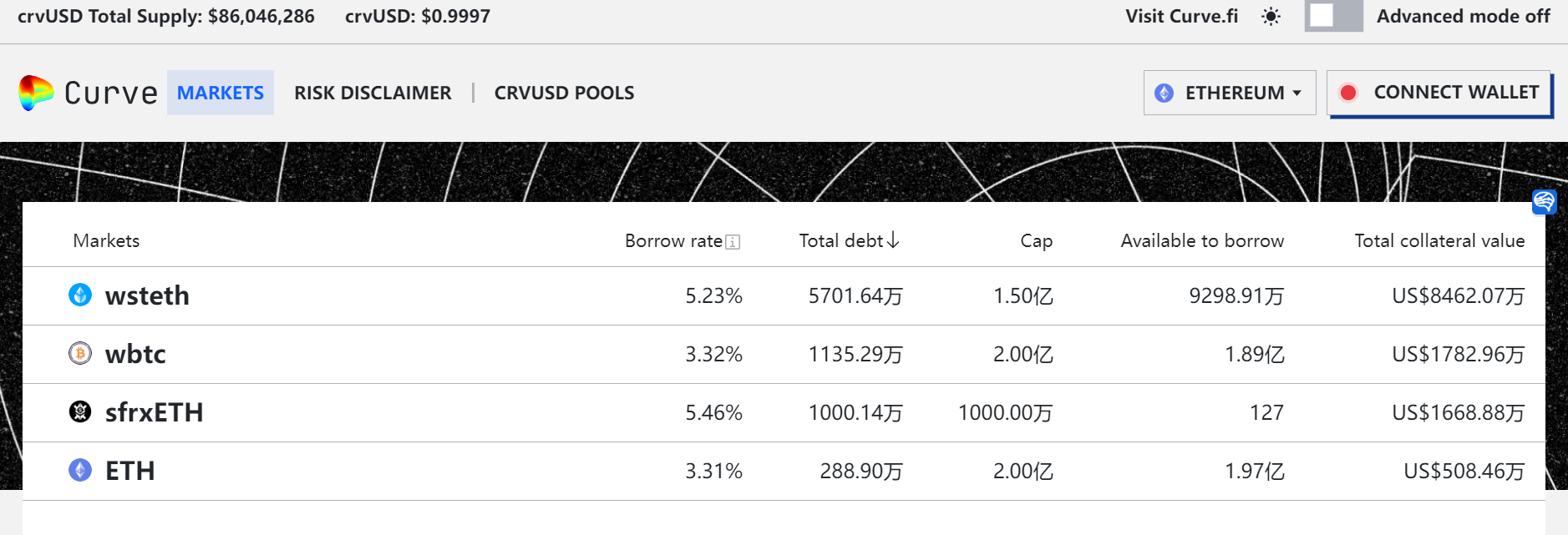
As of July 13th, the total supply of Curve's native stablecoin crvUSD is 86.02 million, and the value of locked collateral has exceeded $123 million.
Currently, the main collateral for crvUSD is sfrxETH, wstETH, WBTC, and ETH. Among them, wstETH has the highest proportion in the collateral, accounting for more than 60% of the total, with a total value of approximately $84.2 million.
Similar to DAI and GHO, crvUSD is also issued through over-collateralization. However, the difference is that crvUSD introduces a soft liquidation mechanism. When the price of the collateral falls, crvUSD innovatively achieves soft liquidation through a specific AMM and repurchases the collateral through the AMM when the price of the collateral recovers.
The issuance of common asset-backed stablecoins is equivalent to users engaging in over-collateralized borrowing and lending. The collateral assets will be liquidated when their prices fall to a certain level to repay the system debt. However, in this case, the liquidated collateral assets are significantly below the market level. Even if the price of the collateral assets quickly recovers, the loss incurred due to the complete liquidation at a low price is difficult to compensate for.
To address this, crvUSD has made improvements to the liquidation process by implementing the LLAMMA (Lending-Liquidating AMM Algorithm) mechanism. It designs a special AMM pool for the collateral assets, gradually liquidating them as the asset prices decline, rather than completely liquidating the positions at once. When the price falls within a certain range, the collateral in the AMM will begin to be sold and exchanged for stablecoins. The collateral assets will continue to be gradually sold during the price decline until only stablecoins remain in the AMM pool. After the price of the collateral assets recovers within a certain range, the AMM will help users buy back the assets.
Based on price fluctuations, crvUSD can rebalance the composition of users' collateral assets, thereby avoiding users' uncompensated losses and the drastic price fluctuations caused by mass liquidations.
However, as crvUSD is still a new stablecoin, it has not yet experienced the test of severe price fluctuations caused by black swan events in the market since its launch in May. Its ability to maintain price stability and avoid anchoring during periods of intense market volatility still needs to be tested. In addition, the constant negative publicity of Curve's founder cashing out and buying luxury homes and being sued by investors casts a shadow over the project's development.
Three: dYdX, Frax Launching Application Chains, Yearn Expanding into LSD
Derivatives leader dYdX explores application chains
The public testnet of the decentralized derivatives protocol dYdX v4 was officially launched on July 6th. Users can test functionalities such as connecting wallets, viewing order books, placing orders, and viewing account information. This is the final testing step before its mainnet launch.
The main purpose of dYdX V4 is to migrate it to the application chain, dYdX Chain, built on Cosmos consensus. This not only enhances its transaction processing speed but also allows for custom gas fees. According to previous plans, the mainnet launch is expected to be completed before the end of September this year.
For dYdX users, the most important thing is that the application chain gives the native token DYDX a new narrative logic.
Currently, the DYDX token can only be used for governance voting and has no other uses. The income of this application is not captured by the DYDX token. However, after the launch of the dYdX Chain, DYDX is not only a governance voting token, but also users who hold it can pledge it as a network node validator and it can also be used as a means of payment for gas fees on the chain. It is reported that the income of the dYdX Chain will be empowered.
Currently, the dYdX platform has a 24-hour trading volume of 1 billion USD and a position size of 280 million USD, making it the largest decentralized contract trading platform in the current cryptocurrency market.
Algorithmic stablecoin Frax enters LSD and launches a new chain
In mid-last month, Frax Finance's L2 network Fraxchain officially appeared, aiming to create a smart contract platform that emphasizes decentralized finance.
Fraxchain is built using Hybrid Rollup (also known as mixed Rollup, which integrates two technologies of Optimistic Rollups and ZK Rollup). It is expected to be ready before the end of this year. The network will support all Frax ecosystem assets and will first integrate its official Fraxferry cross-chain bridge to achieve seamless asset transfer.
In addition, Frax founder Sam Kazemian revealed that Fraxchain will use the stablecoin FRAX and liquidity collateral certificate frxETH to pay for gas fees on the chain. And part of the fees generated by the Fraxchain network will be distributed to FXS holders.
Some users have predicted that the gas fees of Fraxchain will be approximately 1.8 million USD per year conservatively.
From this point of view, Fraxchain is an important stronghold for the future value accumulation of Frax Finance.
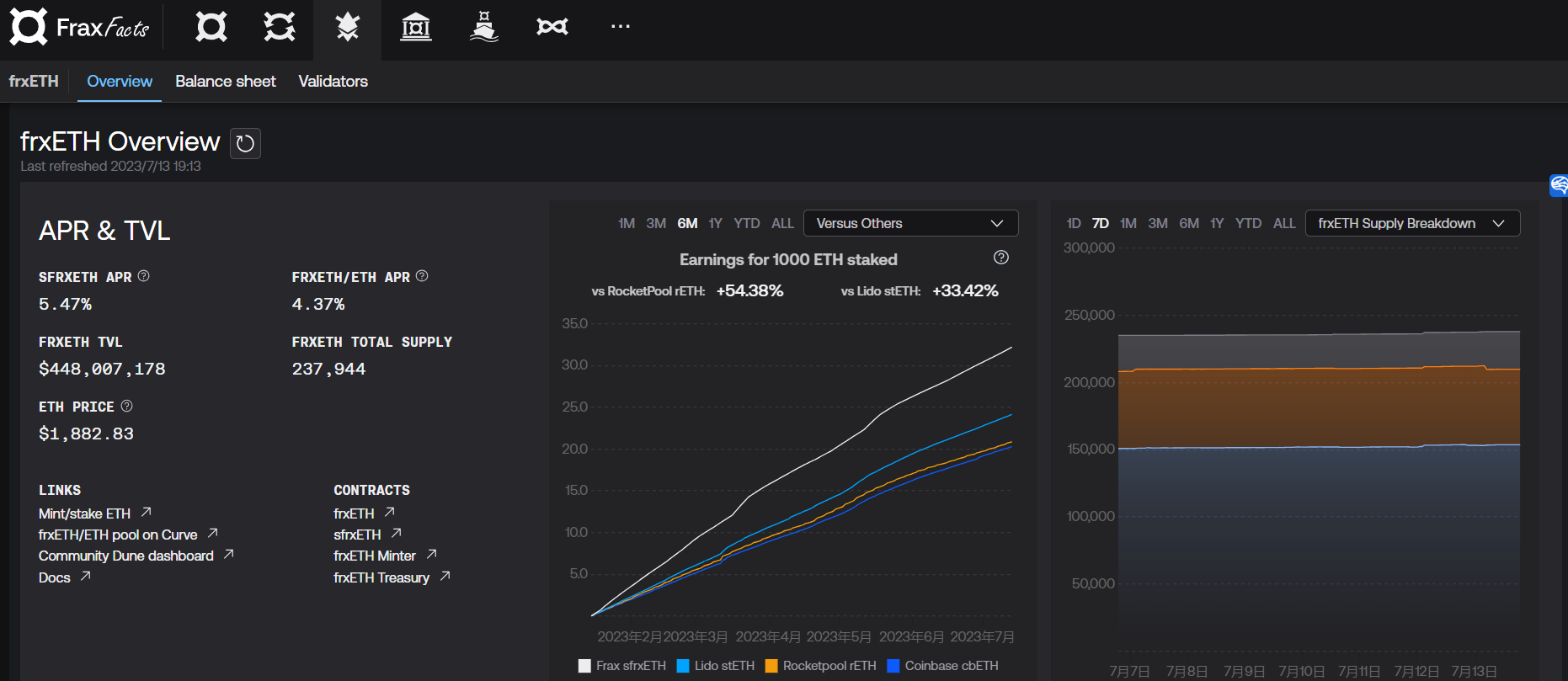
In addition to launching a new chain, Frax Finance's product frxETH deployed in the LSD track is developing rapidly. As of July 13th, the amount of ETH locked in frxETH is about 238,000, worth 445 million USD, ranking third in the entire LSD application. In addition, sfrxETH (pledged frxETH) has become one of the top three collaterals for minting crvUSD, and in February of this year, the Aave community introduced sfrxETH as a strategic reserve asset into the proposal of Aave V3.
Furthermore, in terms of products, Frax Finance has developed and launched the DEX Fraxwap, lending platform FraxLend, and cross-chain bridge Fraxferry.
In general, Frax Finance has been exploring its business boundaries and has developed a complete set of product lines from stablecoins to the DeFi trio, LSD, application chains, and more, covering asset issuance to building application scenarios.
Of course, Frax is also keeping up with empowering the governance token FXS. On June 30th, the Frax community passed the proposal FIP-256 to repurchase FXS tokens, planning to repurchase FXS tokens worth 2 million US dollars whenever the FXS token price drops below 5 US dollars. Currently, the price of FXS is 6.29 US dollars.
Related reading: "How did the veteran algorithmic stablecoin Frax Finance regain its "status" with the LSD trend?"
Yearn launches yETH to enter the LSD market
On July 5th, Yearn announced the latest progress of its LSD product yETH and opened the whitelist application for the liquid staking token LST. yETH is a single LSD token representing a basket of LST assets, composed of various liquidity staking tokens (such as stETH, fxsETH, etc.), which helps diversify investment risk and improve investment returns for users.
In this whitelist application, yETH will ultimately select 5 LST assets as yETH, and the selected projects will be decided by st-yETH holders' votes. This round of applications will end on July 21st.
How to participate in the st-yETH voting? Users need to lock their ETH in the Bootstrapper contract for 16 weeks to receive st-yETH at a ratio of 1:1. The top five ranked projects, namely LidoFinance, FraxFinance, StaFi_Protocol, Tranchess, and Swellnetwork, will each pay an additional reward of 1 ETH to st-yETH voting users.





