






RWA Discussion: Underlying Assets, Business Structure, and Development Path


Original author: Colin Lee
Since the beginning of the year, there has been an increasing discussion in the market about Real World Assets (RWA), with some viewpoints suggesting that RWA will trigger the next bull market. Some entrepreneurs have also shifted their focus to RWA-related tracks, hoping to accelerate business growth with the support of the gradually heating narrative.
RWA is the mapping of traditional market assets onto the blockchain in the form of tokens, for trading by users of Web 3.0. RWA tokens have the right to the income from the assets. A few years ago, STOs mainly focused on corporate bond financing, while the current scope of RWA is much broader: not limited to primary market traditional assets, any assets circulating in the primary and secondary markets can be tokenized and put on the chain, allowing users of Web 3.0 to participate in investment. Therefore, the narrative of RWA includes a wide range of asset types and a broad range of yield coverage.
RWA has gradually attracted attention from the market, possibly for several reasons. First, the encrypted market currently lacks low-risk USD-denominated assets, while in the wave of interest rate hikes in traditional financial markets, the risk-free interest rates of major economies have risen to 4% or even higher levels, which is attractive enough for investors in the native market of cryptocurrency. Corresponding to this phenomenon, during the bull market period in 2020-2021, many traditional funds also entered the crypto market and earned low-risk returns through arbitrage and other strategies. Introducing low-risk, high-yield products from the traditional market through RWA may be welcomed by some investors. Second, the crypto market is currently not in a bull market, and even in the native crypto market, there is a lack of sufficient narratives. RWA is one of the few tracks currently seen with solid income support, which may achieve explosive business growth. Finally, RWA is one of the bridges connecting the traditional market and the crypto market. Through RWA, there is also an opportunity to attract incremental users from the traditional market, injecting new liquidity, which is undoubtedly a positive factor for the development of the blockchain industry.
However, based on some RWA projects currently observed, their business indicators such as TVL have not grown rapidly, and the market may have overly high short-term expectations for RWA. For an RWA project, the following dimensions need to be considered:
Underlying assets. This is the most fundamental issue in the RWA track. Choosing suitable underlying assets is of great help for subsequent management, etc.
Standardization of underlying assets. Due to the different "heterogeneity" of different underlying assets, the difficulty of standardizing underlying assets varies. The stronger the heterogeneity of the assets, the higher the standardization requirements and the more complex the process.
Collaborating institutions and forms of collaboration. High-quality collaborating institutions not only fulfill their obligations smoothly but also fully unleash the value of underlying assets.
Risk management. Risk management is involved in maintaining underlying assets, asset securitization, yield distribution, etc. If it is a debt-based asset, it also involves risk management in asset liquidation and collection after debtor default.
1. Underlying Assets
Underlying assets are the most core elements.
In the current RWA track, underlying assets are mainly divided into the following categories:
Bond assets, mainly short-term US Treasury bonds or bond ETFs. Typical representatives include stablecoins like USDT and USDC. Some lending projects, such as Aave and Maple Finance, have also joined this camp. Government bonds/Government bond ETFs currently have the largest proportion in RWA;
Gold, with a typical representative being PAX Gold. It is still under the narrative of "stablecoins," but its development is slow and market demand is weak;
Real estate RWA, with typical representatives being RealT, LABS Group, etc. Similar to packaging real estate into REITs and putting them on the chain. These types of projects have a wide range of real estate sources, and the project team often chooses their own city as the main source of assets;
Loan assets. Typical types include USDT, Polytrade, etc. The types of assets are diverse, including personal mortgage loans, corporate loans, structured financing tools, car mortgage loans, etc.;
Equity assets, with typical projects including Backed Finance, Sologenic, etc. Trading of these types of assets seeks real existence but is greatly restricted by laws and other issues. An important direction for the development of native cryptosynthetic assets is already listed and circulating stocks, which overlap highly with this field;
Others, including farms, artworks, etc., are large-scale (individual asset amounts are large) but have a lower degree of standardization.
When determining which assets to use as underlying assets, we need to consider 5 dimensions: liquidity, degree of standardization, principal safety, scalability, and yield. From these 5 dimensions, we can roughly define the attributes of the above assets.
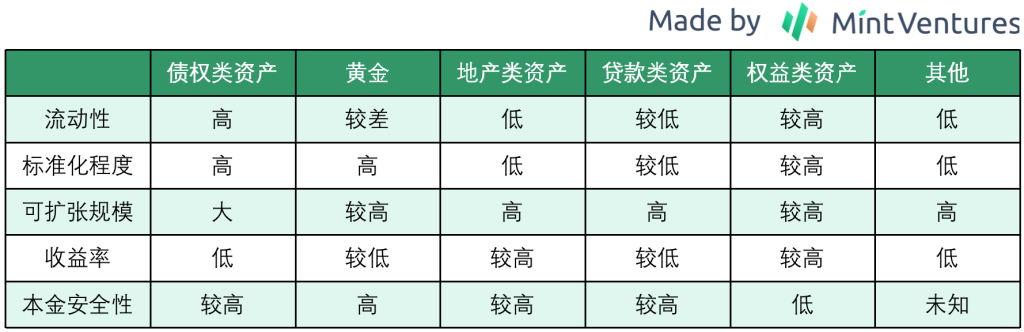
From the perspective of underlying assets, debt assets currently appear to be the most worthwhile category to explore. Based on their own positioning, they can seek differentiated routes: anchoring fiat stablecoins, encrypted market Yu'EBao, etc. Although the stablecoin track anchored to fiat currency is already dominated by a few players, and the main projects have already formed ecological cooperation with many projects, the "encrypted market Yu'EBao" track is still waiting to be explored.
For real estate assets, although the REITs program is already mature, if the project team decides to choose assets themselves and carry out diversified management of regions and properties, it will undoubtedly increase significant costs: for example, in terms of project maintenance, if the distribution of regions is too scattered, the number of people involved in property management will increase, and the procurement costs of property maintenance and personnel transportation costs will also increase. In the process of reviewing projects, the author has encountered situations where project teams hope to control the value of individual properties within $100,000, distributed in more than 5 countries, and where the type of property is not limited to residential and commercial properties. Although it may achieve sufficient diversification, there are significant difficulties in information disclosure, property management, and so on. It is also difficult to achieve rapid growth of underlying assets in the future.
Currently, the author does not recommend overly focusing on "other" types of underlying assets, primarily due to liquidity and standardization issues. For example, agricultural-related underlying assets pose difficulties in determining their quality due to their non-standard nature. Taking individual farmland as an example, the quality of the crops produced can vary, and the processes of storage, transportation, and sales are relatively specialized. It takes years of industry expertise to ensure that the returns from agricultural assets are ultimately delivered to investors. Moreover, economic crops are subject to unpredictable fluctuations in production capacity and weather conditions. Hence, realizing their value also presents significant challenges.
If the project itself seeks and packages the assets independently, it will also greatly impact the project's growth potential. Rapid growth becomes even more challenging for such projects.
Regarding underlying assets, currently, bond-like assets are the core focus, with REITs-like assets being a practical and feasible approach to enhancing returns.
II. Business Architecture
If there were significant challenges in the integration of RWA onto the blockchain in previous years, recent explorations by leading projects like MakerDAO have paved the way for a clearer path forward.
Firstly, to facilitate the integration of RWA onto the blockchain, an RWA Foundation architecture can be established. Under this structure, MakerDAO can manage multiple RWAs through the RWA Foundation. The inclusion of new RWAs can be initiated directly by the RWA Foundation through Special Purpose Vehicles (SPVs).
Source: https://forum.makerdao.com/t/pre-mip-discussion-rwa-foundations/9510
Secondly, for individual SPVs, a management model similar to ABS (Asset Backed Securitization) projects can be adopted, where assets form the support for securitized financing.
Source: https://forum.makerdao.com/t/poll-rwa-working-group-covenant-structure/4836
MakerDAO chooses to invest in priority assets for the safety of funds, and other investors can become investors with subordinate shares. For other project parties, the risk level of holding assets can be determined based on the risk preference of the target user group.
Unlike the traditional process of asset securitization, in MakerDAO's single SPV, there is no role of settlement and fund custody, but a tokenized issuance platform is added. In the future, settlement and fund custody may still be necessary participants for RWA after regulatory space becomes clearer.
III. Risk Management
Risk management of RWA mainly consists of three dimensions:
1. Risk management of underlying assets. The lower the standardization level of the asset, the higher the risk management capability required. Compared with forestry and farming, national bonds have a higher degree of standardization, better asset liquidity, and stronger price discovery ability. Therefore, managing national bonds is less difficult. However, even for the same type of asset, the difficulty of management may vary in different regions and countries. For example, in some developing countries, the level of digitization is low, and debt-type assets may still exist in paper form. This requires project parties to find a place to store bonds that cannot be destroyed during the holding period of large-scale bonds. Assets that exist in paper form also have a greater possibility of being "substituted by the raccoon," and such events have occurred in many regions with large-scale cases.
In short, for the risk management of underlying assets, the most basic requirement is to ensure that the underlying assets are authentic and effective during the project period, followed by ensuring that the value of the underlying assets will not be lost due to human factors, and thirdly, ensuring that the underlying assets can be realized at a fair market price. Finally, it should also ensure that the income and principal can be safely and smoothly delivered to investors. This type of risk has a high degree of overlap with the attributes of traditional assets, and there are risk management measures that can be referenced.
2. On-chain risk management. Because it involves data on the chain, if the off-chain institutions do not receive sufficient management, there may be cases of data falsification. Similar negative cases also frequently occur in the traditional financial field, such as in the areas of commercial bills, supply chain finance, and bulk commodities, where massive falsification activities have taken place. Even with real-time monitoring through sensors or fixed delivery venues, there is still no way to completely eliminate risks 100%.
For the current RWA industry, which is still in its infancy, the author believes that similar situations will also occur, especially since there is currently a lack of corresponding regulatory rules, the cost of illegal activities is too low, and the risk of data falsification on the chain cannot be ignored.
3. Risk management of partners. This type of risk still leans towards the traditional side, but the problem is that there are currently no specific regulatory rules for RWA. For example, in the custody process, which custody institution is compliant? In the auditing process, can the current accounting and financial guidelines accurately and completely reflect the characteristics of RWA? In the project operation process, if there is a risk event, what risk disposal methods and procedures can better protect investors? These types of questions still do not have very accurate answers. Therefore, partners still have the opportunity to engage in wrongdoing.
4. Current User Structure and User Demands
In the previous article "The Outlook of the On-Chain Bond Market in the Crypto World", it was mentioned that due to the extreme volatility and cyclical nature of the crypto market, relatively low-risk and risk-averse investors find it difficult to obtain continuous and stable returns in the market. In such a market, a large number of users also demonstrate a strong risk preference:
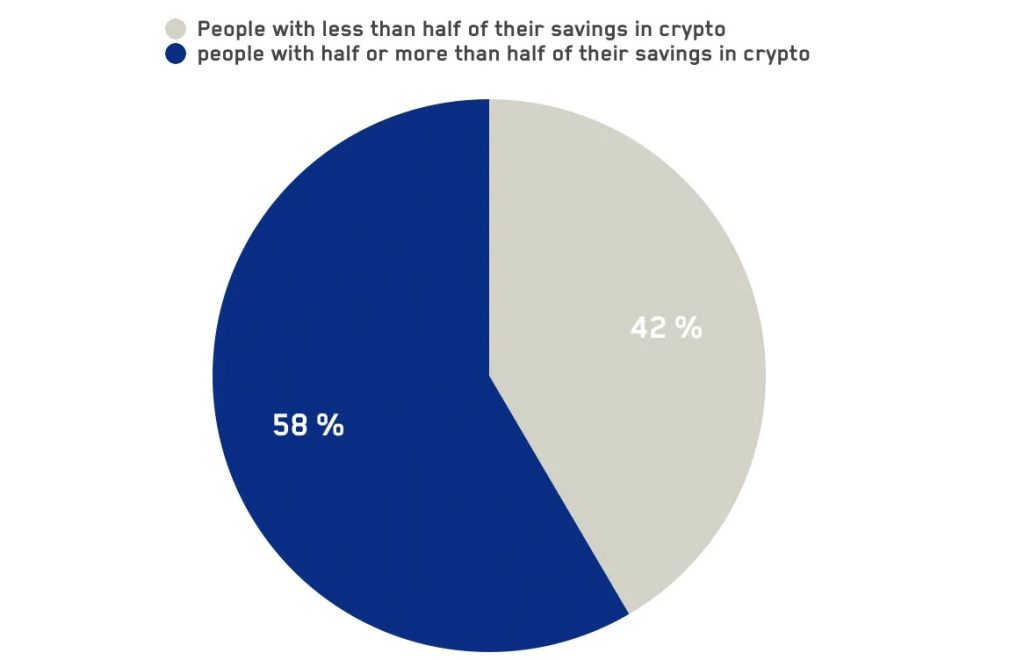
In the survey report released by teams like dex.blue in 2020, half of the surveyed crypto market users have invested 50% or more of their entire savings in the crypto market;Pew Research and Binance also mentioned in their respective survey reports that currently, young people account for a relatively high proportion of users in the crypto market. In this market structure, the risk preference of crypto market investors will be higher than that of traditional market investors.
 Source: https://medium.com/dexdotblue/defi-usage-survey-the-results-insights-b3481275019b
In the current market dominated by "arbitrageurs and high-risk investors", its volatility also exhibits similar characteristics: a study by K 33 Reseach shows that, from the beginning of 2017 to October 2022, the volatility of Bitcoin has been higher than that of Nasdaq and S&P 500 for most of the time, except during extremely dull market periods, when the volatility of the US stock market has a chance to surpass Bitcoin.
Source: https://k33.com/research/archive/articles/volatility-near-6-year-lows
The demand for returns from two main groups of investors in the cryptocurrency market may be different: for arbitrageurs, "low-risk" investment opportunities are easier to obtain. For example, the annualized return rate of Bitcoin perpetual contract funding rate, since the product appeared, has been between 15% and 20%, which is much higher than the long-term return rate of the global stock market of 5% and the long-term return rate of various types of bonds. For high-risk investors, their expected returns are even higher than arbitrage investors.
Therefore, even if stocks are tokenized, it may be difficult to meet the current market's user structure and their expected return levels. In the short term, the risk-return ratio positioning of a large number of RWA products is relatively embarrassing.
5. Regulation: Perhaps a potential opportunity
In early June of this year, the U.S. SEC announced that it would define multiple tokens including BNB, BUSD, MATIC, etc. as securities, which caused market concerns about regulation and corresponding targets also experienced more pronounced declines.
If the SEC's regulatory measures are recognized by other G20 or more countries, more tokens may be classified as securities and included in traditional regulatory frameworks. From the current regulatory policies, we see similar signs: whether in the United States, Japan, or EU countries, regulatory measures for stablecoins are beginning to converge with traditional banks. Perhaps future regulation of tokens will also draw on securities regulatory measures to a certain extent.
If such a situation arises, some practitioners in the traditional financial field would feel more at ease to put their assets on the chain: the benefit of this is that the assets are local, but can absorb global liquidity. This approach has been recognized by some RWA project entrepreneurs: although they are limited by geographical factors, with blockchain, they can obtain global investors. For these practitioners, the asset on-chain under regulation will bring two benefits: 1. With access to global liquidity, the funding side will not be affected by geographical factors, which may bring cheaper money; 2. Because they may find investors with lower return requirements than the local ones, which increases the range of project choices.
At the same time, regulatory measures on the user side are also being promoted: KYC. Native encrypted projects only require a wallet for access, but for start-up projects financing in the primary market, some projects already need KYC assistance to determine whether users are qualified investors. Some projects that introduce RWA, such as Maple Finance, also consider KYC as an indispensable process in the customer acquisition process. If the KYC process is gradually implemented in more new projects, a clearer regulation and KYC co-existing blockchain industry may bring an additional benefit: more ordinary investors can enter the market with confidence.
This type of users' risk preference is more inclined towards familiar assets, and there is also a certain level of interest in emerging native encrypted assets. At this moment, RWA can serve as an important investment direction for this more ordinary type of investors.
Six, Possible Development Paths for RWA
In the short term, RWA brings three benefits to investors in the crypto industry:
1. Fiat-based low-risk investment targets: Currently, the risk-free interest rate levels of major economies, led by the United States, have reached over 3%, which is significantly higher than the borrowing yields in various types of U-based lending agreements in the crypto market. Without the need for cyclic leverage, it provides investors with extremely low-risk investment opportunities. Currently, projects such as Ondo Finance, Maple Finance, and MakerDAO have launched investment projects based on US Treasury bond yields, which are highly attractive to investors settling in fiat currency. In this track, a "Yu'e Bao" project in the crypto market may emerge.
Source: https://fred.stlouisfed.org/series/FEDFUNDS
2. Risk Diversification of Assets: Taking Bitcoin as an example, the correlation with gold and the US stock market fluctuates to different degrees in different market stages.
Source: https://www.theblock.co/data/crypto-markets/prices/btc-pearson-correlation-30d
Even in the macro-driven bull market after 2020, different asset categories still possess a certain level of diversification advantage.
Source: https://www.swanglobalinvestments.com/the-correlation-conundrum/
For allocative investors, mixing native cryptocurrency assets with various types of RWAs can achieve a greater level of risk diversification.
3. A means for investors in developing countries to combat domestic currency volatility: In some developing countries, such as Argentina and Turkey, inflation is consistently high. RWA can assist investors in these regions to hedge against domestic currency volatility to a certain extent and achieve global asset allocation.
From the above three aspects, RWAs that can be widely accepted in the short to medium term are more likely to be the main RWA of high returns and low risks caused by interest rate hikes in major economies, such as government bonds.
In the long term, as the regulatory framework becomes clearer, and with the gradual entry of more mainstream investors into the cryptocurrency market and the industry becoming more convenient to operate, RWAs have the opportunity to replicate the glory of China's Internet finance boom ten years ago:
1. Blockchain-based RWA assets provide unprecedented "accessibility" for global retail investors: RWA, as the most familiar asset for retail investors, may become the primary on-chain investment target for non-Web 3 native investors. The borderless nature and permissionless access and operation of on-chain assets open the door for them to invest in and utilize a wider range of global assets. Conversely, this also provides unprecedented user reach, scale, and extremely low customer acquisition costs for entrepreneurs in the field. The rapid development and widespread use of USDT and USDC as "on-chain dollars" have already partially validated this trend.
2. RWA assets may give rise to new DeFi business models: The emergence of LSD as a new underlying asset has stimulated the rapid development of LSD-Fi. In addition to the conventional business paradigms such as asset management, spot trading, stablecoins, etc., there is also a focus on previously overlooked areas such as yield volatility. If RWA becomes an important class of underlying assets, the introduction of new and substantial off-chain income may give birth to new DeFi business models. In the future, RWA can also be combined with native crypto assets and strategies to form hybrid assets, allowing more users willing to explore native crypto assets to understand them through more familiar means. From this perspective, the next high TVL RWA+DeFi project may be the "on-chain Yu'EBao".
3. The industry's game with regulation will eventually yield answers, and practitioners can seek compliant customer acquisition methods: Whether in Western countries or in Eastern Hong Kong, the gradual implementation of regulation is inevitable. As the crypto industry grows to a volume of $10 trillion, regulation will not sit idly by. As regulatory policies gradually become clear, we can see that certain regions can land business activities that were previously impossible: stablecoin issuance through compliant channels is already possible in Hong Kong, and the Middle East is also exploring the integration of blockchain industry with traditional industries.
In the long run, one of the important factors for the vibrant development of the crypto industry is sufficient liquidity. With the implementation of regulation, RWA, led by fiat-collateralized stablecoins, is bound to grow rapidly. Especially in the next round of global liquidity easing, if new players entering the market can receive strong support in terms of ecology and channels, compliant fiat-collateralized stablecoins may also replicate the path of USDT's high growth.





