






Binance and Coinbase Facing SEC Charges: Detailed Market Response and Impact


Summary:
Summary:
The United States Securities and Exchange Commission (SEC) filed formal lawsuits against cryptocurrency exchanges Binance and Coinbase, which triggered a series of chain events such as a large-scale sell-off in the market and the delisting of tokens involving security definitions;
The SEC’s allegations against Binance are more serious, including fraud, mixing assets across entities, and counterparty transactions with customers;
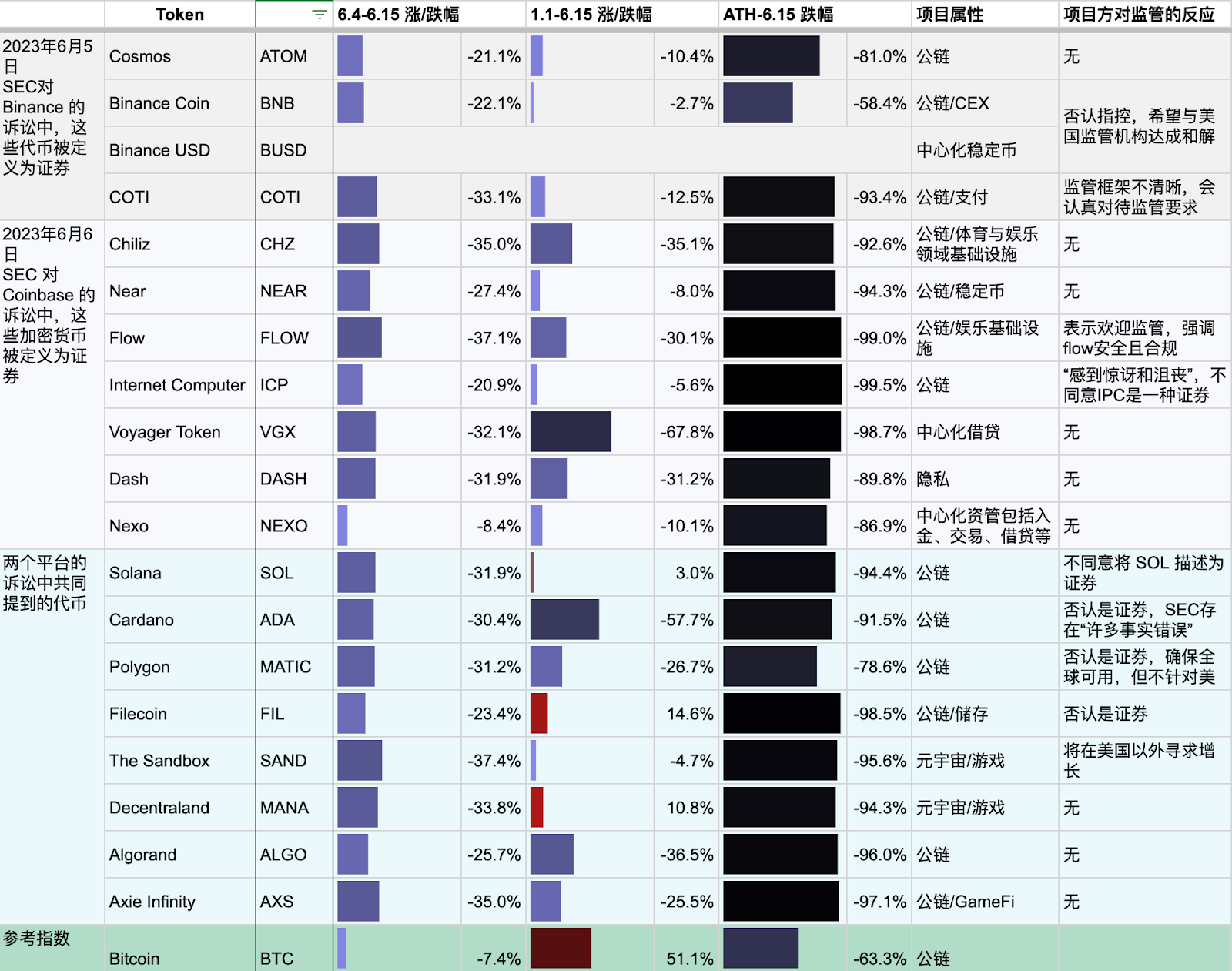
The market reacted violently, with the prices of 18 tokens defined as “securities” by the SEC falling by an average of 28.8%, compared with a 7.4% drop for BTC over the same period. However, even after being sued by the SEC for the first time, the proportion of BNB’s market value even increased slightly, showing that its price is relatively resilient;
This time, the token industry defined by the SEC as securities is mostly on the public chain, accounting for 13/18, followed by entertainment and metaverse, accounting for 4/18, and the latter has a larger decline;
The report predicts possible future scenarios of SEC litigation, including possible legal impact and market reaction, and also discusses the progress of encryption industry legislation;
secondary title
text:
first level title
The SEC's allegations
The SEC accused Coinbase of operating an unregistered stock exchange, brokerage, and clearing agency, as well as unregistering its encrypted asset pledge interest-earning service. But the charges against Binance are quite different, and in addition to being accused of operating an unregistered stock exchange, broker, and clearing agent like CB, the SEC also accused it of more FTX-like activities: deception, mixing assets across entities, and collaborating with Customers conducted counterparty trades, and the SEC did not bring similar charges against Coinbase.
The SEC has warned financial markets that most encrypted digital assets are securities, a stance that could impose strict regulatory requirements on digital asset exchanges.
Since Gary Gensler was sworn in as SEC chairman in 2021, the industry has been predicting stricter cryptocurrency regulation. When Gensler was a professor of blockchain at the Massachusetts Institute of Technology, he mentioned that many cryptocurrencies are likely to be securities. Should be regulated by the SEC and subject to US government jurisdiction.
first level title
chain reaction
These lawsuits and their aftermath have set off a ripple effect across the industry. In response to the SEC's action, Binance.US has announced the suspension of USD deposits and withdrawals. Binance said the SEC’s challenges to its banking partners led to disruptions in fiat currency deposits and withdrawals.
Well-known brokerage firm Robinhood has decided to delist cryptocurrency tokens classified as unregistered securities by the SEC. After June 27th, tokens such as Cardano (ADA), Polygon (MATIC) and Solana (SOL) will no longer be supported on the platform. It purportedly held $583 million worth of MATIC, SOL, and ADA prior to the SEC’s action.
Crypto.com announced the closure of its institutional exchange, citing a lack of demand due to the U.S. market landscape. and regulatory scrutiny.
first level title
Changes in the market
image description
Source: Coinmarketcap, Coingecko, TrendResearch
image description
text
image description
Source: Coinmarketcap, Coingecko, TrendResearch
image description
Source: Coinmarketcap, Coingecko, TrendResearch
image description
Source: Coinmarketcap, Coingecko, TrendResearch
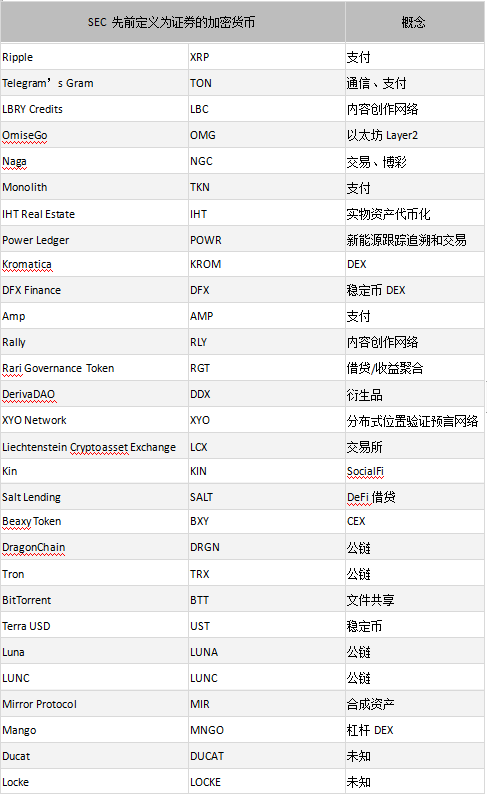
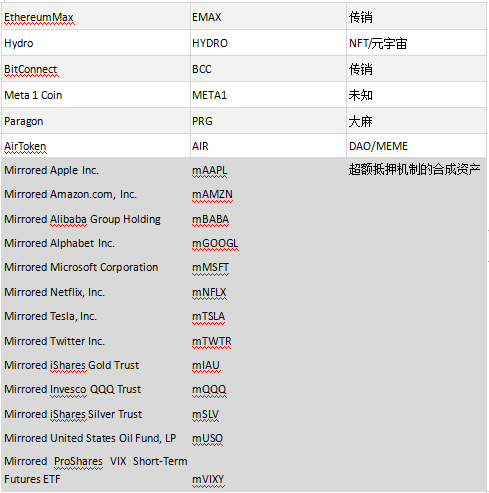
We counted the price changes of encrypted tokens mentioned by the SEC as securities in the past period of time this month. Except for BUSD, the 18 named tokens can be seen:
Table 1 shows that the majority of public chains in the industry are 13/18, followed by entertainment and Metaverse 4/18, and asset management and lending 2/18;
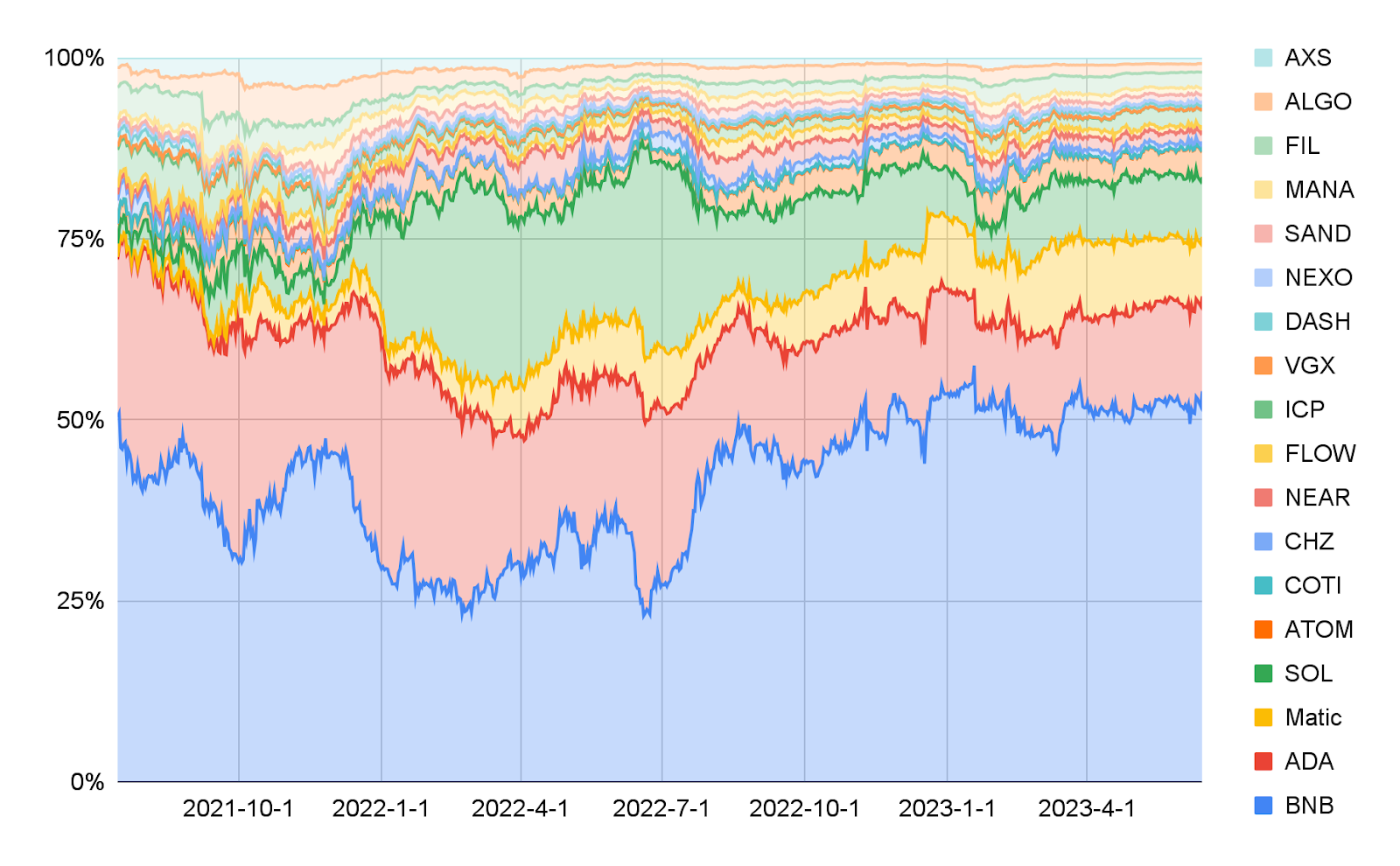
Figure 4 shows that BNB has accounted for more than 50% of the total since the beginning of this year. Even though it was sued by the SEC for the first time, the proportion of market capitalization has even increased slightly, showing that its price is relatively resilient; since the beginning of June, the price has fallen by an average of 28.8%, compared with the decline of BTC in the same period. 7.4%, it can be seen that the decline is very considerable;
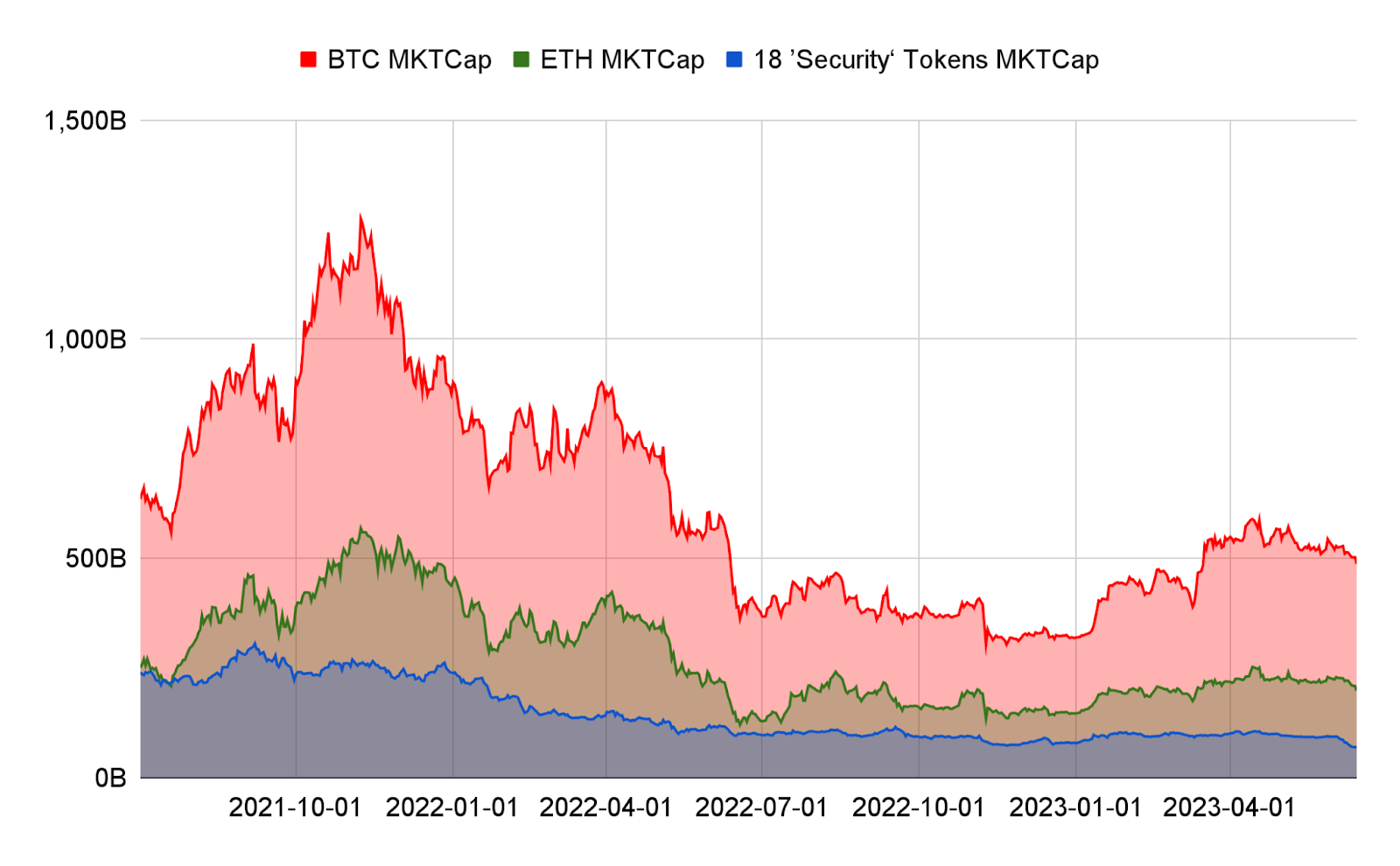
Figure 3 shows that the peak market value of 18 tokens occurred in September 2021, when it exceeded 300 billion US dollars, and the market value trough occurred after the implementation of SEC regulation this month, with only 70 billion US dollars;
Since the beginning of June, the top three decliners are FLOW (-37.1%) SAND (-37.4%) CHZ (-35.0%), it seems that entertainment-related tokens have fallen too much;
Since the beginning of June, NEXO (-8.4%), ATOM (-21.1%), and BNB (-22.2%) have seen the smallest decline. NEXO has paid the fine and settled with the SEC at the beginning of the year, so it has been least affected, and BNB has received charges It is understandable that the volatility of the largest token among the tokens (close to 50 billion US dollars before the fall) has low volatility, but the market value of ATOM is only more than 3 billion, and the decline is limited, showing its resilience;
These tokens have lost an average of 91% since their respective price all-time highs, with the smallest declines being BNB (-58.4%) MATIC (-78.6%) and ATOM (-81.0%) , both of which are also down by 10% since early June. Low currency, it can be seen that its price resilience has continuity;
Since their respective historical highs, ICP (-99.5%), FLOW (-99%), and FIL (-98.5%) have seen the largest declines. Among them, ICP has only fallen by 5.6% this year, and FIL has a 14.6% increase. After the range adjustment, the momentum of price decline has slowed down;
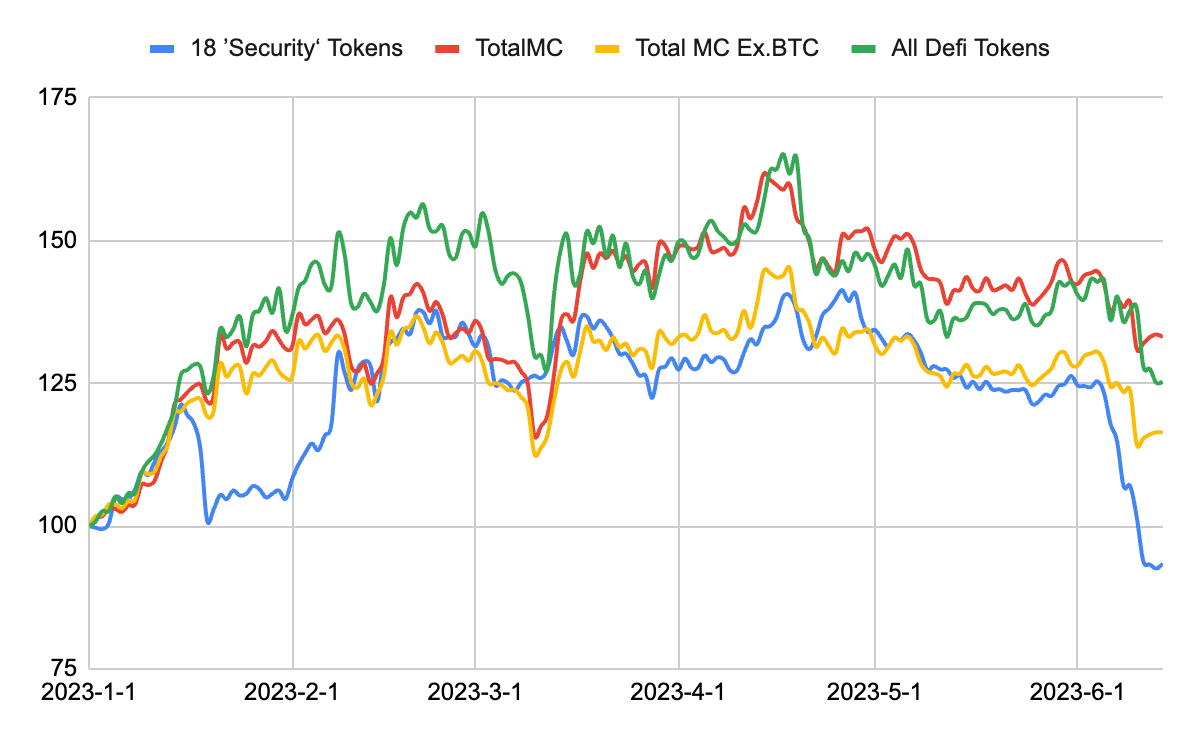
Figure 1 shows that before the regulatory event in June, the performance of 18 tokens lagged behind the market in 2023, and after the regulatory event, the lagging range expanded and all gains were lost during the year and turned down;
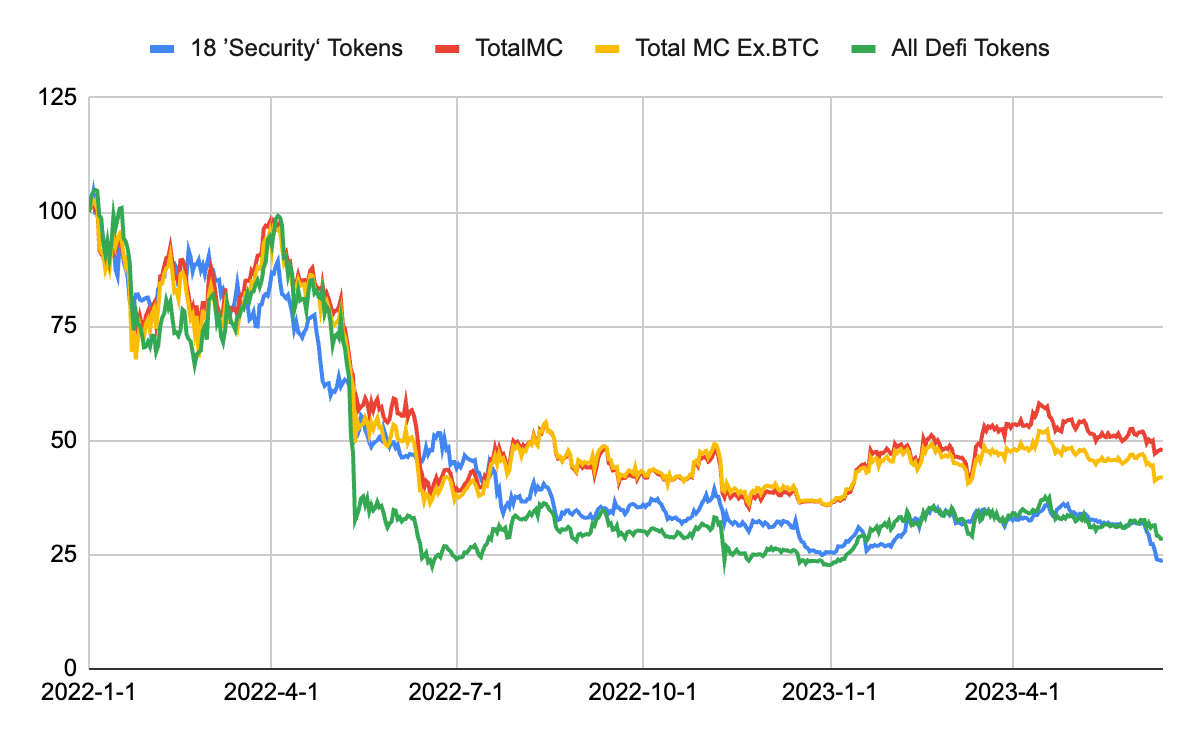
Figure 2 shows that since the timeline is extended to the beginning of 2022, the performance of 18 tokens still lags behind the market, but outperforms Defi tokens for most of 2022.
image description
Source: Coinmarketcap, Coingecko, TrendResearch
image description
Source: Coinmarketcap, Coingecko, TrendResearch
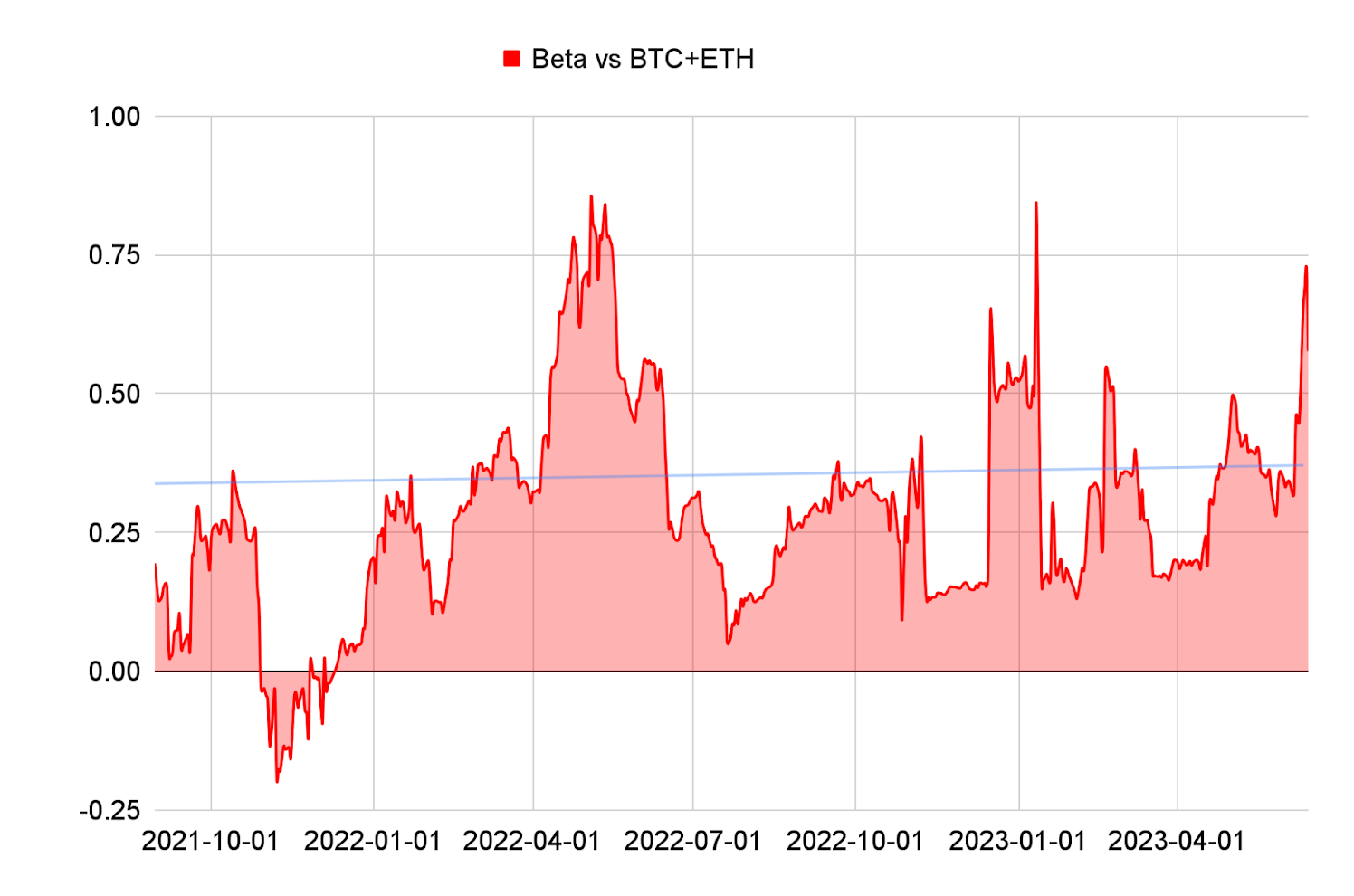
Beta represents the systematic or market risk of a security token relative to a benchmark index. If Beta is greater than 1, the price volatility of the security token may exceed the benchmark index; if Beta is less than 1, the price volatility of the security token may be lower than the benchmark index.
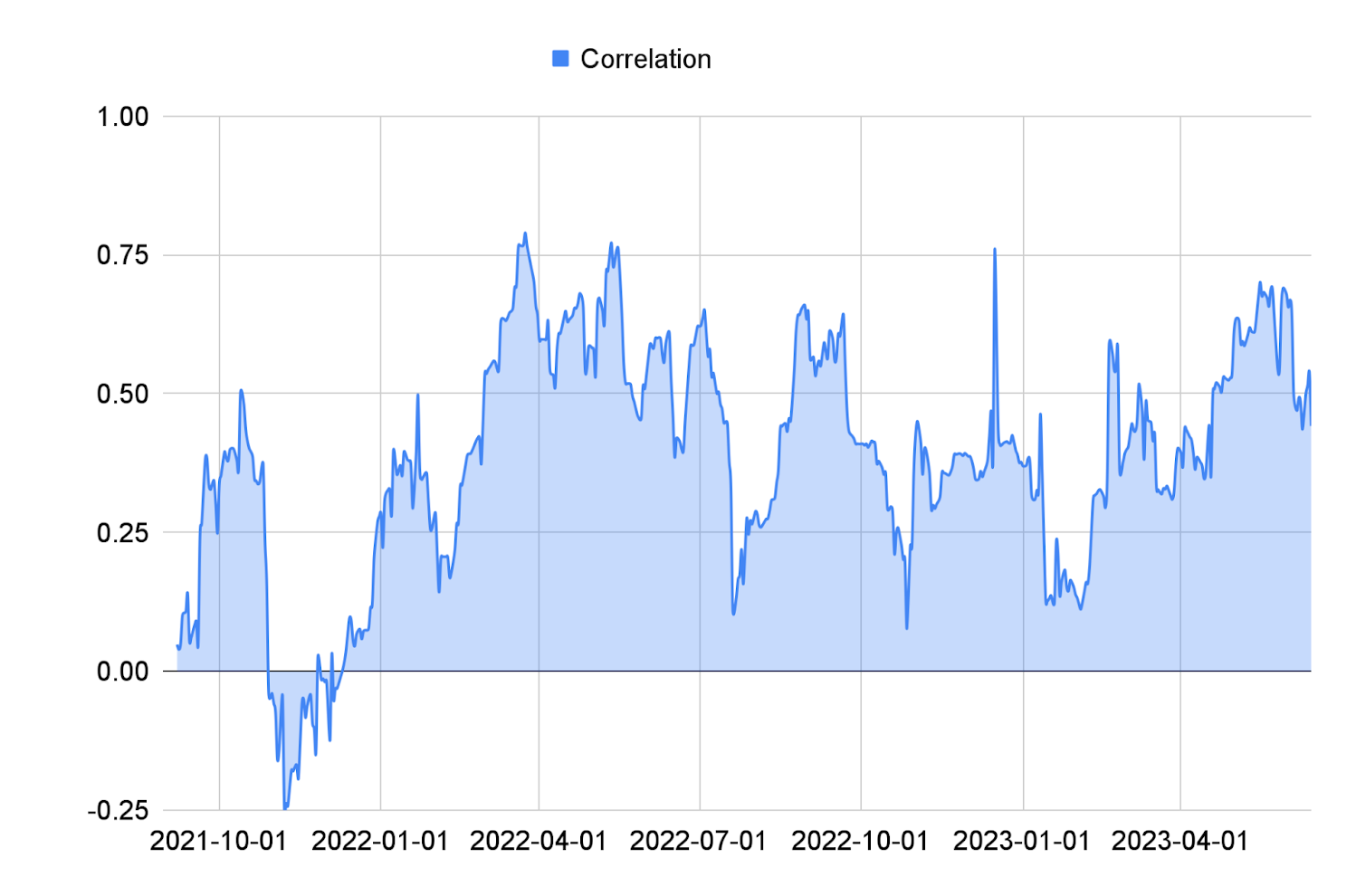
From the perspective of rolling Beta values, the market value fluctuations of these "securities" token combinations are actually smaller than the blue-chip fluctuations based on BTC and ETH. This result is not surprising, mainly considering that under the decentralized configuration, each token is due to project factors. The ups and downs cycles of the stocks do not exactly coincide, which also depresses the Beta of the entire portfolio relative to the benchmark index.
From the data, we can see clear changes in beta and correlation at different points in time, which may be related to market conditions, token fundamentals, or macroeconomic factors. When the Beta value is high, it indicates that the price changes of security tokens are more affected by the market. When the industry sentiment is extremely optimistic or pessimistic, both correlation and beta value tend to increase, which means that the utility of decentralized allocation is weakened.
secondary title
What are securities?
secondary title
What are the implications of being defined as a security?
Calling tokens securities makes it more expensive and complicated to operate a cryptocurrency trading platform. According to US rules, this label has strict investor protection requirements for platforms and issuers. This means exchanges will face constant scrutiny from regulators, which could lead to penalties and, in the worst case, criminal offenses if criminal authorities are involved.
If a large number of cryptocurrencies were to be classified as securities, it would fundamentally change the way the cryptocurrency industry operates. First, compliance with securities laws has become critical, requiring these altcoins and their issuers to comply with strict regulatory requirements. This includes registering with the SEC, making required disclosures and complying with reporting obligations.
In addition, classification can lead to potential transaction restrictions. If most altcoins are considered securities, they can only be traded on registered stock exchanges subject to specific rules and regulations. This could limit the liquidity and accessibility of these assets for retail investors and introduce additional barriers to market participation.
first level title
Future Scenarios for SEC Litigation
The lawsuits against Binance and Coinbase reflect growing tensions between the government and the cryptocurrency industry. SEC Chairman Gary Gensler made it clear that no more digital currencies are needed, emphasizing that the U.S. already has a digital currency called the U.S. dollar. U.S. Treasury Secretary Janet Yellen also expressed support for the SEC's action, favoring the use of regulatory tools to protect consumers and investors. This reflects regulators taking a clearer stance against cryptocurrencies or becoming a bedrock principle of the traditional financial system.
In the future, we may see the following four trends:
1. Supervision and law enforcement has been expanded, and direct prosecutions have been initiated against more blockchain projects, especially public chains with large market capitalization.Recently, the SEC has mainly launched lawsuits against exchanges. Except for BUSD and NEXO, the SEC has not directly issued warnings or lawsuits for the 19 tokens mentioned in the relevant documents, which may indicate that there may be more enforcement actions in the future.
2. Charges ranging from civil to criminal.Charges may not yet come, as the SEC and CFTC do not have the authority to initiate criminal charges. Criminal charges against cryptocurrency exchanges or projects often involve fraud, money laundering, or other illegal activities. Such cases are typically handled by law enforcement agencies such as the FBI or the US Department of Justice. Last year, for example, the DoJ announced criminal charges against six defendants in four cryptocurrency issuance cases for alleged involvement in cryptocurrency-related fraud. Another example is Sam Bankman-Fried (SBF) involving 12 criminal charges in the case involving FTX and Alameda, including SBF conspiracy to commit bank fraud and conspiracy to operate an unlicensed money transmission business, as well as wire fraud against FTX customers, investment in FTX securities fraud and conspiracy to make illegal political contributions and defraud the Federal Election Commission.
3. SEC or Gensler's authority may be revoked.For example:
For example:
U.S. Senator Bill Hagerty tweeted, “The SEC is using their role to wipe out an industry. Allowing a company (Coinbase) to go public and then preventing them from registering as a compliant exchange.”
U.S. Senator Cynthia Lummis also tweeted, “The SEC failed to provide a path to registration for digital asset exchanges, or even worse, failed to provide sufficient legal guidance to distinguish what is a security from what is a commodity .”
On June 16, two Republican representatives, Warren Davidson and Tom Emmer, proposed a bill called the "SEC Stabilization Act", which is intended to reshape the SEC and remove the current chairman Gary Gensler. The bill proposes to increase the number of SEC commissioners, increase directors to oversee the committee, and prevent regulatory policy from being influenced by the SEC chairman's personal ideas or political struggles.
4. Legal see-saw or quick rectification fines.first level title
Progress in Encryption Industry Legislation
Congress may pass a legislative framework for cryptocurrency regulation that will provide clearer rules for the operation of cryptocurrencies and related businesses in the United States. This clarity is likely to spur further development and innovation in the industry. A draft legislation in the House Financial Services Committee, co-sponsored by Representatives Patrick McHenry and Glenn Thompson, is considered the most workable legislation. The legislation seeks to clarify the agencies' jurisdiction over certain digital assets and "strike the right balance" between protecting consumers and encouraging responsible innovation.
The 162-page draft, published in early June, argues that digital assets that begin as securities could eventually be regulated as commodities. Whether it is a security or a commodity depends largely on how decentralized the underlying blockchain network is.
It proposes that if a network meets certain requirements, the network will be considered decentralized and commodity-eligible tokens will be regulated by the Commodity Futures Trading Commission (CFTC).
The specific judgments include that no one has unilaterally had the right to "control or substantially change" the function or operation of the network in the past 12 months, and no token issuer or affiliate has more than 20% of the currency holding ratio.
However, the draft bill is expected to face substantial opposition from congressional Democrats. SEC Chairman Gary Gensler and some Democrats argue that most digital assets should be classified as securities and that existing regulations are sufficient.
secondary title
Crypto case precedent
Ripple (XRP): In 2020, the SEC filed a lawsuit against Ripple Labs Inc. and two of its executives, alleging they conducted an unregistered securities offering worth $1.3 billion through a digital asset known as XRP. The SEC’s claim is that while Ripple positions XRP as a cryptocurrency, its issuance process is closer to a traditional securities offering and should therefore be regulated by securities laws. This is the largest cryptocurrency-related lawsuit brought by the SEC to date. As of my knowledge base update (September 2021), this case is still ongoing and no final decision has been made.
Block.one (EOS): In 2019, the SEC announced a settlement with Block.one, which agreed to pay a $24 million fine to resolve SEC allegations that Block.one conducted EOS between 2017 and 2018 The initial coin offering (ICO) violated securities laws. This is an important case because it shows how the SEC can impose substantial fines on ICOs that violate securities laws.
Telegram (Grams): In 2020, the SEC successfully blocked Telegram’s Grams token offering. The SEC’s contention in the case is that Grams tokens are unregistered securities, and therefore their offering violates securities laws. Ultimately, Telegram agreed to pay the fine and refund investors.
Kik (Kin): In 2020, the SEC successfully brought a lawsuit against Kik Interactive Inc. for an unregistered offering of securities through a digital asset known as Kin. Kik eventually agreed to pay a $5 million fine to settle the SEC's charges.
BlockFi: The SEC believes that investors lending crypto assets to BlockFi in exchange for the promise of variable monthly interest payments provided by the company is a security under applicable law; cash) with more than 40% investment securities and not registering as an investment company is a violation of the registration requirements of the Investment Company Act of 1940. Ultimately BlockFi will pay a $50 million fine directly to the SEC and pay another $50 million in fines to 32 U.S. states to settle similar charges. The settlement represented the largest recorded fine imposed on a crypto company at the time.
NEXO: The SEC charged Nexo Capital with issuing and selling an unregistered retail cryptoasset lending product, the Earn Interest Product (EIP). On January 20, 2023, the encrypted lending platform Nexo reached a settlement with the SEC and state regulators, will pay a total of $45 million in fines and stop providing lending products. The SEC agreed to the settlement with Nexo after considering the company's swift remedial actions and the company's cooperation with the Commission staff.
secondary title
Encrypted interest-bearing business
U.S. regulation is not only aimed at areas related to the issuance and trading of security tokens, but also involves financial management services, such as BlockFi and NEXO mentioned above.
If a company provides a platform for users to store funds and pay certain interest, then this business model is closer to the deposit business of a bank or financial institution. In this case, the company needs to be registered and licensed as a bank or financial institution according to the local laws and regulations.
In the United States, such firms may need to obtain a license from the Federal Reserve System, the Federal Deposit Insurance Corporation (FDIC), the Office of the Comptroller of the Currency (OCC), or state banking regulators. These agencies oversee banks and financial institutions, ensuring that they operate in compliance with laws and regulations.
In other countries, companies may need to obtain a license from the appropriate banking and financial services regulators. In Europe, for example, this could include the European Central Bank and national banking supervisors in each country.
first level title
Is regulation obsolete?
Proponents of more regulation argue that the designation of securities will bring more information and transparency to investors due to applicable SEC disclosure requirements. But cryptocurrency lovers say their projects are somewhat decentralized, making the old rules inappropriate, with crypto trading platforms arguing that the assets they list should be treated as commodities, not securities. In the United States, the rules governing trading in commodities and their derivatives are more focused on ensuring that companies, producers and farmers can effectively hedge against commodity price volatility.
Despite heightened scrutiny from regulators, the crypto industry is still looking to Congress to finally pass new laws to legalize the industry. Last year, Democrats and Republicans introduced several bills that would bring cryptocurrencies under the jurisdiction of the Commodity Futures Trading Commission and make other products, including stablecoins, more legal by regulating the assets those products can hold.
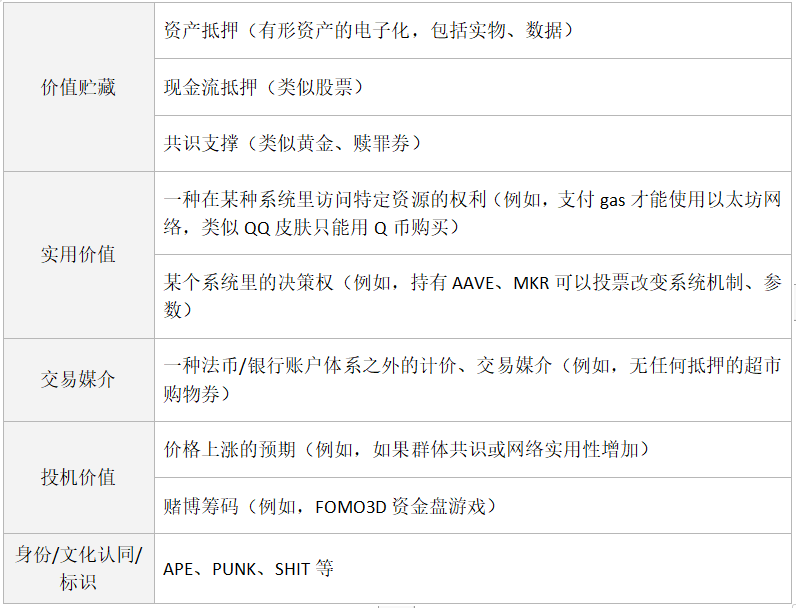
Due to the unique properties of encrypted assets, which can contain multiple sources of value beyond traditional securities, it may be outdated to only use the securities regulatory framework ninety years ago for regulation.
image description
Source: TrendResearch
image description
Source: SEC, Trend Research





