






Spent three years getting compliance for a tokenized fund and now I'm forced to leave the US


This week is destined to be a week worth remembering in the encryption industry.
On Monday, the U.S. Securities and Exchange Commission (SEC) filed a lawsuit against Binance, the world’s largest cryptocurrency exchange, and its CEO Changpeng Zhao, facing 13 charges, including listing multiple tokens as “unregistered securities,” Mixing customer assets with their own assets, allowing US customers to use Binance Globe, using virtual transactions to deliberately increase the trading volume of the Binance.US platform, etc.
Binance responded immediately that the company has been actively cooperating with the investigation and trying to reach a negotiated settlement, but the SEC directly chose enforcement action. Binance will vigorously defend the platform, fight the SEC, and will continue to work tirelessly to become a safe and trustworthy platform.
Later, the Strong Together statement was released again, stating that Binance did not misappropriate user assets, open and transparent wallet addresses, did not provide unsecured loans, did not have large political donations and large-scale sponsorship of media/sports/entertainment, and stated that it would continue to serve users Build, stand up for the crypto industry.
On Tuesday, the US SEC sued Coinbase, a US cryptocurrency compliance trading platform, accusing it of failing to register with the SEC as an exchange, a clearing agency, and a broker, and also clarified the pledge services provided by Coinbase and the large number of tokens being traded on the platform. as "unregistered securities".
At present, ten states in the United States have taken legal action against Coinbase for providing staking services, including Illinois, Vermont, Alabama, Kentucky, California, Maryland, Wisconsin, Washington, New Jersey, and South Carolina.
Coinbase tweeted in response: “Cryptocurrency has come a long way. In the US, it has a long way to go. We are ready!”
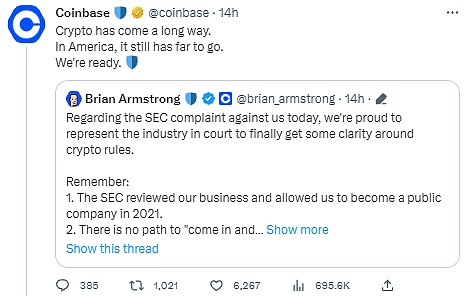
Obviously, Coinbase is also ready to fight the SEC to the end.
Coinbase CEO Brian Armstrong questioned the real purpose of the SEC prosecution:
1. The SEC reviews the business and allows the company to go public in 2021.
2. Tried repeatedly to register, but concluded that the SEC did not open the path to registration.
3. The SEC and the U.S. Commodity Futures Trading Commission (CFTC) have conflicting regulatory views on cryptocurrencies, and they have not even reached an agreement on "what is a security and what is a commodity".
4. The U.S. Congress is still formalizing regulatory laws by introducing legislation, but other crypto-friendly countries have directly enacted clear laws. Instead of issuing a clear rulebook, the SEC regulates directly through enforcement.
Why approve Coinbase's IPO in 2021, then sue 2 years later to get banned from offering the same service?
Therefore, compared with FTX, the real purpose behind the SEC's heavy blow to the two encryption giants within two days is doubtful.
Ripple CEO Brad Garlinghouse joked that this is the SEC trying to "divert" the public's attention from the "FTX collapse." SBF is the second-largest donor to Biden's presidential campaign, which has appointed Gary Gensler as the SEC's current chairman.
Some notable differences in the two lawsuits:
1. The SEC seems intent on “crushing” Binance
- Coinbase needs to repay all "ill-gotten gains" related to what the SEC calls the breach, as well as civil penalties and other forms of investor relief. When Kraken settled with the SEC in February over issues related to its staking product, it was forced to pay a $30 million fine.
- Not only did Binance have to pay a similar fine, it was also ordered to be permanently banned from trading securities and cryptocurrencies.
2. Coinbase is a "battle of life and death"
On the other hand, compared to Binance, the battle between Coinbase and the SEC is a "battle of life and death." Coinbase is more focused on the US market, where over 80% of its revenue came from last year. While Coinbase may continue to operate as normal in the short term, the SEC's allegations could cause Coinbase to suffer reputational damage that could lead to users withdrawing their funds from the platform.
Also, if Coinbase settles with the SEC, at what cost? If regulators want to prosecute to advance innovation goals, rather than create well-crafted rules, that's the same as sitting on the sidelines.
It is a good thing to hope that the encryption industry will take off the "Wild West" hat, and it is also to protect investors, but the SEC may have gone too far by blindly taking enforcement actions without clear legal guidance. Because this provides an opportunity for other countries to become safe havens for cryptocurrencies. Places such as South America and the Caribbean are increasingly popular with crypto companies because they embrace cryptocurrencies in a friendlier and more open manner than the United States.
Senator Cynthia Lummis, who has long campaigned to introduce a crypto regulation bill to the U.S., said in a statement: “The SEC has failed to provide a registration path for digital asset exchanges and, worse, failed to provide sufficient legal guidance on the distinction between securities and commodities.” . The SEC's continued reliance on law enforcement regulation continues to harm investors.Real investor protection needs to establish a sound legal framework that exchanges can abide by, rather than "push" the industry out of the United States. The U.S. Congress needs to pass the crypto regulation bill as soon as possible.
This is by no means alarmist.Recently, Derek Boirun, the founder of Realio, a real world asset (RWA) tokenization project, poured bitter water in a blog post, bluntly saying that "the unfriendliness of the regulators forced him to leave the United States."The Baize Research Institute compiled it as follows, with slight deletions:
This summer, in 2023, I will be leaving the United States indefinitely. Born and raised as a US citizen, now 42 years old, I do this for the sole purpose of protecting my constitutional rights, family, company from excessive government interference. It's like something out of a surreal novel, but it's my story.
I am the founder of Realio, a blockchain company that, as the name suggests, focuses on building digital infrastructure to bring real-world assets such as real estate on-chain. We started building the company full-time in 2018 and have invested a lot of time and money in its growth. From the beginning, our core focus has been compliance, because investing in real-world assets, whether on a blockchain or not, is generally subject to securities laws. After all, investing in real estate isn’t new, and neither is securities law, so doing it “on the blockchain” sounds like a very viable option.
Fast forward to 2022, after surviving the economic collapse caused by the new crown epidemic (mainly due to the rapid growth of the crypto market), we are growing and have a strong interest in issuing security tokens on our platform (within legal compliance regulatory framework companies that are conducting a public offering of tokens) are optimistic. Since we believe compliance is achievable, we generally ignore much of the narrative going on in the crypto industry, which also happens to be where most of the money goes. Plenty of people have gotten very rich chasing "quick money", anonymous or not, but we're sticking with it. We even chose to "tokenize" our own company through a compliant security token offering. Fortunately, we managed to raise enough money to sustain development and construction for several years. We are very grateful for the support provided by companies like Algorand who have invested in us through their token ALGO (just today, I had to hear Gary Gensler refer to ALGO as an illegal unregistered security). We might be in a very different place funding-wise if it weren't for Algorand's generous investment, and ALGO's price growth.
In 2020 to 2023, most of our time will be spent on compliance.
We launched a "tokenized" fund and spent a lot of money on top lawyers to register the fund with the SEC under Act 40. We spend more money on this than the entire operating budget of many startups. By the end of 2022, after multiple calls with SEC staff explaining the structure, we are ready to file for registration. Then the FTX bankruptcy event happened. Not long after, speaking with lawyers, I learned that the SEC was closing the registration of all "tokenized" funds seeking licenses. However, this is the only way we want to be registered or compliant.
At the same time, we also applied to the US Financial Industry Regulatory Authority (FINRA) for a Regulation CF portal license, which is also a very expensive process... Like the SEC, we had many calls with its staff to resolve all questions. However after FTX went bust, FINRA requested a call with us to re-examine our details. We prepared and answered all questions with sincerity. However, we couldn't help feeling that the call was just a "formality" with the staff repeating basic questions over and over in order to put us off or get us stuck in some kind of technical issue. After the call, we received a list of follow-up questions from them that was so extensive that it went beyond our application. Knowing that FINRA could delay this for years, we have decided to hold the application until a new administration takes office.
Most issuers of blockchain-based assets don’t actually have a path to registration, and it’s not for lack of trying or lack of compliance. I can attest empirically that regulators have not been fair and kind to the crypto industry. I'm no stranger to the various tactics regulators employ against us, typical "bureaucracy".
However, those talented people in the crypto industry are working hard to build a better world financial system. This is not a game for us, nor is it politics. Many of us left careers in traditional fields to do this. Now, we are leaving America too.
Money is the last battle for freedom. We will not watch in silence while you continue to control and manipulate us. Despite your position, you do not have this power. You have no right to tell us what the market needs and what it doesn't. This is exactly the kind of overreach we fought for independence to build this country. Capital markets are being smothered by regulations that don't actually protect anyone but the wealthiest.
Leaving the US is not easy either. I have a family and they love New York, etc. But I have an obligation to protect what we have built, and that means finding a country that supports what we can continue to build.
According to the "Notice on Further Preventing and Dealing with the Risk of Hype in Virtual Currency Transactions" issued by the central bank and other departments, the content of this article is only for information sharing, and does not promote or endorse any operation and investment behavior. Participate in any illegal financial practice.
risk warning:
According to the "Notice on Further Preventing and Dealing with the Risk of Hype in Virtual Currency Transactions" issued by the central bank and other departments, the content of this article is only for information sharing, and does not promote or endorse any operation and investment behavior. Participate in any illegal financial practice.





