






veDAO Research Institute: What is the RWA track that Binance Goldman Sachs and other giants have entered?


The concept of RWA (Real World Assets, Real World Assets) has been discussed in recent months. Major institutions have laid out on this track, thinking that it is time to enter the market and express their long-term optimism. For example, at the beginning of this year, Goldman Sachs' digital asset platform was officially launched and helped the European Investment Bank issue a two-year digital bond of 100 million euros; subsequently, electrical engineering giant Siemens also issued a digital bond of 60 million euros for the first time on the blockchain; Binance released a 34-page in-depth research report on the topic of RWA in March this year; Citibank is even more vocal, pointing out in the report that almost anything of value can be tokenized, financial and real-world assets The tokenization of digital assets may be the "killer app" for the breakthrough of blockchain, and it is predicted that by 2030, there will be 4 trillion to 5 trillion US dollars of tokenized digital securities.
It can be seen that the RWA track is enough to become a key narrative this year. This article will explain and analyze the relevant content of the RWA track, and take stock of ecological projects worthy of attention, and share potential speculative opportunities with you.
What is RWA
RWA is the tokenization or NFT of real assets, which can put real estate, bonds, stocks and other assets in the real world on the chain. Owning tokens means that you have ownership of this item in the real world, and you can make loans on the chain , leasing, trading and other transactions. In fact, this concept has long been a successful case of RWA in the currency circle. Our commonly used stablecoins USDT, USDC, etc., they are the real asset tokenization of the US dollar.
The impact and advantages of RWA+DeFi
The core impact of RWA on DeFi is to connect traditional finance and encrypted finance: RWA brings financial assets off the chain to the chain, and RWA tokens can redeem offline assets, opening up the channel between real assets and DeFi. In this way, the sustainability of encrypted finance can be achieved by increasing the externalities of DeFi and improving the liquidity of various assets.
Break the closed system and inject more gameplay and possibilities into DeFi. At present, DeFi is a relatively closed environment, and its income comes from endogenous systems, such as transaction fees, lending fees, pledge income, and inflation income. RWA can make the subject matter more diverse, and it is any possible item in real life, so innovative ways to play will also appear in encrypted finance one after another.
Expand DeFi income and provide players with continuous motivation: As the yields of various DeFi protocols decrease and market uncertainty increases, DeFi investors increasingly need a diversified portfolio of real-world assets in order to obtain stable income. For example, U.S. Treasury bonds have a 5% yield, high yield and low risk, and are the preferred investment target for a large number of investors after the bear market last year. Through RWA, investors can enter the traditional off-chain market, make free investment choices, and obtain diversified portfolio returns.
The commercial value and potential of RWA tokenization in DeFi has been recognized, attracting the layout of major institutions and the entry of capital. Traditional financial institutions hold a large number of real assets, such as real estate, stocks, bonds, etc., but the ownership and transaction of these assets usually need to be certified and supervised by intermediaries, which requires a lot of time and cost. The use of RWA can bring higher liquidity and value to enterprises by reducing the need for intermediaries, automating processes and increasing liquidity, thereby increasing revenue and competitiveness.
RWA project review
At present, according to the nature of assets and the way of tokenization, RWA can be divided into stable coins, private credit, stocks and bonds, real estate, carbon credit certificates, metals, etc. Let's take stock of several RWA projects with great potential:
1.Centrifuge private credit
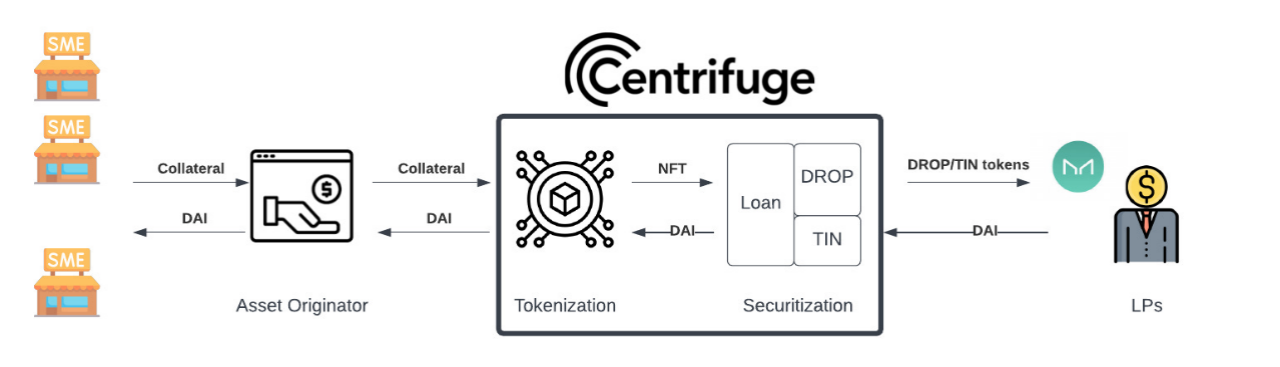
Launched in 2017, Centrifuge is the first project to do RWA on MakerDAO. It is an on-chain ecosystem for structured credit, focusing on securitization and tokenization of previously illiquid debt. It aims to help central enterprises obtain financing with a lower threshold, while allowing investors to obtain income from real assets.
Centrifuge basically simulates the process of corporate credit in traditional finance, but uses DeFi+NFT to eliminate the participation of some intermediaries and the cumbersome process under the chain. The process of financing on Centrifuge can be roughly summarized as follows: the borrower packages and uploads the real assets under the chain, generates a legally effective NFT for mortgage, and obtains interest-bearing ERC 20 tokens, and investors can use DAI to purchase these Interest-bearing ERC 20 tokens; promoters get redemption after financing expires, and investors get income. The fund pools generated by interest-bearing ERC 20 tokens are also divided into primary and advanced. Investors in the primary fund pool have high returns but higher risks, while advanced fund pools have relatively lower returns and risks.
According to previous official website data, Centrifuge has raised more than 385 million US dollars, and its TVL has doubled compared to last year. Its tokenized assets have been integrated across DeFi, including $220 million in risk-weighted assets on MakerDAO.
2. Ondo Finance Public Bonds
Ondo Finance is a DeFi protocol founded by former Goldman Sachs digital asset team member Nathan Allman and former Goldman Sachs technology team vice president Pinku Surana. It has received $34 million in investment from investors including Pantera Capital, Coinbase Ventures, Tiger Global, Wintermute And so on well-known institutions.
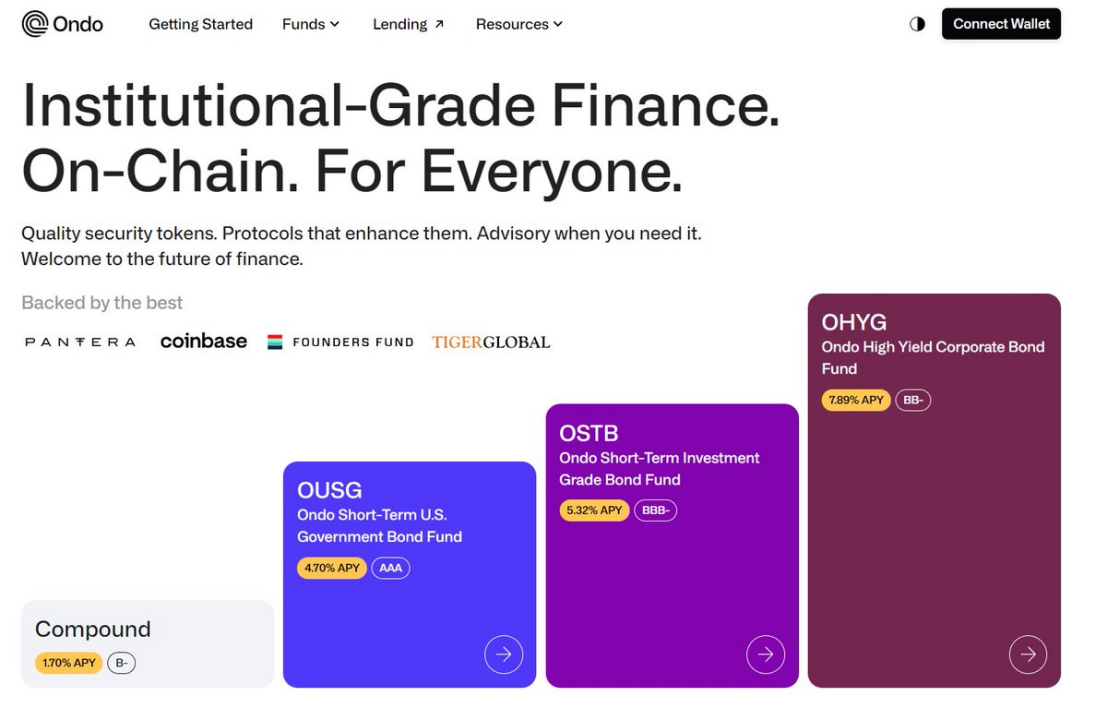
It is understood that Ondo Finance is a large and highly liquid ETF managed by institutions such as asset management giant BlackRock and Pacific Investment Management Corporation (PIMCO), and has launched four tokenized funds: U.S. Money Market Fund (OMMF), U.S. Treasury Bond (OUSG), short-term bonds (OSTB), and high-yield bonds (OHYG), the average yield of these four funds can reach about 6%. However, for compliance reasons, Ondo Finance will adopt a whitelist system. Investors need to pass KYC and AML screening before signing subscription documents. They can use stablecoins or US dollar trading fund tokens and use these funds in licensed DeFi agreements. Tokens, while Ondo Finance will charge an annual management fee of 0.15%.
3. MakerDAO bonds, stablecoins
MakerDAO is an open-source decentralized autonomous organization created on the Ethereum blockchain in 2014. Everyone who holds its token MKR can participate in project governance. In addition, MakerDAO issued the stable currency DAI, and supported and stabilized the value of DAI through mechanisms such as the dynamic system of collateralized debt positions.
MakerDAO issued the world's first DeFi-based real-world asset loan, laying out the RWA track early. In 2020, MakerDAO officially included RWA in its strategic focus and released guidelines and plans for introducing RWA. In addition to issuing the stablecoin DAI, MakerDAO has adopted proposals for RWA as collateral in the form of tokenized real estate, invoices, and receivables to expand the issuance of DAI.
In 2022, MakerDAO will also jointly launch a $220 million fund with BlockTower Credit to provide capital for real-world assets. MakerDAO's RWA business scale exceeds 680 million U.S. dollars, of which 500 million U.S. dollars of RWA collateral is US Treasury bonds. In addition, Societe Generale borrowed 7 million U.S. dollars from MakerDAO, and its position consists of AAA-rated bonds worth 40 million euros as OFH tokens. support. It is reported that about 70% of MakerDAO's revenue in December 2022 will come from RWA.
MakerDAO can definitely be regarded as an early entrant to RWA, but the concept of RWA has received mediocre responses before, and there has been no tepid initiative. It was not until the scale of DeFi rebounded in 23 years and other traditional giants entered the game that RWA came back to the field of vision and ushered in a wave of attention. MakerDAO, which laid the groundwork early, certainly has richer experience, including previous cooperation, the support of the economic value of DAI, and the successful experience of issuing tokens, etc., so the market generally has very good expectations for MakerDAO.
4.RealT real estate real estate
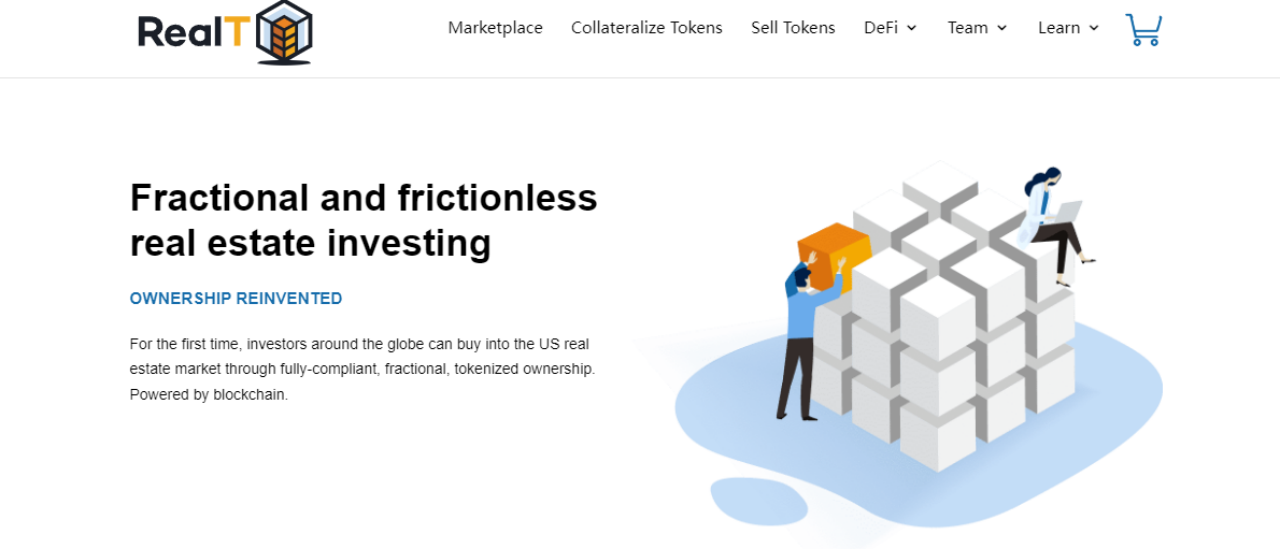
RealT is a company that tokenizes off-chain assets and is one of the pioneers in asset tokenization. It mainly tokenizes real estate in the United States. RealT can solve the liquidity and transaction costs of real estate assets by tokenizing real estate. For example, real estate that needs to be bought and sold in sets can be sold in fragments, allowing ordinary investors to participate in the investment in the form of holding partial ownership. For example, investors who are difficult to directly invest in American real estate in traditional ways can directly invest in American real estate.
When an investor purchases its token token RealToken, he is equivalent to investing in a real estate asset, and he can receive a certificate proving that he owns this part of the asset. Even if RealT goes bankrupt or disappears for some reason, RealToken will still be effective, and the interests of RealToken holders will not be damaged. Therefore, the value and effectiveness of RealToken itself will not be affected by RealT.
And RealT will use IPFS technology to permanently store these documents proving the effectiveness of RealToken assets. Once these files are stored in IPFS, they will last forever and cannot be tampered with, and there is no need to rely on third-party organizations to store these files. In addition to these documents that prove assets will be uploaded to IPFS, data and information on housing inspections, insurance, property taxes, etc. will also be uploaded to the IPFS system one after another. These data and documents will provide real, objective, and verifiable information about the real estate they describe, record all transaction history of this real estate, and can easily verify its authenticity.
When the asset certificate and data are safely stored, the data that will be stored is the house price. RealT will introduce an oracle machine, so that real estate evaluation data can be directly obtained from the market without going through a third-party organization, so as to reflect the real estate price as objectively and truly as possible. Real estate data must be completely open and transparent, and the evaluation of real estate value must also be completely open and transparent.
At present, the total value of global real estate is about 360 trillion US dollars. Such a huge market makes us look forward to the activation and innovation of DeFi after RWA.
5. Galileo protocol open source infrastructure
Galileo Protocol is a platform for the tokenization and redemption of real assets, an open-source infrastructure for executing smart contracts. It allows the creation of "pNFTs" that represent physical goods, are issued on multiple chains and can interact with any blockchain.
Through the Galileo platform, users can diversify their encrypted portfolios into real assets and obtain illiquid assets. Moreover, Galileo can also guarantee that the related physical assets pNFT are real and do not contain fakes. Because pNFT is a token of the QRC 20 standard, it can achieve interoperability on all major chains and provide information such as storage and source tracking of these assets, thereby avoiding counterfeiting and fraud.
LEOX is the native token of Galileo, and users will become 4 different stakeholder roles, namely the owner (The Owner), the buyer (The Buyer), the savior (The Redeemer), and some investors (The fractional investor).
In Galileo, if you are a seller, you can generate an NFT to prove that you are the owner of real assets. As a buyer, you can directly purchase the real assets you want. After the purchase, the seller will send the NFT to the buyer, thus becoming the new official owner of the real asset. If you are a partial investor, you may only buy a part of the actual asset. For example, in real estate, the asset with huge value will be fragmented, so that there may be multiple investors investing in the real estate asset. And if it is the role of the savior, you can directly redeem the asset and take possession of it.
Can RWA be accumulated over time?
The narrative of RWA in 2023 ushered in a wave of attention, and some institutions are also devoting themselves to building the RWA field. However, the current field is still in the early stage of development and the scale is small; and to a certain extent, it needs to rely on various protocols of DeFi, especially the oracle machine, which has in fact been an imperfect infrastructure content; and finally, it is also the compliance of RWA Problems, these builders in the RWA space are also constantly struggling with regulations, determined to connect Web3 with the real world.
🔴Investment is risky, the project is for reference only, please bear the risk by yourself🔴
Follow us
veDAO is a decentralized investment and financing platform led by DAO. It will be committed to discovering the most valuable information in the industry. It is keen on digging the underlying logic and cutting-edge tracks in the field of digital encryption, so that every role in the organization can fulfill its responsibilities and get paid off.
Website: http://www.vedao.com/
🔴Investment is risky, the project is for reference only, please bear the risk by yourself🔴





