






RockTree OG Talk Roundtable: Regulation and Opportunities of Web 3.0 in Hong Kong


The RockTree OG Talk series of roundtable talks is co-hosted by RockTree Capital and In each OG Talk, Stonewood Capital will gather pioneers in the field of Web 3.0, bringing the audience the world's most in-depth OG views and the latest information on top companies in each track.
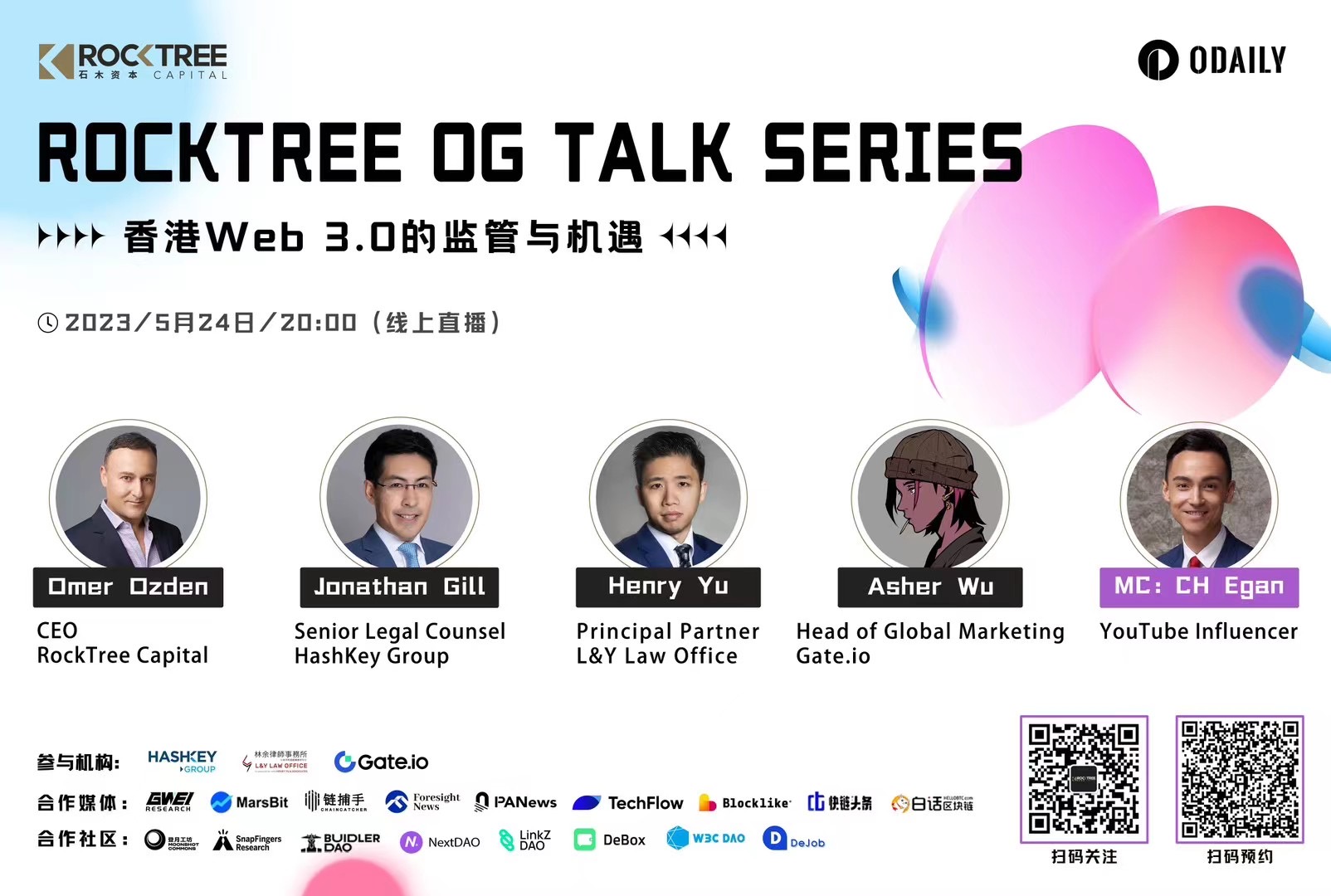
At 20 o'clock on May 24th, this roundtable discussion hosted by YouTube Influencer CH Egan will discuss the theme of "Hong Kong Web 3.0 Regulation and Opportunities". The four guests are: Chairman of Stonewood Capital and ZhenFund International Partners Dr. Omer Ozden, HashKey Group Senior Legal Counsel Jonathan Gil, L&Y Principal Partner Henry Yu, and Gate.io Head of Global Marketing Asher Wu.
Omer Ozden believes that Hong Kong, as a natural financial center, has unique advantages to promote the development of Web 3.0 technology, but at the same time, it also needs the participation of mainland developers and entrepreneurs. Hong Kong serves as a pilot area to promote the development of the regulatory system, and large capitals around the world will regard Hong Kong as a dynamic jurisdiction, which will not only revitalize Hong Kong's economy, but also promote the economic development of the entire Asia-Pacific region. There will be many innovations in Hong Kong in the future, and entrepreneurs and capital will jointly promote innovation. This is also an excellent opportunity for Rockwood Capital.
According to Jonathan Gill, Hong Kong has a competitive advantage in Web 3.0 regulation. Regulatory certainty is important to attract investment, which further drives innovation in the industry. As an international financial center with a sound legal system, Hong Kong has an excellent opportunity to stand out in this round of encryption winter.
Henry Yu believes that Hong Kong has great potential to become the capital of Web 3.0, but the regulatory mindset is also very important. Cryptocurrency is an innovative industry, and its business model is constantly changing, and each institution operates differently. If the Hong Kong Securities Regulatory Commission adopts the regulatory model of the traditional financial field to look at the encryption industry, it will create new regulatory risks.
Asher Wu believes that Hong Kong’s Web 3.0 regulatory guidelines can guide encryption companies in what areas they should innovate, including transaction types, project types, etc. The regulation of the Web 3.0 industry in Hong Kong means that the encryption industry is recognized by the government and the public, and the value of the encryption industry is recognized. Hong Kong Web 3.0 regulation will help increase the mass adoption of cryptocurrencies globally.
The following is the record of the roundtable dialogue, which is condensed and organized by Odaily.
CH Egan: First of all, let me introduce the sponsor Rockwood Capital. Rockwood Capital is an international investment fund and merchant bank, focusing on pioneering frontier transactions between North America and Greater China. The Stonewood Capital team focuses on early-stage investment, providing global ecosystem support for leading Web3 and mobile e-commerce projects. Its network has global funds, exchanges, media and Web3 industry partners, making it the highest quality early stage Web3 investment fund in the world, helping top founders and their teams achieve accelerated global growth.
Omer Ozden (Ouyang Mo) is the chairman of Stonewood Capital and an international partner of ZhenFund. He was part of a team that invented the VIE structure to open China's internet industry to foreign capital. He has participated in the early investment and listing of many companies, including Baidu, Alibaba, New Oriental, NetEase and Facebook. Known as the "Decacorn Hunter" for his unique insights, Omer has made a name for himself in the global cryptocurrency investment industry by focusing on companies with market capitalizations over $10 billion. He has successfully participated in early-stage investments in some of today's most well-known Web 3.0 companies, including ChainLink, The Graph, dYdX, REN, Fantom, Maple, Pocket Network, and others. Under Omer's leadership, Stonewood Capital has become one of the industry pioneers under the Web3 wave, connecting top companies and businesses in the Western and Eastern cryptocurrency markets. Rockwood team members are located in Beijing, Shanghai, Nanjing, Singapore, New York and Toronto, covering experts in the fields of cryptocurrency localization finance, capital market, digital marketing and legal compliance, providing global solutions for blockchain projects, high-quality Projects can be connected to the international ecosystem of Stonewood Capital.
It is a great honor to communicate with four guests today. First of all, please introduce yourself.
Omer Ozden:Hello everyone, I am Omer Ozden, the founder of Stonewood Capital. I am very much looking forward to communicating with all the guests today. We have known each other for many years and have experienced bulls and bears together.
Jonathan Gill:Hi everyone, I'm Jonathan and I'm building utility and security tokens for HashKey, as well as advising on virtual asset regulation in Hong Kong. HashKey is an end-to-end digital financial services group in Asia. We are one of only two virtual asset trading license holders in Hong Kong, and are allowed to provide securities trading and automated trading services.
Henry Yu:Hi everyone, I'm Henry Yu and I'm happy to share some perspectives on Hong Kong's regulatory environment. As a practicing lawyer for more than 20 years, I previously focused on investment banking and established the law firm L&Y 7 years ago. Currently, I focus on the field of cryptocurrency and provide legal advice to exchanges, funds and project parties.
Asher Wu:Hello everyone, I am Asher Wu from the established exchange Gate.io. Founded in 2013, Gate.io has become one of the largest exchanges in the world, providing a variety of digital asset trading services with more than 10 million users. Gate.io is consistently ranked among the top 10 crypto exchanges in the industry. In addition to digital asset trading services, Gate.io also provides services such as decentralized finance, research, analysis, and venture capital labs.
CH Egan: Recently, Hong Kong has ushered in a new narrative and a new outlet. It has begun to welcome Web 3.0, accept DLT, cross-chain infrastructure, embrace the metaverse, connect with NFT, cooperate with stablecoins and central bank digital currencies, and give entrepreneurs in this industry The opportunity is endless. So how can Hong Kong’s policies on cryptocurrencies be interpreted? What are the opportunities and challenges for institutional and retail investors respectively? How should we correctly view the new world of "Web 3.0 Hong Kong"?
Henry Yu:In the past two or three years, many people, especially Chinese practitioners, have moved to Singapore or other jurisdictions. Most people leave Hong Kong because cryptocurrencies are completely banned in the country, so they assume that Hong Kong will adopt the same policy at some point in the future. But now Hong Kong is taking a different stance. In the past few months, everyone (even some government officials) as well as Chinese cryptocurrency companies have been very bullish on the development of Web 3.0. In the next two years, Hong Kong will be used as a pilot. If all goes well, then there may be an opportunity to slowly open up this market. Currently, thousands of practitioners have migrated to Hong Kong.
Omer Ozden:As a natural financial center, Hong Kong has complete infrastructure, sufficient talents, and fine traditions to carry out financial activities, and the first major application of Web 3.0 is in the financial field. In Hong Kong, decentralized finance, centralized finance, and others are all expanding. I think it's a natural thing for Hong Kong to move that type of business to Hong Kong, to make it a gateway. Hong Kong has always lacked "founder-type" entrepreneurs, but also needs mainland developers and entrepreneurs. If the two can be organically combined in the future, it will help the development of Web 3.0 technology.
Jonathan Gill:I think Hong Kong has recently provided a clearer policy message for Web 3.0. The existing methodology in Hong Kong is "same business, same risk, same rules", which allows practitioners to learn from the experience of traditional securities regulations. In terms of opportunities, I focus on tokenization and am also passionate about facilitating the liquidity of high value illiquid assets such as real estate, art or wine. Speaking of challenges, I think it's important not to get distracted by bad news about the short-term volatility of cryptocurrencies when we're measuring the value of assets. I don't think tokenizing an asset will make its value less predictable, nor subject it to more change, and if anything, probably raise its price.
Asher Wu:I think the introduction of policies on cryptocurrencies and making Hong Kong a financial center that is conducive to the development of cryptocurrencies will be of great benefit to the world economy as a whole and the environment of cryptocurrencies. We need to gradually improve the policy and slowly infiltrate the public to make the encryption industry mainstream. A fair and diverse environment can give the cryptocurrency community a channel to express themselves, allow more people to join the encryption field, and allow the outside world to more accept cryptocurrency and Web 3.0, making it more widely used. In addition, it will attract more talent and new mobility. Most importantly, it also increases the level of trust between the crypto community and the general public. I think it's a good thing for everyone working in the industry right now, regulatory certainty is really important, and it's going to allow the entire crypto space to move fast.
CH Egan: Omer, you have participated in the venture capital and IPO of the first Internet companies such as Baidu, Netease and Alibaba, and experienced various stages of the development of China's digital industry. So what is your judgment on recent developments in Hong Kong?
Omer Ozden:Hong Kong has always been a gateway for China to have different types of infrastructure and access to global markets, and now it is once again actively promoting Web 3.0 technology. I think the long-term trend in China is openness, and the liberalization of Hong Kong this time is part of the general trend, which is why Stonewood Capital is still developing in China.
CH Egan: HashKey Group has now become the first company in the world to obtain licenses to operate virtual asset trading platforms in Hong Kong and Japan respectively, and is exempt from operating in Singapore under the Payment Services Act of the Monetary Authority of Singapore (MAS) . As one of the only two SFC Type 7 licensed virtual asset companies in Hong Kong, can you tell us how the Hong Kong SFC has regulated virtual assets over the years, and how their guidelines and general framework compare with other "SFC" companies such as Singapore and the United States? Is the Financial Center any different?
Jonathan Gill:I will look at each of these three jurisdictions separately. The first is Hong Kong, where there are several key regulators: the Securities and Futures Commission of Hong Kong, which regulates securities and futures; and the Hong Kong Monetary Authority, which ensures the stability of the currency and, more broadly, the stability of the banking and financial system. Since at least 2018, the SFC has been trying to understand the virtual asset industry, giving investors and regulated entities like HashKey more certainty and comfort. The government is currently amending the anti-money laundering regulations, which will bring cryptocurrencies under the supervision of the Securities and Futures Commission of Hong Kong.
Singapore's supervision is more direct, under the sole supervision of the Monetary Authority of Singapore. Its rules and regulations pay more attention to anti-money laundering and technical risks, and gradually increase the protection of consumers. The creed of the Hong Kong Securities Regulatory Commission is to provide the best protection. I think the biggest difference between Singapore and Hong Kong is that the Monetary Authority of Singapore does restrict the marketing of digital assets or digital payment token services to the general public.
Next, let’s talk about the United States. Since the United States is a federal country, according to the legal classification of virtual assets, it may be subject to both state and federal laws. There may be remittance licenses, securities laws, and commodity laws (all have their own regulators. and regulations). Another difference is that the U.S. has taken a tougher and more intrusive approach to regulating virtual assets, taking some high-profile legal steps such as regulating staking and classifying cryptocurrencies as securities.
CH Egan:HashKey As a big proponent of asset tokenization, in what ways do you think regulation has unlocked the potential of asset tokenization, and whether Hong Kong provides a sufficient enabling environment for physical asset tokenization to be adopted and fully exploited at the corporate level its potential?
Jonathan Gill:I think regulation will bring a certainty and comfort to asset issuers and holders. If tokenization is to compete with traditional finance as a viable method of raising mainstream capital, then it does need regulation. In this sense, this is a substantial leap forward for licensed institutions to have a clear regulatory regime, which is especially important during the crypto winter, so I think regulations will change from "burden" to competition Advantage.
On the second question, I think Hong Kong has a very good regulatory system, but maybe more can be done to promote the development of this industry. Recently, the Hong Kong Securities and Futures Commission stated that only professional investors should hold security tokens, as they feel they are more complex products. I think that's a pretty conservative stance, because virtual assets are not complex products per se, nor are securities. But when you tokenize securities, suddenly it's a complexity product. This system excludes retail investors, who make up a large percentage of our client base. The Hong Kong Securities Regulatory Commission has recently relaxed restrictions on financial vanilla products, but it stated that for tokens, if they are not legally perfected in the form of financial instruments, they will still be considered as a complex product, and the way forward is still Resistance and long.
Hong Kong does not count cryptocurrencies in the wealth of professional investors, which is not a good thing for crypto asset exchanges like ours. Because we have many potential clients who hold a lot of cryptocurrency and meet the threshold of professional investors, but they only hold very little cash. So that impacts the size of our potential customer base. So I think those two things are things that Hong Kong can do to improve its reputation as a cryptocurrency hub. Hopefully the regulators will make this a reality.
CH Egan: What types of services does L&Y Law Office provide for virtual asset businesses? What are the recent noteworthy developments in Hong Kong's virtual asset market and regulatory environment? Could you please provide more details on the latest developments in the following areas? Such as the new license system for virtual asset service providers, category 1, securities trading, category 9, asset management and its regulated activities, and the regulation of stablecoins? In addition, how does Hong Kong view the application of central bank digital currency?
Henry Yu:As a law firm, we help clients with legal and regulatory issues, including securities, listings, mergers and acquisitions, compliance, licensing, and even litigation and arbitration against SEC investigations. Now that we have a license system for virtual asset service providers, we are helping exchanges, projects, and some cryptocurrency funds to comply with increasingly clear laws and regulations. In fact, we are also strengthening ties with regulatory agencies, trying to help promote the formulation and improvement of laws and regulations.
Now, with the new virtual asset service provider system, every cryptocurrency exchange needs to obtain a license if it wants to operate in the Hong Kong market, which puts all exchanges on the same starting line. I advise clients to start with something simple like Class 1 and Class 9 licences. Currently, Hong Kong allows some Type 1 licenses to be upgraded to broker-dealer licenses to deal in cryptocurrency virtual assets, but only if they trade through licensed platforms in Hong Kong. For category 9, there are currently quite a few crypto asset managers who have applied for licenses, so they are able to handle 100% of cryptocurrencies. In addition, with the implementation of the new virtual asset service provider mechanism, many traditional asset management companies are planning to apply for licenses to conduct cryptocurrency transactions.
Regarding stablecoins, the Hong Kong Monetary Authority has announced that they will supervise stablecoins if they are backed by legal tender. Therefore, we look forward to new laws and regulations. In fact, there is a law in Hong Kong for the issuance of stablecoins, called the Stored Value Facilities Ordinance (Stored Value Facilities Ordinance), but so far, the Hong Kong Monetary Authority has not granted any SVF licensee the right to issue stablecoins. Therefore, we will soon see that once new laws and regulations are implemented, regulators will grant everyone a license to issue stablecoins. In addition, I believe there will definitely be companies or institutions that will play a role in issuing stablecoins backed by offshore renminbi.
CH Egan: What are the recent developments of Gate.io? What do you think of the changes that will occur to Gate.io and the global exchange landscape with the increasingly friendly Web 3.0 environment in Hong Kong? What does this mean for the retail business? And what does it mean for emerging projects that now have a larger market to grow their community? Hong Kong's rise as the new "Web 3.0 capital" and maybe even grab some business from other regions like Europe and North America?
Asher Wu:Gate.io has been at the forefront of the industry for the past decade, advancing the development of blockchain and on-chain technology globally, and has also become the first cryptocurrency exchange to support BRC-20. Regarding how Gate and other exchanges can better embrace Hong Kong's friendly Web 3.0 environment globally, I think this is a great opportunity for both ToB and ToC. Allowing Hong Kong to open up cryptocurrencies means opening up to the entire Chinese community. With the liberalization of Hong Kong's regulatory policies, a new level playing field will be presented. For exchanges or upcoming projects, what needs to be paid attention to can really attract Chinese users. We can clearly see that the encryption center is shifting to the Asia-Pacific region. In terms of how Hong Kong can become the capital of Web 3.0, it will attract not only exchanges but also projects, which will also increase the liquidity of the market.
The opening up of Hong Kong and the change of Hong Kong policy will become a new bridge to promote the development of the use of cryptocurrencies and penetrate into the global environment. The issuance of stable coins will be a direction for everyone to work hard, and it will also build confidence in the encryption industry in Hong Kong and the mainland. The government needs to take measures to push Hong Kong to take on the role and mission of recovering the cryptocurrency industry in Asia.
At present, all encryption companies including Gate.io are also striving for a virtual asset service provider license, and Gate.io has also been preparing for legal compliance documents and licensing.
CH Egan: Hong Kong faces challenges in becoming a Web 3.0 hub. One is that the existing regulatory framework designed for traditional assets may not be suitable for rapidly developing digital assets and technologies. Just the high barriers to obtaining a license have made it a more favorable playing field for established institutions. But innovation often comes from the unpredictable "grass roots". So what do you think about the conflict between regulation and innovation? How should Hong Kong balance the conflict between the two? Does Hong Kong Have a Chance to Boost the Recovery of the Cryptocurrency Industry in Asia?
Omer Ozden:Hong Kong has been chosen to promote the development of the regulatory system, and large capitals from all over the world, as well as foreign companies, regard Hong Kong as a dynamic jurisdiction, which will not only revitalize Hong Kong's economy, but also promote the economic development of the entire Asia-Pacific region. There will be many innovations in Hong Kong in the future, and investment institutions and funds will jointly promote innovation. This is also an excellent opportunity for Rockwood Capital.
Jonathan Gill:I don't think regulations are a burden, but rather a competitive advantage. Regulatory certainty is important to attract investment. As an international financial center with a well-established legal system, Hong Kong has an excellent opportunity to stand out in this crypto winter. I think the regulatory framework is appropriate, but the way it is applied could be slightly tweaked.
Asher Wu:Hong Kong’s Web 3.0 regulatory guidelines can guide encryption companies in what areas they should innovate, including transaction types, project types, and blockchain technology. The regulation of the Web 3.0 industry in Hong Kong means that the encryption industry is recognized by the government and the public, and the value of the encryption industry is recognized. I think Hong Kong Web 3.0 regulation will help increase the mass adoption of cryptocurrencies globally and show the world what the crypto community can bring to the world.
Henry Yu:Hong Kong has great potential to become a Web 3.0 capital, but the most important thing is the regulatory mindset. The Hong Kong Securities Regulatory Commission The Hong Kong Securities Regulatory Commission has a high reputation as a regulatory agency in the traditional financial field. As an innovative industry, the business model of cryptocurrency is constantly changing, and each institution operates in a different way. If the Hong Kong Securities Regulatory Commission adopts the regulatory model in the traditional financial field, facing the same risks and adopting the same methods, new regulatory risks may arise.
But it's not just about regulators, we'll be announcing the establishment of an association soon, and HashKey will be one of the founding members of the industry association. Before the end of this month or the beginning of next month, all licensed virtual asset companies in Hong Kong, including all support or service providers such as securities companies and custody companies, will gather together to try to have a dialogue with the regulatory authorities. We are working hard to push Hong Kong's Web 3.0 regulation in the right direction and develop Hong Kong into a hub for cryptocurrency investment between the East and the West.
CH Egan: The U.S. government’s regulations on cryptocurrencies are becoming more and more stringent. These measures have brought great uncertainty and pressure to the U.S. cryptocurrency industry, and have also hindered the development of many compliant and high-quality cryptocurrency companies and projects. . Some U.S.-based cryptocurrency companies have had to relocate to other, more friendly countries or regions, or abandon some operations or customers. Will U.S. regulatory policies force the "center of gravity" of the encryption industry to quickly shift to Hong Kong, accelerating Hong Kong's becoming a global Web 3.0 hub? How do you view the development of the global pattern? What does this mean for international investment funds like Stonewood Capital?
Omer Ozden:One of the great things about cryptocurrency is that it’s so closely tied to finance, so a lot of organizations in the crypto space are well-funded and they can fight back, and one of the great things about the American system is that it’s decentralized in some ways. Even if the federal government wants to "offensive" cryptocurrencies, the court system is not centralized, which creates a relatively level playing field. The United States should learn from the models of the United Kingdom and the European Union. The European Union has introduced a new regulatory system-the "EU Encrypted Assets Market Regulations". The stifling of innovation in the United States has caused some investors and projects to go overseas. If the United States builds a car behind closed doors in the encryption field and closes it for a year to 18 months, excellent practitioners will choose to leave.
CH Egan: Finally, do you have anything to summarize and add?
Jonathan Gill:I think Hong Kong does have the right time and place. Recently, we were invited to participate in the Web 3.0 Conference held in Hong Kong and were very encouraged. We felt that private capital and the government are uniting to support this industry, and we also saw the confidence of all sectors of society. That's why we're excited about the growth in Hong Kong, which is our home base in Asia and we look forward to driving the next wave of Web 3.0.
Henry Yu:I think Hong Kong has an opportunity. Hong Kong is a suitable place for developing new projects or existing projects, for exchanges, stablecoins, or some new products and projects. We look forward to regulators opening up the retail market, and everyone is looking forward to the market reaction that this policy will cause. We also expect a wider range of openness, such as more types of products, including STO, even derivatives, options, futures, etc.
Asher Wu:From the perspective of Gate.io and its customers, Hong Kong is very important to us, and we are very important to Hong Kong. As Henry said, look forward to the direction of the policy, especially whether it can be opened to retail investors. The direction that Gate and the past ten years have worked hard to develop is to promote the widespread application of cryptocurrency and blockchain technology and contribute to the entire world. Not only in terms of deep cultivation of transactions, but also in building communities and environments. I think cryptocurrencies and blockchain have really changed the world, especially what happened in the last year, Gate.io has been playing a mainstay role in the crypto community, promoting the development of cutting-edge technologies in many industries. Therefore, we look forward to Hong Kong and hope that Hong Kong will welcome us. Congratulations on your 10th anniversary, I think 10 years of cryptocurrency is equivalent to 100 years for other industries.
Omer Ozden:Thanks to every guest who participated today, they are all our old friends and early contributors to the deep cultivation industry. I think the Hong Kong market has the necessary basic conditions to build a Web 3.0 platform. The development of Web 3.0 is very important not only to Hong Kong itself, but also to the entire Asian region and the world. We very much look forward to continuing to invest in some exciting projects and continue to help them grow in the future.
Follow our channels below for more RockTree news:
Official website: https://rocktreecapital.com/
Official Twitter: https://twitter.com/RockTreeCapital
Telegram subscription number: https://t.me/RockTreeCapitalNews
Official account: RockTree_Capital
Host CH Egan's YouTube Channel https://www.youtube.com/@thecryptorabbithole





