






veDAO Research Institute: Open Campus, the Top Web3 Educational Protocol of the Binance Project


Binance announced the launch of its 31st Launchpad project — Open Campus (token EDU) in late April. The agreement is a platform combining educational creation and blockchain technology, aiming to encourage educators to contribute to society and give full recognition, and to provide a global Web3 learning system for students all over the world.
This round of IEO of Open Campus ended on April 28, selling 50 million tokens at a unit price of $0.05, and raised a total of $2.5 million in financing. After the token was launched, the price rose 30 times in a short period of time. After a short period of fluctuation, the price is currently stable at around 1.25 US dollars. The return on investment ROI is as high as 2400%, and the highest price return ATH ROI even exceeds 3200%. It has achieved great success, and it is also of great significance to Binance.
This article will interpret the mysterious and magical protocol of Open Campus, take a look at the story behind IEO, analyze the prospects of EDU tokens, and share views on the web3 education track.
Open Campus
Open Campus is a platform that combines educational creation and blockchain technology. This platform allows educators to create and share their own innovative teaching materials. Students can choose corresponding teaching materials to learn according to their own needs. It is characterized by community creation, ownership and promotion The content they want to know around the world, educators are able to earn income through the protocol and gain recognition for their contributions from learners and platforms.
Users of its platform can be divided into three categories:
Community students: can learn the educational content they need to know.
Creators: Through publisher NFT (Publisher NFT), provide promotional rights to publish their content on the agreement, and educational content and course sales rights can also be converted into NFT, and allow trading of these NFTs to share the content behind the educational course income.
Public welfare philanthropists: can directly support such educational undertakings through donations, and track their donated assets through on-chain data.
To put it simply, Open Campus is a tokenization mechanism that combines the education market and publishing with the function of Web3, and realizes the ownership transfer and profit sharing mechanism on the decentralized platform through smart contracts. So why did the seemingly ordinary Web3 education track project Open Campus successfully pass Binance’s strict review standards and become a new Launchpad project? And get the huge success of IEO?
Open Campus
By building a community-led Web3 educational protocol platform, Open Campus has a vision and goal: to break through the barriers of Web2 education and help more users enter Web3 more easily, thereby bringing a larger incremental market to the industry and development space.
Started by traditional education company TinyTap, Open Campus provides a no-code platform that enables educators to create and distribute interactive educational content while earning a usage-based revenue share. Headquartered in Tel Aviv, Israel, it was founded by Yogev Shelly and Oren Elbaz in 2012. In the latest round of financing announced recently, TinyTap completed $8.5 million in financing. Investors include Sequoia China, Shima Capital, Polygon, Liberty City Ventures, Kingsway Capital and GameFi Ventures et al. In June 2022, Animoca Brands, a well-known Web3 venture capitalist, acquired an 84% stake in TinyTap for $38.9 million after making a private investment in TinyTap in 2015, planning to transform it into a Web3 platform. A few months later, TinyTap issued its first NFT. TinyTap Publisher NFT received a total of about 139 $ETH in revenue, half of which went to creators.
As a mature Web2 company, TinyTap itself has a strong user base, serving more than 100,000 educators and more than 9 million families around the world. At the same time, TinyTap is also one of the top ten children's apps with the highest revenue in the world, and one of the top ten profitable apps in the education field of App Store and Google Play. business cooperation. From 2019 to April 2022 alone, TinyTap generated approximately $17.6 million in revenue.
According to the data, TinyTap's Web3 attempt is successful. According to data research platform DappRadar, as of April 25, TinyTap ranked fifth among all DApps on BNB Chain. In the past 30 days alone, the number of active interactive wallets on TinyTap reached 496,000, and the number of transactions exceeded 782,000.
Mysterious relationship with Binance
In addition to the strong support of TinyTap behind Open Campus, the ranks of Open Campus partners also include Animoca Brands, The Sandbox, Hooked Protocol and Highstreet, which were previously venture capital, and it is not difficult to find that many of them are related to the Binance system.
Since Open Campus itself was born out of nowhere, there is very little project information. It was discovered by the community that its Twitter was registered in March this year, and the domain name was purchased on March 18, and it was only purchased for one year. Discord was only created in April, and the early team members are anonymous. Such a hasty and mysterious project can be launched on Binance IEO, it is impossible not to let people think about the reason.
Looking at Binance, since GMT, there has never been a phenomenon-level IEO. Unlike the previous Launchpad community celebrations, the negative voices of these IEOs have continued. In particular, this Open Campus was launched after the Hooked Protocol (HOOK). Both of them are educational tokens. They also seem to be a hastily launched project, and they also have a taste of Web2, which led to criticism in the pre-IEO community: Binance IEO is getting worse and worse, it is a pheasant project, it is HOOK's girlfriend coin, girlfriend plate, etc.
However, both teams subsequently responded and clarified a series of scandals criticized by the community:
The Open Campus team released the list of EDU council members, which includes some big names, including Animoca Brands co-founder Yat Siu, TinyTap founder and CEO Yogev Shelly, GEMS Education executive director and board member Jay Varkey, KIPP Foundation former chairman Jack Chorowasky, Yida Gao, founder of Shima Capital.
In fact, Binance has always been more optimistic about the education sector before. At the beginning of this year, CZ released the three key directions of Binance's 2023 planning, among which education is the first to bear the brunt. The trading platform is the biggest beneficiary of the growth of industry traffic, so Binance is also the one that most urgently hopes that more people will enter the Web3 industry. The education sector is a good entrance, which can lower the threshold for users to enter Web3.
Judging from the results of this IEO, it is undoubtedly a success on Binance Launchpad, and the price of the currency has skyrocketed after going online, with an ATH ROI of up to 3500%, which has given a high score to the previous rumors. And what is the future prospect of EDU? Let's move on to understand its role, potential and risks.
Token Economic Model
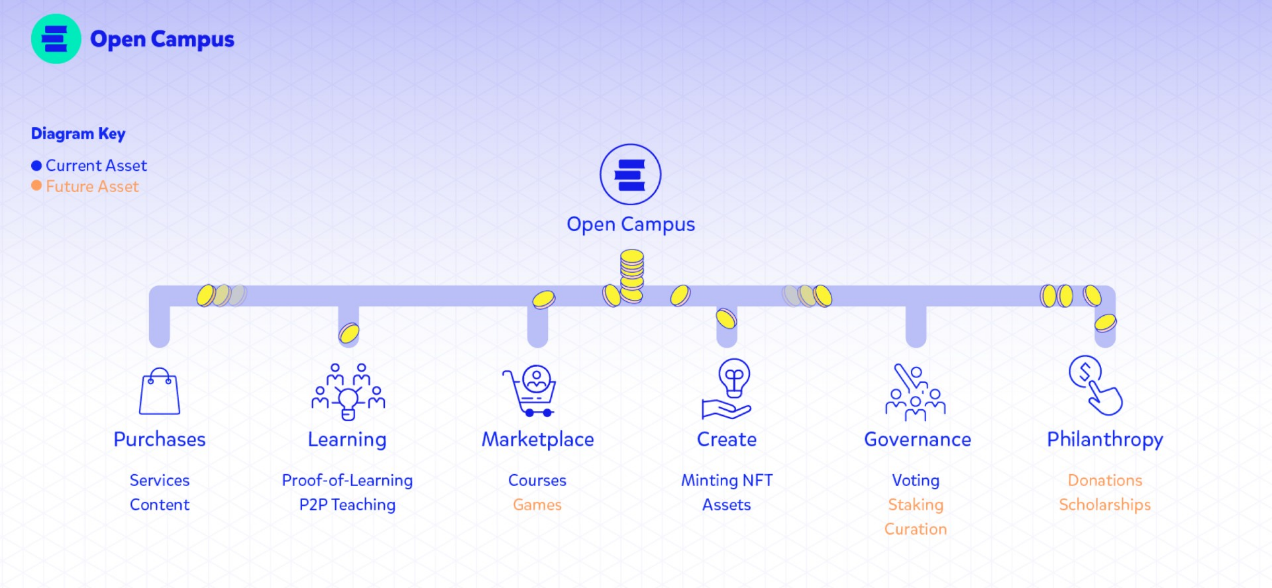
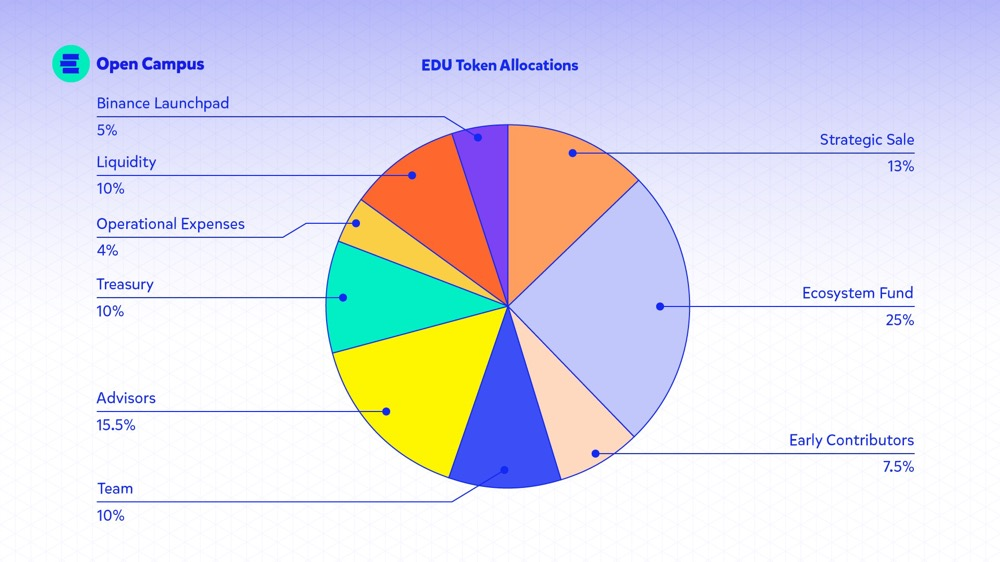
According to the official white paper, the total supply of EDU is 1 billion. It is a BEP-20 token on the BNB Chain. After listing, the circulation is 145 million (accounting for 14.5% of the total Token supply). EDU will serve as an Open Campus The native utility token of the Protocol ecosystem, its features include:
Governance: EDU holders can vote on and vote on DAO proposals (for example, participate in the planning of Token usage allocated to the ecosystem, etc.).
Payment: EDU can be used as a payment method for products and services provided by companies adopting the protocol (such as TinyTap, where % of the proceeds will be allocated to the protocol).
On-chain revenue sharing: Contributors (including content creators, publishers, and platforms) receive a share of protocol revenue in EDU.
User Acquisition: EDU can be used to reward and induce web 2 users to join web3 as they can receive discounts on accessing products offered by protocol ecosystem partners such as TinyTap.
Content ownership: Users can purchase co-publishing rights through Publisher NFT and EDU.
In the future, more functions such as the following may be unlocked:
Assist transactions as currency on the Open Campus Protocol marketplace (e.g., co-publishers buying publisher NFTs).
Funding projects and scholarship distribution are completed through smart contracts.
Decentralized peer review review system.
Help future education partners such as Oxford University Press and publishers such as Schools, GEMS Education, etc. adopt the Open Campus Protocol.
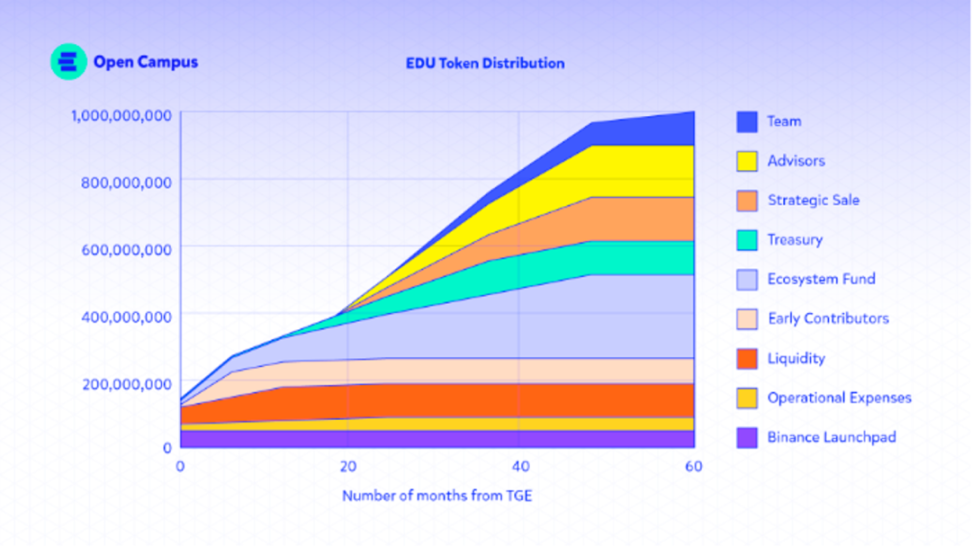
The distribution of EDU tokens is as follows:
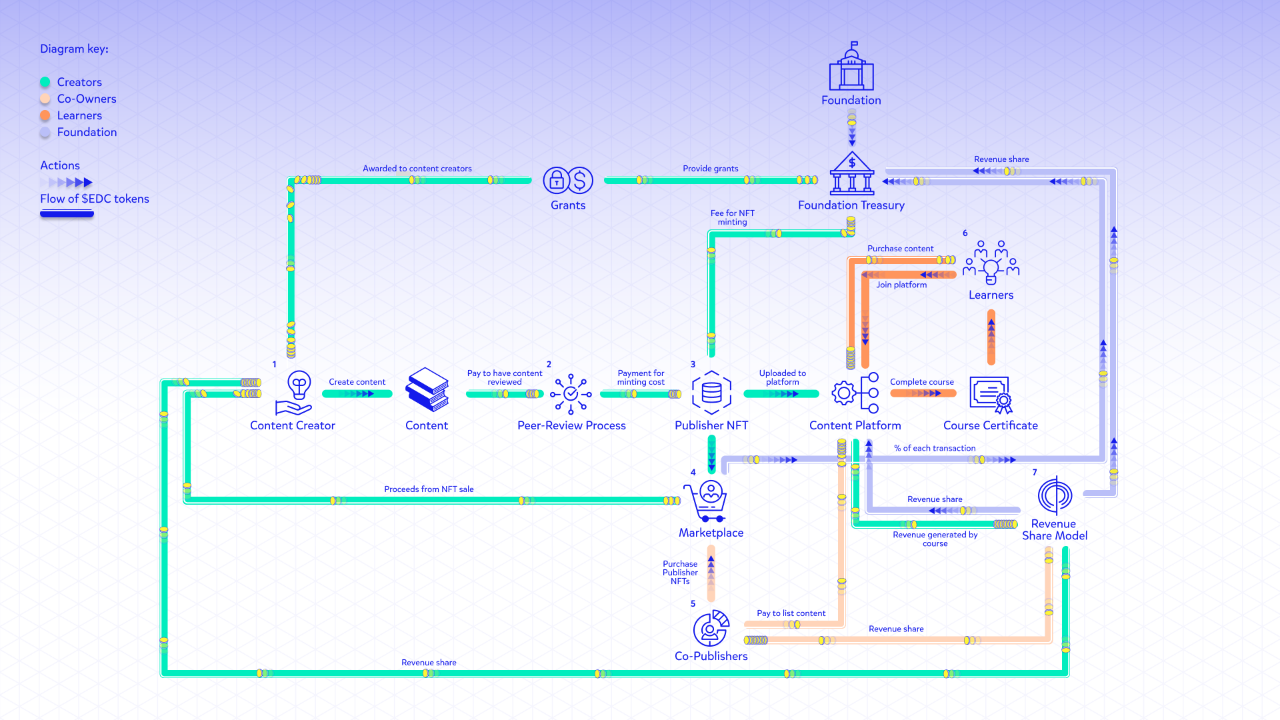
EDU ecological map: the circulation and use steps are as follows:
1. Content creators first generate educational content and provide learning materials and teaching materials;
2. Content creators pay EDU tokens for reviewing their generated learning materials;
3. Once the peer review has approved the content, the creator of the content can pay to cast the content to Publisher NFT;
4. Content creators can sell Publisher NFT in the market, which is teaching material content. Its buyer is the Publisher NFT buyer (or co-publisher), that is, the learning user. A co-creator can be understood as a joint publisher, which will be responsible for promoting the content created.
5. Learning users register on the platform, use EDU to purchase course content, and obtain a certified degree after completing the course;
6. Published content Publisher NFT revenue will be shared by content creators, co-publishers, educational platforms and the EDU Foundation.
The consumption scenarios of EDU are roughly as follows:
Content Creator Paid Application Review
Content creators pay to mint Publisher NFTs
EDU Vault gives basic rewards to content creators
Syndication/Learner Purchases Content
Governance voting rights of EDU:
Token holders can participate in the decision-making of the Open School Protocol (creating a decentralized educational curriculum designed and curated by teachers and other content creators) by voting on future proposals through Snapshot.
Open Campus
Open Campus is a project of the blockchain industry education track. It is a project created to introduce more users outside the blockchain ecology to the blockchain ecology. Since it is aimed at Web2 users outside the circle, the user base will be very big. And attract Web3 educational content creators to join, combine copyright, authorship, etc. with NFT, and stimulate content creation and output. The blockchain industry keeps pace with the times and is changing with each passing day. It is destined to have new projects, new technologies, and new ways of playing. Therefore, in the long run, the education track has obvious needs and a large potential user base. The project will have a relatively strong growth drivers.
On the whole, Open Campus can not only innovate the traditional education industry through blockchain technology, but also establish a Web3 learning system to break the entry barriers of ordinary users, cultivate more Web3 users, and inject fresh blood and education into the sustainable development of the industry. vitality.
However, how to balance the learning mode and incentive mechanism, truly enhance the user's industry awareness, and realize the ecological positive cycle still has great challenges. The overall framework of the current project has a clear blueprint, but the specific educational content display, purchase operation demonstration, Publisher NFT income distribution percentage, and the influence of voting governance are still disclosed. Especially after the EDU released by linear unlocking flows into the market, can the construction of the project ecology be able to catch the ever-increasing circulation? Can it support the stable rise of currency prices? This largely depends on the content creator's demand for holding coins (for review and minting), whether the quality of the content is attractive to stimulate purchases, and at the same time the content creator and multiple parties gain benefits, and whether the learner is actually gaining something, the so-called The gold content of degree certification. These series of questions are all about the future construction, planning and operation of this project. Let us wait and see whether Open Campus can become the top project of Web3 education.
If you're interested in learning more about it:
Official website address: https://www.opencampus.xyz/
Twitter address: https://twitter.com/opencampus_xyz
Whitepaper: https://open-campus.gitbook.io/open-campus-protocol-whitepaper/
Investment is risky, the project is for reference only, please bear the risk yourself
Follow us
veDAO is a decentralized investment and financing platform led by DAO. It will be committed to discovering the most valuable information in the industry. It is keen on digging the underlying logic and cutting-edge tracks in the field of digital encryption, so that every role in the organization can fulfill its responsibilities and get paid off.
Website: https://app.vedao.com/
Twitter: https://twitter.com/vedao_official
Investment is risky, the project is for reference only, please bear the risk yourself





