






Digging Deep into the Data Behind CFTC Suing Binance


Original compilation: Block unicorn
Original compilation: Block unicorn

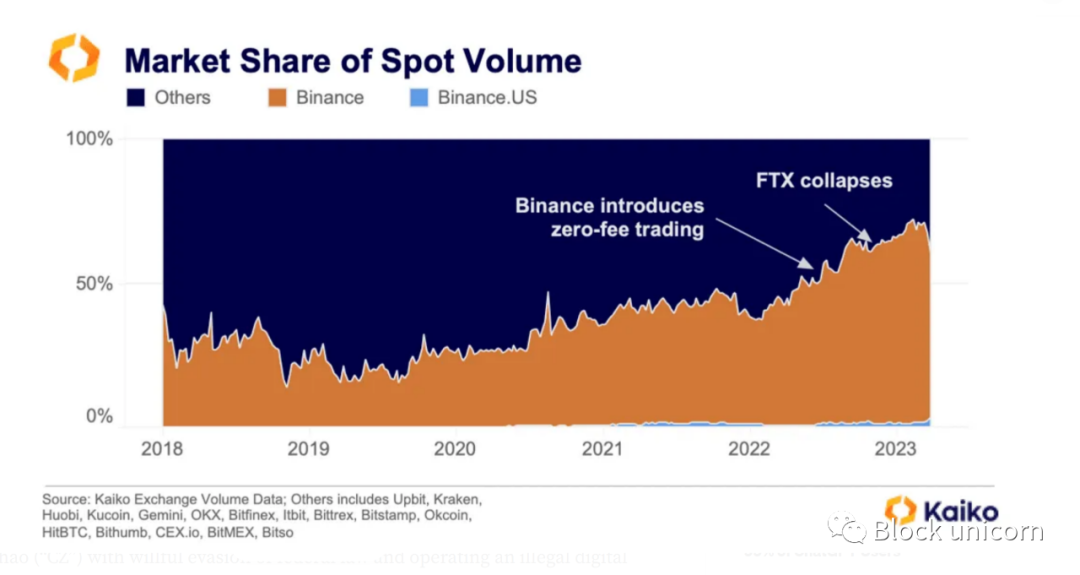
Binance is the largest cryptocurrency exchange in the world by a huge margin. It has seen consistent growth since its inception in 2017, but its growing dominance has been remarkable since 2020, when it captured about 25% of the spot volume market share. At the tail end of the 2021 bull market, its market share was close to 50%, then fell back, and expanded again this year to a peak of more than 70%. Last week, it dropped to just 57%, with most of that due to fee changes and outages.
The first blow to Binance came in February, when the New York Department of Financial Services (NYDFS) ordered Paxos to stop issuing BUSD, and the Securities and Exchange Commission (SEC) sent Paxos a Wells Notice. A NYDFS spokesperson stated that Paxos failed in its duty to conduct due diligence on BUSD customers to prevent bad actors from using the platform ("platform"Whether it refers to Binance or Paxos is not clear). I've covered the saga in more depth here.
In a second, more explosive blow, this week, the CFTC announced charges against Binance and its CEO/Founder Changpeng Zhao ("CZ") knowingly circumvented federal law and operated an illegal digital asset derivatives exchange. These allegations include:
Binance has taken a calculated approach to increasing its presence in the US, first by bringing in retail clients and later institutional clients.
Binance directed retail customers to use a VPN to mask their location and allow them to continue trading without submitting identification.
When Binance started restricting users from certain jurisdictions in 2019, it left a loophole that allowed customers to use the exchange without KYC.
As of January 2020, 19.9% of Binance clients are located in the United States.
Binance utilizes 300 CZ-linked"internal account"Trade on your own exchange.
Binance used Binance.US to identify important U.S. customers, then pushed them to join Binance by using new KYC documents related to a shell company.
Binance uses"prime broker", allowing U.S. institutions to trade spot and derivatives on the exchange.
first level title
Where are the Binance users?
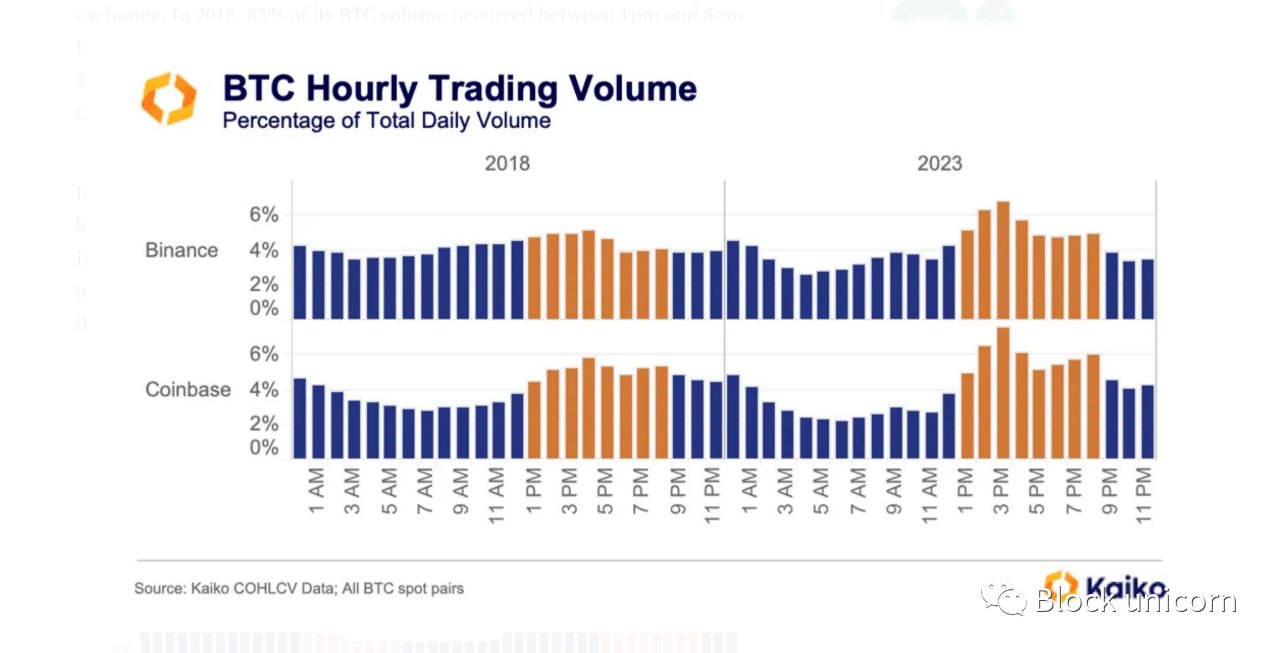
Binance's trading volume is disproportionately skewed towards US hours (orange), and is actually quite similar to US-based exchange Coinbase. In 2018, 35% of its BTC trading volume occurred between 1:00 p.m. and 8:00 p.m. UTC (9:00 a.m. and 4:00 p.m. ET), while Coinbase’s figure was 41.5%. So far in 2023, 43.4% of Binance’s BTC trading volume is in the US time period, slightly behind Coinbase’s 47.5%.
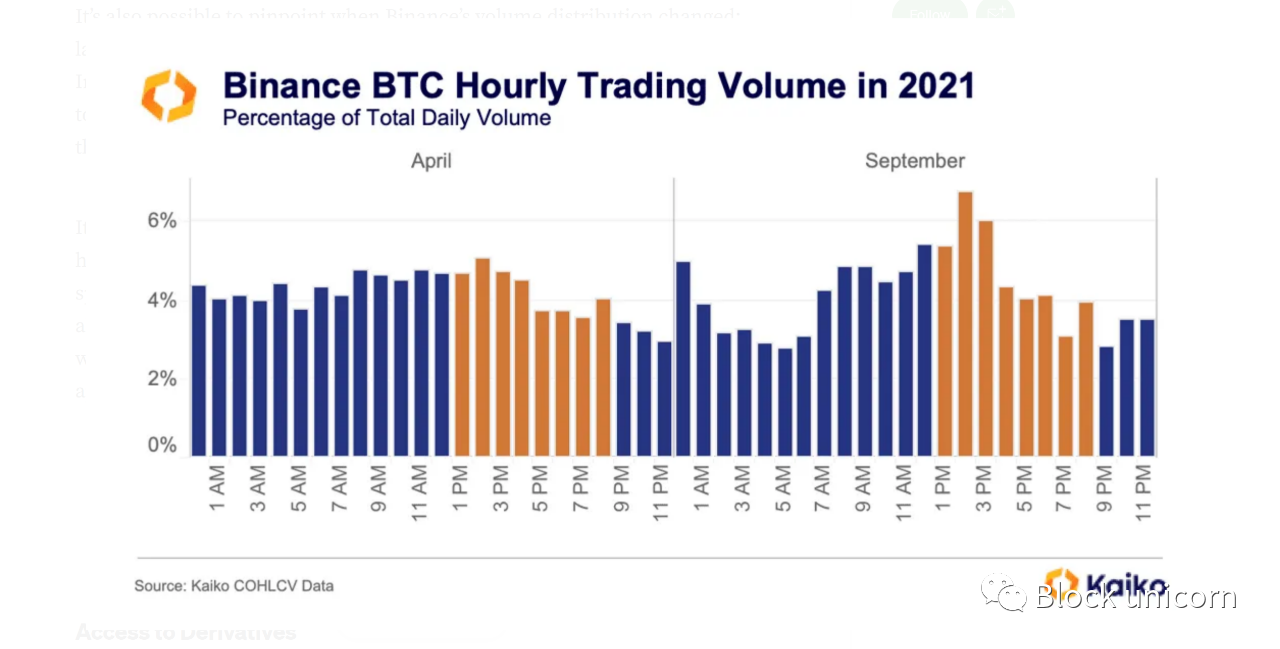
It is also possible to determine when the distribution of trading volume on Binance changed: In late spring and early summer of 2021, China cracked down on cryptocurrency trading. In just a few months, Binance has gone from a relatively flat hourly distribution to one that is significantly skewed towards European and US trading hours, with volume at 10am ET more than double that of 1am ET .
Admittedly, Binance drives most of its trading volume during U.S. trading hours, though it’s unclear if this is purely a result of the exchange’s exclusive targeting of U.S. traders. However, a U.S.-based trading firm has come forward to corroborate some of the details in the lawsuit, so it’s worth considering why some U.S. institutions would choose to use Binance. There seem to be three main reasons:
1. Trading opportunities for derivatives
2. More spot trading pairs
secondary title
Trading Opportunities in Derivatives
In mid-2019, Binance launched its derivatives trading service. Compared with other competitors, Binance was still a newcomer at that time. As a result, BitMEX was previously the largest cryptocurrency derivatives exchange - and when it ran afoul of the CFTC in October 2020, Binance was in the perfect position. The director allegedly told a colleague: "The recent BitMEX incident has had a huge impact on the industry. Please remove US data from all our charts... all but financial and very few people in the future will not See our US data."
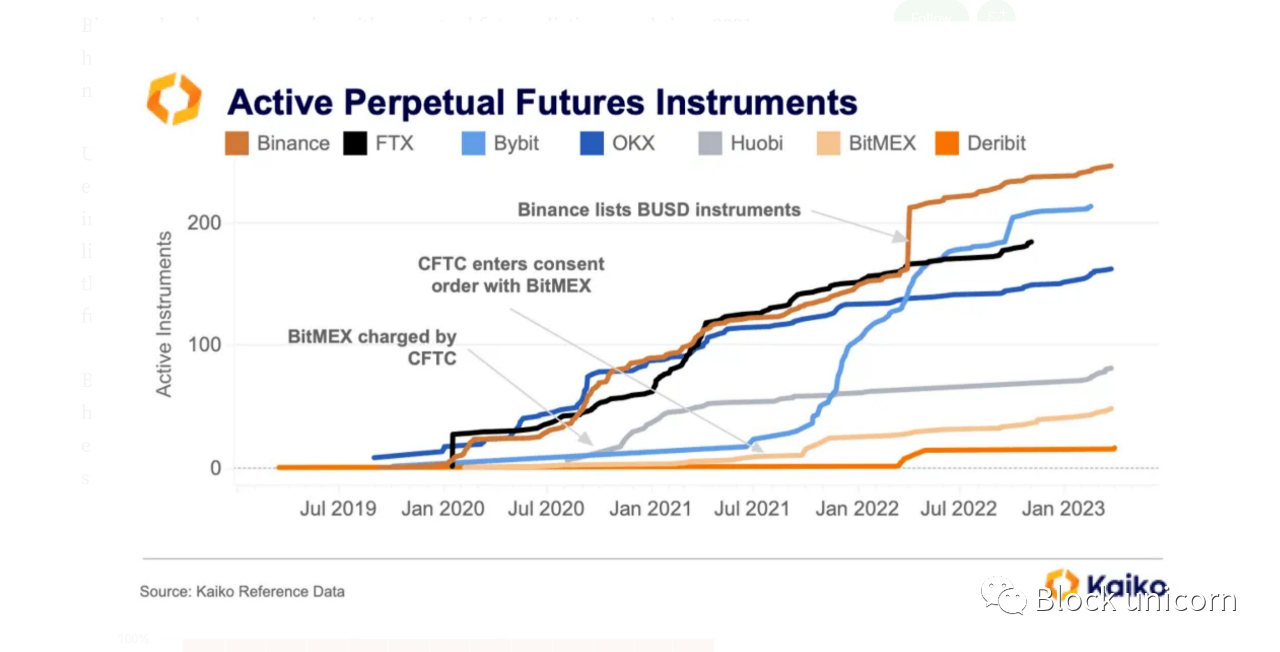
Binance has been very active in perpetual contract listings, and since 2021, only surpassed by FTX, which had 182 contract trading pairs at the time of closure.
US users have limited options when it comes to cryptocurrency derivatives – retail investors can use exchanges that do not require KYC checks (which may not be safe or legal), while institutions can choose to use a handful of licensed derivatives exchanges such as CME (only limited to BTC and ETH), or choose the method described in the lawsuit, which would give them access to over 200 perpetual contract trading pairs.
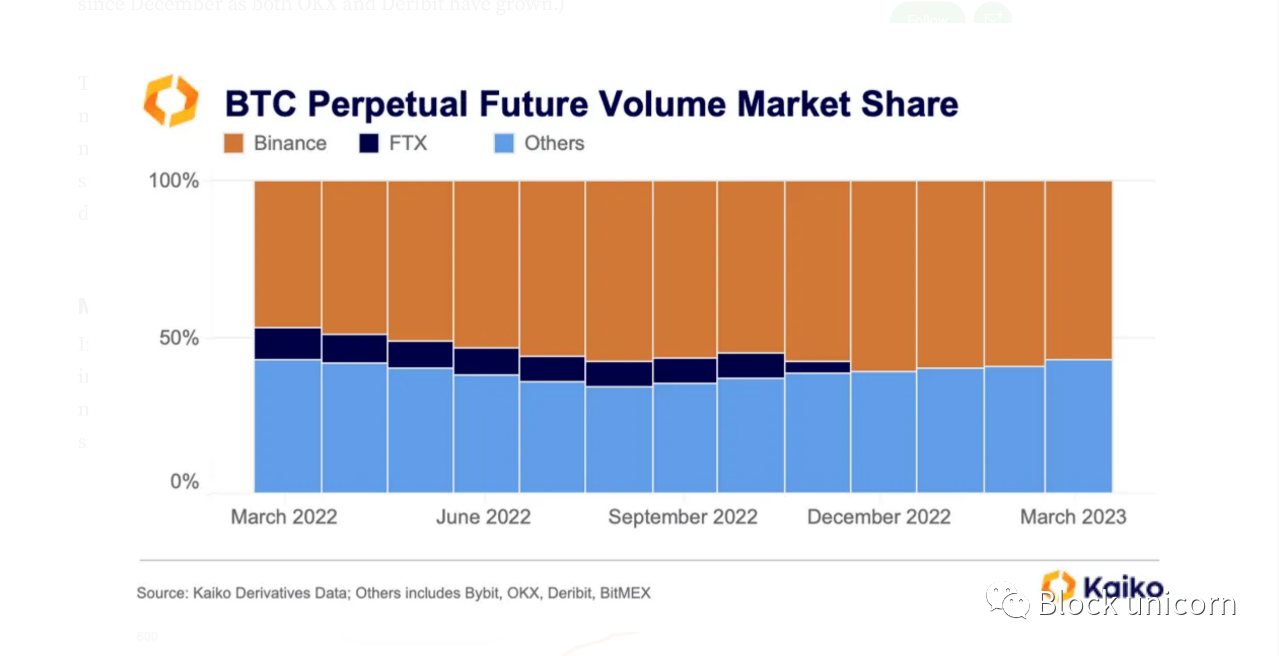
Binance has dominated futures volume for years, and since the FTX debacle, has provided more than half of the volume of all BTC perpetual contracts covered by Kaiko several times in a row. (Note that since December, as OKX and Deribit have grown, their market share has actually decreased.)
secondary title
More Spot Trading Pairs
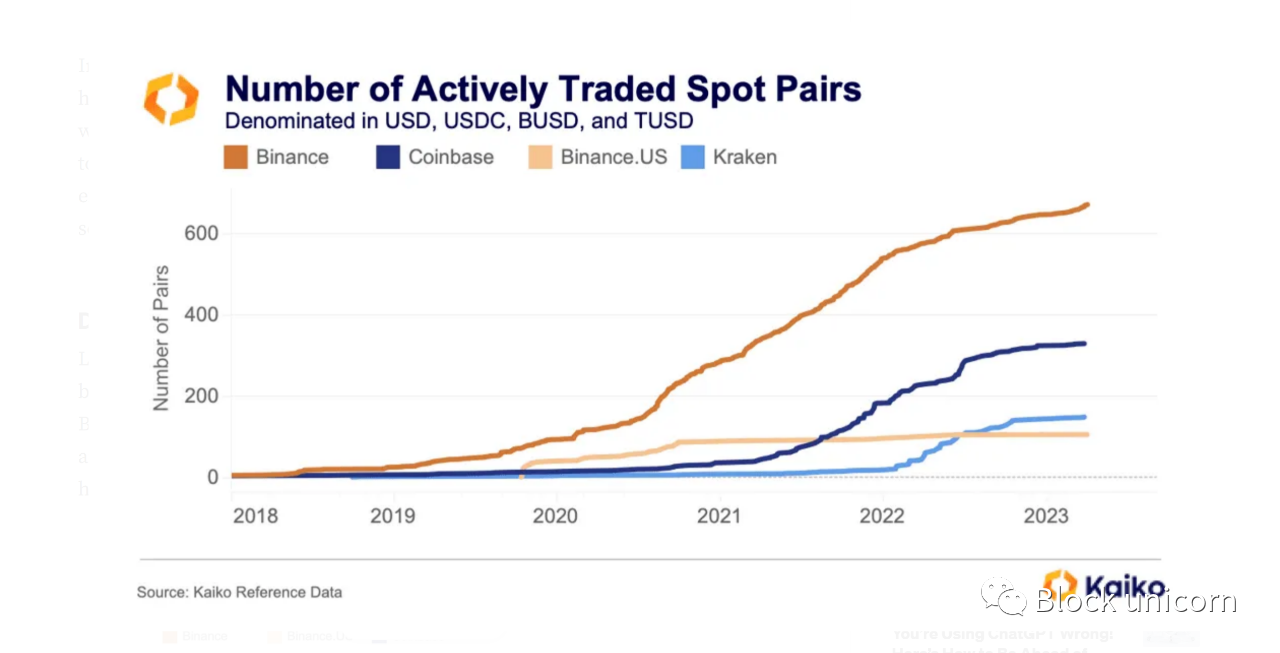
More generally, another advantage Binance has over U.S. exchanges is its freedom to list new tokens for spot trading. As of now, Binance has more than twice as many active trading pairs as Coinbase, four times as many as Kraken, and six times as many as Binance.US.
secondary title
deeper mobility
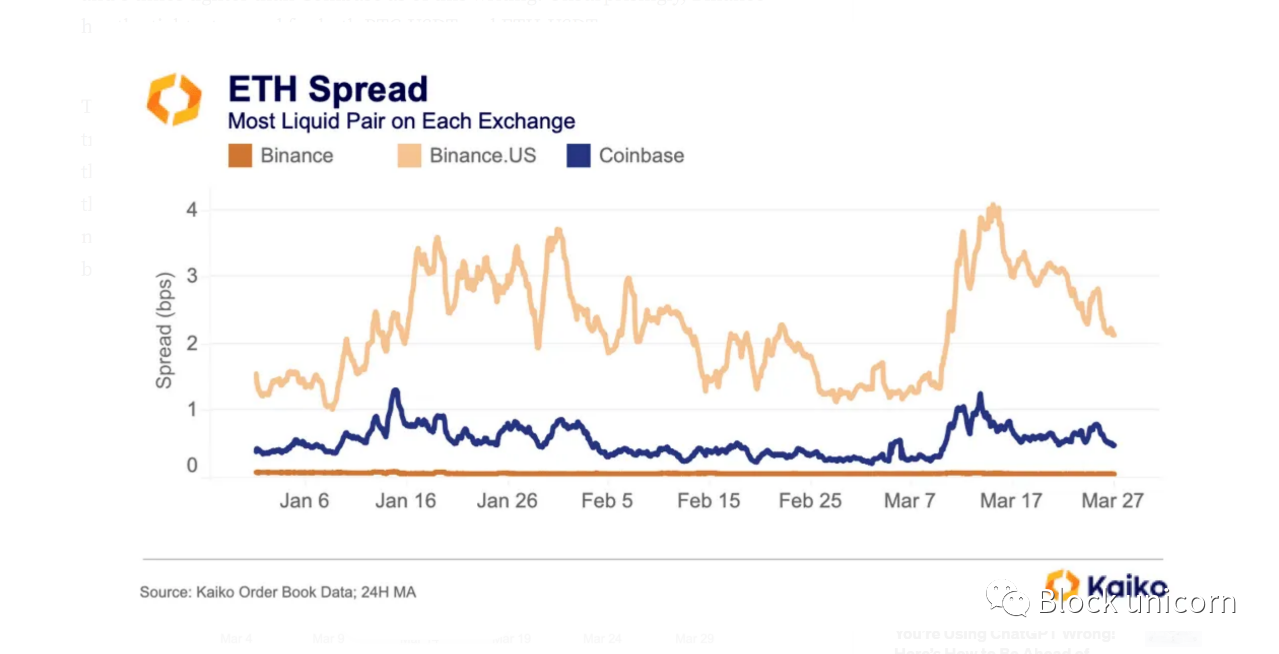
Liquidity is paramount in cryptocurrencies, especially for institutions that build or sell large positions or trade frequently. Here again, Binance has a strong track record, with spreads 36x tighter than Binance.US and 8x tighter than Coinbase as of this writing. Unsurprisingly, Binance has arguably the smallest spread between BTC-USDT and ETH-USDT.
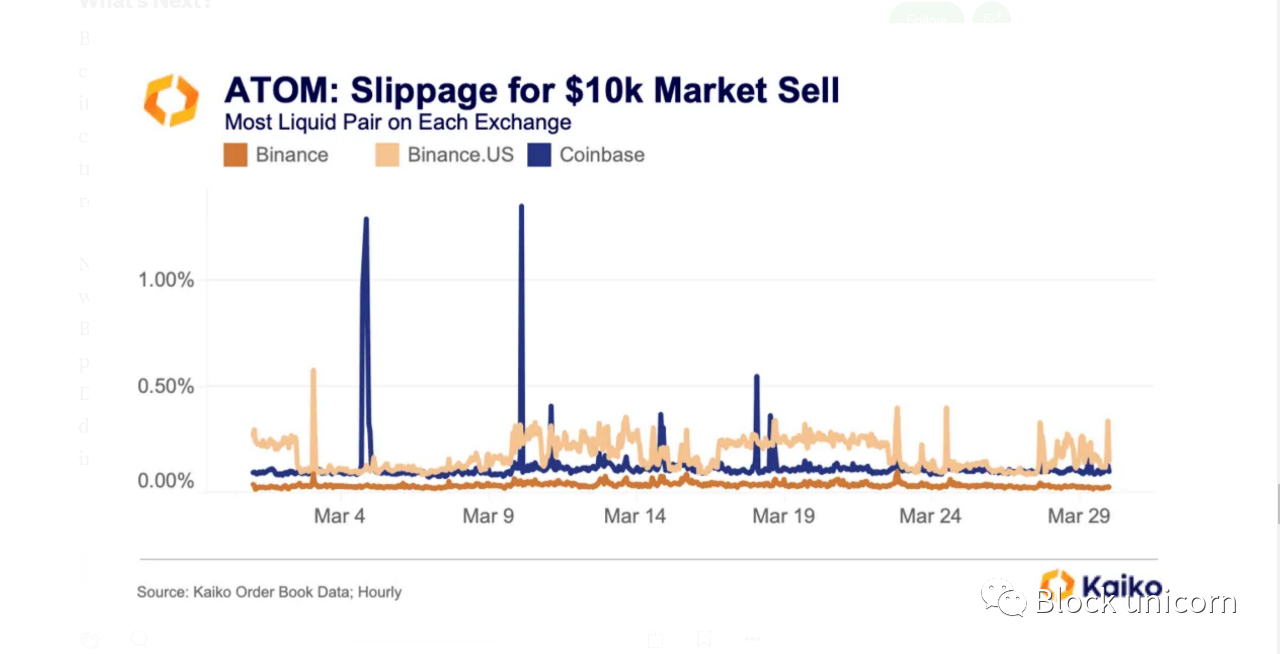
This naturally attracts institutions that trade frequently. Binance's small currency liquidity is also very deep. Below is a table showing a simulated sale value of $10,000 in slippage for a top 25 token by market cap called ATOM that trades on all three exchanges. Slippage was 0.03% on Binance and never exceeded 0.1%; slippage was 0.11% on Coinbase and fluctuated between 0.1% and 0.3% on Binance.US.
Binance’s market share has already fallen and may drop further in the coming months, though it’s hard to tell if this is because it reintroduced fees on the most commonly traded BTC pair, or because U.S. agencies stopped trading on the exchange. The reason for the transaction. Luckily, Kaiko has various liquidity and trading metrics that can give us an idea of how the exchange is coping with its recent changes and this regulatory action.
Normally, I would guess that US exchanges, and Coinbase in particular, absorb some of the US institutional spot volume that leaves Binance. But the regulatory environment is too unclear right now to make any predictions. In the short term, other exchanges such as Deribi, Bybit, and OKX will likely continue to attract some of Binance’s derivatives volume. Competing for this volume could become more interesting if Gemini and Coinbase decide to get involved.





