






What are Circle’s odds of winning the stablecoin war?


This article comes fromDecrypt, original author: Jeff John Roberts
Odaily Translator | Nian Yin Si Tang

Summary:
This article comes from
, original author: Jeff John Roberts
Odaily Translator | Nian Yin Si Tang
secondary titleSummary:- People have questions about USDC reserves.article- Circle is facing serious legal and commercial challenges.
Circle CEO Jeremy Allaire has big plans for his company and the USDC stablecoin it operates
plan. In this week's blog postIn it, Allaire stated that Circle intends to become a federal bank, and he expects USDC to have “hundreds of billions of dollars in circulation.”
Allaire’s comments come as digital tokens pegged to national currencies, known as stablecoins, are in the development phase. While crypto traders have long seen them as a way to get in and out of volatile positions, the traditional financial system is starting to see stablecoins as a more efficient way to move money.
Currently, the market is still dominated by Tether's stablecoin USDT, but it has many competitors. Allaire believes that in the US regulators are reviewing Tether
secondary title
Stablecoins are popular with users because they are as convenient as other blockchain-based currencies like Bitcoin, but without the volatility. For the dozens of companies that issue stablecoins, this method of earning money is relatively simple.disclosure$40 million profitarticleBut this opportunity presents a dilemma: How aggressively should a stablecoin company invest these reserves? Investing reserves in bonds or commercial paper means higher yields, but also means that stablecoins may not be as stable as a company promises.
Circle last month
disclosure
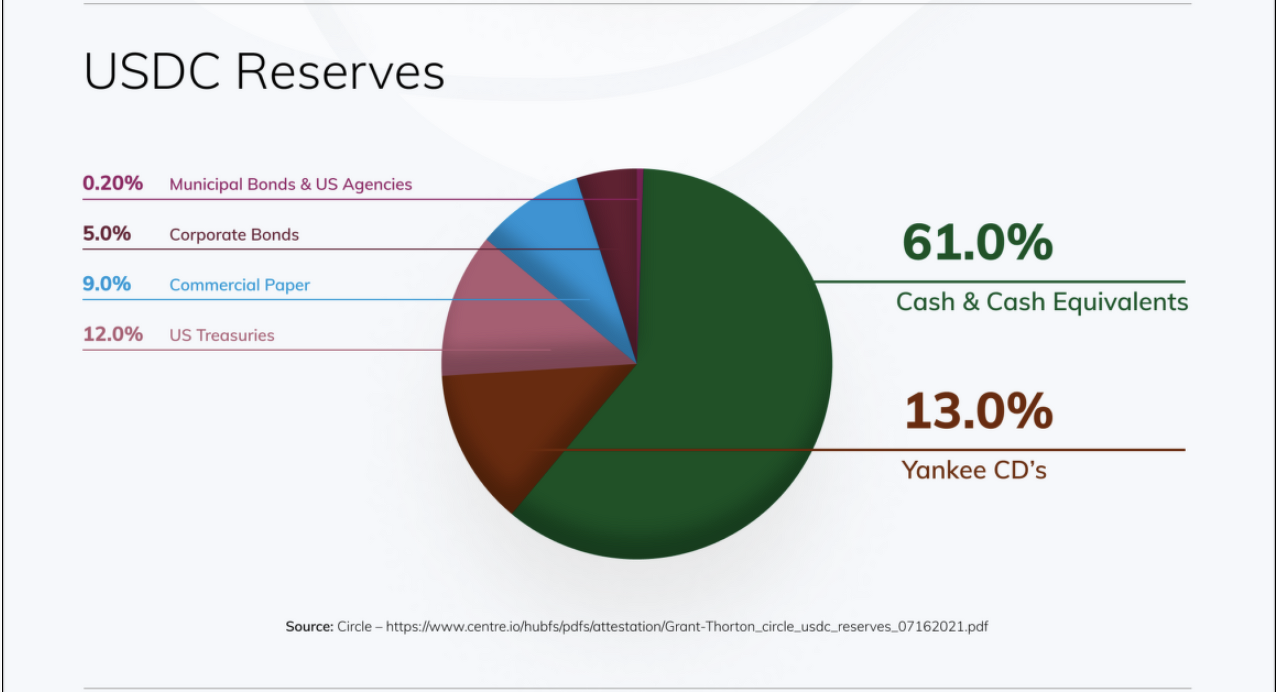
However, USDC is not backed 1:1 by cash as the company has long promised. Circle pointed out in its transparency report released in July that the reserve certification report issued by Grant Thornton shows that the total circulation of USDC is still pegged 1:1 to the US dollar-denominated reserve assets. In addition, since 2021 Since the beginning of the year, USDC circulation has grown by more than 2,600%. The report also shows that 61% of USDC tokens are backed by cash or cash equivalents, along with a certain percentage of Yankee CD's, U.S. Treasury securities, and more. In this regard, competitors have attacked one after another, among which Paxos published a blog
article
, claiming that USDC is not a real stablecoin (pictured).
“USDC is looking for the highest yield possible. The question is, are they putting consumer assets at risk by chasing that yield?” Paxos lead attorney Dan Burnstein told Decrypt.
Dante Disparte, Circle's chief strategy officer, fired back. In an interview, Disparte blasted Paxos' announcement as a meaningless "purity test," declaring, "We're not responding to improve the Paxos article."
According to Disparte, the entire stablecoin industry will be heavily regulated, and Circle will ensure that USDC complies with any rules issued by the U.S. Department of the Treasury or other agencies. However, he declined to say whether Circle plans to change its reserve mix.This raises the question of whether Circle is really putting consumer assets at risk, as Burstein claims. At first glance, Burstein seems to be overstating the point: the non-cash assets Circle is using to back USDC are relatively safe, not junk bonds, altcoins, or assets that could crash at any moment.In such a crisis, consumers may rush to convert their USDC back into cash, forcing Circle to sell its assets to meet redemption demands. If that happened, Circle could be forced to sell the assets for less than market value, or not be able to sell them at all, Koning said. This would cause the price of USDC to drop below $1 and cause Circle's stablecoin to become unstable.
In the event of a new crisis, runs on stablecoins could also be faster and more severe than in traditional markets. As a recent paper points out, this is because in the case of stablecoins, redemption shocks will occur within hours or minutes, not days. At the same time, such crises could be triggered by broader events or by things specific to stablecoins, such as the discovery of a bug in the stablecoin protocol.
These are theoretical concerns at the moment, but we did find that Circle's partner Coinbase has quietly removed
delete
It is said that each USDC is backed by "a dollar deposited in a bank account". This change in rhetoric is likely a move by Coinbase to avoid litigation, but also reflects that USDC is not the fail-safe investment Circle had previously promised.
secondary title
"The road ahead is long and difficult"
Circle is seeking to go public, which means it must convince investors that its USDC business is safe and growing. That may be why the company has announced its intention to become a federally chartered bank — a status that helps assuage potential investors' concerns about regulatory risk.
Circle filed an S-4 form with the US SEC on August 6. According to the table information, since the beginning of 2020, as of July 31, 2021, the circulation of USDC has grown from 400 million US dollars to more than 27 billion US dollars, an increase of more than 65 times. Circle management predicts that USDC in circulation will grow to $194 billion by the end of 2023.
In addition, the table states that all issued and outstanding USDC tokens are backed by at least an equal amount of high-quality U.S. dollar-denominated assets held in segregated accounts at regulated financial institutions in the United States, subject to regulatory oversight and reserve management policies constraints, these policies are designed to always meet or exceed outstanding demand for USDC. As of March 31, 2021, cash segregated for the benefit of customers and USDC holders was $11,167.2 million. USDC currently supports ETH, Algorand, Solana, Stellar, and Tron blockchains.
Circle also plans to allow institutions to enter a new DeFi-driven lending market through a DeFi API launching in Q3 2021. With the DeFi API, institutions will be able to automatically funnel USDC into third-party DeFi lending markets to earn yield through real-time accrual and redemption, including protocol-specific governance tokens, managed within Circle’s trusted account infrastructure .





