






On the night of Robinhood’s listing, it was as flat as the first day’s currency price


image description
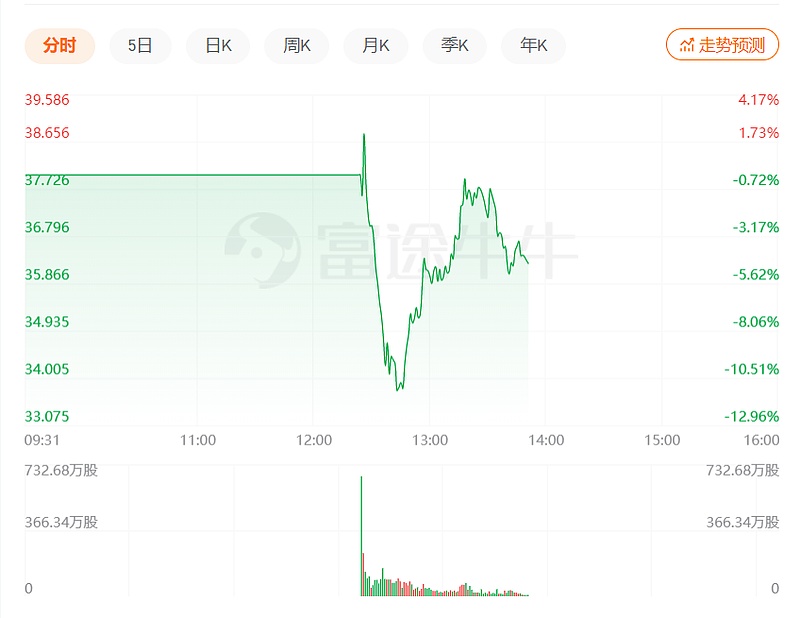
(Robinhood stock price chart, Beijing time at 1:50 on July 30)
The price on the first day was just like everyone's discussion on the stock, with little enthusiasm and no waves.
On July 2 this year, Robinhood, a brokerage platform focusing on retail investors in the United States, submitted a prospectus and set its IPO price at US$38, which is at the bottom of the guidance range of US$38 to US$42. This pricing also makes Robinhood’s valuation reach US$32 billion. .
Robinhood is the world's third-largest brokerage by the number of funding accounts, behind Fidelity and Charles Schwab. But Robinhood's IPO pricing means each funding account is valued at about $1,350, well below peers.
For the capital market, many people pay more attention to Robinhood's encryption business. The prospectus shows that in the first quarter of 2021, 17% of the company's revenue comes from the trading business of encrypted assets.
However, due to the general decline of cryptocurrencies in the past two months, the market heat has decreased. Compared with the performance of Coinbase, the much-anticipated "first crypto trading stock" on the first day of its launch, Robinhood's trend is relatively bleak. On April 15th, the opening price of Coinbase was $381, a 52.4% increase from the issue price ($250). It once rose to $429.54 on that day, setting the highest stock price; affected by the downturn of the encryption market in the following months, Coinbase’s stock price fell, but at present Still maintained at around the issue price of $250.
Despite the current recession in the encryption market, Robinhood still decided to continue investing resources in the encryption business. A week ago, Robinhood CEO Vlad Tenev said that the company was all-in on crypto, focused on expanding its crypto offerings, and that users could expect new crypto features, such as crypto wallets, “at some point.” The recent Robinhood App beta code shows that it is developing new protection measures against cryptocurrency volatility, focusing on allowing users to invest excess change.
first level title
The following is Odaily’s interpretation of Robinhood’s prospectus, which was first published on July 2:
In the early hours of July 2, Beijing time, Robinhood, a stock brokerage that focuses on retail investors in the United States, submitted to the SECIPO application documents, plans to raise up to US$100 million and plans to list on NASDAQ with the stock code "HOOD".
The offering was led by Goldman Sachs, JPMorgan, Barclays, Citigroup, Wells Fargo, Mizuho and others, and Robinhood pegged its valuation at the time of listing at at least $40 billion.
According to the prospectus, Robinhood Markets will issue 52.4 million Class A common shares, and the company founder and chief financial officer will sell an additional 2.63 million Class A common shares in the initial public offering. Proceeds from this financing will be used for repayment of borrowings, working capital, capital expenditures and general corporate purposes.
At the beginning of this year, with the two out-of-circle events of GME and Dogecoin (Dogecoin), Robinhood has attracted much attention in the encryption market. Odaily also flipped through its prospectus for the first time, and circled the key content for readers.
1. You can trade, but you cannot withdraw coins
According to the IPO application documents, Robinhood first launched cryptocurrency transactions in 5 states in the United States in February 2018, and the first batch only supported BTC and ETH transactions; as of March 31, 2021, its coverage has expanded to 46 states and Washington. SAR, and supports the transaction of seven different cryptocurrencies (BTC, ETH, BCH, BSV, LTC, ETC, DOGE), in addition, it also provides 10 cryptocurrency data (but does not support transactions), namely: OMG, LSK , BTG, DASH, XMR, ZEC, NEO, XLM, QTUM, XRP.
It should be noted that, like Robinhood's stock trading, crypto trading also does not charge commissions - it provides commission-free cryptocurrency trading through its subsidiary RHC - RHC will send customer orders to third-party market makers for execution and resell the order flow, cash flow. Moreover, RHC currently does not allow customers to recharge and withdraw legal currency and cryptocurrency directly at RHC. Customers must have both a brokerage account with RHF and sufficient legal currency funds in the brokerage account to fund cryptocurrency purchases through RHC; customers must also have a A brokerage account to which the proceeds of a client's sale of cryptocurrencies can be credited.
(Odaily Note: Although the US version of "Alipay" Paypal can purchase cryptocurrency, it also does not support cryptocurrency recharge and withdrawal.)
In the prospectus, Robinhood stated that "we may provide this feature in the future," but also expressed risks and concerns. "Allowing customers to store and withdraw cryptocurrencies on our platform may expose us to increased risk of possible violations of trade sanctions, including OFAC's regulations, and anti-money laundering and counter-terrorist financing laws."
2. The transaction volume surged in the first quarter, and Dogecoin took the lead
According to the prospectus, in the first quarter of 2021 alone, more than 9.5 million customers traded about $88 billion in cryptocurrency on Robinhood; On March 31, it increased 23 times.

It should be noted that as of the end of the first quarter, the total number of registered users of Robinhood was 17.7 million, which also means that more than half of the users are involved in cryptocurrency transactions.
In addition, 17% of Robinhood’s total revenue of $522 million in the first quarter of this year came from transaction-based revenue earned from cryptocurrency trading. In terms of nominal value in the first quarter, Bitcoin was the most traded cryptocurrency on the platform, but the majority of revenue came from Dogecoin, accounting for 34%, compared with 4% in the fourth quarter of last year; Accounted for 6% of the company's total revenue.
Robinhood also hinted at the risks in the prospectus. "If the Dogecoin market deteriorates or the price of Dogecoin declines, and demand for Dogecoin trading falls and is not replaced by new demand for other cryptocurrencies that are tradable on our platform, our business, financial condition and operations will Results may be adversely affected."
Of course, Robinhood remains optimistic about the entire encryption market and does not rule out the possibility of further expansion of cryptocurrency transactions in the future. “We believe that growing interest in and adoption of cryptocurrencies will drive increased client interest in our platform. Even within our current client base, we have significant room to grow.”
3. From retail investors to retail investors
As an emerging force among U.S. brokerages, Robinhood has always had a clear positioning—targeting retail investors. To this end, it has designed a simple and easy-to-use user interface to help retail investors lower the barriers to entering the stock market. In the prospectus, Robinhood stated that "our business model is focused on enabling a broad range of retail investors to access financial markets."
It is based on this concept that Robinhood first launched commission-free transactions that benefit retail investors. This move caused a huge tsunami in the industry, forcing other securities companies to adopt a zero transaction fee model.
In this prospectus, Robinhood also released a "big move" - in order to give back to platform users, it plans to allocate 20% to 35% of the Class A shares in its IPO to retail investors. Users can pass a name provided on Robinhood Participate in the subscription for the new function of IPO Access, and truly practice the concept of "coming from retail investors, going to retail investors".
However, since the beginning of this year, Robinhood has also been deeply involved in the whirlpool of public opinion. During the GME defense war, due to the system's unloading, Robinhood went down directly, so it was crowned with the title of "capitalist lackey" and other titles; the same system failure occurred again during the Dogecoin transaction, which caused dissatisfaction among users. In addition, Robinhood indirectly caused a user to commit suicide due to a system display error (displaying that the user owed 750,000 yuan)... These negative news have seriously damaged its brand.
Just a day before the IPO announcement, FINRA ordered Robinhood to pay roughly $70 million in fines and order compensation to customers it said had suffered "widespread and material harm." Robinhood reported in its filing that it had reached an agreement in principle with regulators to pay a $57 million fine but only compensate affected users $4.5 million.
Whether Robinhood, which focuses on retail investors, can be recognized in the financial market, the answer can only be revealed on the day it goes public.





