


What impact will the upgrade of Ethereum "London" bring to us?


The explosive growth of the cryptocurrency market over the past year would not have been possible without the Ethereum network.
Remember Ethereum on April 15th"Berlin"upgrade?"Berlin"After the upgrade was successfully carried out, Gas fees on the Ethereum chain began to drop to a manageable level, which also led to a surge in transaction volume on top decentralized exchanges such as Uniswap and SushiSwap. Increased activity in DeFi applications has also led to new highs in the price of Ethereum.
London"London"Upgrade, including upgrading EIP-1559, EIP-3198, EIP-3529, EIP-3541, EIP-3554.
London"London"What changes will the upgrade bring?
The first thing you need to know is that the meaning of EIP is"Ethereum Improvement Proposals", and the above EIPs are all improvement proposals of the Ethereum model.
These"London""London"London
Ethereum"London"The upgrade will complete the following proposals:
EIP-3198: BASEFEE opcode
EIP-3198: BASEFEE opcode
EIP-3541: Reject new contracts starting with 0xEF bytecode
EIP-3541: Reject new contracts starting with 0xEF bytecode
EIP-3554: Difficulty bomb postponed to December 1, 2021
1. EIP-1559 - Transaction Fee Reform
EIP-1559 is the most eye-catching proposal in this London upgrade, and it is also a proposal that miners have been boycotting. EIP-1559 has always been widely controversial. EIP-1559 is essentially"Transaction fee market reform for the ETH 1.0 chain", or in other words, to change the commission model of the Ethereum network.
Today's blockchain world is actually very similar to the early Internet. In particular, our use of the Ethereum network is getting slower and slower, and ordinary users are staying away from DeFi due to high transaction fees. For example, in February this year, the transaction fee of Uniswap, the top decentralized exchange on the Ethereum public chain, once exceeded $100.
mining"mining"converted to"hold"fragments"fragments", so that the speed of the entire Ethereum network has increased by leaps and bounds, increasing the transaction volume from 15 to 100,000 per second, the transactions on the Ethereum network will no longer be congested, and high transaction fees will be resolved. However, at present, Ethereum 2.0 is still a beautiful vision. According to the statement of V God, the founder of Ethereum, Ethereum 1.0 and 2.0 are currently a parallel chain relationship, and there are some technical problems in the transition from PoW to PoS. Completion is not expected until some stage in 2022.
At the same time, Ethereum developers are still making unremitting efforts to reduce transaction congestion on the chain and improve user experience. EIP-1559 was first proposed by V God, the founder of Ethereum, in 2018. By creating a more efficient fee market and simplifying the gas fee payment process for clients and applications, the introduction of fixed fees and destruction mechanisms reduces transaction costs. , while alleviating transaction congestion.
So how does the EIP-1559 proposal work to moderate the gas fee spike?
It can be roughly divided into two changes: Base Fee and increasing the maximum Gas of the block.
1. Base Fee
Base Fee is the most controversial and innovative practice, representing the lowest cost for a transaction to be included in a block.
① The transaction fee will be determined by the current market price and will rise or fall according to the network usage rate (congestion situation). If the network usage rate exceeds 50%, the cost of the basic fee will increase; if the network usage rate is lower than 50% %, the cost of the basic fee is reduced;
②Users can provide "miner tip", the higher the tip, the faster the transaction can be obtained;
③In addition, users can also set a fee cap, so transactions can only be made at their desired Base Fee. This means that when transactions are congested and busy, transactions with a lower Base Fee will also be queued in an orderly manner, instead of being rejected as they are now.
④ All the base fees are burned, which means that all the handling fees are destroyed, and they are not fully obtained by the miners as they are now. This prevents miners from manipulating Gas fees and earning more from users.
2. Increase the maximum Gas of the block
Note: Gas is a unit used to measure workload. Like our usual transfers and smart contracts, a certain amount of Gas is required, so domestic people generally understand Gas as a handling fee.
Every transaction on the Ethereum chain carries a gas cost, and there is a gas limit in each block to limit the number of transactions. Currently, the gas limit is 12.5 million. EIP-1559 recommends increasing the limit to 25 million at network utilization levels above 50%.
expansion"expansion", you can flexibly set the size of the block.
Ethereum after EIP-1559 implementation vs current Ethereum
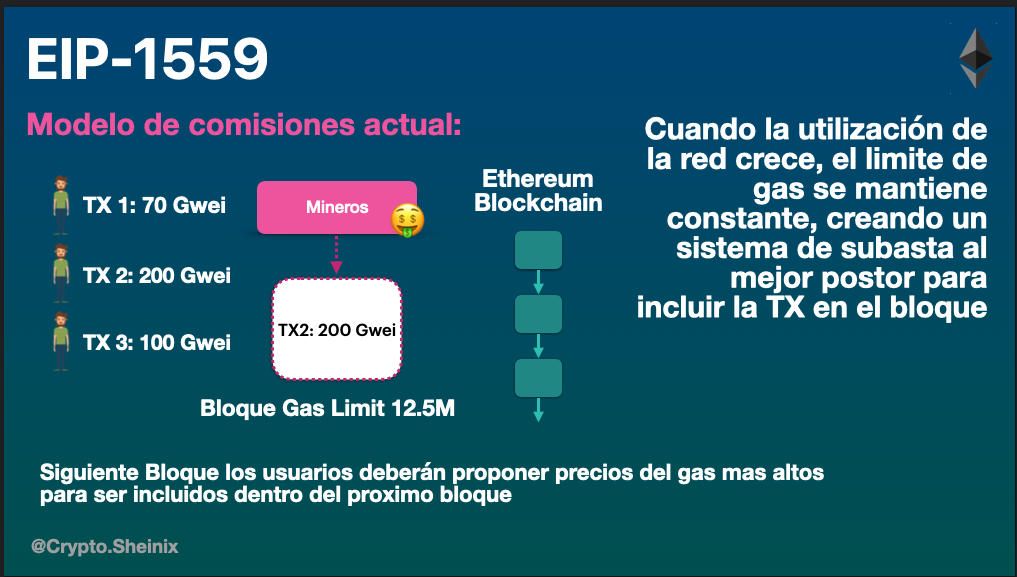
The current commission model of the Ethereum network belongs to"subasta del mejor precio de gas propuesto", to auction the best suggested natural gas price, that is, the auction bidding mechanism. Let me explain with a simple example:
Suppose there are 3 users, and each user's transaction is 70, 200 and 100 Gweis respectively. (This is the Gas price that users are willing to pay for each transaction). Miners always want to steal the transaction from the user who paid the highest Gas. The higher the Gas price of the transaction, the more likely the miner will verify the transaction.
But there is also a problem: when the network is congested, it may be very difficult for someone who sends a 70 Gwei transaction to get this transaction on-chain, because if the Gas price starts to rise due to network congestion, then the Gweis price is lower than the Gweis price. High transactions will be placed in the miner's block. So in the next block, the new transactions included will be those with a higher gas price, while those with a lower gas price will be kept.
And with the introduction of EIP-1559, transaction costs become more predictable, depending on how congested the network is (this does not mean that costs will go down, but will be more controllable, homogeneous and predictable). It reduces the delay in transaction confirmation time (which can decide whether to execute the transaction) and improves user experience by automating the gas price auction system.
The impact of EIP-1559 on miners
As mentioned above, Ethereum 2.0 will realize the transformation of the network consensus mechanism from PoW to PoS, which means that after the completion of Ethereum 2.0, miners will no longer be able to use mining machines to mine ETH. Originally, Ethereum miners could not only get block rewards, but also the gas fees of the entire network. However, after the implementation of the EIP-1559 proposal, miners can only get block rewards and user tips.
Foreign countries are ridiculed by miners:"Get exploited before ETH2.0 is fired"
To use a domestic Internet red sentence, it is"Made me who was about to be poor even worse"
Impact on DeFi users
Some people may say that with the reduction of handling fees, ordinary users can also afford DeFi, which can make DeFi more prosperous. But I am not very optimistic about the future. First of all, the Base Fee (handling fee) is burned and destroyed instead of flowing into the market. Scarcity can lead to the creation of value, which may lead to a skyrocketing price of ETH. On the contrary, it may not be a boon for DeFi users who pay transaction fees with ETH.
I am not here to give you investment advice. After all, the big market is falling, and no one can predict the future. Everyone needs to have independent thinking.
2. EIP-3198
EIP-3198 is a companion proposal to EIP-1559. This proposal only adds opcodes for BASEFEE. This opcode returns the value of the Base Fee of the block it is in.
Bai Ze Note:
Bai Ze Note:
GasToken turns the Gas fee into an ERC20 token, allowing users to buy and sell directly, or as a prepayment for using Gas in the future. When the gas price is cheap, users can purchase and store it properly, and then use it when the gas price rises. GasToken can carry out arbitrage, mint or buy Gas fee tokens when Gas fees are cheap, such as GST and CHI launched by the 1inch team, and then realize income by destroying these tokens when Gas fees fluctuate.
3. EIP-3529
London"London"raised in the upgrade.
Initially, the Ethereum network introduced Gas refunds (SELFDESTRUCT and SSTOR two opcodes) to motivate application developers. When developers no longer need to use a certain smart contract, deleting the contract can clean up the block storage. The corresponding developer can also get a Gas refund.
And there are developers"ulterior motives", using the Gas fee refund mechanism to create GasToken. Specifically, when the Gas price is low, Gas tokens encourage users to create or mint Gas tokens in contracts. At this time, Gas tokens will use the funds provided by users to store data or create contracts at a lower cost. When the Gas price soars, users can use or consume Gas tokens, and Gas tokens can obtain network rewards or Gas refunds by deleting data or contracts (that is, SELFDESTRUCT), so as to achieve a lower cost. The price consumes Gas to maximize the benefits.
Of course, the use of Gas tokens has many benefits for users, such as buying and storing them in advance when the price of Gas is low. When a running arbitrage bot spends thousands of dollars worth of Ethereum transaction fees per day, they can save a lot of money over time by using Gas tokens to save fees.
It has been argued that the presence of Gas tokens has led to considerable state inflation because Ethereum nodes were injected with a lot of"meaningless"contract. By increasing state inflation, the ratio of uncle blocks may increase.
use"use"。
London"London"With the overall upgrade, Gas costs are also controllable, and users have no reason to create Gas tokens.
4. EIP-3541
EIP 3541 was a simple change that laid the groundwork for EIP 3540's proposed EVM improvements. Once EIP 3541 is implemented, new contracts starting with 0xEF bytecode will not be able to be deployed. Existing contracts will not be affected. After the "London" upgrade starts, contract deployments whose bytecode shortest sequence starts with 0xEF but do not match the starting sequence of existing contracts will be rolled back to determine contracts compatible with EIP-3540 semantics. Please note: EIP 3540 requires an additional network upgrade to be deployed. It should also be noted that if EIP 3540 is not deployed, EIP 3541 can also be used to reserve the start byte for other schemes.
5. EIP-3554
difficulty bomb"difficulty bomb"difficulty bomb
"difficulty bomb"It is a mechanism introduced by the Ethereum network. During the current transition from Ethereum 1.0 (PoW) to Ethereum 2.0 (PoS),"freeze"difficulty bomb"difficulty bomb"will continue to be delayed.
While it has been postponed several times before, this time the core developers are only delaying the difficulty bomb until December 2021. At that time, the Ethereum network will either successfully transition to Ethereum 2.0 (PoS), or undergo another upgrade.
difficulty bomb"difficulty bomb"Summarize:
Summarize:
london upgrade"london upgrade", or the implementation of the EIP-1559 proposal, actually brought some positive changes to the fee setting and distribution methods on the Ethereum network. Now trading on Ethereum, the handling fee is prohibitive for many people. The optimal gas cost is almost impossible to predict, and the transaction confirmation time will be delayed. In fact, these impacts are mainly caused by the fact that the Ethereum network currently uses an auction bidding mechanism. In this mechanism, you cannot know the price offered by others during the transaction, and the highest bidder wins, so you will often find that the first bidder That guy would break his thigh, because he bid much more than the second place.
Then EIP-1599 at this time saved Ethereum like a savior. Its implementation eased the transaction congestion of the Ethereum network and stabilized its block rewards. In this way, the improvement of efficiency will lead to more transactions, the income of handling fees will increase accordingly, and the income of pos pledge will also increase one after another, attracting a larger group of miners to pledge ETH, and finally reducing the circulation of ETH in the market .
London"London"No matter who becomes the biggest winner in the upgrade, I believe it will be a qualitative leap for the overall operating environment of the Ethereum network.





