


A detailed explanation of a stable blockchain - Polkadot


When referring to Polkadot, people always see words like "heterogeneous cross-chain and Wanchain interconnection". In fact, these words are a high-level summary of Polkadot technology. In addition to technology, it can also stand Understand Polkadot in a higher dimension, for example, think about why we have to develop a project like Polkadot from scratch, and think about why many applications will be born on this platform in the near future.
secondary title
1. Why develop a blockchain from scratch?
Why don't we "fix" on the existing blockchain, so that this blockchain has advanced technical characteristics to meet current needs?
For example, why didn't Vitalik Buterin fork a Bitcoin and then add smart contract functions to this blockchain, but started in 2013 and spent 3 years developing a new blockchain. Why didn't Gavin Wood add the heterogeneous multi-chain function to Ethereum, but started to develop Polkadot for such a long time since 2015?

There are two main reasons.
First, existing blockchain platforms do not necessarily provide the flexibility and customizability that applications require.
Taking bitcoin as an example, the bottom layer of bitcoin is composed of several modules: storage layer, data layer, network layer, consensus layer, and application layer. However, the customizability of bitcoin is extremely limited. It is extremely difficult, time-consuming and labor-intensive to improve a module to meet the current needs, and it is easy to cause hard forks.
As we all know, after BCH was forked from Bitcoin, it took several years to have the function of smart contracts. The price was that the Bitcoin community was severely split. It’s all “wounds and bones”, no matter how the BCH community tells stories, it can’t make up for the previous rift.
In the same way, although Gavin Wood participated in the development and architecture of Ethereum from the second half of 2013 to 2015, he made great contributions to the protocol development of Ethereum 1.0, and also participated in the architecture design of ETH2.0, but the Ethereum The workshop has become a huge ship, and it is very difficult to change its course in a short time.
Gavin was unable to have any influence on the state of Ethereum at that time, whether it was technical or internal communication.
After the birth of Polkadot, compared with ETH2.0, Polkadot has at least four advantages in terms of technical architecture, namely more advanced sharding design, more advanced smart contract language, more advanced consensus mechanism, and more Advanced governance.
Let's take the slice design of ETH2.0 as an example. According to the Ethereum technology roadmap, after the three stages of ETH2.0 are completed, the number of slices will be 64, but Polkadot can achieve unlimited expansion. There are only 100 parallel chains, but the relay chain can also be linked to the relay chain to achieve the purpose of unlimited fragmentation.
Taking the smart contract language as an example, the important point of the ETH2.0 upgrade is the transition from the virtual machine (EVM) to the WASM module, and Polkadot currently has a WASM module, which is convenient for developers to implement smart contracts in a faster and deeper way. programming, and it's ready to use. In contrast, it will take several years for ETH2.0 to go online.
These performances would not have been possible if Gavin had stayed in Ethereum in 2015.
Secondly, on the original chain, all your actions must be restricted by the original chain, that is, the issue of autonomy.
For example, the application you build on the smart contract platform must accept the governance rules of the original chain, such as block time, Gas pricing, rollback to change the state, etc. These original chain properties are based on the developers of this blockchain. Obey, just like acting in a country, you must abide by the laws of this country.
However, if the Polkadot blockchain is developed from scratch, all states are freely defined by developers. In addition, using the blockchain developed by the Polkadot Substrate toolbox, developers can define various attributes of the blockchain, such as storage layer, data layer, network layer, consensus layer, application layer, all of which can be greatly modified .
secondary title
2. Polkadot is stable, from developers to underlying technologies
The stability here includes the stability of the development team and the stability of the underlying technology.
The reason why developer stability is very important is that once the core developers seek temporary benefits and seek new blockchain projects from a blockchain project that has not been stabilized, this will have a huge negative impact on the development of the project.
A more extreme case is Bytemaster, the developer of EOS, known as BM by people in the rivers and lakes.
Regarding BM's resignation, the following jokes are circulating in the blockchain industry:
BM released BTS in 2013, and declared in 2014 that "it has not announced any new projects and will not leave BTS"; then released STEEM in 2015, and declared in 2016 that "it has not announced any new projects and will not leave STEEM"; subsequently, Released EOS in 2018, and declared in 2018 that "no new projects have been announced and will not leave EOS"; subsequently, a new project Voice was released in 2019.
Although we did not experience the early development of BTS,But it is conceivable that in the early stage of the blockchain, the resignation of the project founder will shock the community!This is equivalent to Satoshi Nakamoto announcing that he would hand over Bitcoin to the community before 2009, and he was going to develop new projects. What would be the result?
In the real world, the stability of founders is also important for company growth.
Take Apple as an example. In 1976, 21-year-old Jobs and his friends founded Apple in their garage. Later, they were fired by investors and partners due to problems with their development philosophy. Later, the company founded by Jobs was acquired by Apple.Taking this opportunity, Jobs returned to the decision-making level, and this is how Apple is today.
Looking back at Polkadot founder Gavin Wood, he helped Vitalik develop ETH1.0 in the second half of 2013, designed the ETH2.0 architecture in 2015, and started developing Polkadot in the second half of 2015. Gavin’s work It has continuity and is supported by goals. The ultimate goal is Web3.0.
To this end, Gavin and Polkadot developers created the "Blockchain Developer Toolbox Substrate" in 2018, allowing developers to build a brand new blockchain within 10 minutes, and founded the Web3 Foundation in 2017. Fully support the research and development of Polkadot and Web3.0 ecology. In addition, Parity Technologies also provides great technical support for Polkadot ecosystem developers around the world.
All of the above are actually explaining a problem, that is, the founder of Polkadot is a stable, dedicated, and well-structured developer, who ensures the stability of the Polkadot project from the perspective of "people".
So, why do I have to repeatedly emphasize this stability?
Because the stability of the underlying public chain is too important for the long-term development of the project.
Before 2019, we often heard slogans such as "a certain public chain is the killer of Ethereum". Similar to the public chain of such and such, it proposed a new governance concept, and its performance far surpassed that of ETH, and it is becoming a killer of Ethereum.
However, the final result is that many of the underlying public chains of the blockchain that once shouted similar slogans have disappeared. The fundamental reason is that "no matter how powerful your public chain is and how low the cost is", it must ultimately be implemented at the level of "application", that is, how many projects are willing to bear fruit on your public chain.
At present, the DeFi projects that we have seen have blossomed on ETH, such as MakerDAO/Compound/Uniswap, etc., have actually started to develop on Ethereum as early as 2018, that is to say, these teams definitely do not value Ethereum. performance, but the stability of Ethereum.
Because the blockchain is far from Window and MAC, and has not yet achieved the performance of one-click migration. All blockchain projects must face a problem: extremely expensive migration costs.
Therefore, many blockchain projects would rather spend high fees to be blocked on Ethereum than to go to EOS, because Ethereum is stable enough, although it is also congested enough.
The question is, is Polkadot stable enough? Yes, I think from Polkadot founder Gavin, to Parity CEO Jutta Steiner, to Polkadot Co-Founder Robert Habermeier, they are all stable, and then to Polkadot vision, it is even more stable and forward, so the Polkadot ecology Attracted many projects and developers.
As of May 18, 2021, polkaproject.com has included 439 Polkadot projects, surpassing all public chains except Ethereum.
image description
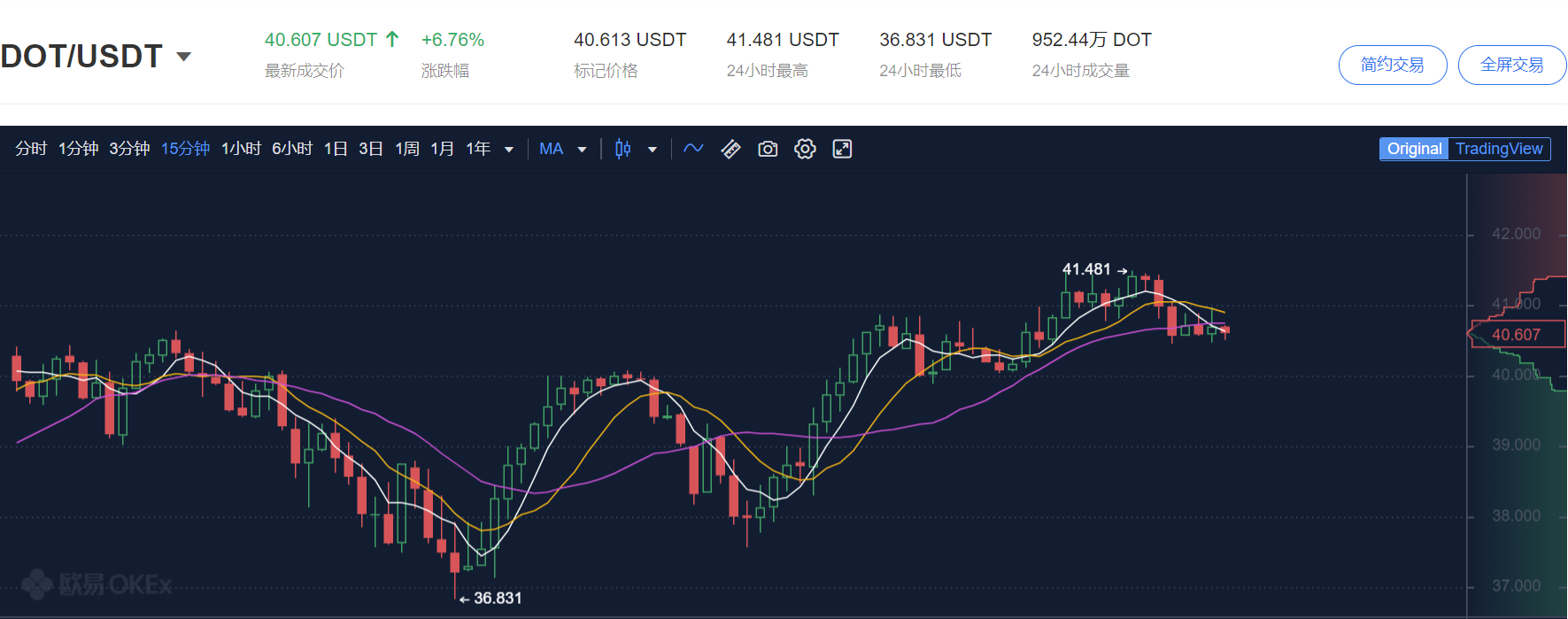
Image source: OKEx
The choice of developers and the support of users may be the best answer.





