


Ethereum London Upgrade Will Delay Difficulty Bomb Until December


This article comes fromDecrypt, original author: Ekin Genç
Odaily Translator | Nian Yin Si Tang

Summary:
This article comes from
, original author: Ekin Genç
Odaily Translator | Nian Yin Si Tang
secondary title
Summary:
- The Ethereum difficulty bomb was originally scheduled to launch this summer.
- Ethereum core developers Tim Beiko and James Hancock say the team will delay the difficulty bomb until December.
- This may be the last time a developer needs to take this action.Ethereum developers agreed on Friday to delay a "difficulty bomb" that will start slowing the ethereum network this summer if left unaddressed.The Ethereum "difficulty bomb" is a piece of code embedded by Ethereum developers in 2015, which artificially slows down the issuance of Ethereum by gradually increasing the difficulty of blockchain mining. This mechanism is designed to enable Ethereum's massive shift to a proof-of-stake (PoS) mechanism algorithm.
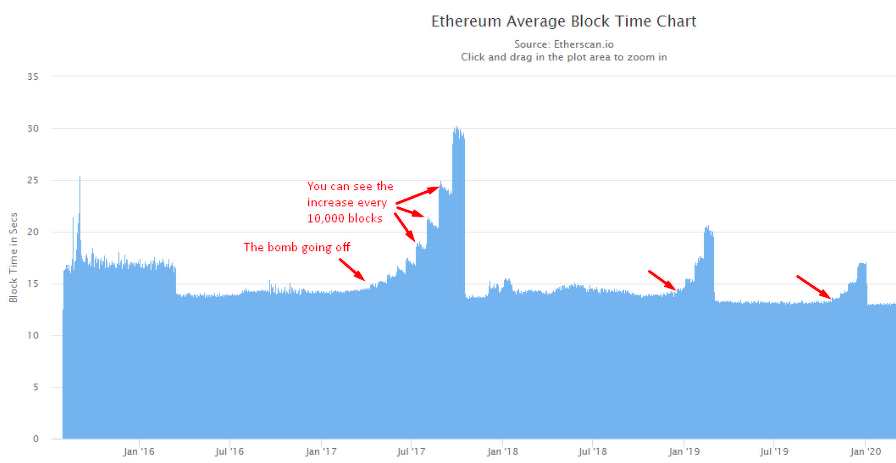
Under the current conditions of the proof-of-work consensus mechanism, miners earn rewards every time they create a new block and add it to the blockchain. But when the Ethereum difficulty bomb is set to "explode," it will be exponentially more difficult for miners to earn rewards through mining.
Ethereum 2.0 will switch the network from Proof of Work (PoW) to Proof of Stake (PoS).
A block is now mined in Ethereum
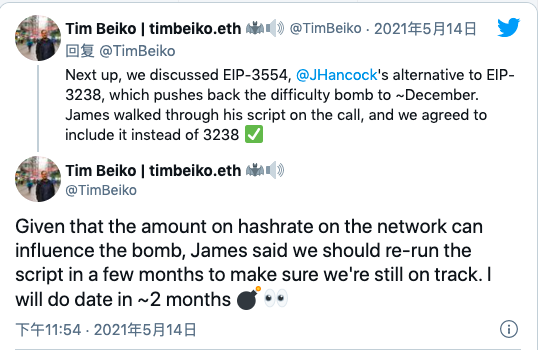
takes an average of 13 seconds. Without a delay in launching the difficulty bomb, it would take more than 20 seconds to verify a block by the end of the year.On May 14th, Ethereum core developers held a conference call, and Ethereum developer Tim Beiko updated the results of the meeting, saying that most of the meeting was focused on resolving the final details of the London upgrade. The London upgrade will be included in EIP-3541, EIP-3554. Among them, EIP-3541 prevents the deployment of contracts starting with "0xEF", laying the foundation for a large-scale EVM overhaul (EIP-3540); EIP-3554 proposes to delay the difficulty bomb until December.
In addition, the meeting discussed the time for the London upgrade of the test network. Ropsten is scheduled for block height 10399301 (June 9), Goerli is scheduled for block height 4979794 (June 16), and Rinkeby is scheduled for block height 8813188 (6 July 23), the main network is still scheduled to be upgraded on July 14. After the first test network is successfully forked, the main network client upgrade block will be determined.
The calculation for this difficulty bomb delay is
Proposed by Ethereum core developer James Hancock
. “The difficulty bomb has always been there, we just dialed back its blocktime a bit to temporarily ‘defuse’ the bomb,” Hancock told Decrypt. He proposed delaying the bomb by 9700000 blocks.
image descriptionBlocktime graph on Etherscan. James Hancock contributed this note to Decrypt.Ethereum core developer Tim Beiko told Decrypt that developers dismissed proposals to delay the difficulty bomb until next spring. He said it wasn't necessary.Ethereum developers expect that by December, the network will be updated to allow communication between ethereum 1.0 (the network that relies on PoW) and ethereum 2.0 (the new network that relies on PoS). This is the so-called merge (Merge).“If the merger is done by December, we don’t need to do anything about the difficulty bomb, because we will completely abandon mining,” Beiko added.If the merger plan still does not materialize, ethereum’s Shanghai fork is expected to take place in October, which will delay the launch of the difficulty bomb again. The difficulty bomb has been delayed three times so far: first。





