


Ethereum 2.0 pledge pool and pledge derivatives


Source | Paradigm Research
Author | Georgios Konstantopoulos & Hasu
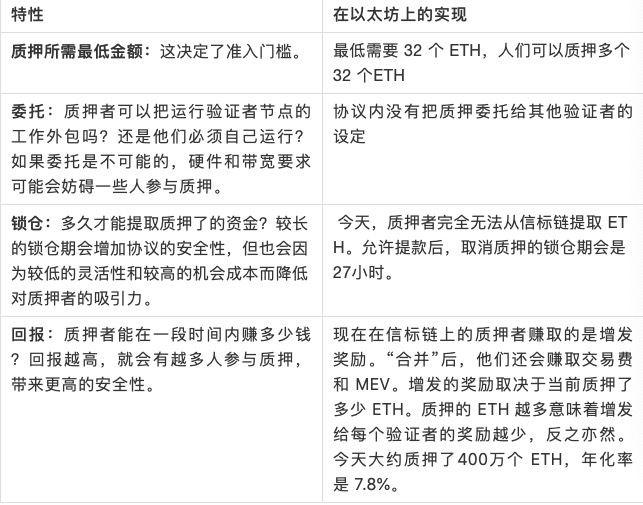
The transition from Proof of Work (PoW) to Proof of Stake (PoS) is the most anticipated milestone of Ethereum since its inception. Instead of scaling a blockchain using PoW, which consumes a lot of energy, PoS allows users to stake their ETH and run block producing nodes called "validators". The first step for Ethereum to move towards PoS is to launch an independent network that can reach consensus - the Beacon Chain. In return for providing security to the system, stakers are issued additional, new ETH. In the future, we know that the beacon chain will merge with the current Ethereum chain, allowing stakers to also earn transaction fees and the Miner Extractable Value (MEV) that is now earned by PoW miners. secondary title To stake independently on Ethereum, users must deposit 32 ETH into the ETH2 deposit contract, and specify two key parameters: 1.validator public key: Before depositing, users generate a key pair for their validator node. The private key is used to sign the block, and the public key is used as its unique identifier. 2. Withdrawal voucher for deposited 32 ETH: After the withdrawal is approved, the principal (32 ETH) and staking rewards can only be withdrawn to this address. A key point here is that the public key and withdrawal credentials need not be controlled by the same entity. Users then need to run an ETH2 validator node and sign blocks when it is their turn, otherwise there is a penalty for non-compliance. What problems do ETH stakers face? In the following, we discuss: ➤ How staking pools address delegation and minimum staking requirements; and secondary title On the surface, staking pools work similarly to PoW mining pools, but the nature of PoS allows it to offer some additional benefits to clients: 1. By pooling ETH together, stakers can pass the 32 ETH threshold. This allows small stakers to participate in PoS as well. 2. Unlike each user running its own validator node, the staking pool is responsible for the operational part of staking. Some staking pools also provide users with insurance against protocol penalties like slashing. 3. The pledge pool can maintain a reserve pool of liquid ETH to meet the demand for immediate withdrawal, similar to the way a bank does. This removes the withdrawal period and assumes that not all users want to withdraw at the same time. 4. Finally, the fund pool can provide a token representing the pledged ETH, which can be used in other applications. This is very important and will be discussed in depth in a chapter below. secondary title Any large exchange can easily implement a staking pool. In fact, many already support (or will support) beacon chain staking. Exchanges only need to: ➤ Allow users to choose to participate in staking, and then get staking rewards ➤ Run validator nodes with client ETH secondary title Now that we have understood the difference between individual staking and staking pool services, and how centralized staking pools work, we will use Lido as an example to explore the structure of decentralized staking pools. From a user's perspective, participating in a decentralized pool is simple: they deposit ETH into an Ethereum smart contract and receive stETH as a receipt. The balance of stETH tokens will change to reflect the distribution of staking rewards obtained by pledging the contract. This means, 1 stETH will always represent 1 staked ETH. In Lido's mechanism, every time 32 ETH is deposited into the Ethereum smart contract, DAO will select a new validator node from the governance-controlled registry. The validator will call the deposit contract, send 32 ETH to the validator's public key, and then use LidoDAO's withdrawal certificate. Two questions need to be answered here: ➤How to manage withdrawal vouchers?The withdrawal certificate is an ETH2 BLS key. A distributed key generation ceremony divides the withdrawal key into 11 parts, and the withdrawal certificate can only be obtained by collecting 6 multi-signatures. This is not an optimal solution, but does not pose a risk when withdrawals are not yet allowed on the beacon chain. By the time stakers can withdraw, Lido will have transitioned to using an ETH1 smart contract as a withdrawal certificate instead of a multisig. After that, assuming that the smart contract does not have any management functions for funds, 1 stETH will be convertible to 1 ETH without trust. ➤Who are validators and how are they registered?secondary title We learned that stETH is a proof of rewards for staked ETH and smart contracts. This is also known as collateralized derivatives. Staking derivatives will have a major impact on the entire Ethereum ecosystem, including ETH stakers, general ETH holders, competition among staking pools, and even Ethereum itself. Pledger:The main benefit for pledgers is that they can re-mortgage, and pledgers can use the principal in other applications while participating in the pledge, similar to how Uniswap's liquidity tokens can be used as collateral on various DeFi. This greatly reduces the opportunity cost of staking. ETH holders who do not stake: If stETH can be used as collateral for borrowing ETH, the demand for borrowing ETH can be released in leveraged pledge. This pushes up the ETH supply rate [1], and ultimately all ETH holders benefit from the high interest rate. Competition among staking poolsEthereum: Ethereum:There is a common belief that staking derivatives reduce the security of PoS because they decouple block generation from staking and slashing. This is also known as the principal-agent problem and can lead to withdrawal generators having no incentive to follow the protocol since they have no stake in it. However, this argument has to be weighed against the benefit it creates: if staking derivatives reduce the cost of staking, they also allow more (or even all) ETH to be staked. Note that this is a perfect example of a virtuous cycle: the higher the liquidity of stETH, the lower the opportunity cost of staking, which leads to more ETH being staked, further deepening the liquidity of stETH, and so on. go down. Without staking derivatives, we might expect 15-30% of ETH to be staked. However, in some cases, this number may rise to 0-100%, because there is no additional overhead between staking and unstaking. To illustrate why this leads to greater economic security, imagine the following attack scenario: ➤ If 20% of ETH is pledged, and the attacker wants to take 66% of all pledged ETH (the critical threshold for breaking the blockchain), then they must buy 40% of all ETH in the free market. ➤ If 60% of ETH is staked, but stETH is liquid, then the attacker would have to buy 66% of all stETH, effectively 40% of all ETH. Note that there are some extra steps involved, the attacker first has to redeem stETH to remove honest validators and re-stake their ETH. ➤ If more than 60% of the ETH is pledged, the attacker must buy more than 40% of the ETH at this time, and can only start from 40%. ➤ If 100% of ETH is staked, the attacker would need to buy 66% of all stETH to reach the same critical point. secondary title Decentralization is often seen as an intangible benefit that comes with a high cost, so users are often unwilling to pay for it (see Binance Smart Chain vs Ethereum debate). This logical thinking does not apply to decentralized staking pools, because there are three key advantages over centralized staking pools. ➤ They are more socially scalable: An important indicator of PoS security is how much stake is controlled by a single entity. For exchanges, this number may be limited to 15-30%; above this ratio, the Ethereum ecosystem may have social concerns about the concentration of power. Decentralized staking pools can control any percentage of staked shares in the network, as long as each individual staker in the DAO is not too large, and withdrawal credentials cannot be changed or voted on. We must emphasize how important it is that decentralized staking pools remove all governance functions. Neither fees, withdrawal addresses, nor validator registries can be modified by input. ➤ Their staking derivatives are trustless: Large exchanges like Coinbase or Binance will only issue custodial tokens, and the number of people using them must be limited. Under the same circumstances, users will definitely choose trustless tokens instead of Need to trust. This would allow centralized staking pools to miss out on the network effects of staking derivatives. One might point out that with WBTC, a centralized coin is able to win the market for tokenized BTC. However, we believe it is only because BTC on Ethereum cannot be tokenized in a trustless and capital-efficient manner, while pledged ETH is possible. ➤They have fewer restrictions on MEV extraction:Institutionalized staking pools (such as exchanges) may have social or reputational restrictions preventing them from withdrawing some form of MEV. This allows small staking companies and decentralized staking pools without these constraints to offer higher returns to their stakers. This turns the aforementioned premium for using a decentralized staking pool into a decentralization discount. in conclusion Staking pools and their staking derivatives are subject to market realities like withdrawing MEV, and in this sense their existence is inevitable. They will all continue to exist and thrive as long as there is a private interest in creating and using them. But it could also have systemic benefits for Ethereum if the right solution wins out and is fully adopted. Due to stETH's massive network effects, and the fact that decentralized staking pools are both non-custodial and likely to earn more revenue from MEV, we think such decentralized pools are likely to win the overall market. Therefore, we should focus on ensuring that a staking pool like a non-custodial, strong version of stETH wins the market, rather than a centralized pool, so as to ensure a good systemic outcome.How does staking ETH alone work?
How does the staking pool work?
How does a centralized staking pool work?
How does a decentralized staking pool work?
Anatomy of the stETH token
So who will win in the staking market?
in conclusion





