


Paradigm Research: Decentralized staking pool will help the healthy development of ETH 2.0 ecology


This article comes fromparadigmThis article comes from

, the original author: Georgios Konstantopoulos & Hasu, compiled by Odaily translator Katie Ku.
The transition from Proof of Work (PoW) to Proof of Stake (PoS) is the most anticipated milestone since the inception of Ethereum. Instead of using energy-costly PoW to scale the blockchain, PoS allows users to stake their ETH and run validators of block producing nodes.
The first step for Ethereum to implement PoS is to start an independent network that can reach consensus, called the Beacon chain. As a reward for providing security to the system, stakers are rewarded with new ETH from inflation. In the future, the Beacon chain and Ethereum will merge, allowing stakers to also earn transaction fees and MEV (miner extractable value) that are currently used by PoW miners.
In this article, we explore the problems that ETH stakers face today. It also shows how staking pools and staking derivatives solve these problems for stakers and, at the same time, increase the effective security of the network.
secondary title
How does staking ETH alone work?
To stake on Ethereum alone, a user must deposit 32 ETH into the ETH2 deposit contract and specify two key parameters:
Validator Public Key: Before depositing, users generate a key pair for their validators. The private key is used to sign the block, while the public key is used as its unique identifier.
Withdrawal certificate for the deposited 32 ETH: When withdrawals are enabled, the principal (32 ETH) and staking rewards can only be withdrawn to this address.
Users are then expected to operate an ETH2 validator node and log into blocks when it is their turn, or be penalized for not following the protocol.
secondary title
Problems faced by ETH stakers?
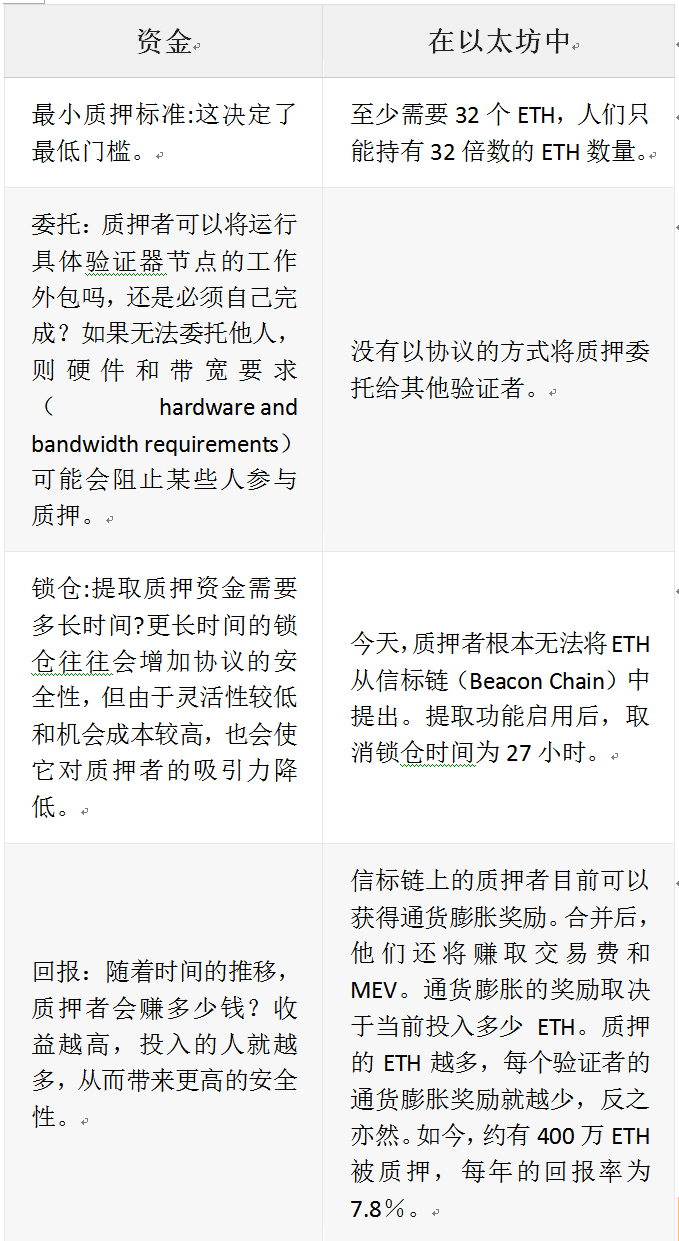 The efficiency and convenience of the staking protocol and its Ethereum measures can be divided into the following properties:
These funds are a big hurdle for stakers. All other things being equal, they want to be able to stake any amount of ETH, delegate their infrastructure to run, and withdraw their staked ETH instantly. They also want to use their ETH holdings for other applications if possible, which has become a standard step in DeFi.
Below, we'll discuss:
How the pledge derivatives of these pledge pools can solve the long-term lock-up problem and allow pledgers to unlock their pledged ETH liquidity.
secondary title
How do staking pools work?
On the surface, a staking pool works similarly to a mining pool in PoW, but due to the nature of PoS, it can provide additional benefits to its users:
By pooling ETH in a mining pool, stakers can bypass the 32 ETH minimum threshold requirement. Allow stakers with smaller funds to participate in PoS;
The mining pool does not allow each user to operate its own validator, but handles the operation of the pledge;
Similar to banks, mining pools can reserve a certain amount of liquid ETH to meet immediate withdrawal needs. This is ignoring the withdrawal period, assuming that not all clients want to withdraw at the same time.
Staking pools can be centralized or distributed, each has its pros and cons.
secondary title
How do centralized staking pools work?
Any large exchange can easily set up a staking pool. In fact, many already support (or will support) Beacon Chain staking.
Transactions only require:
Users are allowed to choose to stake in exchange for staking rewards.
Since the exchange is a staking platform, users do not need to run any infrastructure. It is also very easy for them to provide instant liquidity, since they already have large reserves of liquid ETH. Considering the value of customer liquidity to the exchange business, exchanges can provide users with this service at no additional cost.
secondary title
How do decentralized staking pools work?
Now that we have identified the difference between solo staking and pool staking, and how centralized staking pools work, we will explore the structure of a decentralized staking pool using Lido, the Ethereum 2.0 staking solution, as an example.
From a user perspective: they deposit ETH into an Ethereum smart contract and receive stETH as a receipt. The balance of stETH tokens is adjusted over time to reflect the distribution of staking rewards generated by the contract. That said, 1 stETH will always represent 1 ETH.
From Lido’s perspective, every time 32 ETH is dropped on the Ethereum smart contract, the DAO selects a new validator from a governance-controlled registry. It then activates the deposit contract, distributes 32 ETH to that validator's public key, and uses LidoDAO's withdrawal credentials.
But there are still two problems:
Who are validators and how do they get into the registry? Validators are professional staking transactions like p2p.org, Chorus One, or stakesfish that must be approved by governance. Each validator has a maximum stake they can have, which is also determined by a governance vote.
secondary title
What is the stETH token?
We have established that stETH is a claim on staked ETH and any rewards generated in the smart contract. This is also known as collateralized derivatives.
Staking derivatives will have a major impact on the entire Ethereum ecosystem, including Ethereum stakeholders, regular ETH holders, competition between funding pools, and even Ethereum itself.Pledger:
The main benefit for stakers is that they can re-stake, which allows them to stake while simultaneously using their principal in other applications, just like Uniswap’s LP (Liquidity Provider) tokens can be used as collateral in DeFi. This greatly reduces the opportunity cost of staking.Non-staking ETH holders:
If stETH can be used as collateral for borrowing ETH, it can free up the need to borrow ETH for leveraged pledges. This will drive up the interest rate on the ETH1 supply, ultimately benefiting all ETH holders holding higher interest rates.The existence of stETH enables its mining pool to have significant network effects. This network effect has greatly fueled sentiment towards staking with market leaders, suggesting that ETH staking derivatives may follow a power law or winner-takes-all allocation pattern due to the liquidity protection and network effects associated with it. In many use cases, stETH may replace ETH, possibly even completely replace ETH.
Ethereum:Ethereum:
There is a popular narrative that staking derivatives makes PoS less secure because they separate block production from staking and slashing incentives. And it can lead to the following situation: blockchain producers do not have enough incentive to make them follow the agreement, because they are not participating in the pledge.
However, this argument must be weighed against the question of benefits: if staking derivatives reduces the cost of staking, it could result in more (or even all) ETH being staked. Note that this is a perfect example of a virtuous cycle: the more liquid stETH becomes, the lower the opportunity cost of staking, which leads to more ETH being staked, which in turn further deepens the flow of stETH sex, and so on.
If derivatives were not staked, we could expect 15% to 30% of ETH to be staked. However, with staking derivatives, this figure can be as high as 80-100%, since there is no additional cost for staking compared to non-staking.
To illustrate why this leads to greater economic security, consider the following situation when attacked:
If 20% of all ETH is staked, and an attacker wants to obtain 66% of all ETH (the critical threshold for breaking the chain), then they will have to buy 40% of all ETH on the open market;
If 60% of all ETH is staked, but stETH is liquid, the attacker would have to buy 66% of all stETH, which is 40% of the ETH. Note that there are additional steps to this, the attacker must first redeem stETH to remove honest validators, and then reacquire their ETH;
Over 60% staked, all ETH shares the attacker would have had to buy are now over 40%;
We can conclude that if staking derivatives can increase the amount of ETH invested by more than 60%, then they strictly increase the economic security of Ethereum, not reduce it.
secondary title
So who will be the ultimate winner in the staking market?
Decentralization is often considered an intangible advantage, but it is more expensive, so users are usually not willing to pay for it. This idea does not apply to decentralized staking pools, as they have three key advantages over centralized mining pools.They are more socially scalable:
An important metric for PoS security is how much staked funds are controlled by a single entity. For exchanges, that number could be capped at between 15% and 30%; more than that, the concentration of power in the Ethereum ecosystem could be a social concern. As long as each validator in the DAO does not hold too much power, and withdrawal credentials cannot be changed or voted, a distributed staking pool can control any share of the network.
We must emphasize that in that case, the decentralized staking pool has been freed of all governance functions, which is a critical step. And the handling fee, withdrawal address and verification registration form are not allowed to be changed by human input.Their staking derivatives are trustless:
Large exchanges like Coinbase or Binance can only issue regulatory tokens, and their implementation must be limited, because all else being equal, users definitely prefer trustless tokens over trustless tokens ( trusted) tokens. This causes centralized mining pools to miss out on the network effects of staking derivatives.
It might be pointed out that with WBTC, centralized coins can win the market for tokenized BTC. However, we believe this is simply because BTC on Ethereum cannot be tokenized in a trustless and capital-efficient manner, whereas it is possible with collateralized ETH.They have fewer restrictions on MEV extraction:
secondary title
Summarize
Summarize
From the perspective of plundering users' interests, the existence of staking pools and their staking derivatives is similar to MEV. They will exist and thrive as long as there is a private gain in creating and using them. However, if the right solution is fully adopted, it could also have systemic benefits for Ethereum.
Due to the huge network effects of stETH, and the fact that decentralized mining pools are likely to be both non-custodial and potentially earn more revenue from MEV, we believe that a single such decentralized mining pool can win the entire market.





