






Ouyi OKEx Research Institute: "A feast for the common people", a full analysis of Chia mining


secondary title
1. Chia's "Aura of Nobility"
Speaking of Chia, the most well-known is its three auras: "Silicon Valley genius founder", "star investment institution" and "green mining".
In terms of team background, the founder of Chia is Bram Cohen, the inventor of BitTorrent. BitTorrent protocol---this free and open source protocol, which once occupied 1/3 of the global network, represents the concept of the earliest decentralized digital sharing economy, which undoubtedly brought a huge halo to Bram when he founded the Cina project.
In terms of investment institutions, Chia received two rounds of financing in 2017 and 2018. Investment institutions include well-known first-line investment institutions such as A16Z, Greylock Partners, DCM Ventures, and Coinbase. It is the background of these star investment institutions that makes the market look forward to Chia's future performance.
Of course, in addition to the above honors, what attracts the most attention from Chia is its unique "green mining".
When Satoshi Nakamoto published the Bitcoin white paper, his main vision was that everyone can participate in Bitcoin mining activities through the CPU; Become a competition for professional mining equipment and cheap electricity. At present, unless an ordinary person has a professional ASCI mining machine, it is impossible to mine Bitcoin; similarly, according to the Cambridge Bitcoin Electricity Consumption Index, the current annual electricity consumption of Bitcoin has reached 134.68 TWh, which is more than one Annual electricity consumption in medium-sized countries. This has become outdated at a time when the world is increasingly concerned about environmental protection and climate issues.
In comparison, Chia aims to be an alternative to Bitcoin --- "a green, eco-friendly digital currency"; and its computing power is based on "a widely distributed, ASIC-resistant commodity that has nothing to do with electricity prices- --hard disk space". How did Chia achieve its vision? It mainly relies on its Proof of Space and Time consensus mechanism.
Proof of Space is a way of proving that a user has reserved some unused storage space on a hard drive. Users of the Chia blockchain "seed" unused space on their hard drives by installing Chia mining software. These users are called "farmers". When the blockchain broadcasts the next block challenge, farmers can scan their plots to see if they have the closest challenge hash. The probability that a farmer wins a block is the percentage of the total space that the farmer occupies in the entire network.
Time proof is to realize the sorting of blocks in chronological order, so as to form a complete and effective block main chain. Proof of time is implemented with a verifiable delay function that takes a certain amount of time to compute but is very fast to verify. The key idea of VDFs is that they require sequential computation and since there is no gain in having many parallel machines, power waste is minimized.
Perhaps the above terms are too obscure and complicated, we might as well use Chia’s mining process to better understand the time-space proof mechanism:
(1) Cultivation stage (P plate):
The P disk is plotting (surveying). Chia will generate a large number of Nonce (arbitrary or non-repeating random values that are used only once) through the hash algorithm, and write them to the hard disk in the Plot file format. The P disk process is somewhat similar to farmers sowing seeds (nonce) on the land (hard disk space), so China vividly calls this process "farming (Farming)", and users participating in farming are called "farmers".
(2) Harvest stage:
secondary title
2. "Feast of the Common People" under Chia
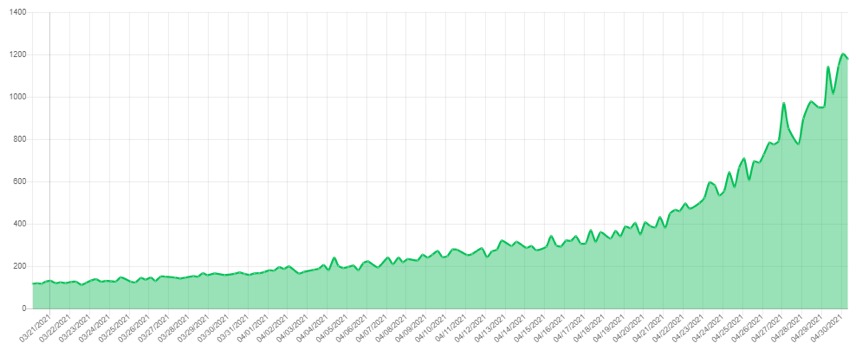
From the above, we can see that the probability of farmers winning block rewards is the ratio of their own storage space to the total network space. Therefore, the more land a farmer owns, the greater the probability of obtaining rewards. Therefore, we see that Chia miners are rushing to buy a large number of hard drives to expand their own land space, which has triggered a surge in hard drive out-of-stock and price increases, which has also led to an exponential increase in Chia's network space.
Figure 1. Chia network space growth
Source: chiaexplorer, OKEx Research Institute
When Satoshi Nakamoto first designed the Bitcoin mining model, his vision was that everyone can use the CPU on the computer to mine. However, with the emergence of ASIC and other specialized computing hardware devices, using CPU mining has become an unattainable dream --- it is difficult for ordinary people to participate in Bitcoin mining activities because of the lack of dedicated ASIC mining machines; Similarly, Filecoin mining, which is often mentioned together with Chia, has extremely high requirements for hardware configuration, consumes a lot of broadband, and cannot be disconnected from the network or power, otherwise the penalty mechanism will be triggered. Therefore, BTC and FIL mining has gradually become an aristocratic mining movement for a few professionals.
From the above, we can see that the key to Chia mining lies in the size of the storage hard disk space—anyone in the market can obtain this hardware device. Therefore, compared with Bitcoin and Filecoin, Chia has a lower threshold for mining hardware, and everyone can participate in it and obtain Chia benefits.
secondary title
3. Chia Mining Analysis
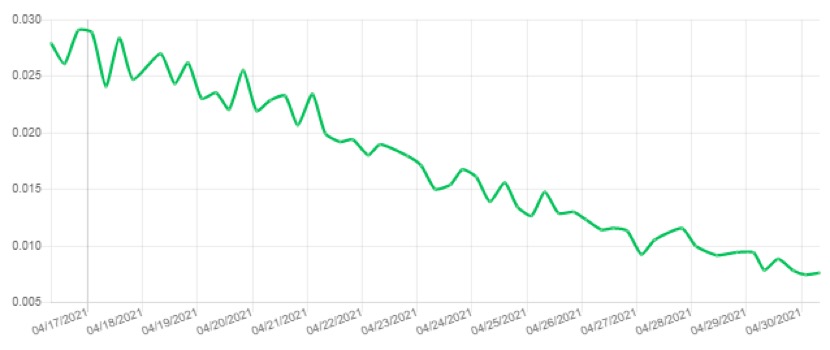
Like Bitcoin, the difficulty of work on the Chia blockchain network is also dynamically adjusted to ensure that the block generation time remains unchanged, maintaining an average of 10 minutes for each 32 blocks to complete the target time, realizing the Chia network. Stable release of XCH. On the other hand, with the intensification of competition in the P disk, Chia's network space will rise, which will eventually lead to a decrease in reward income per unit of "farming space". As shown in the figure below, in the past half a month, the number of XCH rewards per TB per day has been getting lower and lower. As of April 30, every 1 TB of storage space can only get about 0.0076 XCH rewards per day. With the influx of more and more farmers, the number of XCH rewards per daily unit TB will further decrease in the future.
Figure 2. The number of XCH rewards obtained by daily 1TB storage space in the Chia network
Source: chiaexplorer, OKEx Research Institute
On the other hand, it should be noted that the network can be disconnected during the process of the P disk, but it takes a very long time. The main reason is that it takes a long time to write a large number of Nonce to the disk during the P disk. In general, the speed of the P disk depends on the CPU capability and disk read and write speed. The faster the P disk is written, the faster the farming can be completed, and the earlier the farmer can enter the harvesting stage. This means that when some farmers are still stuck in the time dilemma of the P disk, other farmers are already harvesting XCH, and the longer the P disk time, the greater the network space, and the less future income.
Therefore, Chia mining is a "race against time" game. The larger the "land area", the earlier the farmers who enter the game, the higher the income. Since the time required for the P disk cannot be shortened, more farmers adopt the strategy of "trading space for time" --- using a large number of hard disks at one time to obtain a larger "cultivation area" to reduce the "cultivation" stage of the P disk. Come time loss.
Overall, Chia is still in the early stage of dividends. Driven by FOMO sentiment, Chia's popularity will continue for a while. For users who pursue short-term investment, participating in this project is a good choice.





