






Ouyi OKEx Research Institute: The annualized income exceeds 300%, wealth opportunities under the unified account


first level title
(1) Spot arbitrage (perpetual-leverage arbitrage) strategy
1. Core idea:
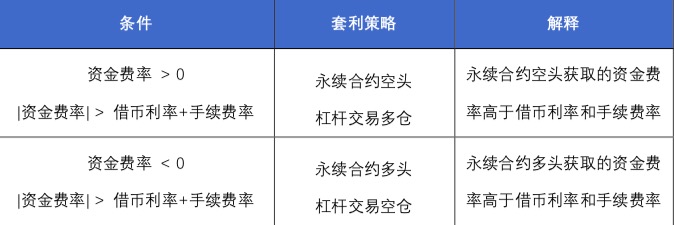
In the encrypted derivatives market, due to the difference between the funding rate of the perpetual contract and the fixed interest rate, there is an arbitrage space between the perpetual contract and the spot leveraged transaction --- we can respectively trade in the currency leveraged transaction and the perpetual contract transaction Establish a position with the same position value and opposite position direction to realize the arbitrage between floating interest rate and fixed interest rate. The specific strategy is as follows:
Table 1. Perpetual-leverage arbitrage strategy
2. High-yield strategy under unified account
For the perpetual-leverage arbitrage strategy, it is now very mature, and it can also be used in the past sub-account system, but the limitations are:In the sub-account mode, the margin trading account and the perpetual contract account are separated, and the two accounts cannot share the margin; similarly, the sub-account mode cannot achieve profit and loss balance, and users have to reduce the leverage multiple to prevent liquidation, making the sub-account The overall capital utilization efficiency of the model is low, and the income is not high.
Taking the actual situation as an example, on April 13, the sum of the funding rate of the currency-margined perpetual contract on the OKEx platform is as follows:
Table 2. Some USDT Margin Perpetual Contract Funding Rates on the OKEx Platform
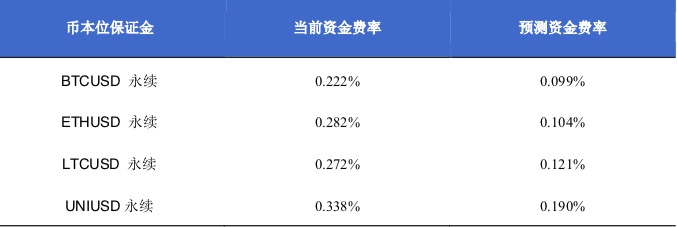
Table 3. Basic daily interest rate for common user loans
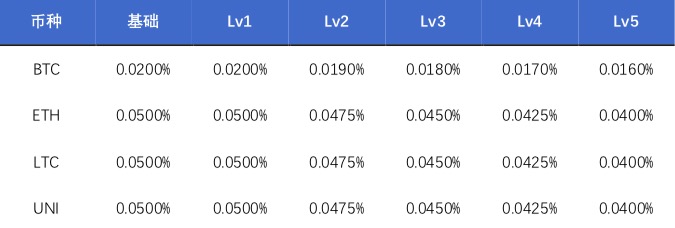
Let's take a user with level LV1 as an example. At this time, the funding rate of the ETHUSDT perpetual contract at the next settlement moment is 0.282%, while the lending rate of ETH is 0.05%. The transaction fee rate (Taker) for LV1 level users is 0.05%, the arbitrage space that exists at this time is 0.282%-0.05%-0.05%*2 = 0.132%. Of course, for professional users with higher grades, the loan interest rate and transaction fee rate are lower, which means that there is more room for arbitrage.
Assuming that the user has 0.2 ETH in his hand, the marked price of the ETHUSD perpetual contract is 2218.57 USD, and the marked price of the ETH/USDT leveraged transaction is 2213.82 USDT.
(1) Transactions under classic account mode
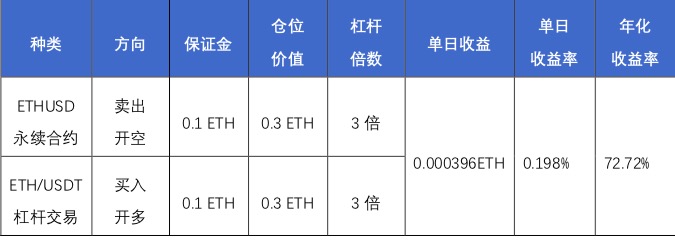
In the classic account (sub-account) mode, in order to use funds more efficiently, the best strategy is to place 0.1 ETH in the margin trading account and the perpetual contract account, and in order to prevent liquidation, the leverage of the positions in each account The maximum multiple is set to 3 times (that is, to ensure that no liquidation will occur under a rise or fall of about 33.3%), as follows:
Under the ETH/USDT currency pair, use 0.1 ETH to open long ETH with 3 times leverage, and the total position value is 0.3 ETH;
In the coin-based perpetual contract, use 0.1 ETH to short 0.3 ETH with 3 times leverage, and the total position value is 0.3 ETH
Table 4. Perpetual-leveraged arbitrage strategy under the classic account model
(2) Transactions under the unified account single currency margin mode
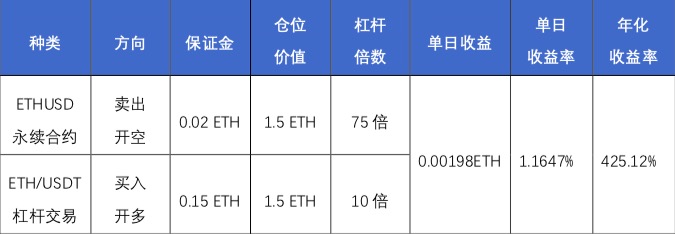
Under the unified account single-currency margin mode, since the delivery contract and the leveraged transaction can share the margin and realize the balance of profit and loss, we can open a higher leverage. In ETH/USDT leveraged trading, the maximum leverage is 10X; in currency-based perpetual contracts, the maximum leverage is 75X. In order to use capital efficiency as high as possible, we can obtain the initial margin of each position by solving the following equations:

Among them, x is the initial margin of margin trading, y is the initial margin of perpetual contract, and m is the amount of assets in the currency in the account. In this case, m is 0.2, so it can be solved that x is 0.023ETH and y is 0.177. Considering factors such as handling fees and slippage, we handle it as appropriate in this case, and set the value of x to 0.02 ETH and the value of y to 0.15 ETH. Therefore, we can do the following:
Use 0.15 ETH to do long ETH with 10 times leverage, and the total position value is 1.5 ETH;
Use 0.02 ETH in the ETHUSD perpetual contract to short 1.5 ETH with 75 times leverage
Table 5. Perpetual-leverage arbitrage strategy under the unified account model
Right now

Right now
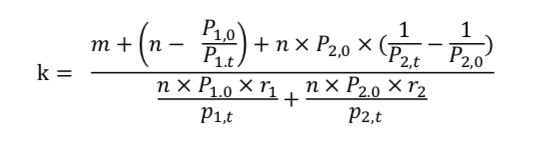
Among them, m represents the balance of the entire position of the currency, n represents the value of the position, P1,0 represents the opening price of the margin transaction, P2,0 represents the opening price of the perpetual contract, P1,t represents the mark price of the margin transaction, P2,t Represents the contract transaction mark price, and r represents the maintenance margin rate. Here, we set
 The S here can represent the change of the leveraged transaction price and the price of the perpetual contract, then at this time

If S1=S2=S3, that is, the price rise and fall of the leveraged transaction and the perpetual contract are equal, then

Here, we multiply the average leverage (G) by the average initial margin (f) to replace the position value n, and α replaces S with the rate of change representing the currency price, then

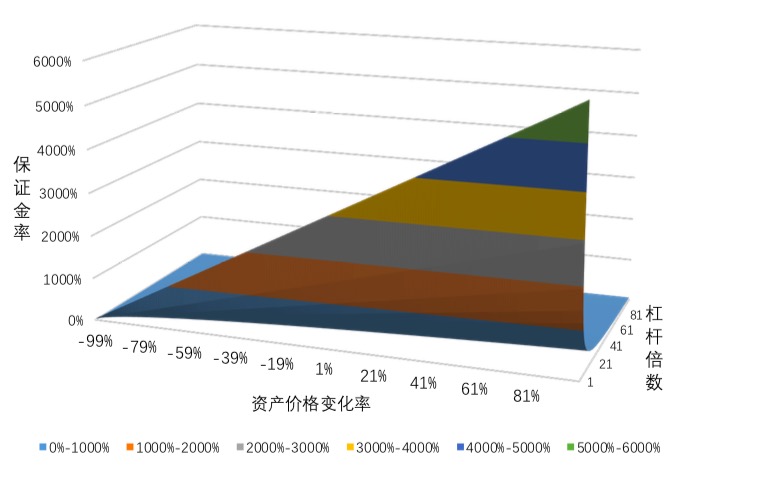
H in the formula is a fixed value, we can draw the above formula with a three-dimensional surface graph, as shown below, this function is similar to a folded paper foil. Under the unified account single currency margin mode, when kWhen <=100%, the account will be forced to reduce the position. From the above formula, it can be seen that leverage and price rise and fall are the decisive factors for liquidation.
Therefore, when users use this strategy, they must first use the interpolation method to obtain the corresponding price increase and decrease and leverage setting range.For example, in the case of this section, the price change range is within [-33%, 33%], using the interpolation method, we can know that the leverage setting needs to be below 20 times, and our average leverage is 15 times (in the unified account single currency In the margin mode, each position of this strategy has already used the highest leverage, so the average leverage is up to about 15 times), which is in a safe range.
Figure 1. Margin rate surface chart of unified account perpetual-leverage arbitrage strategy
 Returning to this arbitrage strategy, in order to improve capital efficiency, we make the occupied margin as close as possible to the account balance, that is, at this time

Next, we substitute G=15 into the above formula to get:

It can be seen from the above that the above arbitrage strategy will be forced to liquidate only when the asset price falls by about 74.5%.It should be emphasized that here we only choose the first tier of positions and maintenance margin rates; for different capital scales, the maintenance margin rates and loan amount corresponding to different tiers are different.
The actual arbitrage situation is shown in the figure below. It can be seen from the figure that although we have opened long and short positions of 1.5 ETH with the highest leverage of 10X and 75X respectively, our risk has not been significantly increased under the unified account mode. Its estimated liquidation price is 643.47 USD, which means that the above-mentioned arbitrage strategy will only face liquidation when the price of ETH plummets by about 74%.
Figure 2. Currency-based perpetual-leverage arbitrage under the unified account can significantly reduce the risk of liquidation
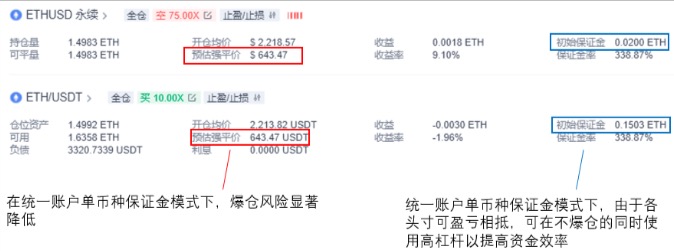
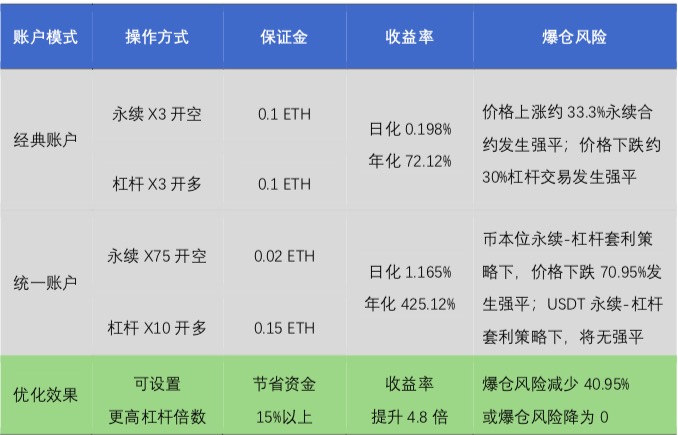
On the whole, in the perpetual-leverage arbitrage strategy, the unified account model saves nearly 15% of the funds compared with the classic account model, and the rate of return reaches 425.12%, which is 4.8 times higher than before, but the risk of liquidation is reduced by about 56.42%, even without risk of liquidation. Of course, this optimization effect is only for ordinary users with a level of LV1. For professional users with a higher level, the optimization effect under the unified account will be better due to lower handling fees and loan interest rates.
Table 6. Comparison of classic accounts and unified accounts under the perpetual-leverage arbitrage strategy
(2) Cross margin contract arbitrage strategy
1. Core idea
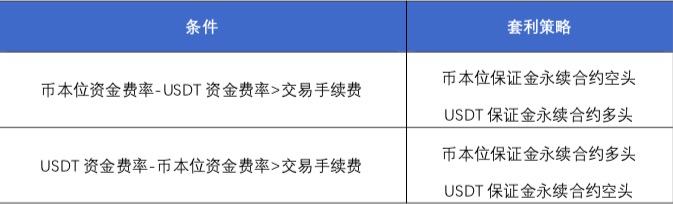
We mentioned earlier that we can use the difference between the funding rate of the perpetual contract and the borrowing rate of the leveraged transaction to carry out arbitrage. With the emergence of the USDT margin contract, we can also use the USDT margin perpetual contract and the currency standard margin perpetual contract The difference between the funding rates of the two contracts is used for arbitrage. The specific arbitrage strategy is as follows:
Table 7. Cross margin contract arbitrage strategy
2. High-yield strategy under unified account
It can be said that cross-margin perpetual contract arbitrage is largely prepared for professional investors under unified accounts. Because the funding rate difference between the two perpetual contracts is usually not too large, it means that only professional users who have received a high fee discount can arbitrage more easily; in addition, because the funding rate difference is too small, high leverage must be used In order to obtain considerable benefits, after all, funds also have opportunity costs.
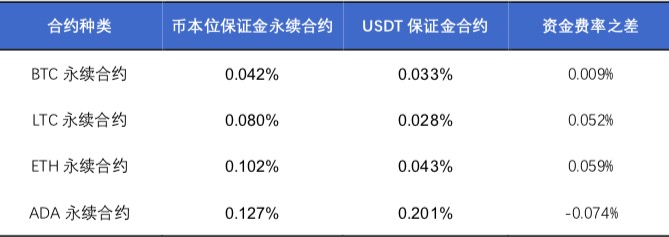
For example, at 16:00 on April 14th, the funding rate of most perpetual contracts is not much different, but in ADA perpetual contracts, the funding rate of currency-based perpetual contracts is higher than that of USDT perpetual contracts. The rate is 0.074% lower. For ordinary users of LV 5 and professional users of all levels, the taker fee is 0.03%; at this time, we can short ADAUSDT perpetual contracts; long ADAUSD perpetual contracts, the theoretical arbitrage space is 0.014%.
Table 8. Perpetual Contract Funding Rates
Now, from the perspective of a professional user, we have 100 ADA and 200 USDT in hand. At this time, the mark price of ADAUSDT perpetual contract (USDT margin) is 1.530 USDT, the mark price of ADAUSD perpetual contract (coin standard) is 1.521 USD, and the spot mark price is 1.520 USD USD.
(1) Transactions under classic account mode
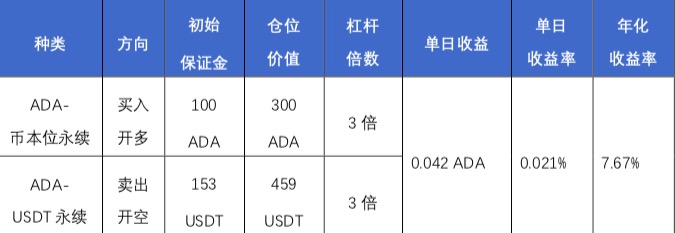
If we adopt the classic account model, then the USDT perpetual contract and the currency-based perpetual contract will not be able to share margins, nor will they be able to achieve profit and loss balance. Therefore, in order to maximize capital efficiency and reduce the risk of liquidation, the maximum leverage of the position is set to 3 times, that is, the operation is as follows:
With 100 ADA as margin, open long ADAUSD perpetual contract (currency standard) with 3 times leverage, the position value is 300 ADA, and the initial margin occupied at this time is 100 ADA;
With 2,000 USDT as margin and 3 times leverage to open short ADAUSDT perpetual contract (USDT margin), the position value is 459 USD (300 ADA), and the initial margin occupied at this time is 153 USDT.
Table 9. Cross-margin contract arbitrage strategy under the classic account mode
(2) Transactions under unified account mode
In the cross-currency margin-automatic loan mode of the unified account. The advantage of the cross-currency margin-automatic loan mode is that all currency assets in the account (uniformly converted into USD value) are used as the common margin, which means that as long as the overall USD value of the account is sufficient, even if the user does not have enough ADA, It is still possible to use USDT as margin to trade ADA currency-based margin, which avoids the problem of wasting some assets in the case of the above-mentioned classic account. At the same time, in the loan mode, even if the loss of a certain contract exceeds the interest-free limit (for example, the loss of an ADA coin-based perpetual contract exceeds the interest-free limit of 5,000 ADA), the forced currency exchange system will not be triggered, ensuring arbitrage across margin contracts Position security.
Because the cross-currency margin model is adopted, the currency conversion rate is 1 for USDT and 0.85 for ADA, so the USD value of the account = 1 * 1 * 200 + 100 * 0.85 * 1.520 = 329.2 USD.
Right now

Right now

In the above formula, m is the amount of trading currency (ADA), n is the position value, h is the amount of USDT, θ is the conversion rate, P is the spot price of trading currency (ADA), and P1,0 represents the opening of currency-based perpetual contract Price, P2,0 represents the opening price of the USDT perpetual contract, P1,t represents the mark price of the currency-based perpetual contract, P2,t represents the mark price of the USDT perpetual contract, and r represents the maintenance margin rate.
set up

Then the above formula is
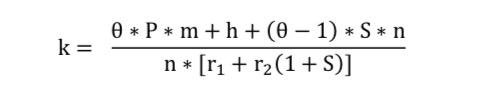
Among them, (θ∗P∗m+h) is the effective margin before opening a position, which is a fixed value. We set it to 2H. In order to maximize the utilization rate of funds, without considering the handling fee, we Divide the effective margin before opening a position into two equal parts (in this case, the initial margin of each position is 164.6 USD), then at this time, position = effective margin/2 * leverage, that is

Substitute into the above formula to get
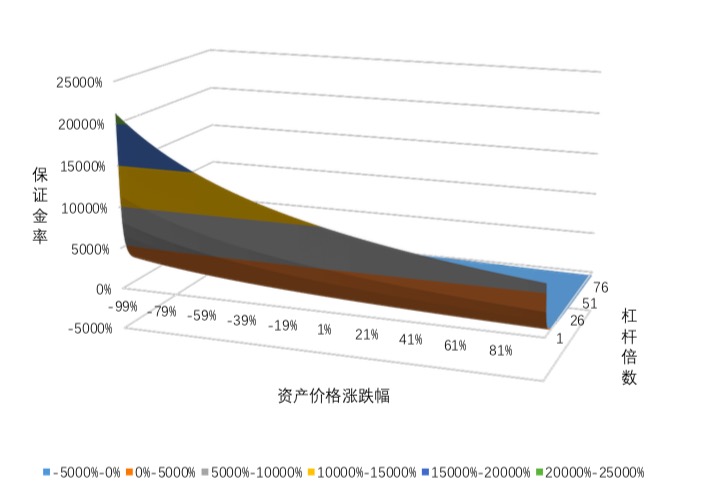
 Here we take θ equal to 0.85, then we can get the following three-dimensional surface diagram.Similarly, when using this strategy, we first use the interpolation method to obtain the corresponding price rise and fall and leverage setting range. For example, in the case of this section, the price change range is within [-30%, 30%], and we can know that the leverage setting needs to be within 30 times by using the interpolation method. Therefore, in this case, we set the leverage multiple at 30 times.
Figure 3. Unified account ADA currency cross-margin contract arbitrage strategy surface diagram
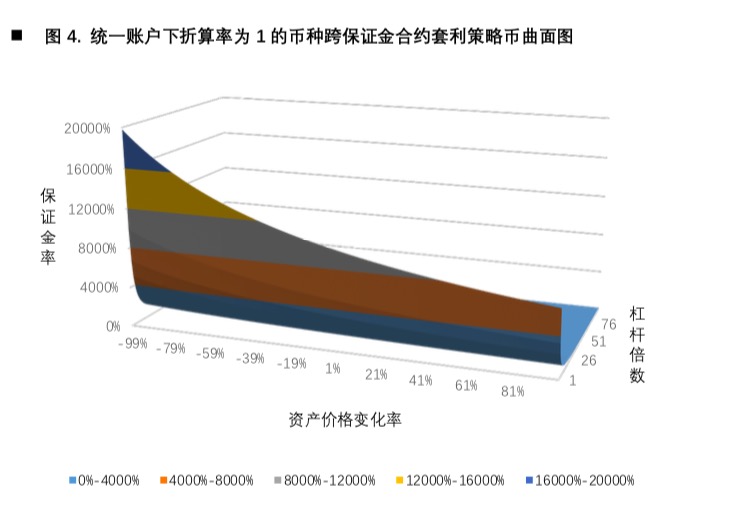
In addition, for currencies such as BTC and ETH with a conversion rate of 1, we can set it to 1 (that is, the conversion rate is assumed to be 1). At this point, we can get the following simple formula, whose three-dimensional surface is shown in Figure 4.

It can be seen from the figure that the larger the leverage ratio setting, the higher the asset price increase, the lower the conversion rate, and the lower the margin rate.
Figure 4. Currency Surface Chart of Currency Cross Margin Contract Arbitrage Strategy under Unified Account with Conversion Rate 1
In actual operation, we complete the strategy arbitrage through the following steps:
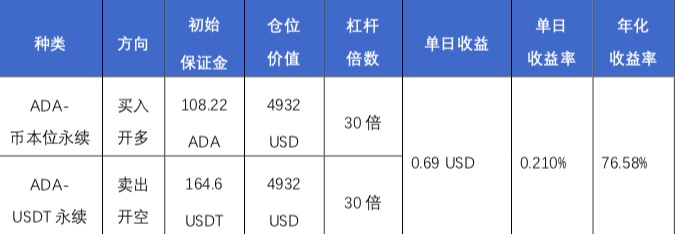
According to the number of account assets and historical currency prices, use the interpolation method to select an appropriate leverage multiple in the three-dimensional surface graph. According to the calculation, we choose 30 times leverage; in order to maximize the use of funds, each position uses 164.6 USD as the initial margin;
Use assets worth 164.6 USD as the initial margin, open long ADAUSD perpetual contracts (currency-based) with 30 times leverage, and the position value is 4932 USD, and the initial margin occupied at this time is 108.22 ADA;
Use assets worth 164.6 USD as the initial margin, open short ADAUSDT perpetual contracts (USDT margin) with 30 times leverage, the position value is 4932 USD, and the initial margin occupied at this time is 164.6 USDT
Table 10. Cross margin contract arbitrage strategy under unified account mode
So how high is the possibility of this position being liquidated in the future? When G is 30, you can get:

At this time, when 𝐒≥𝟒𝟐.𝟒%, that is, when the price of ADA rises by 42.4%, liquidation will occur.
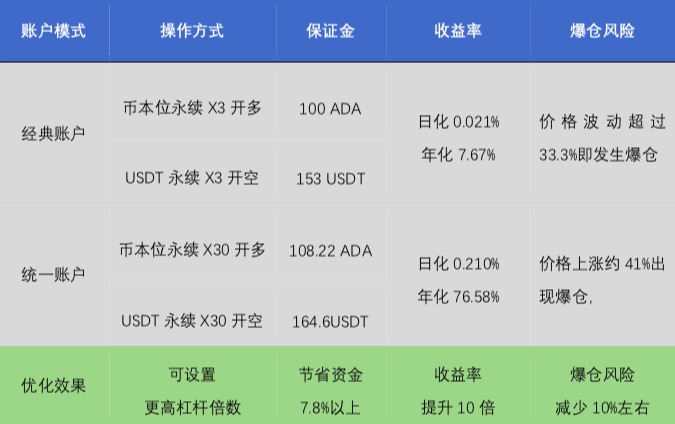
On the whole, in the cross-margin contract desk calendar strategy, the unified account model saves 7.8% of funds compared with the classic account model, the rate of return is increased by 10 times, and the risk of liquidation is reduced by about 10%. Of course, since this case is for ADA perpetual contract arbitrage, the overall dollar value of the account will drop due to the low conversion rate of ADA (only 0.85). If you trade BTC, ETH and other currency contracts with a conversion rate of 1 , then the capital utilization rate will be further improved.
Table 11. Comparison of classic account and unified account under cross-currency margin contract arbitrage strategy
 (3) Currency arbitrage strategy
1. Core idea
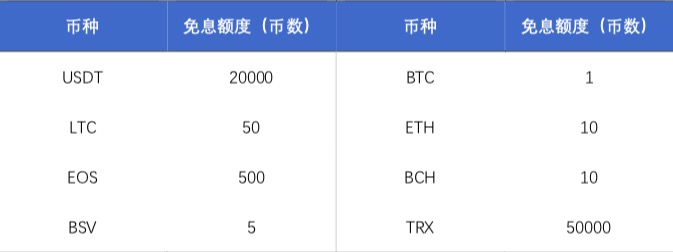
In the cross-currency margin of the unified account---automatic loan mode. When the balance or equity of a certain currency is insufficient, but the overall dollar value is sufficient, the user can also oversell the currency and generate liabilities. This is essentially a currency-to-currency leveraged transaction under the classic account mode, and no interest will be generated within the interest-free amount.
Table 12. Interest-free borrowing limit for cross-currency margin mode of OKEx unified account
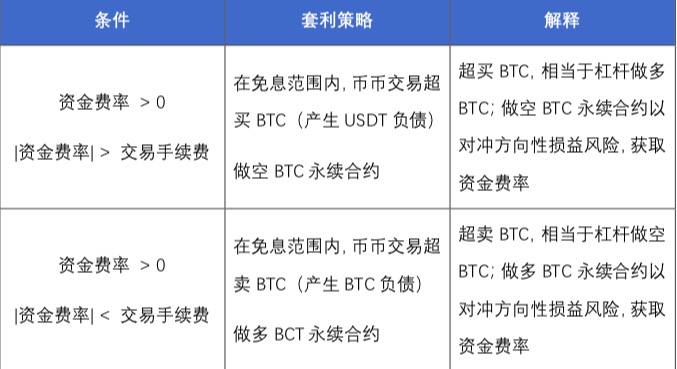
Since it is possible to borrow money interest-free under the unified account, we can build a higher-yield borrowing money arbitrage strategy. Taking the BTC/USDT trading pair as an example, the specific strategy is as follows:
Table 13. Currency Arbitrage Strategy
2. High-yield strategy under unified account
Here, we still take the BTC/USDT trading pair as an example. In the initial state, if the user's account only has USDT currency, and the number is n. Assuming that at a certain moment, the funding rate of the BTCUSDT perpetual contract > the transaction fee, then we can carry out the following arbitrage operations:
Oversold BTC in spot-to-crypto (leveraged) trading with m BTC
Long BTCUSDT perpetual contract, the position value is also m BTC, so as to achieve hedging
There are two implicit constraints in the above operation: first, the interest-free amount of BTC is 1, that is, m≤1; second, to lend m BTC, under the pending order verification rules, the potential borrowing is required The initial margin meets the following conditions: G∗n>𝑚*𝑃1,0 where G is the leverage multiple of the loan 𝑃1,0 is the opening price of the perpetual contract.
Might as well take the maximum interest-free amount of 1, and take the maximum loan leverage of 10, you can get n>1%∗𝑃1,0
At present, the price of BTC has reached more than 50,000 US dollars. Even if we use 10 times leverage to complete the loan when BTC is oversold, this requires the actual amount of USDT to be at least 5,000 USDT.
Now let's calculate the effective margin ratio for this strategy, since

Then we can get:

Among them, 𝑃1, 0 represent the opening price of the perpetual contract 𝑃1, t represents the mark price of the perpetual contract, 𝑃0 represents the opening price of the currency (leveraged) transaction 𝑃t represents the mark price of the currency-to-currency leverage transaction, and r represents the maintenance margin rate. Here, we assume:

but

May wish to take the maximum value of m 1, then

Here 𝑛/Pt is the value of USDT denominated in BTC, and it is recorded as z, which means 𝑍≥0.035, which means USDT assets
Real-time conversion into BTC, the value must be greater than or equal to 0035 BTC.
Two conditions must be met to use this strategy:

The time of this arbitrage strategy does not exceed 8 hours, and the price of BTC will not fluctuate too much, so it can be considered as 𝑃1,0≈𝑃𝑡, so

From the above, we can see that when the market does not fluctuate greatly, as long as the loan is successfully realized in the first step, the above arbitrage strategy will definitely not be liquidated.
because

because

It can be solved that the maximum daily rate of return of this arbitrage strategy

In the above formula, r represents the daily chemical rate, τ represents the funding rate, and only when the USDT asset denominated in BTC is 0.1 BTC, the daily chemical rate r takes the maximum value,
This means that the amount of funds required in BTC is very small. Therefore, this arbitrage has an upper limit and has nothing to do with the leverage of the perpetual contract. It is not suitable for users with large funds, but it is more friendly to ordinary users with small funds.
Let’s look at a specific case below: a user has a total of 10,000 USDT in his account, and on a certain day, the BTC spot price reaches 50,000 USD; the mark price of the BTCUSDT perpetual contract is also 50,000 USD, and the current funding rate is -0.100%; at this time, the user You can oversell BTC, and at the same time do long BTCUSDT perpetual contracts to achieve hedging and arbitrage, and obtain funding rates interest-free. The specific operation strategy is as follows:
In BTC/USDT spot trading, use 10 times leverage to oversell 1 BTC worth 50,000 USD,
In the BTCUSDT perpetual contract, we do long 1 BTC with 10 times leverage
Because the BTC currency has a liability of 1 BTC, it is actually a short position with a position value of 1 BTC. At the same time, there is a perpetual contract long position with a position value of 1 BTC in the account, and the profit and loss can be offset by each other.
Now we use a mathematical formula to strictly estimate whether the arbitrage strategy will be liquidated: Substituting the relevant parameters into the above formula:
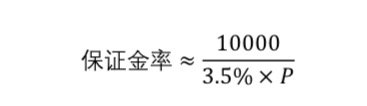
This means that liquidation will only occur when the price of BTC rises to 285,714.3 USD, that is, when the price of BTC increases 27 times, which basically means that there is no risk of liquidation in this strategy. Of course, here we are just making an estimate. Considering the handling fee rate, the actual forced liquidation price may be lower.
first level title
(4) Strategy summary
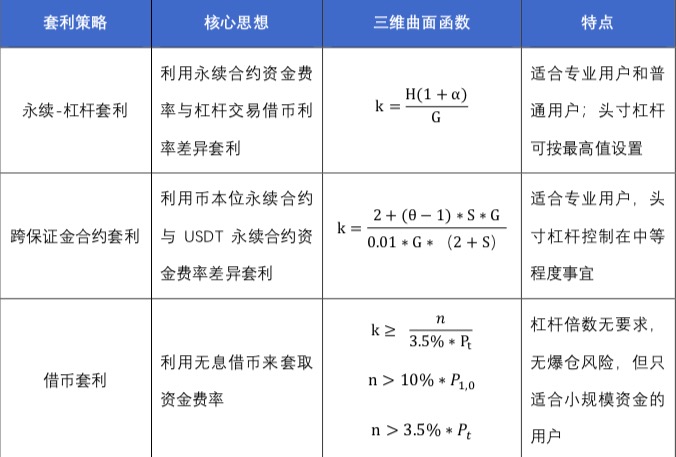
In this article, we introduce three strategies including perpetual-leveraged arbitrage, cross-margin contract arbitrage and currency loan arbitrage. When actually using each arbitrage strategy, the following steps are followed:
According to the actual situation of the market, determine the selection of specific arbitrage strategies;
According to the account funds and market conditions, a three-dimensional surface diagram of the strategy is made, and the specific leverage ratio and initial margin allocation are determined by interpolation method;
Establish long and short positions;
Close the position after obtaining the arbitrage income
Table 14. Comparison of three arbitrage strategies under the unified account
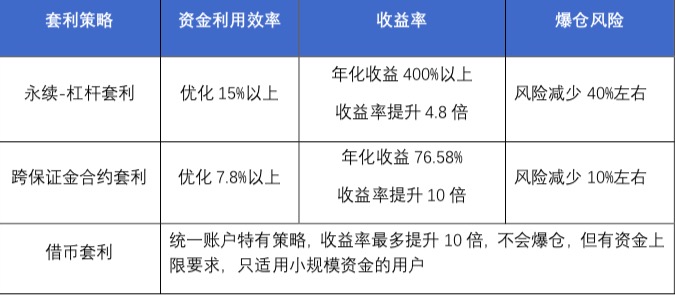
Judging from the actual transaction effect, under the unified account mode, the user's capital efficiency can be optimized by more than 8%, the rate of return can be increased by more than 5 times, and the risk of liquidation can be effectively reduced. Of course, this paper mostly adopts lower-level user fee rates in terms of handling fee rates and loan interest rates, and for users with higher levels, since they can obtain lower handling fees and loan interest rates, the optimization effect under unified accounts On the other hand, in the cross-currency margin, if some assets with high currency conversion rates are selected, the dollar value of the account will be higher, and the efficiency of capital utilization will be further improved.
Table 15. Optimization effect of unified account arbitrage strategy
It should be noted that although the unified account model can achieve profit and loss balance, so that we can set high leverage to obtain profits when arbitrage, but excessive leverage is easy to be automatically reduced. Therefore, it is recommended that users still need to set high leverage as appropriate when conducting arbitrage, otherwise once a certain position is automatically reduced, the arbitrage strategy will fail and face the risk of forced liquidation. In addition, for different currencies and capital scales, the gradient levels of contracts and leverage are also different, and there are differences in borrowing limit, number of positions, initial margin and leverage requirements, etc., which need to be handled by users according to their actual situation.
Finally, the wealth opportunities brought by the unified account are not limited to the above three arbitrage strategies, such as the intertemporal arbitrage strategy under the grid trading method, the Gamma dynamic hedging strategy, etc. Under the unified account, capital efficiency can also be optimized, Increase returns and significantly reduce the risk of liquidation, but limited to the length of this article, I will have the opportunity to introduce them one by one in the future.





