






Eth2 progress update (as of 2021/4/24)


Source | What's New in Eth2
Author | Ben Edgington
Source | What's New in Eth2
first recommendation
beacon chain
This week's must-see is EthGlobal's "Merge Summit"! See below for details.
beacon chain
secondary title
🚨News!🚨
The beacon chain had its first mishap. During the period from 09:36 to 11:28 on April 24th, Beijing time, a large number of blocks were lost. Normally, only about 1% of blocks on the beacon chain will be lost. During this period, close to 70% of the slots were empty (403 out of 560 slots were lost)
In this accident, there are a large number of lost blocks
(Picture from beaconcha.in, click to enlarge)
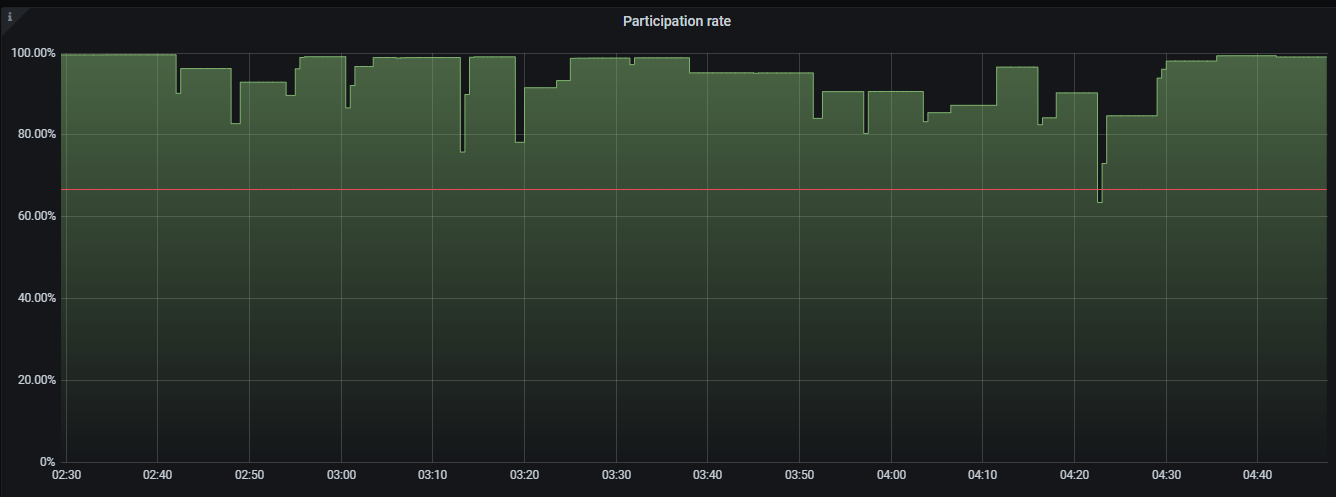
Blockchain is used to generate blocks, so this is really a serious problem. However, the Beacon Chain has been finalizing blocks all the time, and it appears proof generation has not been affected. However, with only so few blocks generated, the remaining block proposers don't have enough space in their blocks to pack all the pending proofs, so the participation rate sometimes drops to dangerous levels. The participation rate on the Beacon Chain has remained around 99%, so it is indeed quite shocking to see this level of decline.
During the incident, there was not enough block space, and the participation rate caused the participation rate to drop
(Data from Metal Albert, click to enlarge)
Someone quickly came up to me and blamed me, but it turned out that the bug was in the most-used Prysm client. The root of the problem has to do with voting on the state of the Eth1 deposit contract: if you can't see the correct data from the deposit contract, you can't propose blocks. When the network votes for a new stub (which typically happens every 7 hours), the crash resolves itself immediately. The Prysm team issued a PR with a quick fix, but before it's released and most users upgrade, it's still possible, albeit very unlikely, for this to happen.
This event has four impacts on stakers. But overall, the impact is relatively small. It can actually develop to a very serious level.
1. For validators who were drawn to propose blocks and use the Prysm client, they lost block rewards during this period.
2. For all verifiers, the reduction in block space severely reduces the chances of their proofs being packaged on-chain, resulting in penalties for non-participation.
3. For all verifiers, the rewards they receive will be reduced if the proofs made are seriously delayed even though they are packaged into the chain.
4. For the last effect on all validators, since the overall reward level increases with the participation rate, the rewards of all validators are reduced during this period.
Here's the latest update from the Prysm team (see graph above, my nodes are showing even worse drops in engagement than they report).
We stress this all the time. It was highlighted before a bug in Prysm nearly brought down the entire Medalla testnet; it was highlighted before a bug in Prysm made the Spadina testnet genesis encounter impossible to finalize. None of this is a Prysm problem: it's a collective glitch caused by letting one client control more than 70% of the network. There's absolutely no harm in running another three production-grade clients. The opposite can only be beneficial, both for your online health and your personal income.
Rayonism project
If you're running a mainstream client (currently Prysm), now is the time to act! Client diversity is no one else's business, it's yours. If you're using a staking service, you can lobby them. If you are running a staking service feel free to contact us.
secondary title
Overall, both Eth1 (execution layer) and Eth2 (consensus layer) clients have strong developer participation. Progress is good, with a short-term multi-client developer testnet likely to launch next week and a longer-term developer testnet next weekend.
"merge"
For details, you can see the GitHub code base, or you can try to run a merged testnet yourself according to the merged testnet tutorial. Currently, on the Eth1 (execution layer) side you can run Catalyst/Geth or Nethermind, and on the Eth2 (consensus layer) side you can run Teku or Lighthouse.
secondary title
merge
The discussion around the "merger" right now is about timing. Last Friday, April 22nd, we had an unconventional core developer meeting to discuss this. The discussion did not have a definite result, because there needs to be a balance between adding some good EIPs to the mainnet and achieving "merging", and there is a lot of work to be done on both sides. The results of the Rayonsim project were also partly influential.
Staking
Tim Beiko summed up the meeting. The plan is roughly like this: the London upgrade will be implemented in mid-July (the target is the 14th), followed by a small Eth1 functional fork (Shanghai upgrade) and "merging" work in parallel. If "merging" is expected to be realized, then "merging" will be implemented first. Otherwise, perform the Shanghai upgrade first.
There's been mention of a "merger" happening as early as October, but that seems unlikely. However, there is still a chance that it can be realized by the end of this year.
secondary title
[The standard disclaimer applies to all of the following. I haven't tried any of the following projects with my ETH; please do your research and research. ]
Abyss Finance brings some interesting stuff. The first is the "Bulk Deposit Facility". After generating the pledge documents according to the standard steps of Launchpad, using the tool can complete all deposits in one transaction, without the need to click multiple times on MetaMask to obtain authorization, which is undoubtedly a huge improvement. Using the bulk deposit method can indeed save a lot of gas fees compared to individual deposits.
The second is a new way to fund validator escrow. Abyss said that if users lock DeFi liquidity tokens in its scheme for a few weeks, Abyss will permanently provide users with free validator custody services. They use Allnodes' hosting service, which I can vouch for because a) Allnodes runs the Teku client and b) their performance is consistently among the top staking services I've tracked.
Speaking of Allnodes, they have also integrated a hardware wallet Ledger Nano X, utilizing its new BLS12-381 functionality, users can deposit directly from their own hardware wallet and securely manage withdrawal keys.
Rocketpool is also coming soon. They just released the third part of the Rockpool introduction series: RPL & Token Economics.
economics
Paradigm Research just released a report on staking pools and staking derivatives. Its conclusion is very favorable for decentralized staking pools. The article uses Lido and its pledge token stETH as a case study.
secondary title
economics
It seems that people have only recently realized that after the merger, Eth2 validators will also earn transaction fees in addition to their rewards for validating and producing beacon chain blocks. I took a quick look at Etherscan at the time of writing, and transaction fees currently average around 1 ETH per block, which is 250 times higher than the current beacon block reward. Of course, EIP-1559 will reduce block rewards, but there is still value miners can extract, which has the potential to significantly increase rewards.
Regardless, the merger has substantially changed the economics of staking. After the merger, the validator's annual income may be at least 25% or even higher. Now it's only 7.85%.
(Calculations: https://docs.google.com/spreadsheets/d/1FslqTnECKvi7_l4x6lbyRhNtzW9f6CVEzwDf04zprfA/edit#gid=0)
EthGlobal Merge Summit
The Scaling Ethereum Hackathon hosted by EthGlobal is underway, and on April 23rd there is a "Merge Summit".
• 17:45 Rayonism, Diederik Loerakker (Protolambda)
The full video has been uploaded. Links to each speech are given below:
• 16:45 The Future is Now - From Metropolis to Serenity, Hsiao-Wei Wang [Slideshow]
• 17:15 State of the Merger, Lakshman Sankar
• 18:15 Discussion: Evolution of Ethereum Consensus, Danny Ryan, Trent Van Epps, Aftab Hossain
• Intermission at 18:45
• 19:00 Guaranteed: Client Diversity Without Drawbacks, Jim McDonald
• 19:30 After the creation of the beacon chain, some layman's views on Ethereum staking, Superphiz
• 20:00 Privately shared validators - the next chapter in Eth2 validator resilience, Mara Schmiedt
• 20:30 How Prysm plans to interoperate with other Eth1 clients, Terence Tsao
• 21:30 What happens after the merge? Vitalik Buterin [Preview: Ethereum 3.0 🙂]
Paraphrase
This is a high-quality set of speeches, and it is worth everyone's time to take a good look.
u/Liberosist posted some notes. But I see a different viewership on EthGlobal.tv live, 3-4 times the number mentioned in the article.
Paraphrase
Barnabé Monnot posted "The Road to the Future of Ethereum": "Visualizing merged, sharded, rollup-centric Ethereum." This is a lovely paraphrase (handwritten diagram!) explaining how Ethereum The future medium and long-term development focus of the workshop. It is recommended that you read it together with the speech video mentioned above.
Jacek of Nimbus posted another thread on Twitter, which is another classic explanation. This time he is talking about the proof in the block.
media resources
Viktor Bunin championed the principles and governance of Ethereum in his first column: Eth2 is our future financial neutral infrastructure. I totally agree. I just realized today that I have probably been thinking about Ethereum every day for over five years. Viktor explains some of the reasons for this.
Coindesk's Eth2 podcast is going well. I feel like we've gotten a lot more comfortable with some tough topics.
I think this podcast is relatively gentle and informative. Recommended!
Research
Christine also writes about Total Value Staked and Rayonism in the latest Valid Points series.
first level title
An article by Vitalik proposed the idea of staggering the block production of shards to reduce transaction delays for users. His latest idea proposes a way to incentivize shard block producers to act honestly.
regular meeting
first level title
Eth2 Implementers Conference
Agenda
conference video
The 62nd meeting was held on 22 April.
conference video
My shorthand, and Alex Stokes' twitter notes
Aside from the usual updates, the main takeaway from this meeting was that the Altair upgrade date might be pushed back a bit. The client team still needs a few weeks to prepare the testnet, and hopes to have the testnet running for about six weeks. After completing these, it will be the end of June. But we don't want to collide with the planned London fork in mid-July. So, the timing of the Altair upgrade is still undecided.
secondary title
Merge implementers meeting
video. This involves quite deep technical issues.
other news
While this meeting was going on, some developers were dealing with some vulnerabilities in OpenEthereum after the Eth1 Berlin fork, so some stakeholders were missing from the meeting.
first level title





