


Ouyi OKEx Observation: Looking at the EIP-1559 Proposal from an Economic Perspective


With the rise of the DeFi ecology on Ethereum, the transfer fee on Ethereum, that is, the gas price continues to rise. Excessive gas fees will bring great restrictions to the ecological application on Ethereum, which is bound to have a crowding out effect on the ecology . The soaring gas fee has also greatly increased the income of miners, among which transaction fees accounted for more than half of the income of miners.
In order to improve the ecological application experience, Vitalik Buterin, the founder of Ethereum, proposed the EIP-1559 solution, which aims to solve the problems of high user transaction fees, network congestion and inflation, but violates the interests of miners, accounting for about 60% of mining pools Publicly disapprove.
secondary title
1 The product of the transition from Ethereum 1.0 to Ethereum 2.0, the pros and cons of EIP-1559
text
image description
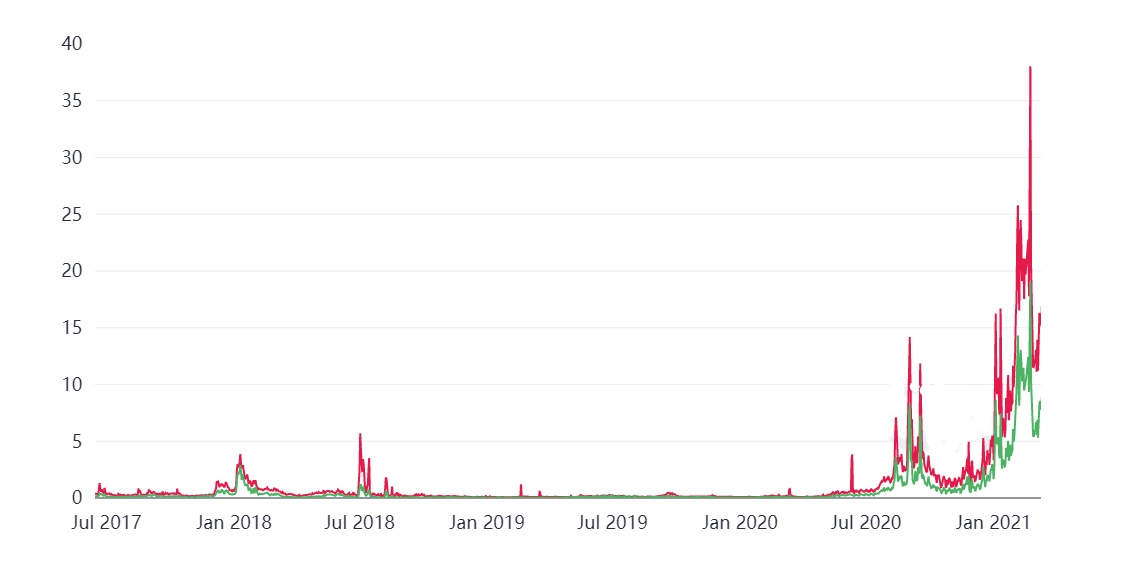
Source: COINMETRICS, OKEx Research Institute
image description
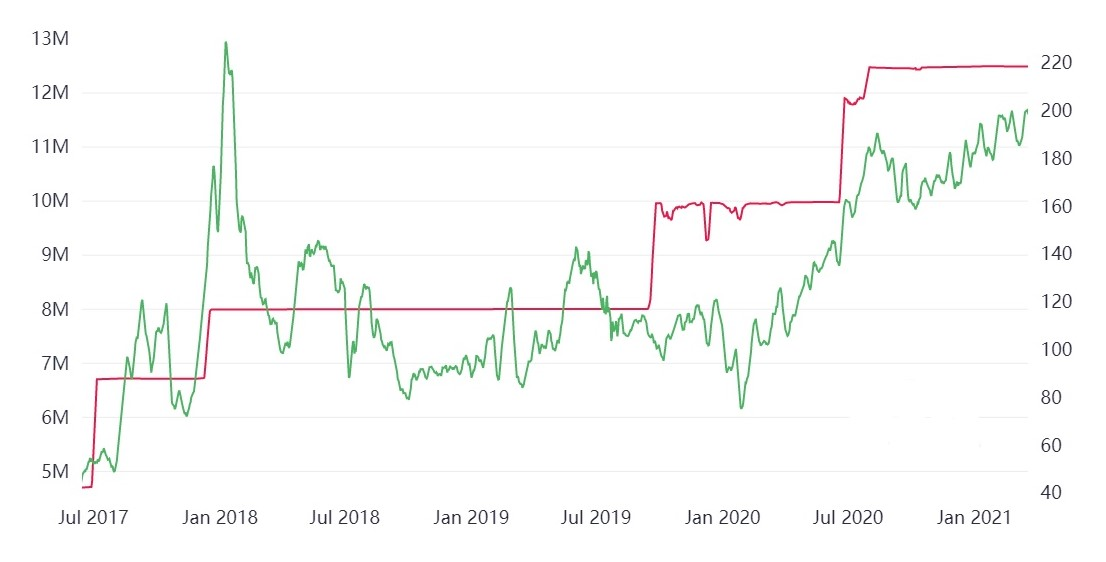
Source: COINMETRICS, OKEx Research Institute
The current gas fee scheme of Ethereum 1.0 is a simple bidding mechanism, also known as the first-price auction (first-price auction), that is, the user bids for the space of the block, and waits for the miners to choose the transaction for packaging. The bidding formula of Ethereum 1.0 is that the user pays the gas price for each transaction. At this time, the miners will sort the gas prices of the transactions in order of high and low, and choose the most profitable transactions to pack into the block. This method is very likely to bring Malicious bidding among users. In addition, when it comes to wallets, Ethereum 1.0 also faces many problems. For example, the Metamask wallet allows users to choose between slow, average and fast confirmation times, or manually set the gas price. Submitting a transaction with a default fee before a spike can end up having to wait a long time for the transaction to be confirmed, degrading the user experience.
secondary title
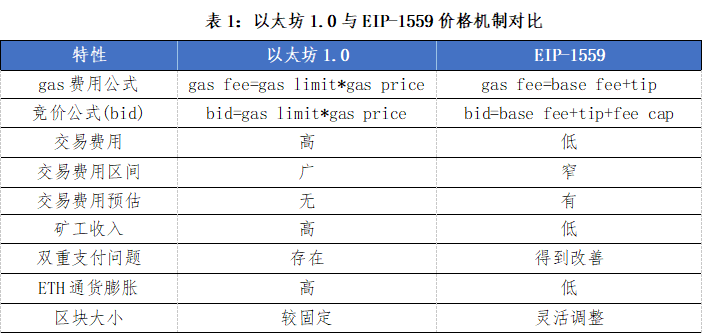
Source: OKEx Research Institute
2 Interpretation of EIP-1559 bidding formula
2.1 EIP-1559 base fee adjustment mechanism
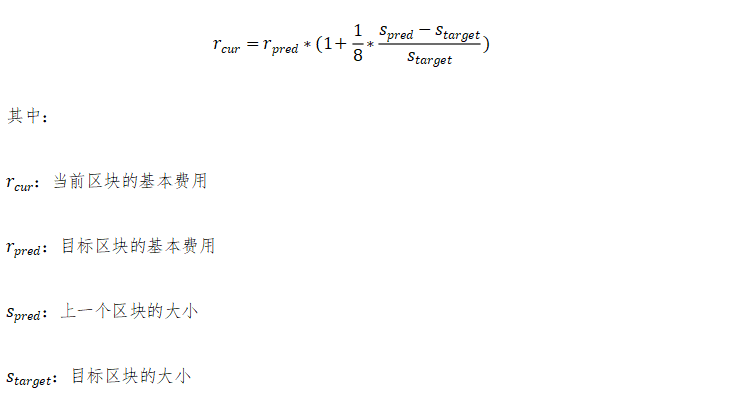 The base fee increases by 12.5% after the largest size block (i.e. a block twice as large as the target block) and decreases by 12.5% after an empty block. The base fee for an empty block following a max-size block is the previous base fee. An ideal base fee ensures that blocks are filled with the highest value transactions, and the base fee adjusts accordingly as demand changes. The base fee must be burned according to regulations, otherwise, miners are very likely to collude with off-chain users to simulate the existing price mechanism (first-price auction) on Ethereum.
2.2 EIP-1559 miner tip (tip) and fee cap (fee cap) adjustment mechanism
secondary title
3 Supply and demand model to see transaction costs
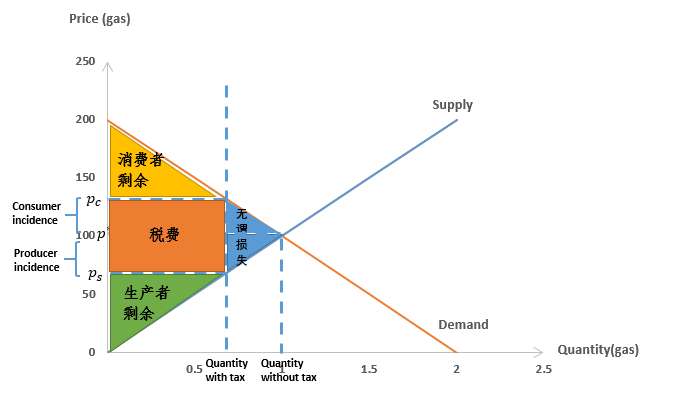
Let’s first briefly review income and deadweight loss in economics. Taxes will reduce the volume of transactions, causing the blue dotted line in the figure to move to the left, which will also reduce some trade gains. The decrease in consumer surplus is due to higher prices for buyers, and the decrease in producer surplus is due to lower prices for sellers, some of which is made up in the form of taxes. The blue portion of the figure represents the gain lost on transactions of units that are not traded due to the tax. These lost gains from trade are called deadweight losses. That is, the deadweight loss is the buyer's value minus the seller's cost of not being able to conduct an economic transaction due to taxes or other market disturbances.
Source: OKEx Research Institute
Source: OKEx Research Institute
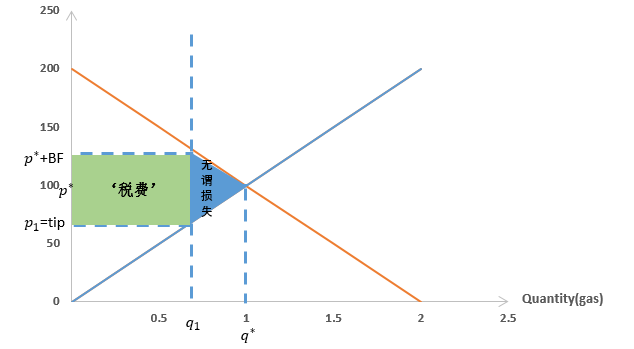
Now let’s look back at the second example of the EIP-1559 gas fee. We can see that the user submits a tip of 10 to the miner, but the miner only gets 5 in the end. The price difference in the middle can be understood as a consumption tax, as shown in Figure 4 The middle green part. The green part of the figure below is 10. When the user's demand for gas is , the price paid is ( ), and the miner's income is , that is, the miner's tip (tip). For any consumption tax, there must be a deadweight loss, that is, the surplus of the buyer and the seller is not enough to pay the tax, so the transaction does not happen at all, which is the blue part in the figure below, that is, EIP-1559 will reduce the supply and demand of gas.
Under the above circumstances, the fees to be paid by users are not reduced, but the income of miners is reduced. The reason is that the deadweight loss robs some of the consumer surplus and producer surplus. At this time, the user experience will not be very good. The best situation occurs at the equilibrium point, that is, the gas price is , the quantity demanded and supplied is , and the deadweight loss will disappear at this time.
image description
Source: Ethereum Enthusiast Community, OKEx Research Institute
image description
Source: Ethereum Enthusiast Community, OKEx Research Institute
image description
Source: Ethereum Enthusiast Community, OKEx Research Institute
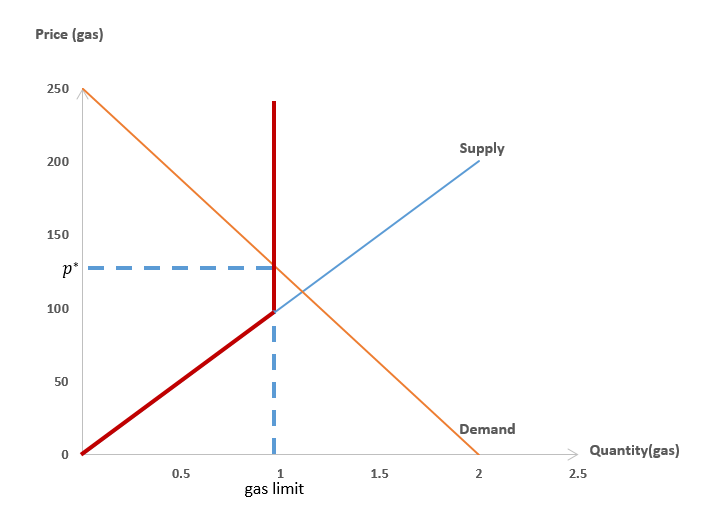
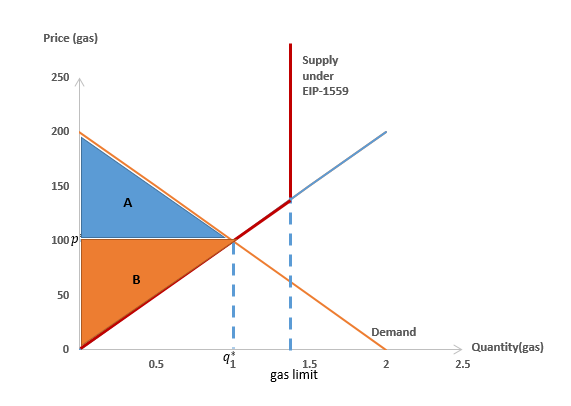
As shown in the figure above, the red line represents the supply curve of the miners, which means that the marginal price required by the miners to provide one more unit of gas is rising. However, when the supply curve reaches the gas limit of the block according to the 1559 agreement, no matter what the bid is, Miners can't supply more. The orange demand line represents diminishing marginal user bids for gas costs, as users will prioritize pressing needs and pay high prices to include them in blocks. The intersection point of the supply and demand curves is the equilibrium point, which means that the user's willingness to bid is consistent with the willingness of the miner to ask for the price. The corresponding gas price is , and the quantity is .
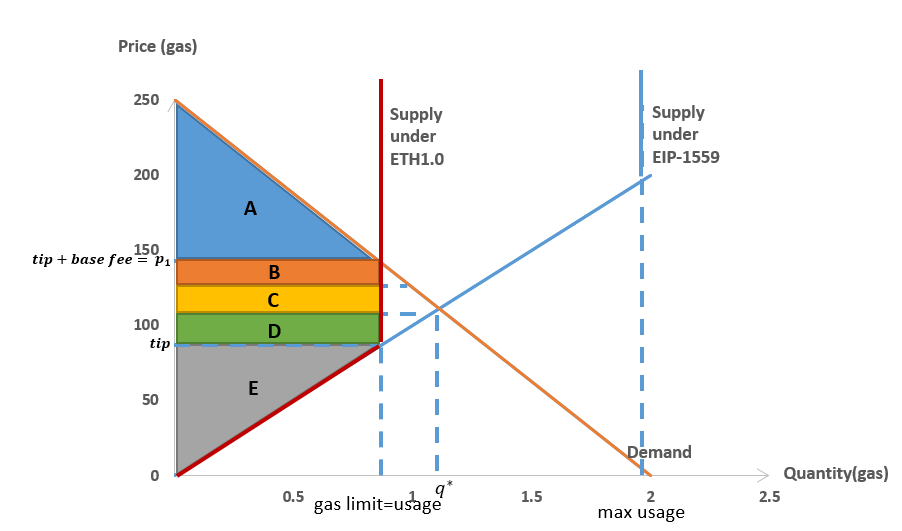
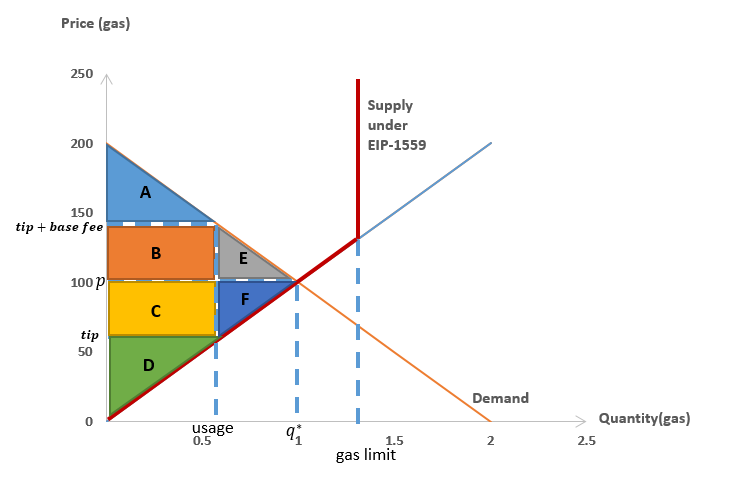
As shown in Figure 5, when the demand is low, it means that users are willing to pay less to include the transaction in the block, and the gas usage in market equilibrium is lower than the gas limit of the block; as shown in the figure As shown in 6, when the demand is strong, users need to pay higher prices to compete with other users to complete the transaction, and the gas supply of miners remains unchanged. Therefore, the gas usage at this time is equal to the gas usage on the line ( gas limit). The equilibrium price is the intersection of the supply and demand curves, ie.
image description
Source: Ethereum Enthusiast Community, OKEx Research Institute
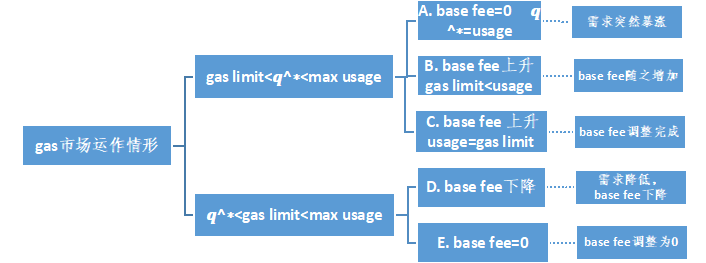
A. gas limit<actual gas usage (usage)=natural market equilibrium point ()<maximum gas usage (max usage),
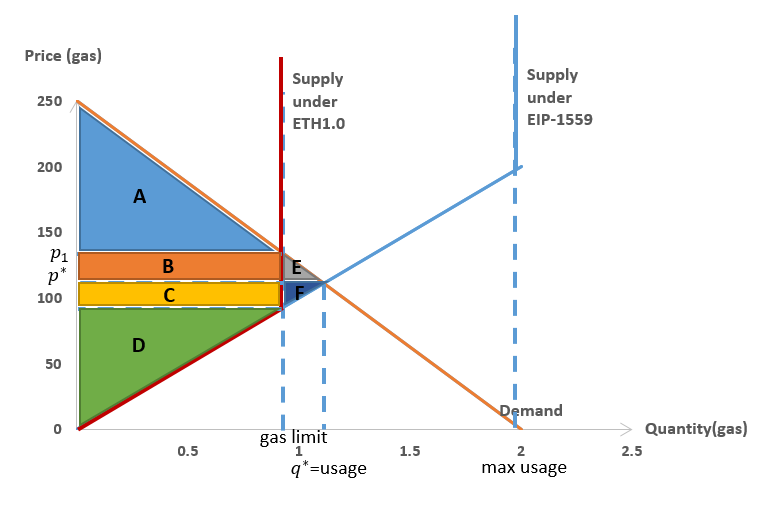
image description
Source: Ethereum Enthusiast Community, OKEx Research Institute
In the case of not implementing the EIP-1559 price mechanism, the gas supply is limited by the agreement and has a gas limit, and the supply curve is the red line in the above figure, which is the Supply under ETH1.0 line. At this time, the gas price paid by the user is, the miner’s income (producer’s surplus) is area B+C+D+ block reward, and the consumer’s surplus is area A.
In the case of implementing the EIP-1559 price mechanism, the block is scalable, and the maximum can reach the max usage point, and the supply curve is the blue line, which is the Supply under EIP-1559 line. When the base fee (base fee) is zero, the price can reach the equilibrium point, the gas consumption is , and the consumer surplus at this time is area A+B+E> area A, which is what the block scalability mechanism of EIP-1559 gives benefits for users. For miners, producer surplus is area C+D+F+ block reward, if and only if area F is greater than area B, miners will obtain more benefits under the price mechanism of EIP-1559 than the existing mechanism, At present, this seems unrealistic. From the perspective of the overall market, with the implementation of the EIP-1559 mechanism, the balance between supply and demand will be restored, the efficiency of resource allocation will increase, the social cost caused by market inefficiency will decrease, and deadweight loss will disappear.
image description
Source: Ethereum Enthusiast Community, OKEx Research Institute
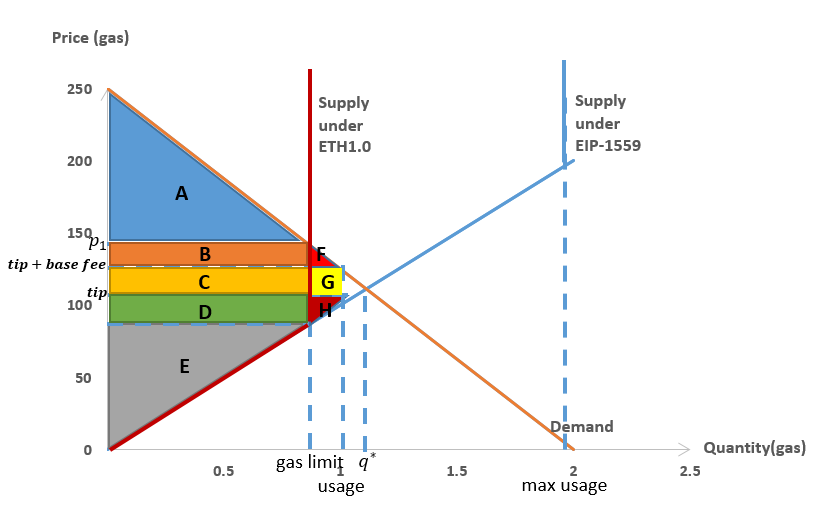
Next, let's look at the situation where the base fee (base fee) gradually increases. When the base fee (base fee) is the length of the vertical axis of area C or area G, the user pays tip (tip) + base fee (base fee), while the miner only gets the tip (tip), and the difference between The amount of tax that was siphoned off.
Without the implementation of EIP-1559, the miner's income (producer surplus) is still the area B+C+D+E+ block reward, and after the implementation of the 1559 price mechanism, the producer surplus becomes the area D+E+H+ Block Reward*. At this time, block reward * > block reward, because the burning of the base fee will increase the block reward. We assume that the surplus drawn by the 1559 price mechanism from miners and users, that is, the burned base fee, will be transferred to the value increase of block rewards without loss (of course, this is not consistent with the facts), which means that areas C and G It will be added to the miner's income, and the block reward * will also be changed back to the block reward. At this time, the miner's income (producer surplus) is the area C+D+E+G+H+block reward. Before and after the implementation of the 1559 mechanism, the increase or decrease of miners' income depends on the size of area B and area H.
Before and after the implementation of the EIP-1559 mechanism, user revenue (consumer surplus) increases from area A to area A+B+F, because users benefit from larger blocks.
image description
Source: Ethereum Enthusiast Community, OKEx Research Institute
When the base fee (base fee) is increased, the gas usage is equal to the target gas usage, the miner’s income is the region E+block reward*, and the remainder drawn by the base fee (tax system) is the region B+C+D, and the user’s consumer The rest is area A. Assuming that the surplus drawn by the 1559 price mechanism from miners and users, that is, the burned base fee, will be transferred to the value increase of block rewards without loss (of course, this is not consistent with the facts), and the producer surplus is area B+C +D+E+ block reward, consumer surplus remains unchanged.
image description
Source: Ethereum Enthusiast Community, OKEx Research Institute
When the user demand reaches the highest point and then falls, the corresponding gas usage is lower than the gas limit (gas limit), and at the same time lower than the market equilibrium point (), within the existing price mechanism, the miner's income is the area C+D+F+ area Block rewards, user income is area A+B+E. After the implementation of EIP-1559, when the base fee has not yet dropped to 0, the "tax" part consumed due to the burning of the base fee is area B+C, and the miner's income is area D+block reward*, or it can be said to be area B+C+D+ block reward. Before and after the implementation of EIP-1559, the increase in miners' income depends on the size of areas B and F. The user income is in area A, which is significantly lower than the existing price mechanism.
image description
Source: Ethereum Enthusiast Community, OKEx Research Institute
secondary title
4. Looking at the price mechanism of EIP-1559 from the perspective of game
Under the price mechanism of Ethereum 1.0, the user transaction fee mainly adopts the first bidding method, that is, whoever has the highest bid is more likely to have the transaction executed. There are two obvious disadvantages in such a transaction fee mechanism: first, users with urgent needs will be forced to bid with those users with relatively loose needs, resulting in the price of transaction fees only increasing; For the purpose of profit, create a large number of dust transactions to achieve the purpose of driving up transaction fees.
From a game point of view, in the auction mode of Ethereum 1.0, due to the lack of sufficient reference information during congestion, the cost estimation can only be made subjectively and vaguely. Users usually want to ensure that their transactions can be packaged and confirmed quickly , keep increasing your own gas fee to surpass other users who are waiting for packaging. In the same way, other users will also compete to increase the price, so that the result of repeated bidding among each other will lead to vicious competition, which will cause the gas fee to deviate from the normal range, resulting in the dilemma of high handling fees.
The emergence of EIP-1559 provides a prediction of gas costs, reduces the deviation of gas costs, and will theoretically solve the problem of high transaction fees. However, from another point of view, the rules of EIP-1559 can be said to put miners in a game theory "prisoner's dilemma", and each miner's behavior of maximizing his own mining income will increase the basic income (base fee) , and damage the income of other miners. During the specific implementation process, miners may not abide by the established distribution rules and incorporate false transactions into blocks. Since users have an obvious optimal bid: set a fee cap for the price of the transaction, and pay a tip as the marginal cost of the miner's gas fee, miners and users may raise their prices through off-chain alliances. common utility. In other words, the prisoner's dilemma of this repeated game in the real world will prompt miners to control the base fee in the form of a monopoly alliance, and even deliberately do not quote the increased base fee dug out by miners outside the alliance. block. This will be extremely detrimental to the long-term development of Ethereum.
To sum up, when demand soars, users will get more benefits because EIP-1559 allows miners to produce blocks that are twice as large. When the market demand falls back and the base fee has not yet reached 0, users must pay a higher fee than the previous fee. Compared with the existing price mechanism, the income of miners has been reduced from beginning to end. Therefore, Bitfly, the parent company of Ethermine mining pool, announced that it will compensate miners for the reduced mining rewards brought by EIP-1559. At the same time, if the competition for block space remains fierce, fees will inevitably increase; in addition, the implementation of Proposal 1559 may also prompt miners to control the base fee in the form of a monopoly alliance, so the implementation of EIP-1559 does not It cannot effectively reduce the gas cost on Ethereum. At present, it seems that the 1559 price mechanism can only help to improve the gas cost difference and predict the gas cost within a reasonable range. In the long run, 1559 is just a way to transition from Ethereum 1.0 to Ethereum 2.0, and the real reduction of transaction fees still needs to look forward to Ethereum 2.0.
Literature reference:
1. "Opinion | EIP-1559 is futile and of no benefit", Ethereum enthusiast community
2. 《Transaction Fee Mechanism Design for the Ethereum Blockchain:An Economic Analysis of EIP-1559》,Tim Roughgarden,January 2020





