BTC
ETH
HTX
SOL
BNB
View Market
简中
繁中
English
日本語
한국어
ภาษาไทย
Tiếng Việt

ETH Weekly Report | Meitu purchased 16,000 Ethereum again; the upgrade of Ethereum Shanghai may start in October at the earliest (3.15-3.21)

秦晓峰
Odaily资深作者
@QinXiaofeng888
This article is about 5164 words, reading the full article takes about 8 minutes
Developers: Miners should have participated in discussions on EIP-1559 a year ago.
AI Summary
Expand
Developers: Miners should have participated in discussions on EIP-1559 a year ago.

Author | Qin Xiaofeng

Produced | Odaily

Produced | Odaily
1. Overall overview

1. Overall overview

Second, the secondary market

Second, the secondary market

1. Spot market

image description
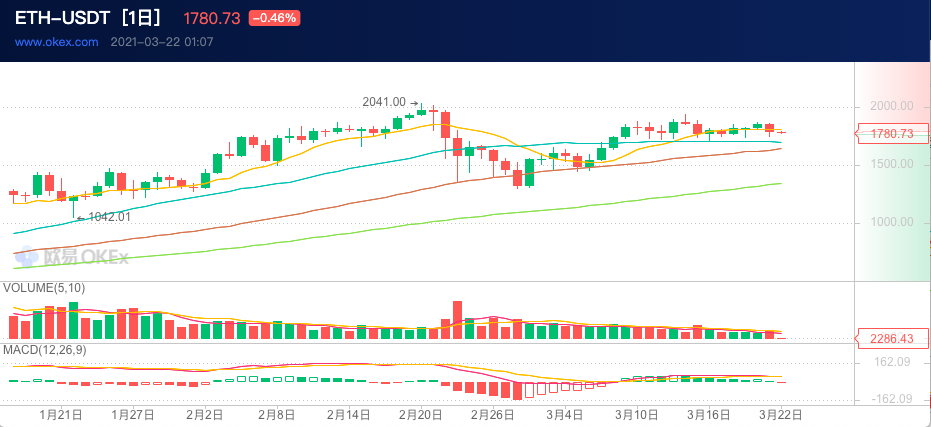
(ETH daily chart, picture from OKEx)

(ETH daily chart, picture from OKEx)

The ETH daily chart shows that the price is oscillating around the 30-day moving average; the resistance level is the $2,000 mark and the previous high of $2,041; the support level is the 30-day moving average ($1,700) and the 60-day moving average ($1,650); in the coming week, It is expected that ETH will still fluctuate or pull back slightly.                                                                 

2. Fund flow

(data from Tokenview)                                     

(data from Tokenview)

Tokenview dataIt shows that the number of transfers on the chain dropped sharply last week, and the number of large-value transfers of "above 5,000 ETH" and "above 10,000 ETH" decreased by 25% and 22% month-on-month respectively; but the number of transfers of "above 50,000 ETH" increased by 125% month-on-month , the frequency of giant whale account transactions has increased significantly.

OKlink data1. Technological progress

3. Ecology and technology

1. Technological progress

(1)EthereumEthereum

Core developer meeting progress: London upgrade will still implement EIP-1559, auxiliary EIP is still under decision

Ethereum core developers met on March 19 to discuss the EIP related to the London upgrade. Edson Ayllon, project manager of Ethereum Cat Shepherd and contributor to the Ethereum ecosystem, updated the discussion results of the meeting and said that the London upgrade in July will still implement EIP-1559, and the auxiliary EIP is still being decided. On March 16, the Ethereum client OpenEthereum has begun to deploy the implementation of EIP-1559.

(2) V God announced the "polynomial commitment" diagram, which is regarded as the key to the future upgrade of Ethereum

V God recently issued a document announcing the "polynomial commitments" (polynomial commitments) method diagram. Polynomial commitments are being considered as a way to verify the state of the network at a low computational cost. It is related to the future upgrade of Halo and Ethereum, which can reduce the size of the witness data (Witnesses) of the stateless Ethereum client to close to zero and achieve better scalability. V God said that the Merkle root of the current block data (such as the shard block of Ethereum 2.0) can be replaced with a polynomial commitment, and the Merkle branches (Merkle branches) can be replaced with open proofs. This will bring two benefits: data availability checks will be easy and there will be no fraud; it will provide benefits for multiple accesses of block data.

At the same time, Buterin has said that polynomial commitment encryption technology is the key to stateless clients, but it is far from perfect. The main advantage of polynomial commitments is that it is much easier to generate complex proofs due to their mathematical structure. In addition, researcher Danny Ryan said that the Ethereum 2.0 research team is now leaning towards using polynomial commitments to reduce the data used for each calculation on the network. "Polynomial commitments could be the big breakthrough we've been looking for," Ryan said.

(3) The upgrade of Ethereum Shanghai may start in October at the earliest

The Shanghai upgrade is an Ethereum hard fork upgrade following the London upgrade and may contain EIPs that did not make it into the London upgrade, as the London upgrade will only make minor changes (delaying the difficulty bomb and EIP-1559) to minimize the complexity of the upgrade sex. Shanghai upgrade EIP may include 3298 (elimination of gas refund for SSTORE and SELFDESTRUCT) or 3322 (effective gas refund).

2. Voice of the Community

2. Voice of the Community

(1) Tim Beiko, developer of Ethereum: Miners should have participated in the discussion of EIP-1559 a year ago

In response to Twitter netizens, miners are stakeholders in Ethereum and have not received enough attention. Although EIP1559 directly affected them, their opinions were not respected. If miners felt they were being heard, they would not have planned a 51-hour hashrate demonstration against EIP-1559.

Ethereum developer Tim Beiko replied that there was a strong disapproval that miners were not being listened to and respected. Some developers/researchers have spent weeks answering their questions, refuting some of their objections, and helping them build an EIP. Almost every core developer is aware that after EIP-1559, the hash rate may drop significantly, but they don't see it as a big problem like miners. A big part of the reason miners "feel unheard" is that they didn't get involved until the very end. The best time for miners to get involved would have been 1 year ago when 1559 was under very active development. Any proposal from miners will, by its nature, be contentious, and I have a hard time seeing it assess people's sentiment before the London hard fork.

(2) Ethereum developers put forward the EIP-3382 proposal to fix the block gas limit without being restricted by miners

Ethereum developer Philippe Castonguay proposed the EIP-3382 proposal, which proposes to hardcode the block gas limit to 12,500,000 gas per block. Update the block verification rules, if the Gas limit header field is not equal to 12,500,000, the block is invalid. Philippe Castonguay said that the block gas gas limit is hard-coded because it is a key parameter that requires a consensus on the network and is not subject to miners. Philippe Castonguay believes that both PoW and PoS designs of Ethereum assume that block producers (miners) are financially rational, but they do not assume that miners are benevolent. However, there is one exception, and that is when miners choose the gas limit for a block, it assumes that the miner cares about the long-term health and decentralization of the chain. In fact, the block gas limit is the only parameter in Ethereum that is not determined by node consensus, but chosen by miners. This decision was initially made to allow for emergency changes to block gas limits if necessary. Significantly increasing or decreasing this parameter may have serious consequences, which may be undesirable. Therefore, this is a critical parameter that requires node consensus to avoid any sudden harmful changes imposed by a small number of participants on the rest of the network.

(3) Ethereum developers propose to solve the ETH state scale problem to promote the mass adoption of ETH

Ethereum developer Lakshman Sankar said that Ethereum has developed a lot in terms of state size (state size), but it has not attracted widespread attention, but in order to achieve mass adoption, it is a major problem that needs to be solved.

The "state" of Ethereum consists of all the data needed to process new transactions. Every node needs to store this data to validate the chain. With the explosive growth of NFT and DeFi, the scale of this data is growing at an increasingly faster rate. If this continues, most people will not be able to participate in validating the network. The key insight motivating the solution is that ETH does not charge users for storage "rent". Now the cost of storing ETH (via gas) is the STORE instruction in ETH. This is bad economically. The cost of storing nodes is infinite (assuming ETH exists forever), but users only need to pay once. The current solution to the state problem is: 1. State expires; 2. Weak stateless.

(4) Ethereum developers proposed to give priority to the merger of ETH2.0 after the London hard fork upgrade

According to previous news, the core developers of Ethereum are developing the minimum technical specifications for the merger of ETH2.0. Ethereum Foundation researcher and developer Danny Ryan and Mikhail Kalinin of the ethereum 2.0 client Teku are exploring creating a deliverable to save some functionality for later use. Mikhail Kalinin proposed an "executable beacon chain" (proposed at the end of November 2020) that would simplify the complexity of the original design. Kalinin has posted a pull request on GitHub to involve developers in implementing the proposal. At the same time, Vitalik hopes to speed up the process of merging Eth1 and Eth2.

3. Project trends

3. Project trends

(1) Aztec, the Ethereum privacy technology solution, launched Aztec 2.0 Rollup, and the ETH privacy Rollup service has been enabled

Aztec, the Ethereum privacy technology solution, announced the official launch of Aztec 2.0 Rollup on the main network. Currently, the privacy Rollup service and block browser for ETH have been enabled, and ERC-20 tokens will be added in the next few weeks. Aztec 3.0 Alpha version of the Noir private smart contract. Noir is Aztec's Rust formal language that will implement programmable privacy protection in PLONK Rollup. Aztec reminded that the beta version is currently deployed to the mainnet, and ETH can now be submitted to the Aztec Rollup contract, and the following operations can be performed, including Shield, private sending, Unshield, and emergency unlocking. In addition, Aztec is about to launch Aztec 2.1+ version, which will introduce new assets such as WBTC, BAT, AAVE, and DAI to Rollup in the next few weeks.

(2) The Ethermine mining pool launches the MEV beta plan, which will distribute 80% of the MEV income to miners as EIP-1559 compensation

At the same time, Bitfly stated that the objection to EIP-1559 is due to security concerns. These security concerns can be alleviated with EIP-3368. Regardless of the outcome of EIP-1559 and EIP-3368, Bitfly will never support or participate in any hostile actions by miners against the Ethereum network.

4. Borrowing

Defipulse4. Borrowing

5. Mining

5. Mining

image description

etherchain.orgThe data shows that the average computing power increased by 5.57% month-on-month, temporarily reported as 464TH/s; the average mining difficulty increased by 5.23% month-on-month, reaching 5893 T; the activity on the chain increased by 3% month-on-month; network congestion continued to intensify, and the total mining revenue up 9%.

4. News

4. News

(1) Nvidia RTX 3060 can already mine Ethereum at full speed, with a computing power of about 46MH/s

Some user tests have found that the RTX 3060, which was previously restricted by Nvidia for mining Ethereum, can achieve full-speed mining after flashing into the recently released GeForce developer driver 470.05. It is reported that the RTX 3060 needs to be plugged into a display output, and at the same time, it needs to use a channel above PCIe x8 to realize full-speed mining. According to the test, the computing power of RTX 3060 full-speed Ethereum mining is about 46 MH/s. (drive home)

(2) Kraken users have pledged over 500,000 ETH

Kraken announced last Tuesday that Kraken users have staked more than 500,000 ETH as the Ethereum community continues to support the transition to Ethereum 2.0. (Cointelegraph)

(3) Meitu once again spent $50 million to purchase 16,000 Ethereum and 386 Bitcoin

ETH
Welcome to Join Odaily Official Community
