


Ouyi OKEx Research Institute: Ethereum Midfield Battle - Rollup's Reality and Falsehood


Since the birth of Ethereum, its low transaction processing capacity has caused frequent blockages in the Ethereum network, and the high Gas fee has severely limited the development of the Ethereum ecosystem. For this reason, the expansion of Ethereum has always been concerned by the market. Under the background of the explosion of DeFi, Layer 2 expansion solutions such as side chains, state channels, and Plasma cannot meet the requirements of the market. Rollup has become the darling of the times.
Of course, Rollup is not a pure Layer 2 solution, but more like a mixture of Layer 1 and Layer 2: data is calculated off-chain, packed and compressed, and then stored on-chain. In addition, in order to solve the authenticity and validity of data and ensure the security of assets, Rollup has launched ZK-Rollup, which uses "validity proof", and Optimistic Rollup, which uses Plasma's "fraud proof".
In general, ZK-Rollup and Optimistic Rollup have their own advantages and disadvantages. ZK-Rollup is suitable for non-contract fields such as payment and trading, with low cost and fast speed; and Optimistic Rollup is currently suitable for smart contract applications due to the existence of OVM; However, as ZK-Rollup projects launch Turing-complete EVM, ZK-Rollup may replace Optimistic Rollup in the future.
However, the upper limit of Rollup’s capacity expansion depends on the upper limit of block Gas consumption, so it can only be a short-to-medium-term expansion plan for Ethereum in the future to solve the urgent needs of the DeFi ecosystem. In the long run, it is necessary to fundamentally solve the scalability of Ethereum The problem also depends on the smooth realization of Ethereum 2.0 sharding technology.
However, it is worth noting that the Rollup protocol can capture value and be economically sustainable. It is foreseeable that the tokens issued by the Rollup project will have huge investment potential.
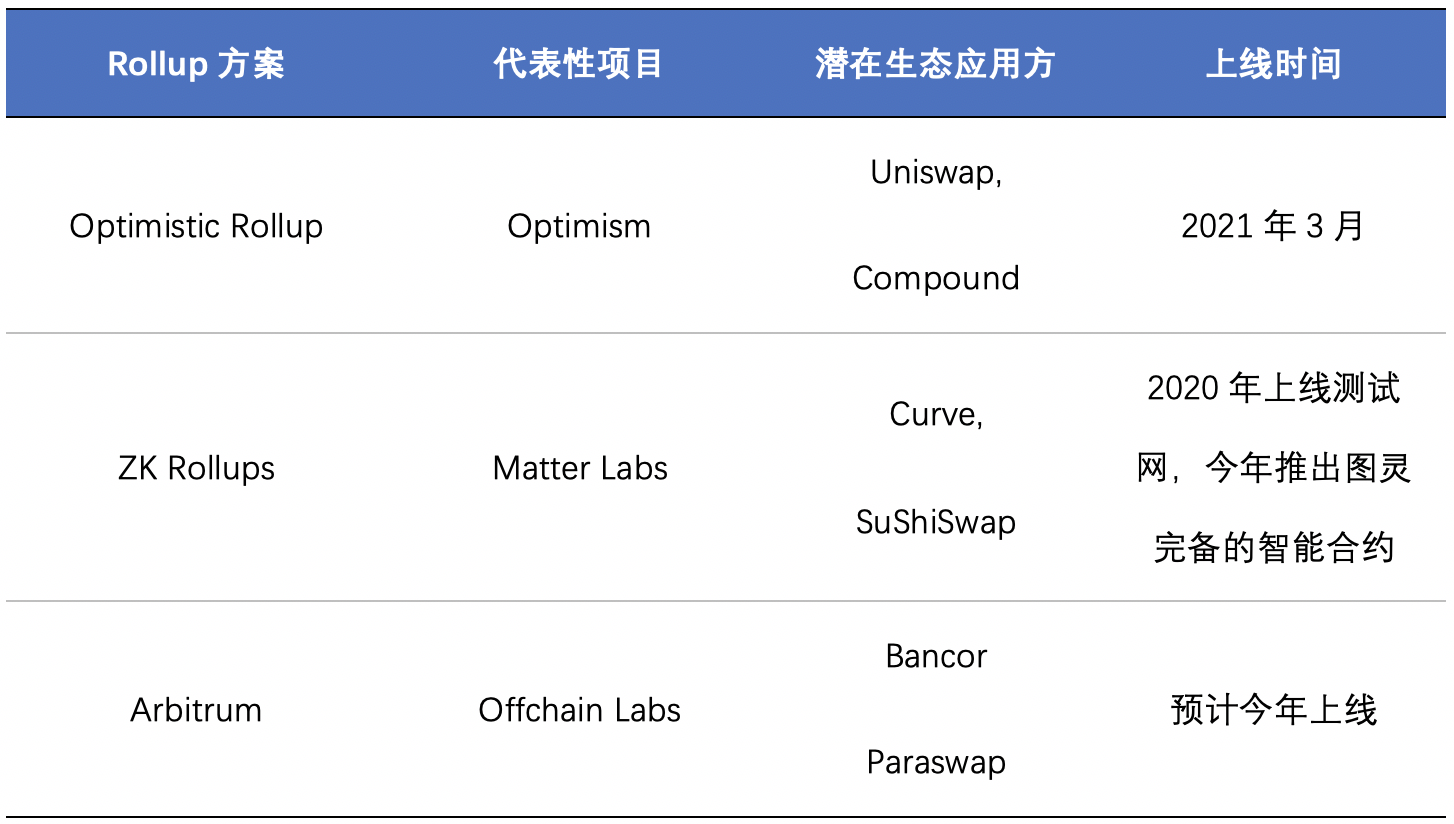
After nearly two years of dormancy, Ethereum’s Rollup expansion plan has finally come to fruition: In February this year, Optimism announced the completion of the A round of financing and will launch the main network in March; ZkSync from Matter Labs, Its main network was also launched last year, and will launch a smart contract that supports Turing completeness this year; in addition, another Rollup solution that has attracted the attention of the industry --- Arbitrum, will also be launched on the main network this year.
Source: OKEx Research Institute
Source: OKEx Research Institute
At the end of the night for Rollup, the market is also full of expectations and pursuit of it. But from the actual situation, many investors and Ethereum users do not have a clear understanding of Rollup, but a consensus has been reached on the whole: Rollup is very important and is the future of Ethereum.
The first half of this sentence is correct, Rollup is indeed important to the current Ethereum; but the second half is inaccurate, Rollup is not the future of Ethereum. More precisely, Rollup only represents Ethereum’s short-to-medium-term expansion plan. It is a halftime battle for Ethereum to solve the problem of network congestion. In the long run, to fundamentally solve the scalability problem of Ethereum, we must rely on Ethereum 2.0 The smooth implementation of sharding technology.
secondary title
1. The expansion war of Ethereum and the rise of Rollup
image description
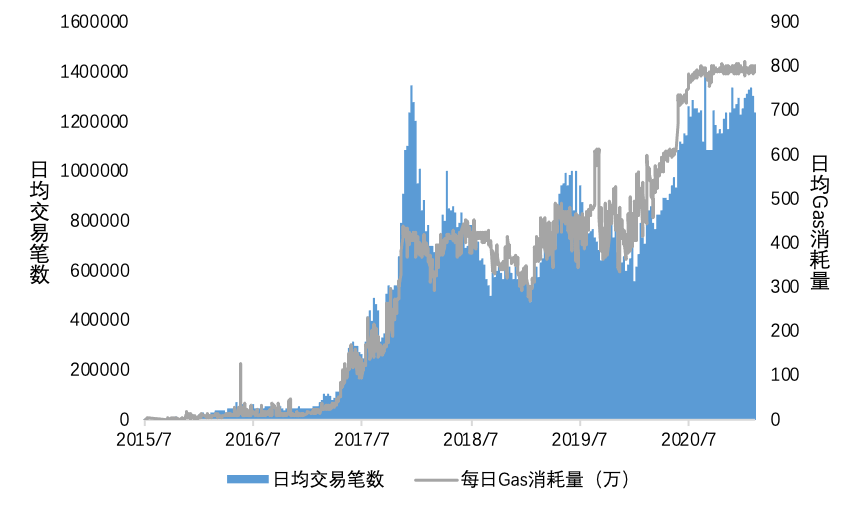
image description
Source: Etherscan, OKEx Research Institute
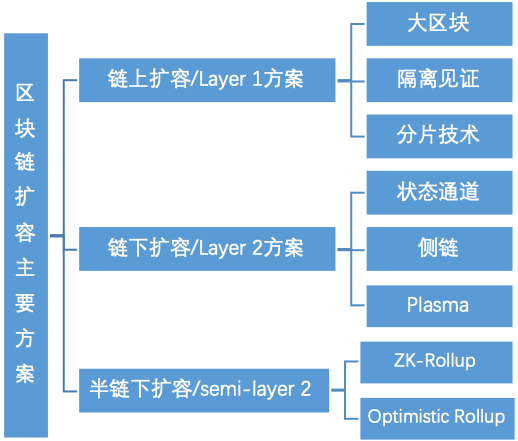
Solving the congestion of the blockchain network and improving the scalability of the public chain have gradually become the focus of the industry. Various blockchain expansion schemes are also coming, mainly including two categories:
The on-chain expansion scheme, also called the Layer 1 scheme, mainly achieves expansion by increasing the transaction capacity of the blockchain itself. Common Layer1 solutions include increasing block capacity (such as BCH using a large block with a capacity of 32M), isolated witness (BTC, which separates digital signatures from transaction data, and changes the original block structure to achieve expansion), fragmentation technology (Ether Square 2.0, divide the state and history of the main chain into different shards to achieve expansion).
image description
Source: OKEx Research Institute
Source: OKEx Research Institute
image description
Source: OKEx Research Institute
Source: OKEx Research Institute
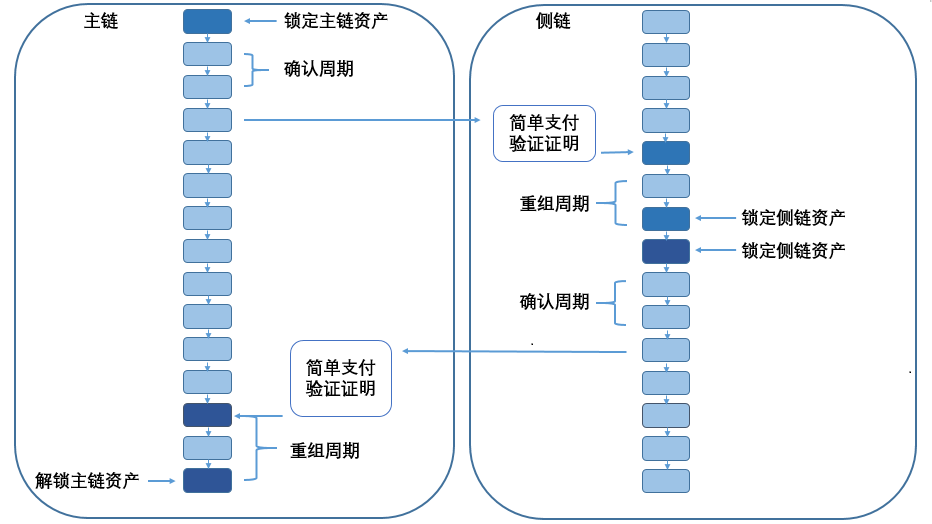
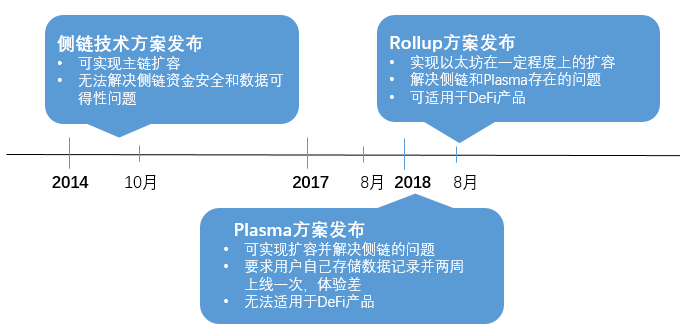
In order to solve the problems existing in the side chain and realize the expansion of Ethereum, Vitalik, the founder of Ethereum, launched a Layer 2 expansion solution called "Plasma" in 2017. The special feature of Plasma lies in the design of a fraud proof mechanism: Plasma sends specific underlying data to the user for safekeeping, which solves the problem of data availability; in addition, Plasma has an "exit period" design, even if hackers obtain side When trying to withdraw the control of the chain and try to withdraw, any user can submit evidence to challenge within the "exit period". If the challenge is successful, no one can withdraw the asset, and the operator will also be fined, thus ensuring The authenticity, validity and accuracy of the data solve the problem of financial security.
However, Plasma solves the problem of side chains, but creates new problems: first, users must go online every two weeks to monitor the Plasma chain, otherwise the "exit period" is missed, and hackers can withdraw assets; , users must save the underlying transaction data by themselves to ensure the availability of data, but it brings huge storage costs to users. Therefore, Plasma is not friendly to users, and the experience is extremely poor. In the context of the big bear market in 2018, the Plasma solution that was once based on the high hopes of the Ethereum community was gradually abandoned.
image description
Source: OKEx Research Institute
Source: OKEx Research Institute
Similarly, state channels also have the problems faced by sidechains and Plasma: state channels cannot represent objects that do not logically have clear owners (such as Uniswap), and require objects to have clear asset owners.
secondary title
2. Analysis of Rollup principle
Before analyzing Rollup, we might as well understand the expansion method of Plasma: under the chain, the Plasma operator will aggregate the transactions waiting for batch processing to generate a Merkle Tree (Merkle Tree), each leaf in the tree can represent a transaction The information of the transaction asset, if there is no transaction, the leaf value is 0. Subsequently, Plasma sends the root of the Merkle tree to the main chain, and at the same time sends the branch of the Merkle tree to the user for safekeeping.
image description
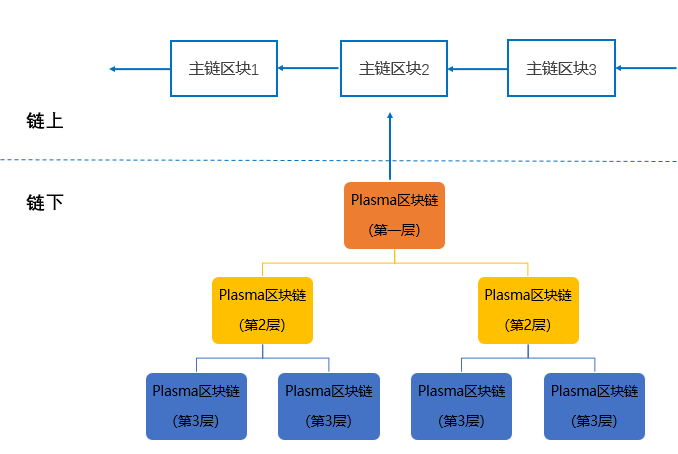
image description
Source: Plasma white paper, OKEx Research Institute
But as mentioned earlier, users save specific transaction information off-chain, which discounts data availability and is not suitable for DeFi applications. To this end, the Ethereum community has proposed a new solution: compress transaction data and put it on the chain, which is the Rollup (aggregation) solution.
Specifically, Rollup compresses transaction data into a Merkle tree and stores it on the chain; at the same time, it saves the root (state root) of the Merkle tree in the smart contract. The Rollup operator can publish a batch of summary transactions (Batch), which is a compressed transaction set, and includes the previous state root and the new state root (the new Merkle tree root after processing the transaction). The smart contract checks and updates the state root, thereby realizing the transfer of assets.
image description
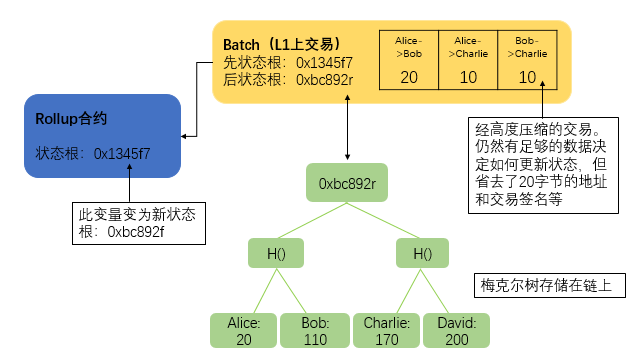
image description
Source: Vitalik. An Incomplete Guide to Rollups, OKEx Research Institute
Using an image metaphor, now we want to save a lot of movies, Plasma is similar to how we store movies on the computer, and then only save a directory file on the U disk, according to the guidelines of this directory file, we can easily find any movie The location of the movie in the computer; and the Rollup method is to compress the movie first, and then save it all to the U disk. In this way, we can store more movies in the U disk.
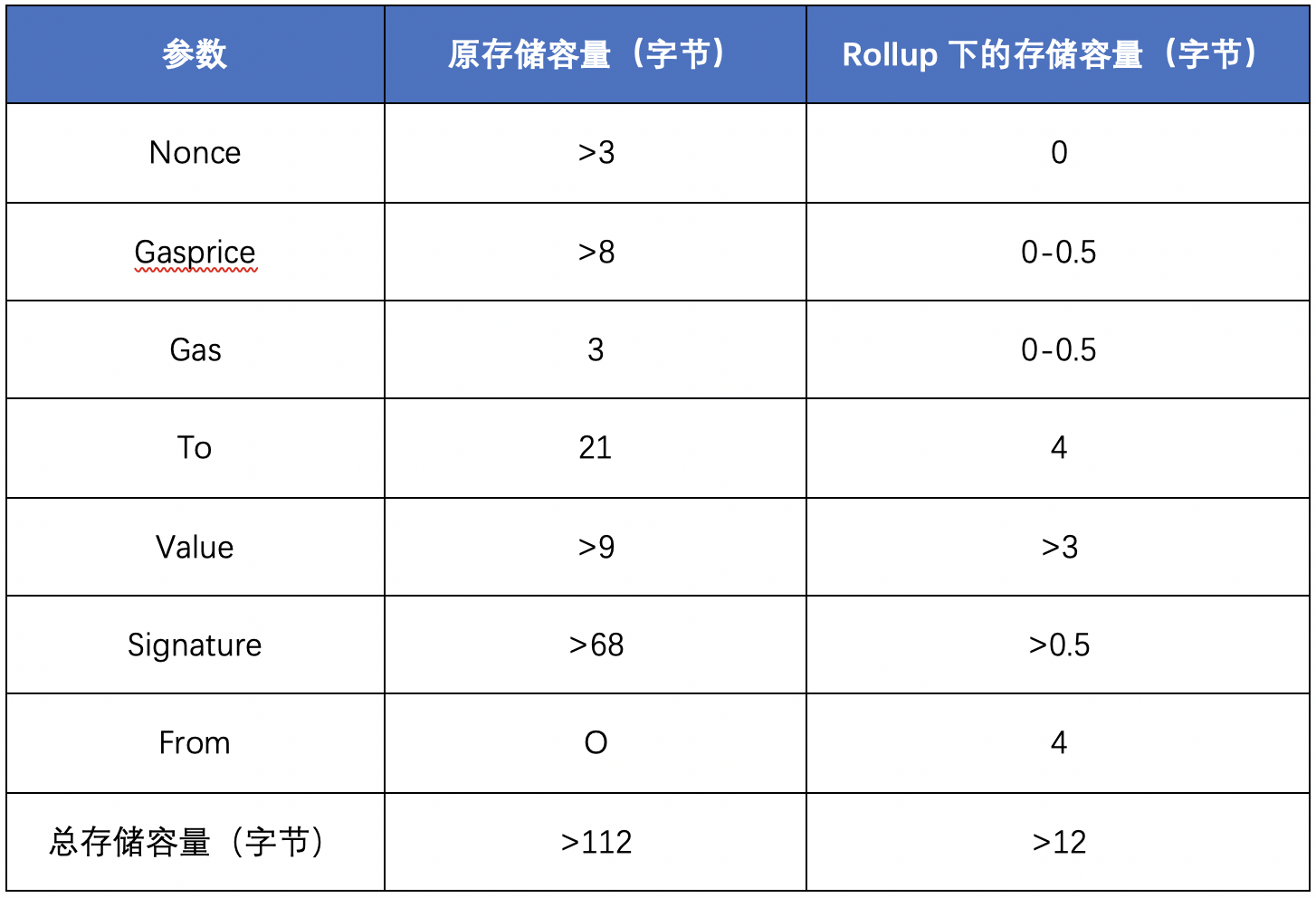
So how does Rollup achieve compression? ---It is mainly to compress the parameters of the transaction, mainly including Nonce, Gasprice, Gas, To, Value, Signature, as shown in the following table:
image description
Source: Vitalik. An Incomplete Guide to Rollups, OKEx Research Institute
In the past, a transaction required 112 bytes of storage space, but now it only requires 12 bytes of space, and one byte costs about 16 Gas; while on Ethereum, the upper limit of Gas is 12.5 million, and we assume that Rollup will cost 50 10,000 Gas, then on Rollup, its transaction processing capacity is:
(Block Gas consumption limit – Rollup Gas consumption) / Gas consumption per byte / Number of bytes in a transaction / Block generation time = (12,500,000 – 500,000) / 16 / 12 /14 = 4464 transactions per second
At present, a transfer on Ethereum needs to consume about 21,000 Gas, which means that if all of it is used for transfer, then the maximum transaction processing capacity of Ethereum is: the upper limit of block Gas consumption / single transfer Gas consumption / block generation time = 12,500,000 / 21,000 /13 = 45 transactions/second
This means that the TPS of Rollup in the transfer scenario has decreased by 100 times. Similarly, according to Vitalik's calculations, in the ERC20 transfer and Uniswap application scenarios, the Ethereum TPS can be expanded by 100-400 times under the same conditions.
secondary title
3. ZK-Rollup VS Optimistic Rollup
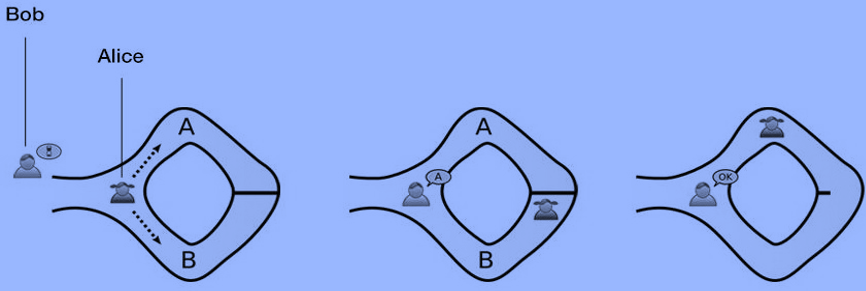
Zero Knowledge Proof (ZKP)
"Zero Knowledge Proof (ZKP)"Proposed by S.Goldwasser, S.Micali and C.Rackoff in the early 1980s, it means that the prover can convince the verifier that a certain assertion is correct without providing any useful information to the verifier.
image description
Source: OKEx Research Institute
Source: OKEx Research Institute
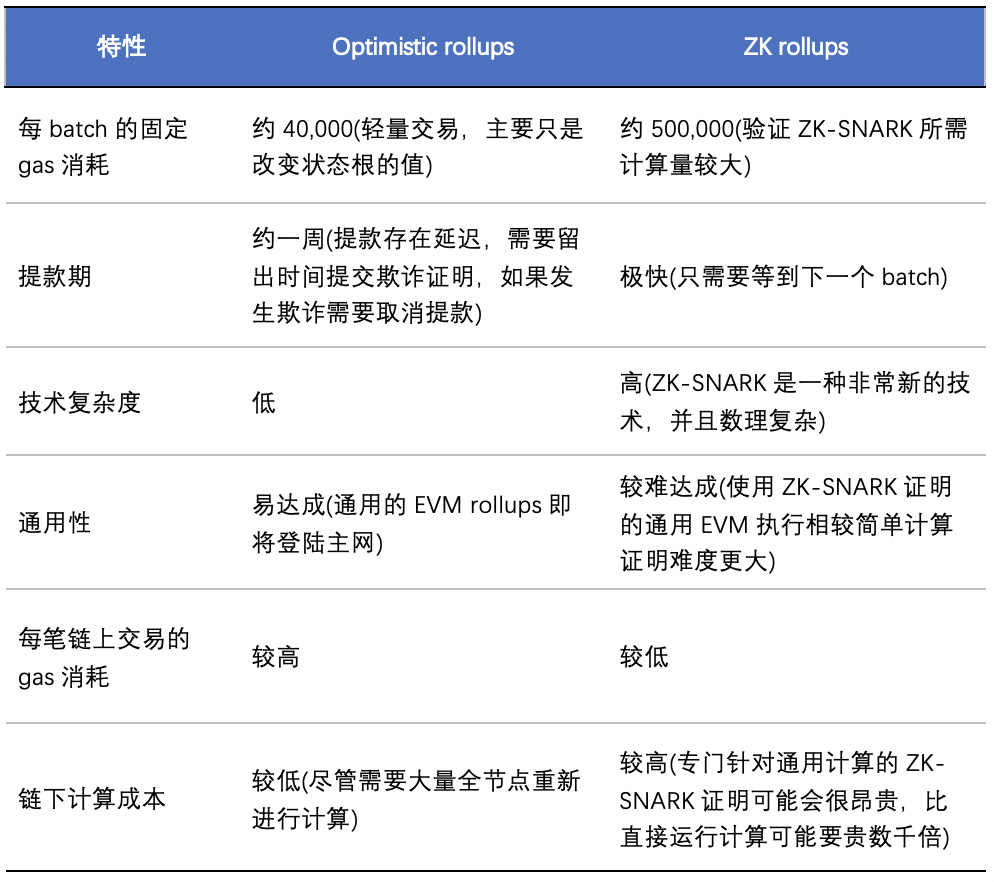
From the above we can see that ZKP has computational asymmetry. In the ZK-Rollup scheme, the Rollup operator invests a lot of resources to perform ZK-SNARK calculations and put them in a summary transaction (batch), while the smart contract (verifier) can quickly and cost-effectively prove transaction security. Therefore, ZK-Rollup has many advantages: it can verify the authenticity of data concisely and quickly while protecting privacy; but its disadvantages are large amount of calculation, high technical difficulty and difficulty in supporting virtual machines.
In the previous Plasma solution, we have introduced the "fraud proof" mechanism designed by it, which can realize the authenticity, validity and accuracy of transaction data and ensure the security of assets. Optimistic Rollups follow exactly this mechanism: this type of Rollup keeps track of all historical state roots and the hash value of each batch. If anyone discovers that the post-state root of a batch is incorrect, they can post a proof to the blockchain that the batch was miscalculated. The smart contract verifies the proof and rolls back the batch and subsequent batches.
Optimistic chose Plasma's fraud proof mechanism, which means that there is a long "exit period" (about a week) like Plasma, which greatly reduces the efficiency of capital utilization, but the good news is that as the DeFi ecosystem matures, There can be a large number of liquidity providers to provide funds for users during the "exit period", which can effectively solve the problem of fund utilization offset. In addition, the most important thing is that Optimistic Rollup also inherits Plasma's OVM, which means that smart contracts compatible with Ethereum EVM can be deployed on the Optimistic Rollup network, which is especially important for DeFi.
image description
Source: Vitalik. An Incomplete Guide to Rollups, OKEx Research Institute
secondary title
4. Rollup's future and wealth opportunities
From the above we can see that compared to other Layer 2 solutions, Rollup can better guarantee data security and data availability, but is Rollup really the future of Ethereum?
No, it can be seen from the expansion plan of Rollup that the upper limit of block Gas consumption is the upper limit of the Rollup plan. This is similar to taking the subway during the morning rush hour. In order to make the subway car (block) hold more people, we squeeze more people into the car (compression). However, no matter how compressed, there is an upper limit. With the continuous development of blockchain applications in the future, will we only be satisfied with a maximum expansion of 100 times? So in the long run, the future of Ethereum expansion still depends on the smooth realization of Ethereum 2.0 sharding technology.
However, according to the official plan of Ethereum, the realization of Ethereum 2.0 sharding may have to wait until 2030. But even now, due to the popularity of DeFi, Ethereum is already overcrowded and the gas fee is high. Layer 2 solutions such as state channels and Plasma a few years ago cannot meet the requirements of DeFi, and sharding technology is a distant goal. It is precisely because "the past cannot be persuaded, and the coming cannot be chased", Rollup has naturally become the best solution to deal with Ethereum's expansion plan in the short and medium term, and has become a midfielder towards Ethereum 2.0.
Of course, another reason why Vitalik promotes Rollup is that the Rollup protocol can capture value and is economically sustainable.
Let’s talk about the economic value first. Rollup can alleviate the congestion of Ethereum and reduce the gas fee. Part of the saved cost can be converted into the revenue of the Rollup agreement (such as fees and MEV[1]way) and be economically sustainable.
So why can Rollup capture value? This is related to the particularity of Rollup: the data is placed on the main chain, and only the data calculation is performed off the chain. This hybrid solution between Layer 1 and Layer 2 makes Rollup a special Dapp application on the main chain. Therefore, the Rollup project can issue tokens based on the Rollup protocol on the main chain, and the value of the protocol can be captured through tokens.
It is foreseeable that after the explosion of Rollup in the next few months, there will be many Rollup project tokens issued, and those projects that are willing to attach the economic value of the protocol to the tokens will have great investment potential.
[1]Note: MEV is miner extractable value, which refers to a measure of profit earned by miners (or verifiers, sorters, etc.) through the ability to arbitrarily include, exclude or reorder transactions in the blocks they produce.





