






How does Soteria, a mutual insurance platform on BSC, escort DeFi?


Author | Qin Xiaofeng
Editor | Hao Fangzhou
Produced | Odaily
Author | Qin Xiaofeng
Editor | Hao Fangzhou
Produced | Odaily
In the development of decentralized finance (DeFi), there are always problems such as hacker attacks and contract loopholes.
In order to reduce project losses, DeFi insurance came into being.
It is worth noting that at present, most insurance projects still choose Ethereum as the main battlefield, and most other public chain ecosystems are in the embarrassing situation of "no insurance". But this is also an opportunity for emerging insurance projects. By seizing other public chain markets, they can effectively gain a first-mover advantage.
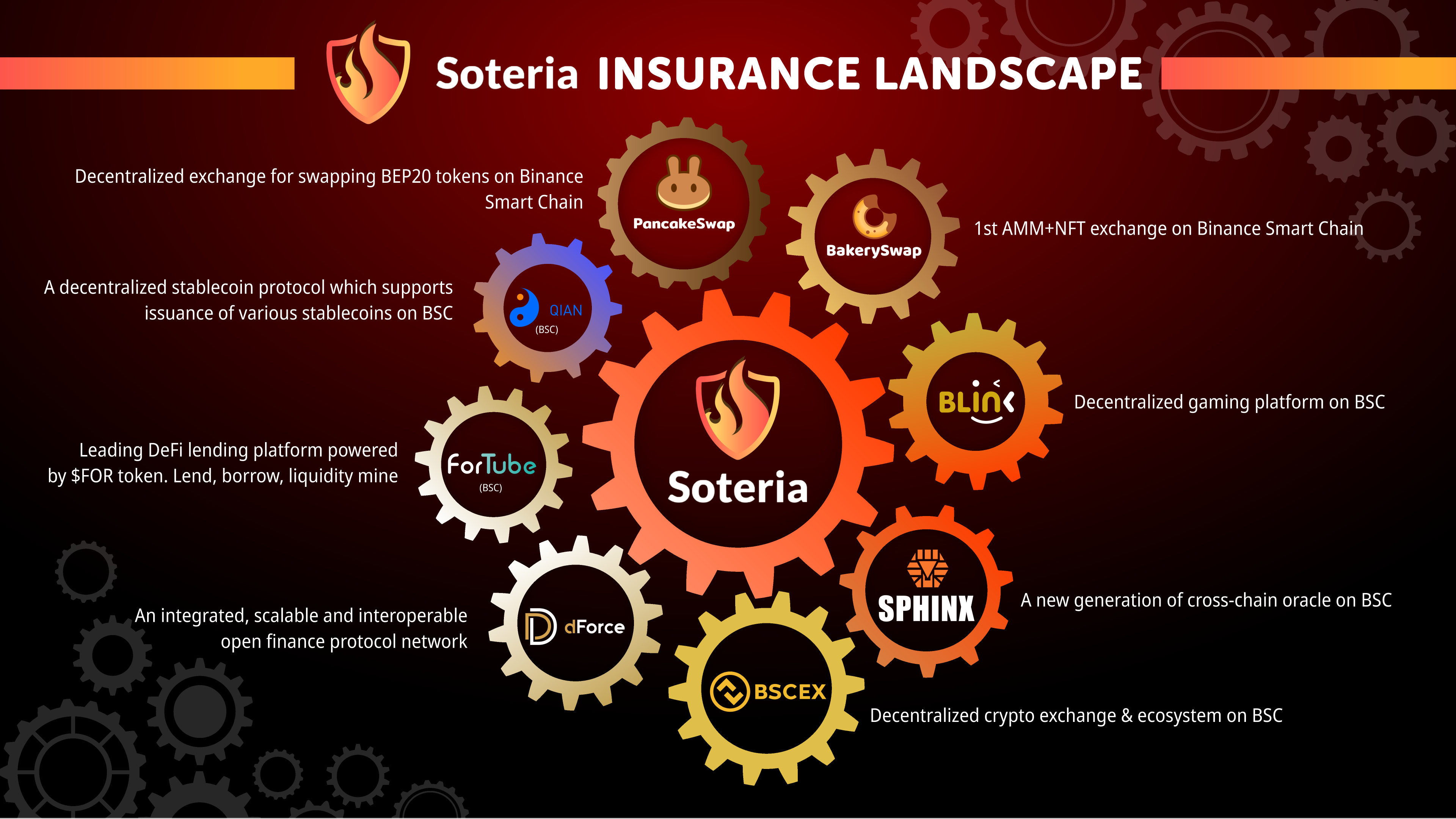
Odaily recently observed that Binance Smart Chain (BSC) recently gave birth to Soteria, the first native mutual insurance platform. In less than a month since it was launched, Soteria has 4,531 registered users and 9 cooperative projects. The insurance amount has increased rapidly, and the amount of funds in the insurance pool has successfully exceeded 2 million US dollars.
What are the characteristics of Soteria that can be officially recommended by BSC and favored by many projects?DeFipulsefirst level title
The data shows that the value of locked positions on the chain has reached 36 billion U.S. dollars, an increase of more than 35 times compared with the 1 billion U.S. dollars in the same period last year.
according tomediaHowever, in the development of DeFi, various security incidents such as code loopholes and attacks on stolen coins have emerged one after another, and DeFi has gradually become a cash machine for hackers.
according to
media
According to statistics, there will be more than 60 DeFi attacks in 2020, with a cumulative loss of more than 250 million U.S. dollars, and attacks are gradually becoming normalized. A few representative events are briefly listed:
On October 27, Harvest Finance, a DeFi aggregation protocol, suffered a flash loan attack and lost about $33.8 million;
……
On November 14, the Value DeFi protocol was attacked by a flash loan and lost about 7.4 million US dollars in DAI tokens;
On November 26, Compound suffered from oracle price manipulation, and about $90 million in assets were liquidated;
On February 5, the Yearn Finance protocol suffered a flash loan attack and lost tens of millions of dollars;
The rapid growth of the DeFi ecosystem, but frequent security incidents also make DeFi participants deeply worried.
As an important financial tool for hedging risks and reducing losses, DeFi insurance has also attracted the attention of more DeFi participants.
In the past few months, the DeFi insurance track has been booming, and dozens of emerging insurance projects including COVER and ins3.finance have been born. At the same time, the governance tokens of these projects are also highly sought after, with an increase of about 100%. Among them, WNXM, the native token of Nexus Mutua, the leading project of the insurance track, saw the highest increase of 360%.
"DeFi insurance is an essential need for the development of DeFi, and the future potential is huge." Colby, technical director of the emerging insurance platform Soteria, is very optimistic about the future of DeFi insurance. "In the traditional financial market, the scale of insurance is trillions. With the development of the encryption market and DeFi, the scale of the DeFi insurance market will also continue to rise, and several insurance giants will also be born.”
therefore,If you want to expand the volume of DeFi insurance, it will not be achieved overnight, and you must find the right direction.
Reasons for the current small volume: On the one hand, the development time is relatively short, and the blowout growth of DeFi insurance projects is mainly concentrated in recent months; second, insurance projects are mostly concentrated in the single ecosystem of Ethereum, and have not been connected to other The ecological value of the public chain has caused other public chains to be in an embarrassing situation of "no risk and no insurance".
therefore,
A batch of emerging insurance projects are also aiming at the "next ecology" with more potential and explosive power. Among the new DeFi ecosystems, Binance Smart Chain (BSC) is developing rapidly and attracting attention.
According to the official website data, BSC currently supports 42 currencies to cross-chain to BSC, the total value of cross-chain assets has reached 1.37 billion US dollars, and the total market value (peak) of Binance BTokens tokens has reached 556 million US dollars.
2. How does Soteria, a mutual insurance platform on BSC, stand out?
according tomediaSince the launch of the mainnet in September last year, BSC has developed rapidly, but it has also brought pains and frequent security incidents.
media

( CertiKShield )
According to reports, on February 1, the liquidity mining project popcornswap on BSC ran away, and the project volume approached 48,000 BNB, worth about 2.15 million US dollars; similarly, Zap Finance, Tin Finance, SharkYield and other projects on BSC also ran away one after another. way, causing losses to users.
image description
Inquiring about CertiKShield shows that it currently only underwrites three Binance-based projects, BNB, BUSD, and PancakeSwap, and its business is difficult to cover the entire BSC ecosystem.
secondary title

1. What is Soteria?
Soteria is a mutual insurance platform that can provide insurance for losses caused by vulnerabilities in smart contracts and hacker attacks, thereby providing risk protection for DeFi products.
image description
(Soteria official website)
Pledging tokens means that members recognize the security of the project, and the amount of pledged tokens also determines the purchase amount of this project; whether the claim application is approved or not is decided by the token holders through voting, and the voting needs to lock the tokens , and if the option opposite to the final result is chosen, its tokens will be locked for a longer period of time.
Similar to Nexus Mutual, Soteria also has a venture capital pool (Capital Pool). On the one hand, the funds in the fund pool come from the direct injection of funds purchased by the insurer, and on the other hand, 50% of the funds purchased by the policy holder will be injected into the fund pool.
When compensation occurs in a certain contract, the SOTE token pledged in the contract is first destroyed to pay the compensation. If the pledged SOTE cannot fully pay the compensation, then other funds in the fund pool will be used for compensation. Therefore, although users pledge SOTE for different contracts, the insurance fund pool is essentially shared by all contracts.
secondary title
2. Results: In half a month, the amount of funds exceeded one million US dollars
Although there are restrictions on the registration threshold, Soteria is still sought after by the market. Colby told Odaily that Soteria currently has 4,531 registered users.
In addition, when Soteria and PancakeSwap conducted IFO on January 21, the quota was overraised within one minute of launch, and the total fundraising amount exceeded the plan by 22.7 times, breaking the record of other projects on PancakeSwap that was 14 times the highest; during the one-hour fundraising period, In total, more than 1000 users participated.
“The projects we are cooperating with now account for 10% of the active projects on BSC, and we want to push this number to 30% or even 60% in the short term.” Colby explained.

Odaily’s query found that when Soteria was launched half a month ago, the amount of funds in the insurance pool exceeded US$1 million; as of February 8, Soteria’s insurance fund pool had reached 35,132 BNB (approximately US$2.33 million), as shown below:
image description
(Screenshot of Soteria official website)
secondary title
3. Project comparison: Soteria, COVER, Nexus Mutual
In the insurance field, Soteria is not the first to eat crabs. There is a leader of Nexus Mutual in the front, and a rookie of COVER in the back. How does Soteria differentiate itself from these projects?
Soteria's first advantage capital utilization is higher.
Three important core roles are introduced in the COVER protocol: Coverage Seekers, Liquidity Providers, and Prediction Market Users, and insurance premiums are priced by the market, and a single project has a single pool of funds.
Soteria relies on the actuarial team to design actuarial models, evaluate costs, benefits, and risks, and conduct pricing guidance. All funds enter an insurance pool, and the utilization rate of funds is higher. Of course, the risk is that once multiple projects are hit by thunder, the capital pool will shrink sharply.
"Compensation for user losses is the meaning of insurance. And because a single project has a subscription quota limit, coupled with our risk control, it will not completely drain the insurance pool. As long as the pool is not dry, it proves our model. It's feasible, it's sustainable," Colby said.
The second advantage of Soteria is the degree of community and higher efficiency.
Both COVER and Nexus Mutual rely on committees for governance. Whether it is a new insured project or a project claim, both need to be audited by a professional committee, and the process is relatively cumbersome.
Soteria relies on community governance, which is reviewed by registered members. The Soteria team will first prepare for the project and conduct detailed background investigations, such as whether it is open source, whether the smart contract has passed the audit... Then the information will be publicized to registered users, who will decide whether to underwrite the project.
The advantage of this is that for popular projects such as PancakeSwap, Soteria's response is more timely, and it can meet the demand in the first time.
"Although our insurance model is similar to that of Nexus Mutual, our operations and management are different. When we choose projects, we prefer community-based projects. Compared with Nexus Mutual, we act faster and support community projects more strongly." Colby explained.
The third advantage of Soteria is that relying on the strong traffic of BSC, it has seized the first-mover advantage.

Although the scale of BSC is not too large compared to Ethereum, it is still enough for Soteria to achieve good development. Moreover, as the first native insurance platform of BSC, Soteria has also received official support and assistance.
BSC often organizes online DeFi community meetings, and Soteria has been invited many times, so it can show its talents and be recognized by more BSC projects; in addition, BSC also helps Soteria to connect to the wallet flow portal.
Relying on the huge traffic and support of BSC, Soteria has achieved relatively large growth in a short period of time. We counted the changes in the amount of funds in Soteria and Nexus Mutual insurance pools, and the results show that Soteria's growth rate is significantly faster, as shown below:
Colby is more optimistic about this. He believes that in the DeFi insurance market, the moat built by the code and business model is actually very low. The key to a project's success lies in whether it can quickly iterate to meet market demand. Soteria is the main service, and it responds quickly to user needs, so it develops rapidly in a short period of time.
Soteria started from BSC, but it does not stop there, covering a wider decentralized financial ecology as its future goal.
Regarding the future development plan, Colby said, "First take the top spot in BSC insurance, expand to other public chains in the future, and finally cooperate with institutions to launch offline insurance business."
first level title
3. Summary: DeFi insurance still needs to be improved
Judging from the current situation of insurance, DeFi insurance is still in a very early stage, with limited coverage and a single type. Most of the insurances only focus on smart contract vulnerabilities or attacks, and it is not yet possible to attract large funds to really invest in this track.
Colby believes that the limited scope of DeFi insurance coverage matches the current stage of DeFi development. In DeFi, more attention is paid to the security of smart contracts, and the demand is strong, so there are currently more security risks. In the future, DeFi insurance will further expand the scope of protection.





