In the currency circle, you never know which one will come first, tomorrow or Justin Sun.

After talking about Polkadot, many readers left messages asking me to talk about Ethereum. One of the most asked questions is:"Uncle Jian, do you think Polkadot can surpass Ethereum?"As usual, I pushed my glasses, frowned, and replied: "Don't worry, let me think about it."The first question I think about is not who can surpass whom, but:Why compare them together? Polkadot’s market value is fourth, so it needs to be compared with Ethereum?After searching, I found out that it was the media who were leading the rhythm:The reason for comparing them together is also very simple, because they all use sharding technology, and the founders used to be a team...Duan Yongping and his partner Chen Jianren used to be in Xiaobawang. Later, Duan Yongping came out to do backgammon on his own. There are indeed overlaps in the technologies behind it, but would you compare Xiaobawang and Backgammon? A game machine, a learning machine, who is good and who is bad?Hey, as a technical background, I can't see this kind of ridiculous comparison, so I write an article today to be more realistic:1. Polkadot VS Ethereum, the direction is different, how can we talk about surpassing?
First of all, I want to say that the media not only got the rhythm wrong, but they didn't even understand the comparison objects.The sharding technology is Ethereum 2.0, so even for comparison, it is Ethereum 2.0 instead of Ethereum.Here comes the question, what is the difference between Ethereum 1.0 and 2.0? I drew a picture to help you understand:When many media analyze the difference between Ethereum 1.0 and 2.0, they will talk about two changes: one is the implementation of sharding, and the other is that the consensus mechanism is changed from PoW (proof of work) to PoS (proof of stake).But in my opinion,Technological changes are just appearances, behind which lies the pattern and ambition of Ethereum 2.0.If Ethernet 1.0 is like a computer, then the layout of Ethernet 2.0 is a system, an entire computer room.In the picture, those shard chains are like "extensions", helping the "computer room host" and "beacon chain" of Ethereum to process tasks.Of course, as the structure becomes larger and more "extensions" are added, the "algorithm" must also be upgraded, so the consensus mechanism is changed from PoW (Proof of Work) to PoS (Proof of Stake). (PoW and PoSThe difference has been popularized before, so it doesn’t take up too much space here, you can click the link to go back and review)PolkadotPolkadotWoolen cloth? As mentioned in the previous article, what it needs to do is "chain links".One is an application platform and the other is a chain platform. They are not in the same direction. Two things that do not develop in the same direction, how can we talk about surpassing?2. When we talk about Polkadot will surpass Ethereum, what should we talk about?
Since "Polkadot surpasses Ethereum" itself is a false proposition, when we talk about Polkadot will surpass Ethereum, what should we talk about?I think the point is not to compare who is good and who is bad, but to compare whose "blueprint" design ideas are better and the initial settings are more complete.As for the "blueprint" stage, I think that Polkadot has two initial settings that are indeed beyond Ethereum.They are: consensus mechanism and system upgrade method.Let’s talk about the consensus mechanism first. The consensus mechanism of Ethereum 2.0 was just mentioned as PoS (Proof of Stake). Although it has been upgraded compared to 1.0, it is still not as good as Polkadot’s consensus mechanism - NpoS (Nomination Proof of Stake).There are two words that are not easy to understand here - proof of stake and proof of nominated stake. Don't be scared by them, they are actually very easy to understand.You can understand the proof-of-stake mechanism as saying whoever has the money counts, and the richer people have more power; and the nomination proof-of-stake mechanism, you can understand it as a community neighborhood committee. In the past, building a community depended on the face of the rich. Now Everyone voted together to elect a neighborhood committee and let the neighborhood committee manage it. Compared with proof of rights, this mechanism is obviously more fair and democratic, and there will be no Matthew effect of the rich getting richer.Let's talk about Polkadot's second advantage-system upgrades.The upgrade of Ethereum requires a hard fork, that is to say, it will be split into two chains, the old and the new. We all know that the hard fork has a great impact on the public chain. If it does not go well, it will lead to community splits, project splits, etc. dire consequences.For example, BCH, after it was forked from Bitcoin, it had the function of smart contracts several years later. The price was that the Bitcoin community was severely split. Forks are "wounds and bones", and no matter how the BCH community tells stories, it cannot make up for the previous rift.As for the upgrade, Polkadot has seized the acquired advantage and solved the hard fork problem through the Substrate framework, becoming the only public chain in history that can be freely upgraded indefinitely.What is Substrate? In the words of Polkadot's co-founder: It's a set of libraries for handling all the annoying things when writing a blockchain. This means that all the protocols, programs, and architectures required for on-chain development are set up for you in this framework. You even only need 30 minutes to configure some necessary parameters to develop a fully functional blockchain .If you use a camera as a metaphor, the Ethereum fork process is like the process of taking pictures with an old-fashioned camera. You have to turn on the lights, adjust the parameters, and change the lens, which is quite complicated. And Polkadot's bifurcation is like a point-and-shoot camera. The basic configuration is all set up for you, and you can take pictures with one click.But don’t underestimate this difference. Looking at it now, it seems that one is forked and the other is not. But in the future, what if Ethereum continues to upgrade to the 3.0, 4.0, and 5.0 stages? Go to war every time you upgrade? Who will bear the irreparable impact of the hard fork?first level title
3. Polkadot does not understand the ambition of ether
After talking about the "blueprint" design, let's analyze the most fundamental reason why the media compare them together:Fragmentation.Although they are all shards, the shards of Polkadot and the shards of Ethereum 2.0 are completely different.Ethereum 2.0 is a homogeneous shard, while Polkadot is a heterogeneous shard. What's the meaning?It is easy to understand that "isomorphism" means the same structure, in other words, they are all self-produced. Ethereum 2.0 will have 64 shard chains, and the structure of these chains is the same, which is a bit similar to "host" and "extension". "Relationship.The sharding of Polkadot is the parachain that is now hotly hyped. 100 slots and 100 parachains need to be auctioned. Since it is an auction, it means that other chains can also bid. The structure is different, so it is called " heterogeneous".Here comes the question, is it better to be "isomorphic" or "heterogeneous"?It’s still the same sentence just now, we need to see the result after it goes online, but one thing can be mentioned, after the completion of the three stages of Ethereum 2.0, the number of shards is 64, but Polkadot’s relay chain has only 100 parallel blocks in the early stage. chain, but the relay chain can also be connected to the relay chain, so it can eventually be infinitely expanded.Why do I say that Polkadot does not understand the ambition of Ethereum?Because Ethereum has a Layer 2 technology ecosystem.Layer2The science popularization has been shared last week. On the surface, it means the 2-layer network of Ethereum. In fact, it makes up for the lack of heterogeneous parallel chains of Ethereum 2.0.The 64 isomorphic shard chains of Ethereum 2.0 help expand the capacity of Ethereum inside Ethereum, while the countless public chains of Layer 2 help expand the capacity of Ethereum outside Ethereum.If you take ETH2.0 and Polkadot alone, it may be a bit inferior, but ETH2.0+Layer2, a combination of internal and external expansion and Polkadot, will not necessarily win or lose.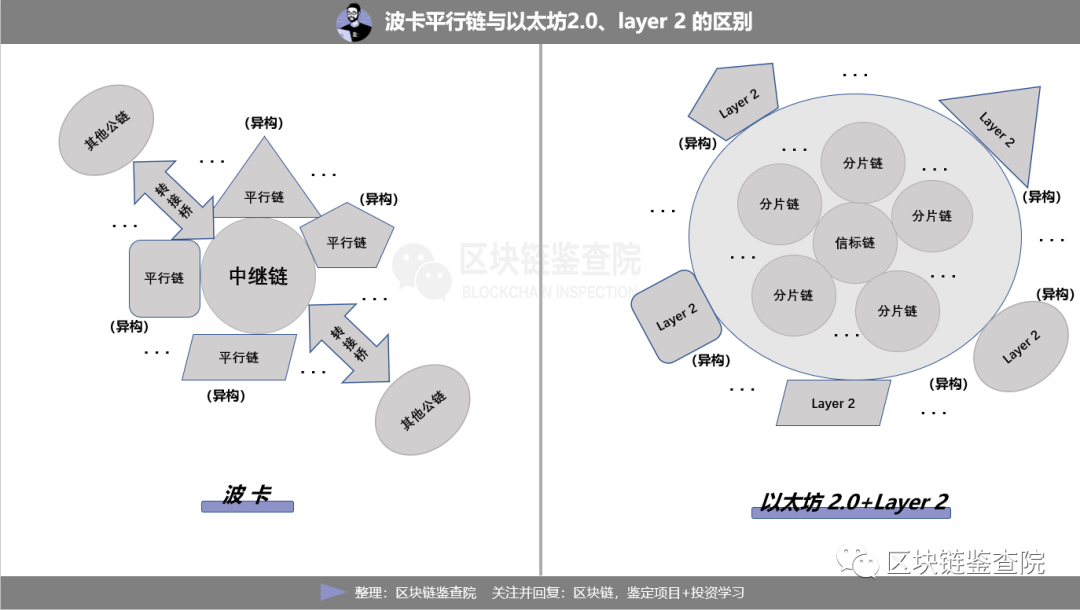
Jianshu summary
(data and progress, the update time node is the day of posting)
The comparison of Polkadot VS Ethereum has been a false proposition from the beginning, and only the "blueprint" design can be compared.In the "blueprint" design stage, Polkadot and Ethereum have one win, one loss and one tie.1. Initial design, Polkadot winsWhether it is sharding technology, consensus mechanism, system upgrade or project execution fee, Polkadot's initial settings are more comprehensive, flexible and decentralized than Ethereum 2.0.2. Mass base + ecology, Ethereum 2.0 winsBut from the perspective of the number of users, the accumulation and testing of Ethereum over the years has given it a strong mass base, which is far behind Polkadot. In addition, Layer2 ecological projects continue to emerge and have begun to be used. The combination of ETH2.0+Layer2 has potential that is worth looking forward to.3. Future development, each with its own strengths, equalAs for the future development, one is the ecology of the coin and the other is the ecology of the chain. Although the directions are not consistent, once it is implemented, it can be called an innovation and breakthrough at the level of "changing the blockchain world".





