


ETH breaks through $700, don't you know ETH2.0 yet?


secondary title

What exactly does ETH2.0 mean?
The ETH 2.0 Beacon Chain (Beacon Chain) was successfully launched on December 1, 2020. It has been nearly a month since Ethereum entered the new era of 2.0. What changes have been made during this period?
Phases of ETH2.0
Phases of ETH2.0
Of course, the realization of ETH2.0 is not achieved overnight. According to V God’s plan, the transition from ETH1.0 to ETH2.0 needs to be realized in four stages, and it will take at least 2-3 years.
1. Phase 0: Beacon Chain
When the number of pledged ETH reaches 524,288, the beacon chain is officially activated. As of December 28, the total number of ETH in the deposit contract has exceeded 2.08 million, and the number is still growing. The user deposits ETH into the deposit contract, and the mortgage is completed. At the same time, in return, users will receive a certain percentage of interest income.
2. Phase 1: Shard Chains
In order to solve the problem of increasingly congested network and high transaction fees, it is imperative to expand the capacity of Ethereum. The purpose of sharding is actually to expand capacity to improve the efficiency of network processing transactions.
3. Phase 1.5: Integration
This stage is mainly to migrate ETH1 to the shard of ETH2.
4. Phase 2: State Execution: (State Execution)
secondary title
To pledge or not to pledge?
Although staking can obtain income, there are several issues that need to be considered clearly:
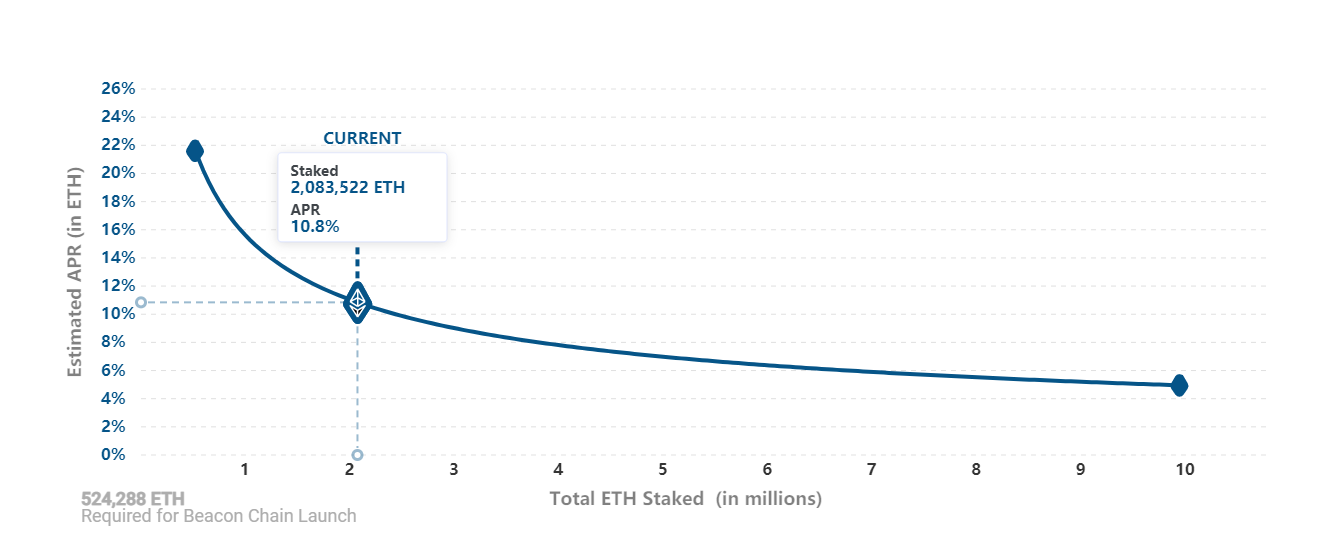
1. Reward up to 10.8%
Ethereum 2.0 is implementing a dynamic inflation curve as a way to reward validators for securing the network while keeping currency issuance at a minimum. Using the Ethereum Betting Calculator, you can estimate the pledged ETH and roughly clarify the future earnings.
2. Minimum pledge threshold: 32 ETH
To become a beacon chain validator, you need to stake a minimum of 32 ETH. Therefore, each set validator can only stake ETH in multiples of 32ETH. According to the current price of an ETH700 USD, the mortgage threshold is relatively high.
3. Staked ETH is locked until phase 1.5
The launch of phase 1.5 of ETH2.0 is still uncertain and may take 12-24 months or even longer. Phase 0 does not support withdrawals and transfers. Users want to pay a lot of liquidity if they want to get benefits.
4. funds may be reduced
If the act of acting as a verifier is provably destructive, such as double signing. Then it will be punished, that is, a certain amount of ETH pledged will be deducted.
5. Staking on the ETH2 chain is a one-way conversion
secondary title
Ethereum 2.0 Pledge Service Solution
1. Self-run validator node
If you are an avid long-term holder of ETH with solid expertise, then this should be your first choice. While having full control over hosting, node operators give the ETH2 network great support in terms of security and decentralization.
2. Pre-configured validator nodes
With pre-configured validator hardware or cloud operations, you can save a lot of time and effort on initial setup to get validators up and running.
3. Validator as a service solution
Institutional and high net worth ETH holders need safe, secure and easy-to-use solutions to meet their staking needs while maintaining control over their funds. The validator-as-a-service solution will only keep your signed validator key (used to perform validator duties) and give you full control over your funds through the withdrawal key. Most of these services are considered semi-managed.
4. Staking pool
Retail holders and active DeFi participants are likely to have “staking pools” as their first choice. The big difference with staking pools is that you don't need all 32 ETH. Although funds are primarily held by staking pool operators, escrow is transparent and verifiable on-chain.
5. Loan platform
This is the best option for investors who like to leverage their ETH holdings for trading.
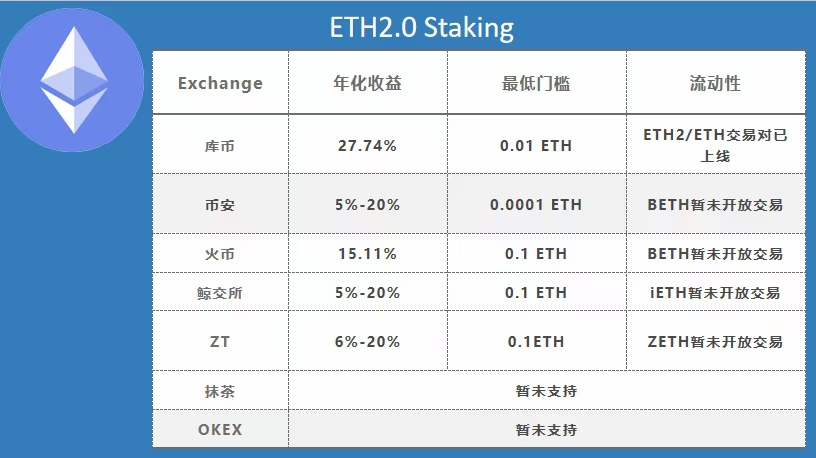
6. Exchange and Custodian
image description
in conclusion
in conclusion
Search for "wealthy women, intellectual women and big beauties" to get more cutting-edge and interesting articles!
Search for "wealthy women, intellectual women and big beauties" to get more cutting-edge and interesting articles!





