


Comparing Ethereum 2.0 Staking service providers from eight angles, looking for a balance between risks and benefits


Author: Dmash
On the first day of the last month of 2020, the Ethereum 2.0 beacon chain was launched as scheduled, marking that Ethereum has officially entered the new era of 2.0, adding another impetus to the already hot market.
Ethereum, as the second largest crypto asset, has naturally attracted the attention of the entire industry, Ethereum co-founder Vitalik Buterin tweetedsendCongratulations, over 2,000 retweets, r/ethstakerturn onA 24-hour live broadcast to welcome the creation of the world, the Ethereum Foundation’s creation live broadcast on that day onceattractsecondary title
The strong appeal of Ethereum 2.0
The transition of Ethereum from 1.0 to 2.0 is not only an upgrade of the network and technology, but also carries the "hope" of many project parties and developers. Therefore, its development process has also attracted the attention of the entire encryption industry.
The Beacon Chain, which was just launched on December 1, means that the Proof of Stake (PoS) consensus mechanism will be enabled, with the purpose of promoting a fairer mining mechanism in Ethereum and reducing Gas fees and mining costs.
At the same time, the main group maintaining the security of the Ethereum network will change from miners to validators. To become a validator, you first need to pledge Ethereum to the pledge contract of Ethereum 2.0. This process is ETH 2 Staking.
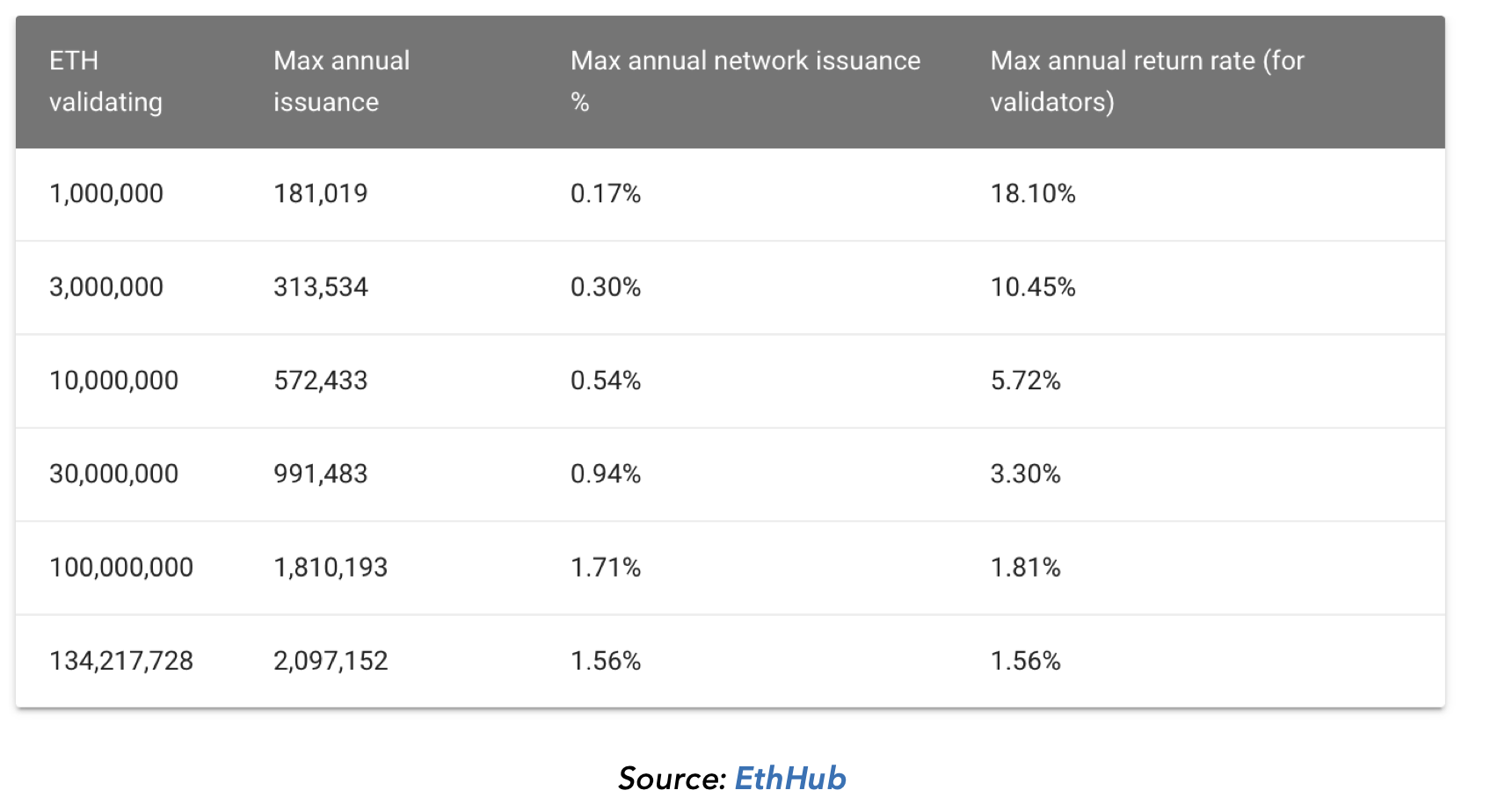
The participation of many validators can not only protect the security and decentralization of the network, but also enjoy an annualized rate of return of about 5% to 21% by staking tokens to obtain network income in the process of participating in Staking.
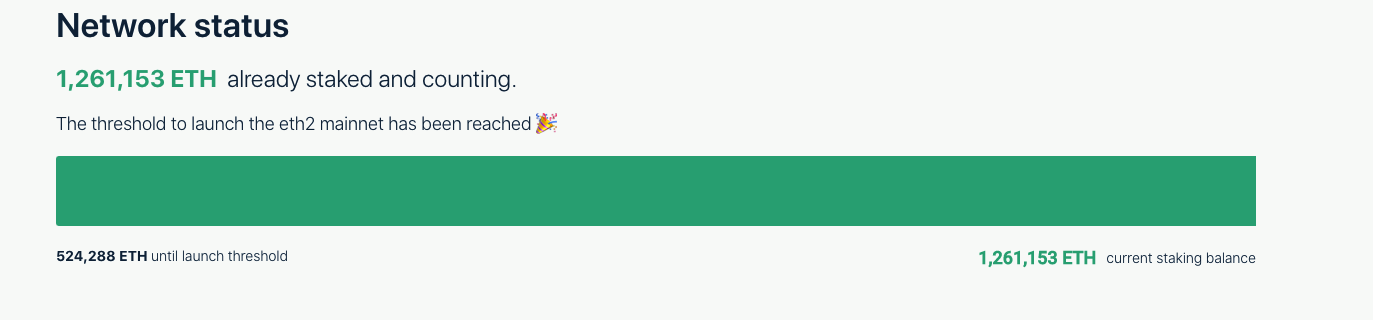
showshow, as of December 9, 2020, Ethereum 2.0 deposit contract addresses have received more than 1.26 million ETH, and 37,158 addresses have completed the pledge of 32 ETH, and this data is still showing a continuous upward trend, indicating that in With the strong appeal of Ethereum 2.0, the market participation is still high.
secondary title
Learn how to participate in ETH 2 Staking
After entering Ethereum 2.0, the Ethereum network will reward the participants of the block node, that is, the verifier. To put it simply, in addition to some basic operating procedures, you need to meet the two hard entry conditions of running a node and pledging 32 Ethereum to become a validator.
Access condition 1: running nodes
In order to achieve the more decentralized goal of Ethereum 2.0, each verifier may need to utilize various infrastructures such as internal deployment and cloud computing to ensure stable operation of verification nodes.
In the process of running the node, the user needs to ensure that the verifier node maintains a safe and stable operating environment, including ensuring that the network connection will not be offline, the operating system and hardware facilities will be safe, and there will be no downtime.
If the running node has abnormal or malicious operation behavior, the assets pledged by the verifier will be slashed (penalized). Therefore, a certain maintenance cost needs to be borne in the process of running the node.
Access condition two: 32 Ethereum
In addition to the above-mentioned machine operation and node costs, becoming a validator also needs to pledge 32 ETH assets, which is about $18,240 (119,300 RMB) at a price of $570 per ETH on December 10.
Judging from these two rigid terms, the first access condition requires participants to have a certain technical foundation and hardware conditions, and to bear certain operation and maintenance costs and Slash risks, which may be too cumbersome and complicated for some ordinary users.
The second condition requires participants to have token support with a certain amount of funds. Since Ethereum 2.0 is a long and complex system, once the pledged funds enter the contract, they will be locked and cannot be circulated. Before enabling transactions , tokens cannot be transferred, and this lockup period may be as long as one to two years.
Although participation in staking can bring certain benefits to participants, the participation rate of ordinary users is not very high. Therefore, many service providers that focus on staking provide alternatives to reduce risks to help users simplify the way of participation, so that users can Participate in staking bonuses in a low-cost and more efficient way.
Faced with a variety of third-party service solutions emerging in the market, participants also need to carefully read the rules and choose the most suitable way to participate in the balance between risk and return.
secondary title
A Quick Look at ETH 2.0 Staking Service Providers from Eight Angles
From the perspective of third-party staking service agencies, in order to better allow ordinary currency holders to participate in this staking feast, many service providers choose to provide "one-stop service", which not only helps ordinary users solve the two major participation problems, but also uses The way of liquidity tokens allows users to obtain more additional income.
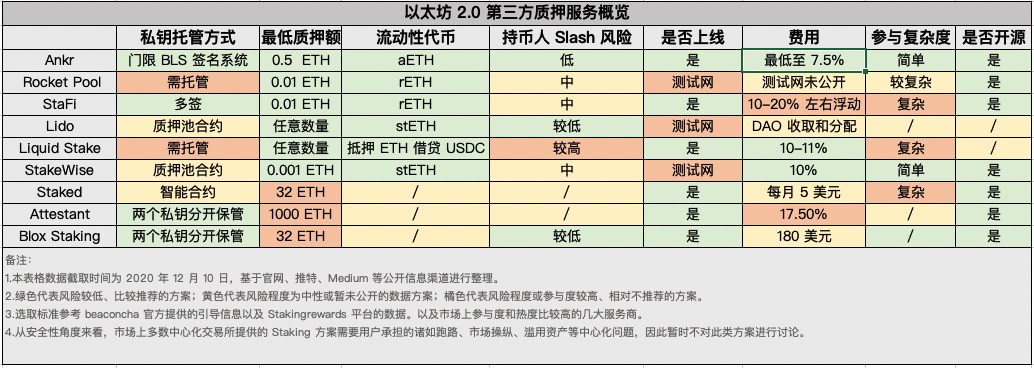
officialofficialplatformplatformAccording to the data, several major service providers with relatively high participation and popularity in the market were selected, from the private key custody method, minimum pledge amount, liquidity token, token holder Slash risk, whether to go online, fee, participation complexity, whether The eight angles of open source are simply analyzed and sorted out.
Ethereum 2.0 third-party staking service providers can be divided into two types: centralized and decentralized. Centralized service providers usually mean that users will host the private key (withdraw key) of funds.
For example, the staking services provided by many centralized exchanges recently require fund custody. Although this custody method does save a lot of operating procedures, from a security point of view, users need to bear centralized problems such as running away, market manipulation, and asset abuse, and give up the management authority over funds. Therefore, this article does not discuss the custody solutions of exchanges on the market for the time being.
Private key escrow method
From the perspective of private key escrow, Rocket Pool and Liquid Stake require pledgers to escrow their private keys to service providers, which poses certain trust and security risks, while Lido, StakeWise, and Staked choose to escrow their private keys to smart pools. In the contract, although this method enhances transparency compared to direct hosting, there are still security issues such as the contract itself being stolen.
AdoptedAdoptedThreshold BLS System Signature System, which is a cryptographic signature scheme that allows users to verify the identity of the signer. Using BLS it is possible to aggregate all primitives (secret key, public key, signature) into one valid primitive, and using this threshold system to generate signatures, the actual full key is unknown to any signer. There is only one fragment per signer. In this way, the safety of users' funds is guaranteed.
StaFi, Attestant, and Blox Staking have also adopted similar multi-signature methods to ensure the security of users' assets, and the risk of fund custody is relatively low.
Minimum pledge
As mentioned above, the staking threshold of 32 ETH may not be low for ordinary users. The service provider has lowered the minimum pledge threshold, which is convenient for users to participate.
Staked, Blox Staking, and Attestant pay more attention to the service quality of institutional-level users with relatively large amounts of funds, so they did not choose to lower the access conditions of 32 Ethereum.
Ankr, Rocket Pool, StaFi, Lido, Liquid Stake, and StakeWise chose to lower the threshold for users, setting the minimum staking amount between any amount and 0.5 ETH, which is also within the acceptable range of most users.
It is worth mentioning that Ankr also provides a pledge service plan that is more friendly to large users. If more than 32 Ethereum are pledged, Ankr will pledge the funds at one time without distributing them to multiple nodes, ensuring the pledged Simple and efficient.
liquidity token
After the release of Ethereum 2.0, the two Ethereum networks, ETH 1 and ETH 2, will run in parallel. Users can convert ETH1 tokens to ETH2, but cannot convert ETH2 tokens back to ETH1 until Phase 1.5 or Phase 2 goes online and pledge funds This time may be subject to the progress of the development and the progress of the project, so it may take a long time.
The uncertain lock-up period limits the liquidity of user funds, so many third-party staking service providers choose to provide additional liquidity solutions, and the usual practice is to issue an ERC20 token. For example, Ankr will return pledged users aETH, and Rocket Pool will return rETH to users. These tokens can also be circulated elsewhere. Liquid Stake chooses to issue USDC after users pledge ETH, which is equivalent to lending USDC by mortgaging ETH.
Among them, Ankr's aETH is a token that can be acquired and traded immediately after staking, and can be exchanged for real ETH on Stkr (Ethereum 2.0 liquidity staking DeFi protocol built by Ankr). At the same time, Ankr is on Uniswap Liquidity incentive pools related to ANKR/aETH, ETH/aETH, and ANKR/ETH have also been established, and you can also choose to participate in various DeFi activities.
Holder Slash Risk
Slash refers to collecting fines from the 32 ETH pledged in the node. If the number of ETH pledged by the node falls below 16 due to the accumulation of Slash, the node will automatically withdraw from the Ethereum 2.0 network.
For this risk, both Ankr and Lido introduced the concept of "insurance provider". If a node suffers a Slash penalty, Ankr will choose to transfer the pledged funds to another node, and automatically pay the insurance money from the insurance fund paid by the provider. . According to the test network information provided by Lido, an insurance provider must be selected in its ecology, and the insurance for confiscation needs to be negotiated and determined.
Stafi chose to establish an incentive and punishment system to encourage positive behavior and increase the punishment of Slash caused by malicious behavior to reduce the risk of stakers.
cost
cost
From the perspective of service providers charging fees, each company basically maintains around 10% to 20%. Staked will choose to charge monthly fees, and Blox Staking will charge a one-time service fee of $180.
However, Ankr recently announced that it will increase the stakers’ access to all staking rewards to 85%. Of the remaining 15%, half will be allocated to providers and half will be redistributed to ANKR stakers. Therefore, stakers can theoretically get up to 92.5% award.
Participation complexity
From the perspective of user-friendliness, third-party staking service providers also need to lower their operating and participation thresholds. Based on the degree of participation in the websites of major service providers, the operation steps and processes of Ankr and StakeWise are relatively simple and convenient at present.
self-built node
CommunityCommunityThere are also some technical guides and tutorials.
However, overall, the steps are relatively cumbersome, and it needs to undertake operation and maintenance, power, network security, and a certain level of computing equipment.
summary
summary
Before participating in Ethereum 2.0 Staking, users first need to understand the risk points and hard conditions including liquidity, Slash, security, funding conditions, etc. Only after understanding the risks can we find a suitable participation method and adaptation plan, and find the balance between benefits and risks.
In the process of growing with Ethereum 2.0, users also need to have enough patience. After having a comprehensive understanding of some third-party Staking service providers in the market through different latitudes such as security and risks, they choose to rely on their service providers Services and facilities can obtain more stable income while reducing operations and costs, and are more suitable for the majority of ordinary currency holders.





