


ETH Weekly | ETH2.0 starts the genesis block, Phase 0 is officially launched; Grayscale splits the shares of the Ethereum Trust Fund (11.30-12.6)


Author | Qin Xiaofeng
Produced | Odaily
Produced | Odaily
1. Overall overview
1. Overall overview
At 8:00 p.m. on December 1st, Ethereum 2.0 launched the genesis block, and phase 0 (beacon chain) was officially launched. As of 24:00 on December 6, the Ethereum 2.0 deposit contract address has received 1,139,792 ETH.On December 2, the first verifier was slashed in the Ethereum 2.0 beacon chain (phase 0). The Epoch of the slashed validator is 208. According to network information, the verifier is asProposer
Second, the secondary market
Second, the secondary market
1. Spot market
image description
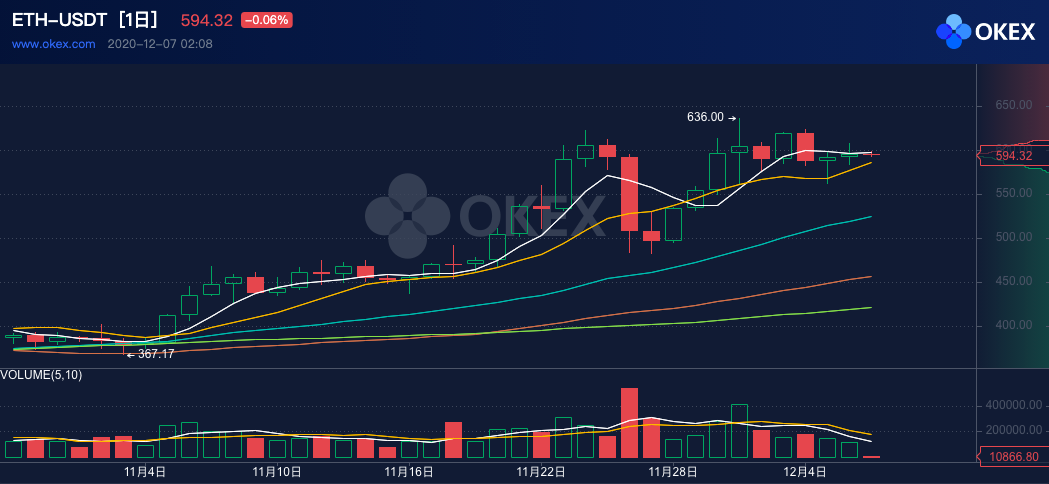
(ETH daily chart, picture from OKEx)
(ETH daily chart, picture from OKEx)
image description
(data from BiNuNiu)
(data from BiNuNiu)
(data from Tokenview)
(data from Tokenview)
Tokenview dataIt shows that the number of transfers on the chain dropped sharply last week, and the number of large-value transfers of "above 5,000 ETH", "above 10,000 ETH" and "above 50,000 ETH" decreased by 16.39%, 15.31%, and 80% month-on-month. Reduced frequency.
OKlink dataOKlink data
3. Ecology and technology
3. Ecology and technology
1. Technological progress
1. Technological progress
At 8:00 p.m. on December 1st, Ethereum 2.0 launched the genesis block, and phase 0 (beacon chain) was officially launched.
December 2,EthermineDecember 2,Bitfly, the parent company of the mining pool, tweeted that the Ethereum 2.0 beacon chain (phase 0) has seen the first verifier slashed. The Epoch of the slashed validator is 208. According to network information, the verifier is asProposer
And slashed, which means that the validator proposed two different blocks in one slot.
It is reported that Slash is a mechanism designed to eliminate potential network attacks by punishing and banning misbehaving validators.
(2) Data: The balance of the Ethereum 2.0 mortgage address exceeded 1.1 million ETH
In the Ethereum developer meeting, the core developers discussed the upgrade scope of the next hard fork upgrade of Ethereum (codenamed Berlin), which may include EIP-2929, EIP-2930, EIP-2718, EIP-2565 and EIP2315. The more controversial part is EIP-2929, which was proposed by Vitalik Buterin, proposing to increase the Gas cost for the first storage read and account access, but this solution may affect the execution of some old smart contracts.
2. Voice of the Community
V God: Ethereum PoS has stronger features than most existing solutions
Speaking at the event today, Joseph Lubin, co-founder of Ethereum and founder of ConsenSys, predicted that in the "not too distant future," ETH2 will swallow Ethereum. “People who understand the ecosystem are very optimistic about the pace of developments, as the really complex work in launching phase 0 has been done,” he said. While Eth2’s rollout is seen as a tightly controlled “phase,” Lubin emphasized ETH2’s Other aspects are "running in parallel". That means the protocol upgrade could come much sooner than many onlookers expect. Lubin predicts that the next phase of Eth2 will go live nine to 12 months from now. He asserts that future increases in data availability will enable Layer 2 networks to "significantly increase the number of transactions per second that can be processed." (Cointelegraph)
3. Project trends
(1) Basis Cash, an open-source algorithmic stablecoin project launched
On November 30, the smart contract of Basis Cash, an open-source algorithmic stablecoin project, was officially opened. "Rick Sanchez," one of the project's two anonymous leads, said: "In the long run, we look forward to seeing Basis Cash become widely adopted as a base layer due to the organic demand in many DeFi and business environments." Unlike most stablecoins Similarly, Basis Cash (BAC) is pegged 1:1 to the US dollar, and its price will be managed by two other cryptoassets: Basis Bonds and Basis Shares. Starting from the end of November, 50,000 BAC will be distributed within 5 days (10,000 per day) to users who deposit five stablecoins (DAI, yCRV, USDT, SUSD, and USDC) into their smart contracts. Depositors do not deposit more than 20,000 stablecoins into any one account. Daily rewards will be distributed proportionally, and users can withdraw assets at any time.
(2) The Ethereum pledged on ETH2.0 can be withdrawn at the earliest or in the first quarter of 2021
ETH staked on Ethereum 2.0 could be withdrawn as early as the first quarter of 2021, according to a blog post by staking service Rocket Pool. While Phase 0 of the Eth2 rollout kicked off with the beacon chain on Dec. 1, stakers’ 900,000 ETH cannot be withdrawn until Phase 1.5, which is expected to arrive in early 2022. However, last week ethereum developer Danny Ryan proposed a new "withdrawal contract" that, if realized, he estimates 80% of the withdrawal contract use cases would be satisfied and users could withdraw their ether.
(3) The Loopring protocol launched the second-layer AMM flash swap function of Ethereum, and will start AMM liquidity mining in the middle of this month
According to official news, StarkWare, a research and development organization for zero-knowledge proofs, announced that StarkEx 2.0, the second-layer expansion plan of Ethereum, is officially launched on the mainnet. DeversiFi, a decentralized exchange, also announced that it has adopted this plan to release an upgraded version. In addition, the StarkWare team is developing a new version, which will deploy the StarkEx system that supports Immutable’s decentralized exchange ImmableX before the end of this year, and then will launch the StarkEx system that supports dYdX perpetual contracts.
4. Borrowing
Defipulse4. Borrowing
The data shows that the value of locked collateral on the chain rose from US$13.515 billion to US$14.417 billion last week, an increase of 6.65% a week; the net increase of -US$604 million in the previous week (11.23-11.29) was a net increase of US$902 million last week, a month-on-month increase of 249% .
image description
5. Mining
(data from etherchain.org)
etherchain.orgThe data shows that the average computing power has increased by 2.97% month-on-month, temporarily reporting 287.6 TH/s, which is close to the historical high of 295 TH/s in August 2018; the average mining difficulty reached 3623 T, a record high; The total mining revenue decreased by 9.78% month-on-month; new addresses decreased by 11.45% month-on-month, and the activity on the chain dropped significantly.
4. News
(1) Grayscale announced that it will split the shares of the Ethereum Trust Fund
On December 2, Grayscale officially announced that it will split the total issuance share of the Ethereum Trust Fund 9:1. Following the share split, holders of record on December 14, 2020 will receive 8 additional shares for each share held. The share split will be effective on December 17, 2020 for holders of record prior to the close of business on December 14, 2020. After the share split, the trust's shares will continue to be quoted on OTCQX under the symbol ETHE.
(2) Data: Ethereum miners earned $262 million in November
(3) The market value of Ethereum exceeds that of General Motors and CME
(4) The open interest of Deribit Ethereum options hit a record high





