


Retail investors participate in ETH2.0, we advise you to be cautious | Evolution Road


Produced | Odaily
Editor | Hao Fangzhou
Produced | Odaily

Click here to watch the videoClick here to watch the video)。
During the round table discussion, Odaily invited many participants from the Ethereum ecosystem, including Kaba, founder of StaFi, Lurpis, co-founder of Bifrost, Tony, product director of HashQuark, Mako, head of imtoken marketing, and Qiu Xiaodong, business leader of Spark Mining Pool, to discuss The advantages and disadvantages of Eth2.0 pledge scheme and the opportunities and challenges it brings.
Participants expressed their unique insights on how retail investors participate in Eth2.0, the liquidity of ETH derived from the pledge scheme, and the security of the Eth2.0 network:
Tony: Those who have greater demand for Eth2.0 should be early investors and long-term currency holders who want to earn some currency-based income. But for retail investors who care about liquidity, their willingness to participate is not very strong. From past experience, liquidity tokens (that is, the derivative ETH generated by the pledge scheme) often have little trading volume.
Qiu Xiaodong: Miners and users have relatively large currency holdings, but their willingness to participate in Eth2.0 pledge is not strong. Whether it is mining in the zero-level market, or cashing out in the secondary market, buying and selling mining machines, etc., there are many ways for miners to earn this profit, so they are not particularly interested in the 17% annualized return.
Mako: There are three options for retail investors to participate in Eth2.0, from difficult to easy: the first is self-built nodes, which require technical knowledge and 32 ETH. The second is to hand over the coins to the service provider. There are probably two types. One is to hand over ETH to the service provider for pledge and operation, and to take charge of the withdrawal key (withdrawal key) by yourself. This is safe for user funds. of. The other is to directly hand over the currency to the service provider for management, which requires trust in the platform. The third is to directly purchase liquidity tokens issued based on pledged Ethereum. In this case, users only need to choose the platform, and the participation cost is the lowest.
Kabaa: Although many institutions will provide derivatives of Eth2.0 pledged coins, these products are relatively fragmented and have no application behind them. Therefore, when small and medium-sized investors look at Eth2.0, they must consider and understand that two years is there, and whether the project may skip tickets. In fact, judging from the experience of the developer, there is still a possibility of skipping tickets. . Then how much opportunity cost this uncertain cycle can bring to oneself must be considered clearly, and don't be attracted by income alone.
Lurpis: For Eth2.0 staking solution providers, there is a slightly negative point that the bottom layer does not support a completely decentralized operation mode, such as the decentralized storage of withdrawal keys and the generation and distribution of mining revenue. Only when there is a solution at the bottom layer can the business logic run. When decentralization really appears, I believe that there will be more available scenarios, whether it is cash-out, pledged currency borrowing plus leverage, or double mining, etc. When they are done well, it is also possible for these derivatives to inherit the original amount of Ethereum and develop.
Guest introduction
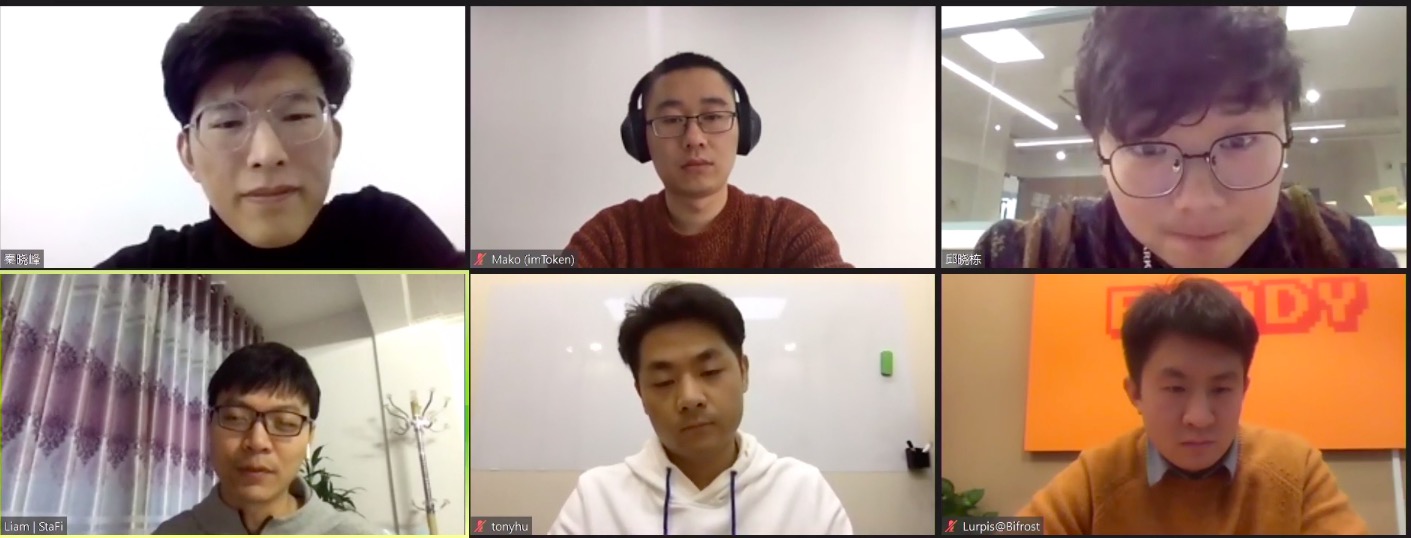
Guest introduction
Odaily: First of all, please introduce yourself and your business.
Kabaa:Qiu Xiaodong:
Qiu Xiaodong:Hello everyone, I am Qiu Xiaodong from Xinghuo Mining Pool, and I am currently in charge of business. Xinghuo Mining Pool now specializes in Ethereum POW mining pools, focusing on GPU mining pools, accounting for about 25% of the total network computing power, and is currently the largest Ethereum mining pool in the world.
As a former Ethereum enthusiast and a team focused on promoting the development of Ethereum in China, Xinghuo has been preparing for the POS project since 2016, and has also made some preparations. At that time, it felt that Eth2.0 would be launched soon. However, because Eth2.0 has not been launched for a long time, we tried to do staking of other projects in 2019, such as COSMOS. At present, we also have some technical reserves and accumulations for Ethereum 2.0, but we have not carried out related business at present, and the reasons will be introduced later.
Tony:Hi everyone, I'm Tony from HashQuark and I'm currently the Product Owner. HashQuark has been focusing on POS ecological staking services since 2018, and now has more than 40 public chain nodes.
On Ethereum, we have also started to follow up the technical research of the testnet in the very early stage, and have also conducted in-depth research on the verification node service. At present, HashQuark has launched two products to support the verification nodes of Ethereum 2.0, and has also received deposits from many users. It is estimated that our node will be online soon, and we hope that you can find us if you have related needs.
Lurpis:I'm Lurpis from Bifrost, responsible for product, marketing, etc. Bifrost is a parachain equivalent to Polkadot developed based on Substrate. It has recently launched the third version of the test network, and the overall parachain has not yet been launched. At present, we are focusing on the liquidity of two types of pledged assets. The first is Staking derivatives for POS projects such as Eth2.0, and the second is the liquidity of Polkadot slot auctions. Since Eth2.0 is about to start, we also released Voucher Ethereum, a solution for ETH 2.0 to provide staking liquidity on the 27th. Users can use our contract to convert ETH into VETH in exchange for liquidity. Within 24 hours after the release on the 27th, the amount of locked positions reached 10,700 ETH. The activity is continuing. We plan to officially use the Ethereum deposited by users for staking on December 3. Currently, users can still exchange and redeem Yes, we will also keep an eye on the launch of Ethereum 2.0.
Mako:secondary title
Q1
Odaily: On November 24, the ETH deposit contract reached the minimum standard of 524,288 ETH for the start of the Genesis block, and the current mortgage amount has risen to 870,000 ETH. However, as the amount of ETH pledged increases, the pledge income will also decrease. In your opinion, is it suitable for ordinary users to continue to participate in staking? If you want to participate, which way should you choose, self-operated verification node or entrusted node service provider? What are the advantages and disadvantages of these two methods?
Mako:I got some feedback from the wallet, including our users. There are a lot of people who want to participate in Ethereum 2.0. But at present, Ethereum 2.0 is very unfriendly to ordinary users. Unlike EOS, he can entrust nodes. Ordinary users only need to entrust their own coins to nodes.
According to our research, there are currently three ways to participate in Ethereum 2.0:
The first is self-operated nodes. This requires some technical knowledge and 32 ETH, which is still a very big challenge for ordinary users. There are people around me who care about Ethereum 2.0 and know some technology. They all buy a server and run the node by themselves.
The second is to entrust ETH to a service provider, which has the advantage of being more worry-free. There are two types of such service providers:
One type is to hand over ETH to the service provider for pledge and operation. The user is in charge of the withdrawal key (withdrawal key), and the service provider helps you run the server. You need to pay the cost of the server for two years at one time. I think this solution may be more efficient. It is suitable for some ordinary users, and it is also safe for user funds.
Another type is that the user does not control the withdrawal key (withdrawal key). For example, if you only have 0.1 or 0.5 ETH, give ETH directly to the service provider, they will provide liquidity solutions, and you can get liquidity tokens. This token can be traded on exchanges in the future. Of course, the price of liquidity tokens cannot determine your corresponding price. It may rise a lot, or it may fall a lot.
Qiu Xiaodong:
Qiu Xiaodong:If you really want to participate, there is still a threshold for ordinary users to self-operate nodes. The advantage is that they can hold their own private keys, but the security and stability need to be borne by themselves. You may not be able to really run this node well, and you may also face fines. Therefore, there is almost nothing that ordinary users can do such a thing now.
Entrusting node service providers is also risky. The current pledge schemes are similar, they are all Eth2.0 derivative tokens for you to circulate in the form of pawn tickets. But can these derivative ETHs really be converted into real ones on the Eth2.0 beacon chain? No one dares to promise this. And if you give the coins directly to the third-party node service provider, there are certain risks if you do not have the private key.
At present, most users prefer the latter solution, because everyone is used to not owning their coins.
Why has Spark made technical reserves, but has not announced the start of Eth2.0 pledge business? Because we still have some doubts about the roadmap and the uncertainty of development in the next two years. We don’t think we can take this risk for users, and we recommend that ordinary users and miners take it cautiously. Everyone should think about what is the purpose and significance of your participation in Eth2.0?
For the miners of Spark Mining Pool, the investment income of participating in Eth2.0 is 17%, which is too tasteless for them. Whether it is mining in the zero-level market, or cashing out in the secondary market, buying and selling mining machines, etc., there are many ways for miners to earn this profit, so they are not particularly interested in the 17% annualized return.
Moreover, these miners themselves have many identities, and there are some self-sustaining exchanges or corporatization of the blockchain industry. For them, Ethereum 2.0 is just a layout, and they have other things to do. For individual miners, those with relatively large currency holdings may properly participate in the pledge of Ethereum 2.0, but most of them still trade on centralized exchanges.
Kabaa:First of all, I think that no matter what problems Eth2.0 has, it will continue to advance, so the pledge volume will continue to rise, which will also drive pledge demand.
Secondly, I think that the service and distribution of POS are all inclined to large customers at the earliest stage. The contribution of retail investors to node service providers and network security is relatively small. We currently see that the relevant liquidity plan for retail investors is very awkward, because Eth2.0 did not want retail investors to participate, and (officially) did not provide a plan.
Back to the question, retail investors really need to meet some conditions to participate, such as 32 ETH and 24-hour continuous network and power supply. In this case, there is still a 50% risk of being confiscated, resulting in damage to the amount of ETH pledged, and the risk does not match the return. In addition, retail investors have not figured out how much opportunity cost is in an uncertain cycle (at least two years). Moreover, whether the ticket will be skipped after two years, after all, Ethereum has many lessons learned from the past, and the ticket has been skipped many times before. You can't just focus on the rate of return and ignore other issues.
In addition, we have seen many liquidity solutions, including exchanges, independent third-party institutions, and some decentralized solutions, all of which have issued derivative ETH. This is also different from all kinds of stablecoins before, after all, everyone's awareness of stablecoins is much higher. These fragmented derived ETH may have no subsequent use value, which is very unfavorable for the growth of derived ETH. Exchanges can provide trading scenarios for derivative ETH, but other solutions still have a long way to go. Even the exchange derivatives were not all successful before, and the trading volume was very small after going online.
Everyone is doing derivatives of Eth2.0. In fact, there is no way to complete the closed loop, and a lot of fragmentation will be formed, and this fragmentation cannot be resolved within two years.
Therefore, when users participate, they must weigh some of the risks now. If you really want to participate, you should also pay attention to the follow-up plan and development of this derivative ETH, such as financial management, pledge, etc., which is also the focus of StaFi's later attention.
Tony:First of all, you need to define a common user. The Ethereum community is active, with a large number of developers, investors, and participants. My understanding of "ordinary users" is: Ethereum technology enthusiasts do not hold a large amount of Ethereum, but they have certain Technology.
For such a user, he has technical ability and understands the risks of Ethereum 2.0, and he will not entrust his own coins to others, so self-operated nodes are very reasonable.
Do retail investors really have this need to participate in Ethereum 2.0? Judging from our contacts, most of the current customers may be early investors or long-term holders of Ethereum. Participating in Eth2.0 is to obtain currency-based value-added, and they don’t care much about the lock-up time. On the contrary, small retail investors who care about liquidity are not very willing to participate, and they do not have their own technical capabilities. Although HashQuark also provides liquidity solutions, we are still mostly dealing with large investors.
In addition, most of the liquidity schemes are legally securitized tokens. This currency on the exchange is not compliant, and everyone needs to understand the risks. And after everyone obtains liquidity tokens, in many cases, there is no transaction volume, and these tokens will not circulate.
The design of Ethereum itself does not mean that we hope that everyone can easily mortgage coins to others, or hand them over to others. This node threshold restricts many people. If you really have 32 coins and want to participate, it is better to find a more reliable node service provider.
Lurpis:In my opinion, user participation needs to consider two issues:
The time of the first Ethereum pledge is a very uncertain factor. Including the products we are currently making, there will also be considerations in this regard, when can the derivatives you make be taken out.
The second is that node service providers must consider the issue of financial security. At present, hosting service providers are basically divided into two categories, centralized and decentralized protocols, and everyone has their own private key processing methods. At present, the two methods have their own advantages and disadvantages: centralization can also achieve relatively safe assets through the way of multi-signature wallets, and the same is true for decentralization.
I personally think that for ordinary users, entrusting nodes to pledge may be a little easier, because they can participate in Ethereum faster, but whether they really want to participate or not depends on their own choice.
secondary title
Q2
Odaily: At present, there are many Eth2.0 liquidity release solutions on the market. Although the specific implementation methods (decentralization & centralization) are different, they basically release liquidity through derivative ETH. In your opinion, what are the advantages and disadvantages of the above two methods? Which way will become the mainstream in the future?
Mako:As far as I know, there are basically no completely decentralized solutions on the market. There are a few companies that do better, such as Rocket Pool and ANKR. They basically hold the withdrawal key (withdrawal key) through smart contracts.
In addition, the centralized solution also has many problems. For example, the derivative ETH of the exchange may only be admitted by the exchange itself. The transaction volume is very small, and there will not be a lot of DeFi or other protocol support.
Qiu Xiaodong:
Qiu Xiaodong:I agree with Mako that there is currently no truly decentralized Ethereum 2.0 liquidity solution because we haven't seen one that truly decentralizes withdrawals. Kaba and the others have made some efforts, and we have also seen that his method is more like a centralized democracy, working towards decentralization. The essential reason is that the Ethereum 2.0 chain has not really implemented smart contracts at present, and there is no way for everyone to develop based on it. Therefore, the ones who announce Ethereum 2.0 are basically centralized exchanges and centralized teams. They have brands, confidence, and they can afford to lose.
In 2019, we have worked very hard to do POS, but found that this ecology is not that big, and there is no ecological project with a market value like Ethereum. POS has become a game for the rich later, and a large number of voting rights are in the hands of the earliest teams and exchanges. We also don't think DPOS like EOS is a real POS solution.
In the future, there will definitely be many projects that will announce Ethereum 2.0, and they will cultivate a group of users. But in the end, whoever owns most of the coins has the right to vote.
In the end, POS pledge is definitely more advantageous than centralized exchanges, because they have a lot of Tokens, and it is still relatively difficult for entrepreneurs who want to participate in this ecology in the future.
Kabaa:First of all, centralized exchanges definitely have their solutions, which are also very convenient. They are also very concerned about these Eth2.0 solutions, and will definitely accept projects that are widely recognized by the community and some related derivatives. It's just that whoever is chosen to pick it up depends on the final situation. In addition, we pay more attention to foreign communities and constantly communicate our solutions with foreign communities.
In fact, the support of this chain is very important for making a derivative. It can directly change the chain code, support a certain protocol, and do not need to entrust a certain private key to someone. But now we have no way to change the code of Ethereum, which creates a very difficult gap between centralization and decentralization. You really want to do this thing, but you can't quite do it.
Now it is nothing more than human management or contract management. Human management has a DAO method, and contract management is also solved by signing multiple contracts, and the more advanced point is solved through MAC. We hope to achieve complete decentralization, but due to reality, we can only launch it according to the current plan, which is also an important reason for our delay.
In my opinion, decentralization is a product that is very popular with the community. Take Rocketpool as an example, the solution to all problems has a very good design, but this design is not necessarily user-friendly. They deployed more than 20 smart contracts, and the stringing and communication interactions of these contracts are very numerous and complex. For security reasons, their absence was both expected and unexpected.
I still feel that centralized exchanges are just a transitional solution. We have received relevant feedback from centralized exchanges, and they still want to transition to decentralized ones.
Tony:Judging from the current point of view, all exchanges of the centralized solution will definitely do it, because they have natural advantages to do this. Including Coinbase, they will launch the derived BETH in 2021.
From the perspective of node service providers, we have also communicated with many DEXs and CEXs. While they provide their own services to customers, some exchanges are willing to cooperate with us. In the end, they will still use us as a node service to provide a liquidity solution within their ecosystem. Even if users cannot exercise their liquidity rights well in a decentralized environment, they can still digest it internally. Just like liquidity mining before, exchanges have also connected to many DeFi protocols.
So, if you are on a centralized platform, play with their own liquidity solution or provide a pledge solution within the exchange. This can be played in a small amount, but his amount will not be too large.
Lurpis:The embarrassing point at present is that there is no way to completely decentralize, and there is no way to completely decentralize your withdrawal key (withdrawal key).
secondary title
Q3
Odaily: Since everyone has mentioned the liquidity issue of derivative ETH, how to improve the liquidity of derivative ETH? What should be the application scenarios for these derived ETHs?
Kabaa:From our point of view, there must be a need to solve problems. How big is this demand?
First, the industry needs to work together to let everyone know what derivatives are. The second is that there are incentives, including the education of exchanges, which have contributed to a very important point of user education. If the amount of your pledge increases, you need some facilities to provide services. Now I think that the decentralized facilities are relatively complete, especially the facilities on ETH1 are the most complete, such as stable currency transactions on Curve. This is much better than doing a project in Polkadot and Solona, you don't need to improve the protocol and infrastructure.
We hope that these derivatives (rtoken) can inherit the trading volume of the original product, so that rational users will naturally not choose an original product under the premise of safety and availability. Of course, there will be discounts and discounts in the middle. We have also discussed related cooperation with the central exchange, and we must admit that the centralized exchange still has a lot. This is one of our plans.
Second, the decentralization scheme also needs to provide relevant incentives. Now these liquidity providers have developed a habit. Why should I do it without incentives, so this is also very important.
Third, whether your solution can be recognized by users. If it can be recognized by users, it will be recognized by the community; if it is recognized by the community, you will have a great say in all the infrastructure of Ethereum, otherwise it will be very difficult.
Finally, let me add that all your plans are transparent. Everyone knows what you do and what you rely on to win. I think this problem is still obvious.
Mako:Kaba just talked about a very interesting thing, Curve is doing different derivatives transactions. I am wondering if Curve can provide liquidity for different derivatives ETH, allowing them to do an equivalent exchange. (Kaba responded: It is not necessarily equivalent, depending on the plans of each company, some derived ETH may be more valuable.)
Tony:HashQuark has also made some attempts and efforts in terms of liquidity, including the fact that we have previously announced a liquidity plan.
Even if everyone wants to provide such liquidity tokens, each has its own tokens, ecology, income, audience, and circulation, so each token will not be the same. Even if a trading pair is opened on the DeFi protocol, how many liquidity providers will come to provide liquidity? Even if liquidity is provided, from the current point of view, this large amount of money will eat up all the depth with a single order. Therefore, this will not be as good as everyone imagined. It needs to be viewed from the development of the entire market and the entire industry.
Lurpis:secondary title
Q4
Odaily: The advent of Eth2.0 marks the official path of Ethereum towards PoS and expansion. Odaily observed that currently the number one deposit contract address holds 1352 verification nodes, accounting for more than 5%, and the top ten addresses account for more than 30%. Many people may worry that these nodes have too much power, which will affect the operation of Eth2.0. What do you think about this issue?
Mako:I think some of the top-ranked addresses may be custodians. Due to their particularity, they hold these assets on behalf of users. It looks like an address from the outside, but there are actually many people behind it, controlled by independent users.
Qiu Xiaodong:
Qiu Xiaodong:The design of Ethereum is to lower the threshold for participating in POS and to make currency holding more decentralized. At present, it has not really achieved this goal. The amount of pledge in the deposit contract is still very small compared to the amount of Ethereum held in the entire network. With the launch of the beacon chain and the influx of many projects into Eth2.0 pledges, it may play a role in drainage. As for whether the ETH on ETH1.0 will continue to be transferred, it is still impossible to judge.
In essence, both POS and POW are "anti-Sybil attack" mechanisms, which prevent a single user from copying their identity and pretending to be a majority of nodes. The design of this mechanism is to require you to participate in the consensus to pay the cost. In other words, capital comes first, and a user with a large amount of funds has also paid a corresponding cost and assumed the risk of a larger amount of funds. The POS design of Ethereum 2.0 is also an "anti-sybil attack" mechanism, but it is impossible to demonstrate the final implementation effect. At present, the most effective mechanism of this "anti-Sybil attack" is Bitcoin mining and Ethereum 1.0 POW mining.
Judging from past experience, they all fell into a vicious circle in the end-large exchanges and capital holding a large number of Tokens became a head node. So the community's concerns are justified.
Will the road of Ethereum 2.0 POS fail in the end? I don't think so. The last big node of other public chains (TRON, EOS) is the exchange, which also makes its TPS very high and the processing speed is very fast; while Ethereum wants to pursue decentralization, so it needs more nodes. This goes back to the impossible triangle: if you want higher TPS, you need fewer nodes, faster bandwidth synchronization, and more professional verifiers to do node synchronization; if you want more nodes, you may have to sacrifice network performance . This game is something that the Ethereum Foundation has to think about now.
The POS project before Ethereum 2.0 was not very successful, because the early token distribution was not very decentralized, and the chips were not dispersed. Ethereum is the opposite, Ethereum and Bitcoin are currently the most decentralized, which is very exciting.
Kabaa:In fact, we can regard Eth2.0 as an early secondary distribution of rewards, which were all distributed in the form of POW before.
Of course, POS is beneficial to large users. This is actually the paradox of POS design: if you want people to participate, you must give rewards; big. This is also the dilemma faced by the previous POS project design. Although there are new projects that propose some concepts to try to change, I think none of them are very ideal, including the current economic operation in the traditional world. This is a very common phenomenon.
So, will the problems here affect the security of Ethereum in the future? I don't think so. Because these coins on Ethereum 2.0 are only participating in the consensus and will not vote, and the volume is also very small. Therefore, it is difficult for it to affect the security of the entire Ethereum network. Of course, it is not ruled out that advanced attack methods will appear in the future.
Just now Xiaodong also mentioned that Ethereum has completed the early dispersion of chips, and the scope is relatively large. Therefore, with the gradual advancement of Ethereum 2.0, I believe that more and more people will enter it to further decentralize power. At present, it is just a transition, let some people get rich first, and then get rich together.
Tony:I don't think the power of these nodes is too great. First of all, in the mechanism design of Ethereum 2.0, even if you account for 50% of the nodes and have more mortgages, you cannot decide anything through on-chain governance or voting, but only participate in the consensus, so it will not affect its operation . What really affects the operation of POS is actually the mortgage amount. The more collateral, the more secure the chain will be. In addition, even if these nodes want to do evil, the cost and loss of the attack will be very large, but the benefits are very small, and the gains outweigh the losses.
Lurpis:We have done a lot of research in the POS field, and we also published an article to introduce why we choose POS. There are three main points:
First, POS is more secure in the same situation. Ethereum 2.0 itself has a slashing mechanism, and the cost of POS attacks is higher. Once doing evil, your funds will have problems, and there is no way to complete the second and third attacks. From an economic point of view, large households have no motivation to do this.
Second, it is easier to recover from attacks under the POS mechanism.
Third, compared to the POW mechanism of Ethereum 1.0, POS can be more decentralized. For Ethereum POW miners, it is necessary to purchase a very large number of mining machines in order to have a relatively large economic return; and POS only needs 32 Ethereum to participate in the node. Therefore, POS will be more decentralized than POW.
Of course, everyone will say that POS makes the rich richer. But whether it is POW or POS, there is no way to avoid it.
secondary title
Q5
Odaily: In your opinion, what impact does the launch of Eth2.0 have on the price of Ethereum? Can you predict the price trend of this year and the next year?
Lurpis:In the past period of time, the price of Ethereum has skyrocketed, mainly due to the positive impact of Eth2.0. But as the launch begins, it will be a negative after the good is gone.
From the current point of view, the overall environment is still going up before the end of the year, and Ethereum should still perform relatively well. I personally predict that Ethereum may reach 5,000-6,000 yuan this year. Next year will depend on the development of Ethereum 2.0. There is no way to predict the specific price. The overall environment is currently very good.
Mako:I think the market price is related to technological progress, and the price reflects everyone's expectations for your future. Ethereum 2.0 has been researched for so many years and finally delivered. It is a great progress for the community. I am personally very optimistic about the future of Ethereum.
Kabaa:Qiu Xiaodong:
Qiu Xiaodong:I see that the computing power of the entire network of Ethereum is constantly rising, and it is about to break through the historical record. Although the computing power has little to do with the currency price, it can reflect that the bullish sentiment of the miners is very high. In addition, now that the US dollar is released, the Chinese cannot pull the market, and there will be foreigners. This year, I predict that Ethereum will reach around $800. It’s hard to say next year. If there is a problem with Eth2.0, it will definitely have a negative impact on the price.
Tony:Overall, I am still optimistic about the development of Ethereum. First of all, look at the fundamentals. The Ethereum community is already very good, and with the launch of Ethereum 2.0, it will further attract other community traffic (developers, investors), and there is not much time left for competitors. Looking at the overall environment, if there are no good investment targets in the future, institutional funds may pay attention to cryptocurrencies, and their volume will directly push up the entire encryption market.
(over)
(over)





