






Ethereum 2.0 is ready to go, the market performance in the last three days


This article is from:Hashpie (ID: hashpie), Author: LucyCheng, forwarded with authorization.

This article is from:
Hashpie (ID: hashpie)
, Author: LucyCheng, forwarded with authorization.
secondary title
Ethereum 2.0, which has long been jokingly called "Eighteen months away", has finally made breakthrough new progress in the past month. Earlier this month, the Ethereum Foundation officially opened the ETH pledge contract. The address finally successfully reached the minimum standard for the beacon chain to go online during the effective pledge period. Next, if there is no accident, the ETH 2.0 Phase 0 stage will be officially launched on December 1.
Driven by these good news and the rising momentum of Bitcoin, the price of Ethereum has been rising since November. At the same time, on-chain and off-chain data including non-zero addresses, deposit contract pledges, large-value transfer transactions, and daily transaction volume all show a relatively obvious growth trend. In this article, HashPie will analyze various data indicators of Ethereum, and observe what preparations the field has made to meet ETH 2.0.
2. The price broke through 600 US dollars, setting a new high in 29 months
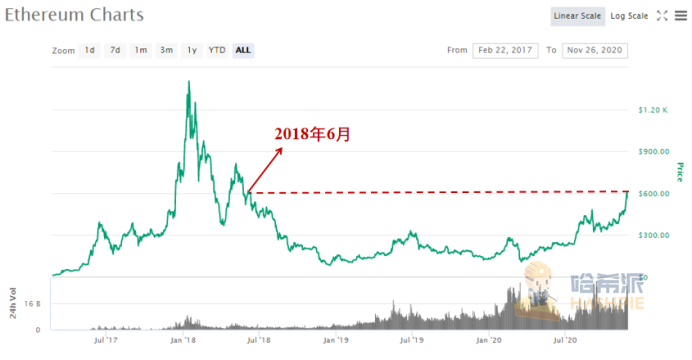
Last year Ethereum ushered in 2019 with a price of $130, and ended 2019 with a price of $130. Until this year, the market finally experienced a different spring. The price trend of ETH broke the sideways situation from the beginning of the year, and doubled to $267 from January to February. Although it quickly fell back below $130, entering the third quarter, stimulated by the DeFi frenzy, the price of Ethereum was pushed up again, rising to $471, with a cumulative increase of over 108% in Q3.
The price rise and fall of Ethereum since 2017 (data source: Coinmarketcap)
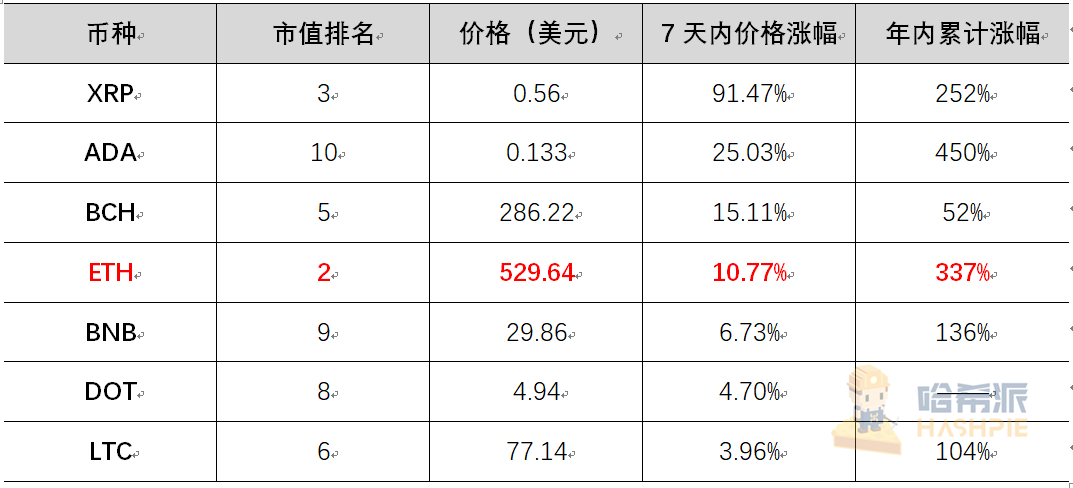
In November 2020, under the influence of news such as the U.S. general election, the vigorous increase of institutional holdings, and the acceleration of the Ethereum 2.0 process, the cryptocurrency market is booming. At the same time, other altcoins also showed a strong upward trend, achieving different degrees of price growth. As one of the mainstream currencies, Ethereum rose by more than 10 percentage points within seven days, second only to XRP (91.47%), ADA (25.03%) and BCH (15.11%).
Data source: Coinmarketcap; deadline: November 25, 2020
According to data from Coinmarketcap, Ethereum broke through the $600 mark on November 24, setting a new high in 29 months. Even if the current price has dropped slightly, it remains above $500, with a cumulative increase of nearly 30% within the month, which is better than the cumulative growth level of Bitcoin prices this month.
secondary title
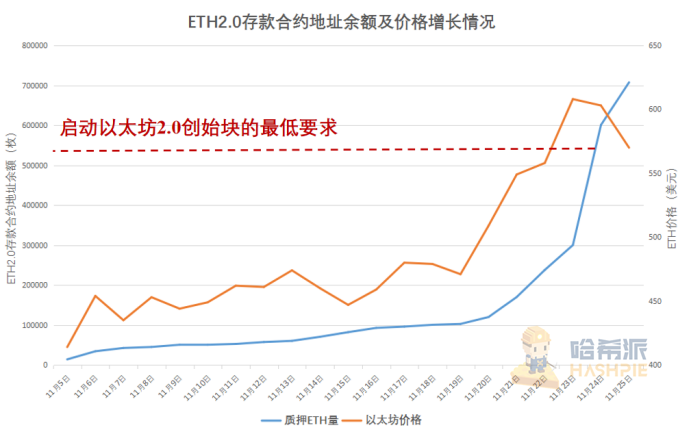
The excellent performance of the Ethereum price has to a certain extent promoted the completion of the minimum pledge threshold for the 2.0 startup genesis block. On November 24, the last effective pledge period, more than 300,000 ETHs flowed into the deposit contract address, making the deposit progress of the beacon chain in the Advance directly from 57% to 100% within 24 hours. On the same day, the price of Ethereum rose above $616, returning to the price level in June 2018, with the highest single-day increase of 4.9%.
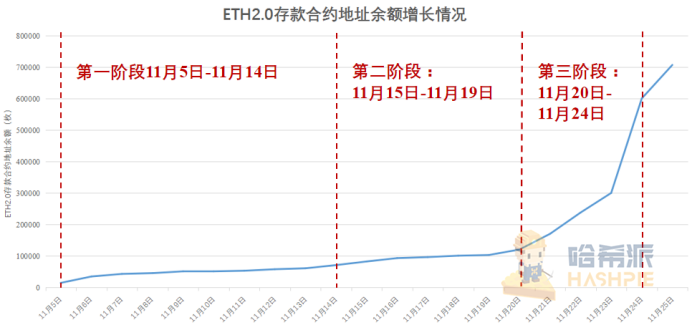
image description
It should be known that before November 23, the Ethereum 2.0 deposit address received only 286,528 ETHs, and the relevant pledge progress was less than half of the minimum activation threshold. Faced with such a slow pledge progress, on November 18, the decentralized forecasting platform Ploymarket gave rather negative forecast data. 61% of the investment forecasters in the relevant betting market believed that ETH 2.0 would not be launched as scheduled on December 1. . On the same day, Danny Ryan, the head of the Ethereum 2.0 project, even publicly stated that, if necessary, the minimum threshold for the deposit contract may be appropriately lowered, so as to ensure the smooth start of the ETH 2.0 genesis block.
However, as the final pledge deadline is approaching, with the rising price of Ethereum, the market’s expectations for 2.0 are also rising, and the pledged tokens flowing into the deposit contract began to increase sharply. At 10:20 am on November 24th, Beijing time After reaching the minimum activation threshold, the balance of the contract address is still rising, and the amount of ETH pledged currently received has exceeded 700,000.
ETH2.0 deposit contract address balance growth (data source: OKLink)
In addition, it can be seen from the chart obtained by OKLink that the balance growth process of the ETH 2.0 deposit contract address can be roughly divided into three stages, namely, November 5th-November when the daily deposit amount is only a few thousand pieces On the 14th, the daily growth rate increased to about 10% from November 15th to November 19th, and the daily inflow reached tens of thousands or even hundreds of thousands of coins from November 20th to November 24th.
image description
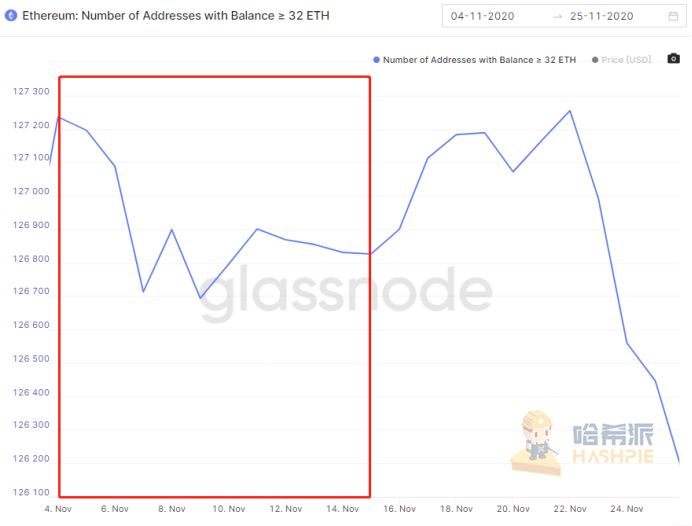
Since ETH 2.0 currently only has the limitation of the deposit function, the ETH mortgaged in the deposit contract needs to be locked for at least one to two years, and the circulation can only be resumed after the official launch of Phase 2 of the beacon chain. For this reason, there were not many users resolutely participating in the deposit pledge in the first stage, and the growth of addresses holding at least 32 ETH also dropped slightly compared with early November (32 ETH is the minimum threshold for participating in Ethereum 2.0 to run a validator node). In order to dispel the doubts of users, Vitalik Buterin took the lead in depositing his own 3200 ETH; however, this move did not work. At this stage, most users in the market are still cautious about participating in 2.0 deposit pledge.
image description
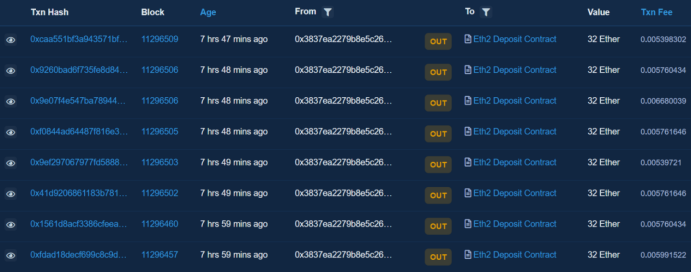
This state lasted until about November 14. Later, with the rise in the price of Ethereum and the addition of giant whale addresses, the daily growth rate of the balance of its contract addresses gradually increased to a level of more than 10%. From the transfer information tracked on the blockchain information website Etherscan, it can be seen that from November 14 to November 20, nearly 30,000 Ethereum flowed into deposits from multiple giant whale addresses starting with 0x62, 0x38, and 0xdD. The contract occupies more than half of the deposits of the contract address during this period.
Although the participation of the giant whale address has accelerated the deposit pledge process, as of November 20, the deposit contract address received only 120,000 ETH, which is less than a quarter of the minimum standard of 524,288 ETH. If the growth rate at that time is followed, the deposit contract will not reach the minimum pledge threshold until at least December 6. However, this situation did not appear. Starting from November 21, the balance of the Ethereum deposit contract address has grown exponentially, enabling it to complete the remaining three-quarters of the deposit progress in time for the final effective pledge deadline. . Judging from the 131,300 ETH deposit contract lock-in volume given by Swiss encrypted asset dealer Bitcoin Suisse, we have reason to speculate that the ETH flowing into the deposit contract in the third stage mainly comes from institutional supporters.
4. Large transfers are frequent, and more than 10% of the mortgage funds come from giant whale addresses
As mentioned above, Ethereum was able to complete the minimum number of pledges for the 2.0 start-up genesis block, thanks to the huge amount of addresses. The three Ethereum whales analyzed by Bison Trails protocol expert Viktor Bunin alone deposited 17,088 ETH, 5,504 ETH, and 5,024 ETH into the deposit contract, accounting for more than 5% of the activation threshold of 524,288 ETH.
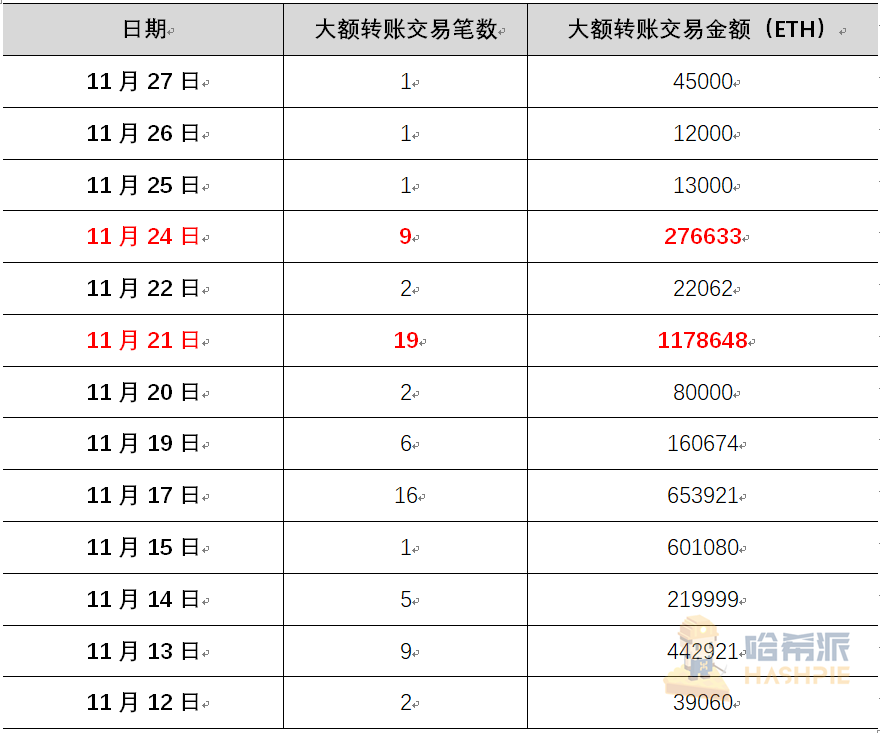
The basic situation of Ethereum large-value transfers in November (data source: Whalealert)
On the other hand, according to statistics from Whalealert, it can also be seen that during the growth of the balance of ETH 2.0 deposit contract addresses, the inflection point at which the growth rate began to accelerate, the number of large-value transfer transactions on the chain and the number of related transfer amounts have increased significantly. Among them, on November 21, when the pledged deposit of 50,000 ETH was obtained in a single day, there were more than 15 large-value transfer transactions between addresses with an amount of up to 60,000 ETH; On the day when the tokens increased to 10,000 tokens, there were about 5 large-value transfer transactions between addresses with an amount of 50,000 ETH.
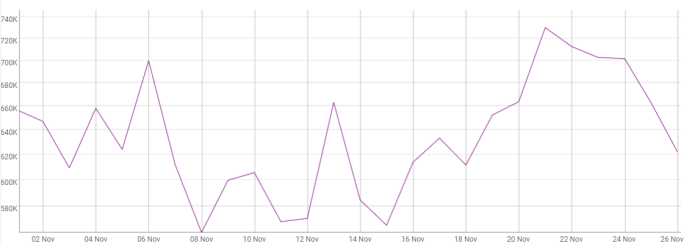
The number of transactions on the Ethereum chain during November (data source: Coin Metrics)
After successfully meeting the standard, large-value transfer transactions on the Ethereum network began to decrease during the year. At the same time, the number of transactions on the 24-hour chain also turned down, returning to the level of early November. Not only that, after reaching the minimum activation threshold of 2.0, the transaction type of large-value transfers on the Ethereum chain has gradually changed from inter-address transfers and exchange expenditures to large-value exchange deposits and transfers, and the exchange has held currency in Ethereum within the past seven days The amount showed an inflow state, and the balance increased by more than 270,000 Ethereum during the week (data source: ViewBase).
5. The transaction in the secondary market is hot, and the computing power of the mining market is stagnant
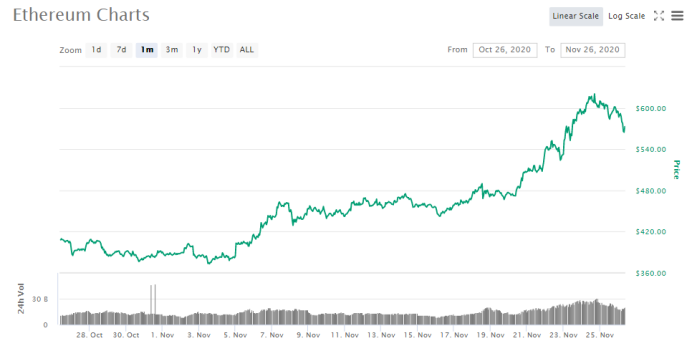
If there is no accident, the mainnet of the Ethereum Beacon Chain will be launched on time, and the 2.0 founding block will be dug up on December 1st. The recent breakthroughs of the 2.0 network and the recovery of the market have brought upward momentum to Ethereum. After its price broke through the $600 mark, the selling pressure behind the market also increased sharply.
Changes in Ethereum price and transaction volume in November (data source: Coinmarketcap)
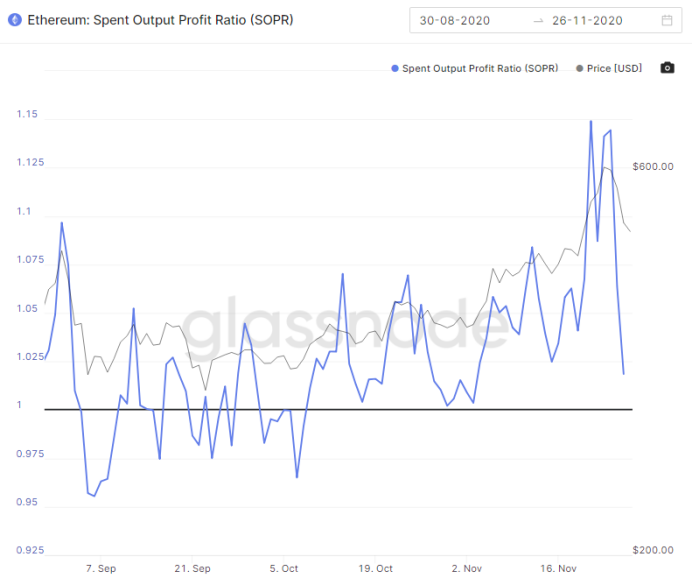
According to indicators released by the encryption analysis company Into TheBlock, 499,000 addresses purchased a total of 6.43 million ETH between $531 and $547. According to the data given by Coinmarketcap, the average daily transaction volume of Ethereum from November 21 to November 25 was 6.564 billion US dollars, a month-on-month increase of more than 20 percentage points; until November 26, the price of ETH fell to 520 US dollars Below, its 24-hour trading volume has only dropped to a level of around 580,000 US dollars, but compared with the beginning of the month, it has also shown a transaction volume growth of more than 30%.
SOPR ratio developed by Renato Shirakashi (data source: Glassnode)
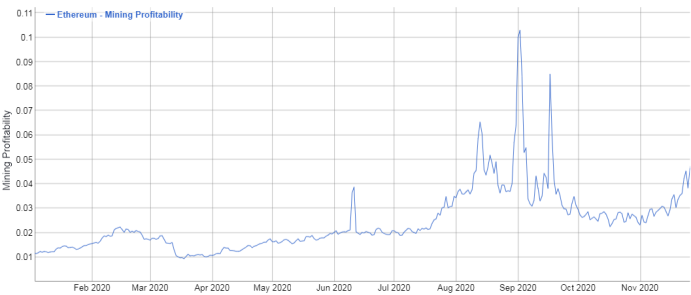
image description
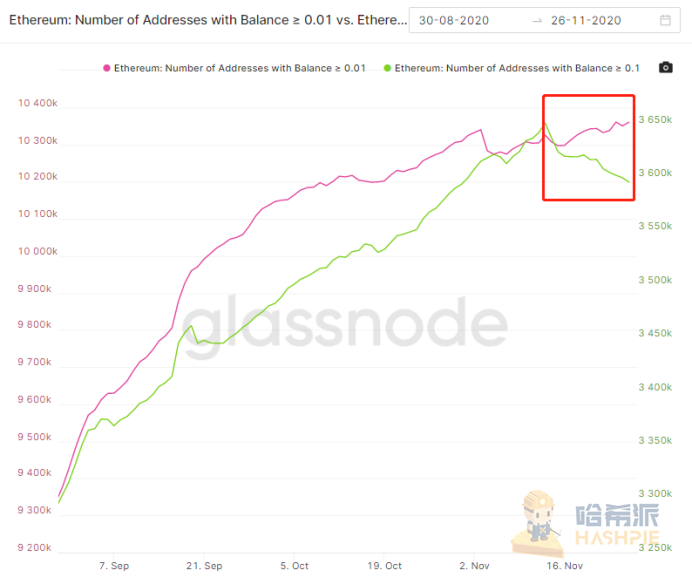
In the past three months, the growth of addresses with Ethereum currency holdings greater than 0.01 and 0.1 (data source: Glassnode)
image description
The mining income of Ethereum over the years (data source: BitinfoCharts)
secondary title
image description
7. Summary
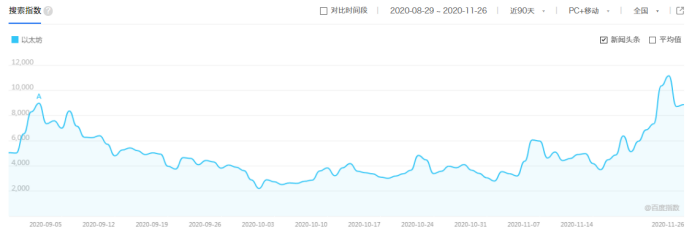
Baidu search index of Ethereum in the past year (data source: Baidu Index)
For institutional investors and giant whale users who are optimistic about Ethereum 2.0, participating in the deposit pledge of Phase 0 is a good long-term investment. Driven by them, more small investors also began to relax their vigilance and entered the market one after another, trying to become the first beneficiaries of Ethereum's transition to the PoS mechanism. Perhaps for these entrants, what ETH 2.0 is and how its specific route planning is a concept that has only recently been brought into the scope of understanding, but for veteran miners and community participants, this is a long and controversial topic.





